Operational risk management tools in banks fall into a handful of families: event management and loss data, risk and control self-assessments, control testing, key risk indicators and other metrics, scenario analysis, and benchmarking against peers and external losses. Most of them depend on the first, because the loss history is the evidence the others are tested against. A loss data tool is also the hardest to go live with, because it has to tie to the general ledger: a bank must choose which accounts can hold an operational loss, write the rules that decide what is and is not one, set a threshold and run the new process beside the old one until the numbers agree. Botminds' Operational Risk Loss Data Collection is built to be taken live that way, on a bank's own accounts, in a plan whose every duration is a target the bank sets with its validator.
The plan follows fictional Corvane National Bank, a $92 billion regional bank, whose 38 accounts and settings are sample data in the solution. The durations are Botminds' targets, not measured results.
What a bank brings to a loss data go-live: seven inputs, each with an owner
General ledger accounts
38 accounts in 8 groups: operational losses, fraud losses, legal expense, suspense write-offs, customer remediation and refunds, settlements, loan servicing charges (for the credit-boundary check) and recoveries
OwnerFinance and the head of operational risk
Feeds
A daily general ledger feed of those accounts; incident tickets and near misses every 15 minutes; payments references; legal invoices and policies from document imaging
OwnerIT and finance systems
Event types and business lines
Basel Level 1 and 2, the bank’s own Level 3, the nine Basel business lines and the internal lines
OwnerOperational risk
Boundary rules
Nine written rules: credit boundary, timing events, fraud versus process, internal involvement, outage versus processing, legal costs, one event across lines, small recurring losses, near misses and gains
OwnerHead of operational risk, with the validator
Thresholds and clocks
$10,000 gross collection threshold; descriptions from $100,000; decide in 5 business days, confirm ownership in 3, check in 5, reconciliation signed by business day 8
OwnerHead of operational risk
People and duties
Analysts, validators, business line risk managers, the head of operational risk, a GRC administrator; nobody checks their own decision
OwnerOperational risk and HR
History to test against
Last quarter’s approved loss events and one month of the accounts, for the parallel run
OwnerOperational risk
What operational risk management tools do banks use?
Banks use a recognized set, and the Basel Committee lists it. Its principles for the sound management of operational risk give "Examples of tools used for identifying and assessing operational risk": event management, operational risk event data, self-assessments, a control monitoring and assurance framework, metrics, scenario analysis, and benchmarking and comparative analysis, adding that the list "is not comprehensive" (BCBS, Revisions to the principles for the sound management of operational risk, 2021).
In software terms, banks usually run these on a GRC platform for the workflow, a data store for loss history and metrics, and spreadsheets for whatever the platform does not do well. The spreadsheet is most often the general ledger comparison, because GRC platforms are built around forms and approvals rather than accounting entries. That gap is where a loss data tool earns its place.
Where a loss data tool sits among the other operational risk tools
A loss data tool sits upstream of the others. The self-assessment uses loss events as evidence of control effectiveness; metrics count events and dollars; scenario analysis calibrates against internal and external losses; benchmarking compares internal losses with self-assessments to see whether the assessment works. If the loss history is incomplete, each of them is quietly wrong in the same direction.
That makes integration the first design question. In the solution, the GRC system remains the place business lines submit losses and where approved events are written back; the RCSA control library is read so that a loss's cause can be linked to the control that failed; and the regulatory reporting system receives the quarterly loss file only after the head of operational risk approves it. The tool adds the general ledger and incident channels and the reconciliation; it does not replace the GRC platform.
Which general ledger accounts hold operational losses?
More than the ones named "operational losses". Corvane scans 38 accounts in eight groups, and the scope is the most important decision of the go-live, because the agents cannot find a loss in an account they do not read. The table shows the groups and what typically lands in each.
The eight account groups where operational losses land, and what each one carries
| Account group | What lands there | Why it is in scope |
|---|---|---|
| Operational losses, wire and payments | Reimbursements for misdirected or fraudulent payments, processing write-offs | The obvious channel; often the only one a form-based process watches |
| Fraud losses, card and check | Card, check and deposit fraud charge-offs | High volume and small amounts; most are external fraud |
| Legal expense, operational matters | Outside counsel, settlements in progress, legal reserves | Legal costs belong to the event that caused them and often post weeks later |
| Suspense write-offs | Unreconciled items written off from transitory and suspense accounts | The Basel standard names suspense-booked "pending losses" as part of gross loss |
| Customer remediation and refunds | Fee refunds, goodwill credits, remediation programs | Booked as customer service; rarely reported as losses |
| Settlements and other | Settlements with counterparties and vendors, penalties | Large, infrequent, often owned by legal or finance |
| Loan servicing charges | Charge-offs on loans with an operational cause | Read for the credit-boundary check, so they can be excluded by rule and flagged for credit risk |
| Recoveries | Funds returned by beneficiary banks, perpetrators, vendors | A recovery with no event reveals a missed loss; recoveries tie separately |
The list should be built from evidence, not from account names. Take last year's approved loss events, trace each one's entries to the accounts they posted to, and add every account that appears; then ask finance which accounts receive refunds, write-offs and settlements that no event has ever touched. The second step finds the blind spots.
What data is needed to go live?
Three feeds and four documents. The feeds are the general ledger entries for the chosen accounts, the incident tickets with their near misses, and the payments references that tie a reimbursement to its recovery. The documents are the event-type and business line taxonomy, the boundary rules, the threshold and clock settings, and the roster of who decides, checks and signs. Last quarter's approved events and one month of entries are the test set.
Two rules frame the documents. The March 2026 capital re-proposal, still a proposal, would require that "Procedures for the identification and collection of internal loss event data must be documented", and that those procedures and the completeness review be subject to "regular independent reviews by internal or external audit functions" (91 FR 14952, proposed §__.150(d)(2)). The Basel standard adds that such procedures "must be subject to validation before the use of the loss data" in capital calculations (OPE25.16). A go-live that writes the procedures down as settings produces that documentation as a by-product.
How do you set boundary rules?
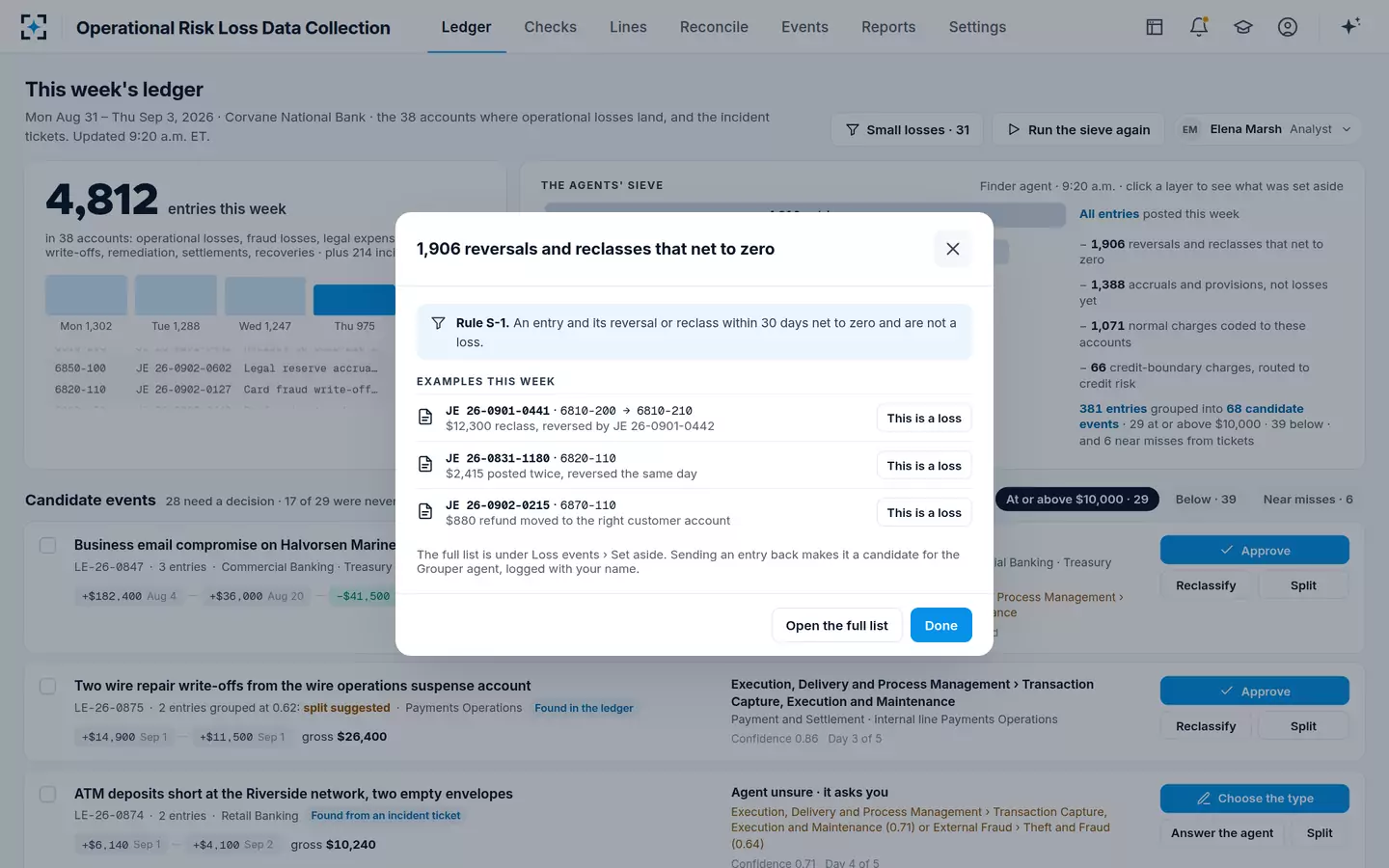
Write one rule per recurring argument, in a sentence a validator can apply, and give each a number. Corvane's version 4.2 has nine: credit boundary, timing events, fraud versus process, internal involvement, outage versus processing, legal costs, one event across lines, small recurring losses, and near misses and gains. Each rule exists because the definitions alone left two reasonable people with different answers.
The best source for the first draft is the last year of disputes: every event the validator returned and every reclassification a business line contested. Rule B-3, which gives External Fraud precedence when a third party's deception causes the loss and keeps the failed control as the cause, settles the most common fight in payments. The credit boundary decision tree shows how the first rule, the line between credit and operational losses, can be written as branches with a citation at each.
A rule behind every entry the agents set aside
Who approves loss data settings?
The head of operational risk, as owner of the independent function. In the solution every threshold, clock, account list, rule, prompt and model is a versioned setting; a GRC administrator prepares the change and the head of operational risk approves it, and the approval is on the audit trail. A new prompt or model version runs on the previous month's events before it is approved, so its effect is known in advance.
The threshold deserves its own sign-off and its own evidence. The 2011 interagency guidance on the advanced approaches says "Banks should have documented support for their internal data collection threshold(s)" that considers what is needed to manage losses at the corporate and business line levels (SR 11-8 attachment), and FR Y-14Q asks for every collection threshold used, the internal business lines it applies to and the period it was in effect (Schedule E.4). A threshold change is therefore a dated event in its own right, not a configuration detail.
Six weeks to go live: a target plan
On Botminds' target plan, a bank goes live in six weeks: one to connect the accounts and feeds, one to write the rules and settings and test them on last quarter's events, and four running in parallel with the existing forms, ending with the first signed reconciliation. The durations depend on the bank's systems and on how much of its rulebook is already written.
Six weeks from first feed to first signed reconciliation (target)
- Accounts and feedsWeek 1
- Rules, settings, back-testWeek 2
- Parallel month beside the formsWeeks 3–6
Week one is accounts and feeds: agree the account list with finance, connect the daily general ledger feed and the incident system, and confirm the payments and document references can be read. Week two is rules and settings: load the taxonomy and the boundary rules, set the threshold and clocks, assign the roles, and run the agents on last quarter's approved events to see where their proposals and the bank's decisions differ. Every difference either changes a rule or becomes a known override reason.
How do you parallel run loss data collection?
Run both channels for a full accounting month and compare them event by event. The existing forms keep flowing into the GRC system as before; the agents read the general ledger and the tickets each week; at month-end, every event either channel found is listed, and each difference is explained: a loss the forms missed, a loss the agents missed, or a disagreement about grouping, type or amount.
Checks before switching off the parallel run
- The month reconciles to the general ledger with nothing unexplained
Every difference is an entry or a rule, and the head of operational risk signs it.
- Every event the forms found was also found from the general ledger or a ticket
Or there is a written reason it could not be, such as an account out of scope, and the scope changes.
- Every event the agents found that the forms missed is confirmed by its business line
Within the ownership clock; a disputed one is decided by the analyst with a reason.
- The validator has checked every reclassification and split, and a sample of the rest
Returned decisions are counted by reason, so rule gaps show.
- Grouping and recoveries tie
Recoveries reconcile separately and every recovery belongs to an event.
- The override rate is known
How often people changed the agents’ proposals, and why, is the baseline for the next quarter.
- Internal audit has the procedures
Documented as settings with versions, ready for the independent review the rules expect.
The parallel month answers the question every head of operational risk will be asked: what did the old process miss? The answer, counted by account group and business line, is also the first completeness measure the bank has ever had. How internal audit follows up on what it finds is the next step once that measure exists.
What the first month of a loss data tool shows
The first month usually shows more losses, not fewer, and most of them small. In the sample data, Corvane's first reconciliation shown, in March, found nine losses in the general ledger with no event in the database; by July the monthly count had fallen to three, and August stood at two while still open. The first week of the sample shows the same pattern from the other side: 17 of 29 losses at or above $10,000 had not been submitted on a form.
The business line confirms ownership, and is told about every change
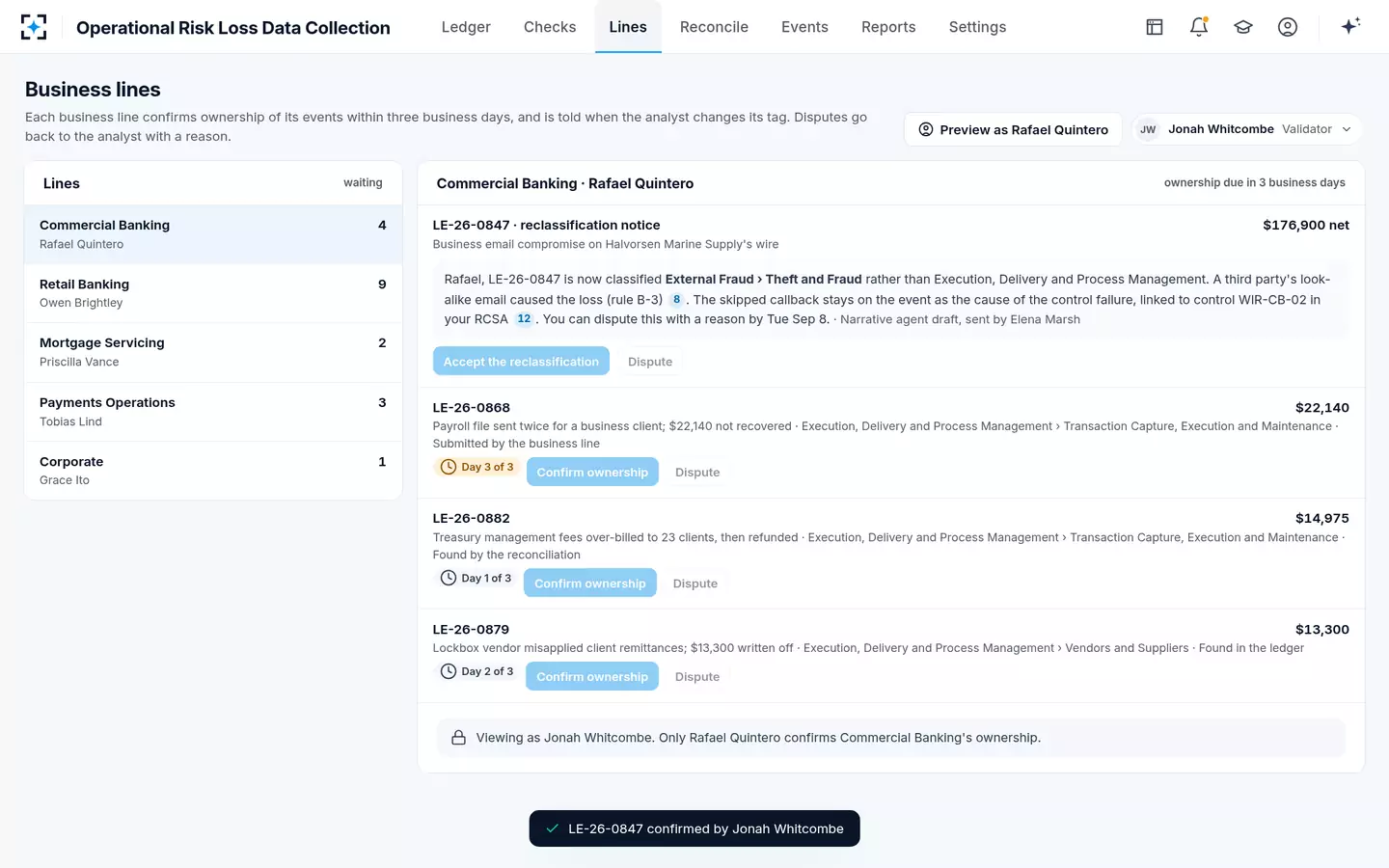
A rising count in the first month is not a deterioration; it is the database catching up with the general ledger. Reporting it that way to the risk committee matters, because a loss trend that jumps when a new tool goes live will otherwise be read as a jump in losses.
Where Operational Risk Loss Data Collection fits among operational risk management tools
It fits as the loss data and reconciliation layer between the general ledger, the incident system and the GRC platform. It finds, groups and classifies loss events with cited reasoning; the analyst decides; the validator checks; the business line confirms; and the database ties to the general ledger each month. It also builds the quarterly loss file in the FR Y-14Q Schedule E layout for approval, but never files it.
It does not replace the GRC platform, run the RCSA, compute operational risk capital, model scenarios or supply external loss data. And it is only as complete as its scope: a loss posted to an account outside the 38, or a near miss nobody logged as a ticket, stays invisible until the scope changes. The go-live plan exists to make those limits visible on day one. The full solution is at Operational Risk Loss Data Collection, and the cost of one loss event sets out the business case.
Questions people ask
How long does it take to implement a loss data tool?
On Botminds' target plan, six weeks from first feed to first signed reconciliation for a bank with a daily general ledger feed and an incident system, including a four-week parallel month. The longest variable is usually the rulebook: a bank that has never written down its boundary rules needs time to agree them.
Does a loss data tool replace the GRC system?
It need not. In the solution's design, business lines still submit losses in the GRC system, approved events are written back there, and the RCSA control library is read from it. The tool adds the general ledger and incident channels and the monthly reconciliation.
Do we need to change our chart of accounts?
No. The tool reads the accounts where losses already land; the go-live chooses which ones. Some banks later add a dedicated account for operational loss suspense items, but that is a finance decision, not a prerequisite.
Who should own the go-live?
The head of operational risk, with finance for the account scope, IT for the feeds and the second-line validator for the rules and the parallel-run checks. Internal audit should see the procedures before the parallel month ends, because the 2026 proposal would subject them to regular independent review.
What if the agents and the business line disagree during the parallel run?
The analyst decides, with a reason code, and the validator checks. Each recurring disagreement is a candidate for a new boundary rule; the override count by reason, 23 of 812 proposals in the solution's sample quarter, shows where the rules or the agents need work.