Operational loss events are what an operational risk analyst's role is built around, and on paper the role reads like this: capture operational loss events, classify them by Basel event type and business line, check the data is complete and accurate, analyze trends and root causes, and report losses to business management, senior management and the board. The duties are right, but the week they describe is not the one most analysts live. Losses arrive in the general ledger as reimbursements, legal fees, suspense write-offs, refunds and recoveries, posted by finance on its own calendar, while the loss database is filled from forms that business lines remember to send. So the analyst spends most of the week finding what was never reported, joining entries into events and arguing about event types. Botminds' Operational Risk Loss Data Collection was built for that gap: agents sieve the general ledger and the incident tickets, group and classify each loss with cited reasoning, and the analyst decides.
The week followed here belongs to Elena Marsh, Operational Risk Analyst at Corvane National Bank, a fictional $92 billion regional bank; she, her colleagues and every figure about the bank are sample data from the solution. The hour split is Botminds' own estimate for a first-line loss data analyst, labeled as such.
Where an operational risk analyst's week goes, by hand and with Operational Risk Loss Data Collection
By hand, 40 hours
- Finding unreported losses · 30%
- Joining entries into events · 17.5%
- Re-classifying event types · 15%
- Chasing business lines · 15%
- Deciding and describing · 10%
- Analysis · 12.5%
With agents, 40 hours
- Reviewing the sieve · 10%
- Checking groupings · 7.5%
- Classification decisions · 12.5%
- Business lines · 5%
- Deciding and describing · 15%
- Reconciliation · 10%
- Analysis and root cause · 40%
What does an operational risk analyst do?
An operational risk analyst keeps the bank's evidence of what has gone wrong. In a loss data role that means five recurring jobs: finding operational loss events, building each one from its entries and dates, classifying it by event type, business line and cause, checking that the database is complete against the general ledger, and turning the history into trends a risk committee can act on. The first three are evidence work, the fourth is control work, and the fifth is analysis.
The federal occupation classification has no title for it. The nearest is Financial Risk Specialists (SOC 13-2054), whose sample job titles include "Risk Analyst" and "Risk Manager" (O*NET OnLine). Of the occupation's thirty listed tasks, three describe the loss data seat well: "Document, and ensure communication of, key risks."; "Devise systems or processes to monitor validity of risk assessments."; and "Recommend ways to control or reduce risk." The first is the event and its description, the second is the completeness check, and the third is the root-cause note that goes back to the business line.
The volume is what makes the seat a job. Supervisory loss data for the 35 largest U.S. bank holding companies shows an average of 458 operational losses of $10,000 or more per firm per quarter, about 35 a week, at an average of $489,270 each in 2019 dollars (Frame, Lazaryan, McLemore and Mihov, Federal Reserve Bank of Dallas Working Paper 2215). Below the threshold, the count is far higher.
The role on paper, and the week it leaves out
The written duties come almost word for word from capital regulation, which is why they look the same at every large bank. The advanced approaches rule in force today requires an operational risk management function that "Is independent of business line management" and that reports "operational loss events, and other relevant operational risk information to business unit management, senior management, and the board of directors (or a designated committee of the board)" (12 CFR 217.122(g)(1)). The March 2026 capital re-proposal, still a proposal, keeps that function and makes it responsible for "designing, implementing, and overseeing" the loss data collection processes themselves (91 FR 14952, proposed §__.150(d)).
What the role on paper leaves out is where the data comes from. A form-based process assumes someone in the business line notices a loss, fills in the form and sends it. Many losses never pass through anyone who thinks of them as an operational loss: a goodwill refund posted by a branch, a legal invoice paid by the general counsel's office, a write-off from a wire repair suspense account. They arrive in the general ledger, and the analyst finds them, if at all, at the quarter-end tie-out.
The role's written duties, and what each one takes in a week
| Written duty | What it means in practice | By hand | With agents |
|---|---|---|---|
| Capture operational loss events | Find losses in the general ledger and incident tickets that no form reported | 12 hours | 4 hours reviewing what the agents found and set aside |
| Ensure data quality | Join a reimbursement, a legal fee and a recovery into one event; split events joined wrongly | 7 hours | 3 hours checking proposed groupings |
| Classify by Basel event type and business line | Re-classify what the business line chose when the definitions say otherwise | 6 hours | 5 hours deciding proposals that cite their reasons |
| Liaise with the business | Chase forms, ownership and explanations of unexplained entries | 6 hours | 2 hours on notices and disputes |
| Analyse and report | Trends, root causes, risk committee figures, input to the RCSA | 5 hours | 16 hours |
Monday to Thursday: one analyst's loss data week
In the sample week, Monday August 31 to Thursday September 3, 2026, Corvane's general ledger carried 4,812 entries in the 38 accounts where its operational losses land: operational losses, fraud losses, legal expense, suspense write-offs, customer remediation and refunds, settlements, loan servicing charges and recoveries. The incident management system added 214 tickets. By hand, an analyst sees almost none of this; she sees the forms, and runs the account-by-account comparison at quarter-end.
With the agents, Thursday at 9:20 begins with the sieve already run. The Finder agent set aside 1,906 reversals and reclasses, 1,388 accruals and provisions, 1,071 normal charges and 66 credit-boundary charges, each with the rule that set it aside, leaving 381 entries in 68 candidate loss events: 29 at or above the bank's $10,000 threshold and 39 below, plus six near misses from the tickets. Seventeen of the 29 larger losses had never been submitted on a form.
The analyst's week starts from the general ledger, not the form
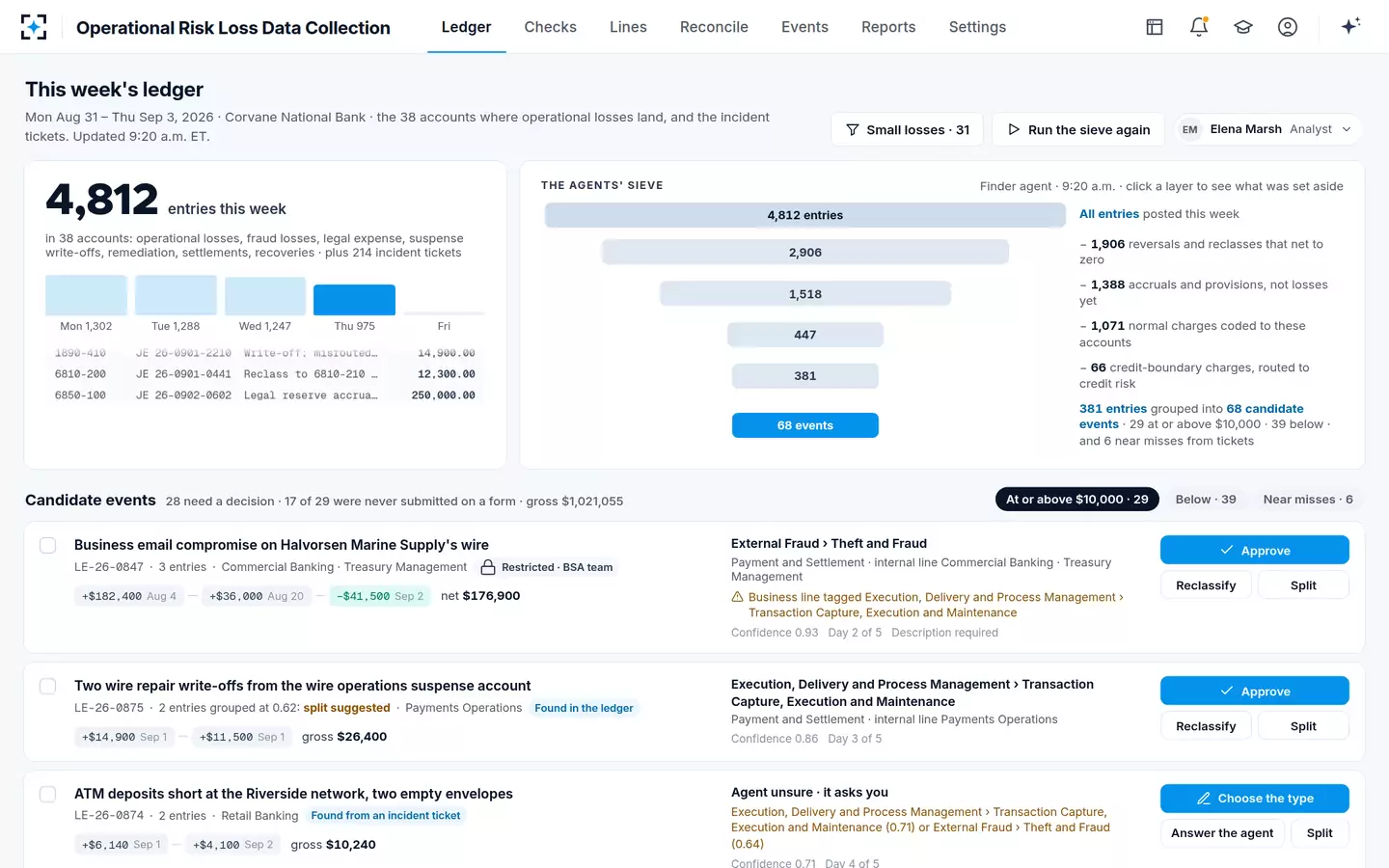
The rest of the week is decisions. Elena works the 29 larger events one by one, approves 31 small recurring losses below the threshold in one action, with the validator checking 7 of them at random, and keeps the six near misses as events with no loss. The decisions she would have made by hand are the same; the difference is that she makes them on Thursday with the evidence open, rather than in October from a spreadsheet.
Where the hours go: finding, joining and re-classifying
Finding takes the most time because the general ledger is not organised by loss event. A business email compromise on a commercial client's wire, the case that runs through this series, left three entries in three accounts a month apart: a $182,400 reimbursement on August 4, a $36,000 legal fee on August 20 and a $41,500 recovery on September 2. Nothing in any one entry says "operational loss event". The wire reference, the incident ticket and the legal matter number are what tie them together, and they live in three different systems.
Joining is next. The 2026 proposal would require losses with a common trigger to be grouped into one event, and the Basel standard expects a documented grouping policy that the whole bank applies the same way. A grouping policy is easy to write and slow to apply: every legal fee, every recovery and every refund has to be matched to the event it belongs to, and some of what looks like one event is two.
Re-classifying is the most argued. Business lines classify by what they recognize: the line that skipped a callback calls a spoofed-email wire a processing error. The Basel definitions call it External Fraud, because a third party's deception caused the loss. How a classifier argues fraud versus process follows that one decision in detail; for the analyst, the point is that each such change needs a reason the second line can check.
Who approves an operational loss event?
The analyst approves; a second-line validator checks; the head of operational risk signs the month. That is the common design, and the one the solution follows, because the rules ask for independence in two places: the function that runs loss data must be independent of the business lines, and the 2026 proposal would add an independent review of whether the data is complete and accurate, itself reviewed by internal or external audit at regular intervals.
Four people carry one week of loss data, and only one of them sits in the business
Today
Decides 60 to 70 candidate events a week, chases business lines for forms and rebuilds the monthly tie-out in a spreadsheet.
With agents
Opens a short list the agents have sieved, grouped and argued, asks about anything unclear, and decides each event with Approve, Reclassify or Split.
Still theirs: Every decision, and the text of every description
Today
Reviews a sample at quarter-end, long after the decision.
With agents
Checks every reclassification, split and event of $100,000 or more as it happens, on the same evidence the analyst saw.
Still theirs: The second-line check; nobody checks their own decision
Today
Reports from a database that rarely ties to the general ledger.
With agents
Signs a monthly reconciliation in which every difference is traced to an entry or a rule, and approves every change to thresholds and rules.
Still theirs: The signature on the month and on every setting
Today
Learns at quarter-end that the line’s losses were moved or missed.
With agents
Confirms ownership within three business days and sees every change to the line’s classification, with the reason, and can dispute it.
Still theirs: Ownership of the line’s losses and the right to dispute
What is the second line's role in loss data?
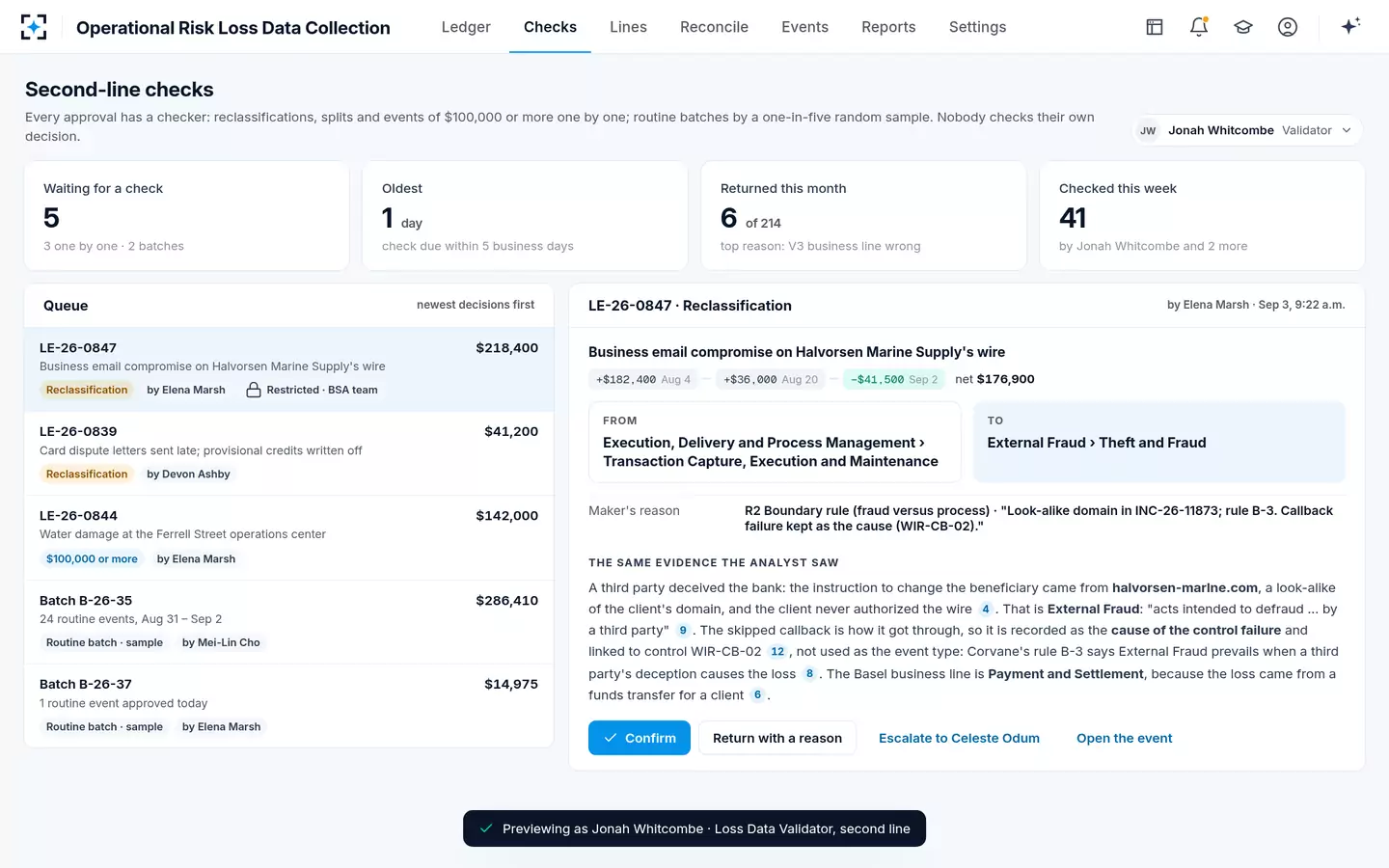
The second line checks that the first line's decisions are supported, and it checks them on the same evidence. In the sample week, Jonah Whitcombe, the loss data validator, had five events waiting, the oldest one day old, and had returned 6 of the 214 decisions he checked that month, most often because the business line was wrong. His queue holds every reclassification, every split and every event of $100,000 or more; routine batches are sampled one in five.
The validator sees the maker's reason and the same cited evidence
The second line also owns the uncomfortable statistic. At the Federal Reserve's community and regional banking organizations, "IT and operational risk MR(I)As, which include cyber risk, represented the largest category of outstanding MR(I)As" at year-end 2025 (Federal Reserve, Supervision and Regulation Report, June 2026). A loss history that the second line has checked as it was built is the kind of evidence that answers an examiner's question before it becomes a finding.
What skills should a bank hire for on the loss data desk?
The skills that matter most are reading accounting entries, knowing the event-type definitions well enough to argue them, and writing a two-sentence description an examiner can follow. Statistics and modeling help in a quantification team; in loss data, the daily work is evidence and judgment. O*NET places the occupation in Job Zone Four, where most jobs ask for a four-year bachelor's degree (O*NET OnLine).
Seven skills a loss data analyst uses every week
- Read a journal entry and know what it is
A reclass, a reversal, an accrual and a write-off look alike in an export. Telling them apart is most of finding a loss.
- Know the seven event types by their definitions
Not by the business line’s habit. External Fraud turns on a third party’s intent to defraud; process failures on failed transaction processing.
- Separate the event from its cause
A skipped callback is a control failure; the loss it let through can still be fraud. Both belong on the event, in different fields.
- Apply a grouping policy
Losses with a common trigger are one event. Losses that merely look similar are not, and bundling separate small losses into one is not allowed on FR Y-14Q.
- Keep gross, recovery and net apart
A recovery is its own entry with its own date, linked to the event, never netted into the gross loss.
- Write for the second line
Every reclassification needs a reason another person can check without asking.
- Reconcile to the general ledger
Explain every difference between the loss database and the accounts with an entry or a rule.
Hiring for the loss data desk: what the federal data shows
The Bureau of Labor Statistics does not count operational risk analysts by name. The closest occupation, Financial Risk Specialists, employed 66,000 people in 2025, and its growth projected for 2025–2035 is much faster than average, at 7% or more (BLS data via O*NET OnLine): that is the market a bank hires its loss data analysts from.
Financial risk specialists: the closest federal occupation to the operational risk analyst
66,000
people employed, 2025
65%
of them work in finance and insurance
7%+
projected growth 2025–2035, much faster than average
Two cautions on the number. The occupation mixes market, credit and operational risk with securities analysis, so it is a band, not a quote. And the count says nothing about the seat's grade: a first-line analyst who decides events, a second-line validator and a quantification analyst are different roles, often with the same title.
From analyst to manager: what ownership adds to the loss data role
An operational risk manager's role adds ownership to the analyst's duties: owning the loss data standards, approving thresholds and boundary rules, signing the reconciliation of the loss database to the general ledger, and reporting losses and trends to the risk committee and the board. The manager also owns the relationship with internal audit, which the proposal would ask to review the collection procedures and the completeness checks at regular intervals.
The step from analyst to manager is less about seniority than about what gets signed. In Corvane's settings, every change to a threshold, a clock, an account list or a boundary rule is a new version approved by the head of operational risk. That signature is the job: a manager is accountable for whether the database is complete, which is a harder thing to defend than whether any one event is right. How many losses a form-based process misses sets out how a bank can measure that before an examiner does.
What changes in the week with Operational Risk Loss Data Collection
The analyst's decisions stay; the hunting goes. The Finder agent reads every entry in the accounts where losses land and every incident ticket, and sets nothing aside without a rule. The Grouper agent joins entries by wire reference, ticket, legal matter, customer and dates, keeps recoveries apart from the gross loss, and asks before joining anything below 0.80 confidence. The Classifier agent proposes the Basel Level 1 and 2 event type, the business line and the cause in one plain sentence with its citations, and below 0.80 it asks instead of proposing.
Nothing is decided by an agent. The analyst approves, reclassifies or splits; a reclassification needs a reason code; the validator checks; the business line is told and can dispute. The agents never post to the general ledger and never file anything. What moves is time: on Botminds' estimate the hours spent finding and joining fall from about half the week to under a fifth, and the hours available for analysis and root cause rise from five to sixteen. That is a design target for the solution, to be measured on a bank's own data, not a result we can quote.
One honest limit: the agents only see what reaches the accounts and systems they read. A loss settled in cash outside the 38 accounts, or a near miss nobody logged as a ticket, is invisible to them as it is to the analyst. Choosing the accounts is the first decision of a go-live, and going live on 38 general ledger accounts walks through it. The full solution is at Operational Risk Loss Data Collection.
Questions people ask
What is loss data collection?
It is the process of capturing every operational loss event above a threshold with its gross amount, recoveries, dates, event type, business line and cause. The March 2026 capital proposal, not yet final, would set a $20,000 collection threshold for Category I and II banking organizations and require the data to be comprehensive above it; a bank may collect below that, and the fictional bank in this series collects from $10,000.
What is the difference between an operational risk analyst and an operational risk officer?
Titles vary by bank, but an officer title usually carries a business line or a topic (fraud, technology, a region) and the authority to challenge decisions there, while an analyst works the events and the data. In the solution's design the analyst decides events and the officer or manager approves the rules and signs the month.
Does an operational risk analyst need to know accounting?
Enough to read entries. The accounting date that FR Y-14Q asks for is the day the loss hit the financial statements, not the day it happened or was found, and much of a loss analyst's week is telling a write-off from a reversal or an accrual. A controller's depth is not needed; fluency in the general ledger is.
How many loss events does an analyst handle?
At the largest U.S. bank holding companies, the Dallas Fed paper counted an average of 458 losses of $10,000 or more per firm per quarter between 2005 and 2019. In the solution's sample week, one analyst at a $92 billion fictional bank decided 68 candidate events.