A credit boundary event is a loss that is related to both operational risk and credit risk: the FR Y-14Q instructions give the example of a loan that defaults (credit risk) where the bank then discovers the collateral was not properly secured (operational risk). Such losses stay credit losses for capital and are left out of the operational gross loss on FR Y-14Q, with one exception: retail credit card losses from non-contractual third-party fraud, such as identity theft, are external fraud operational losses. The line matters because it decides which dollars enter the operational loss history, and an analyst at a large bank draws it many times a month. Botminds' Operational Risk Loss Data Collection applies it as a written rule: the agents set credit-boundary charges aside with the rule cited, keep them flagged for credit risk, and an analyst can send any of them back.
The examples come from fictional Corvane National Bank's sample data in the solution; the rules are quoted from the FR Y-14Q instructions, the eCFR, the Federal Register and the Basel Framework.
The credit boundary decision tree: four questions, the rule cited at each branch
1. Did the bank lose money?
YesGo to 2.
NoNo loss, or a gain: keep it as a near miss or a gain, outside gross loss. FR Y-14Q leaves both out of the schedule.
FR Y-14Q Schedule E, field H exclusions
2. Is the loss a credit loss on an exposure inside the credit risk framework (a charge-off or provision on a loan, line or card)?
YesGo to 3.
NoGo to 4.
12 CFR 217.101; proposed definition of operational loss
3. Is it a retail credit card loss from non-contractual, third-party-initiated fraud, such as identity theft?
YesExternal Fraud operational loss: include it.
NoCredit boundary event if an operational failure caused or enlarged it (collateral not perfected, documents missing): it stays a credit loss for capital and FR Y-14Q gross loss, and the loss database keeps it flagged. With no operational failure, it is a plain credit loss and stays out.
FR Y-14Q credit boundary exception; 12 CFR 217.101(2)
4. Did the event only distort the financial statements for a period, fully corrected when found (a revenue overstatement, an accounting or mark-to-market error)?
YesTiming event: out of FR Y-14Q. Under the Basel standard, keep it in the loss data if material, spanning more than one accounting period and giving rise to legal risk.
NoOperational loss: include it at gross, with its event type, business line and cause.
FR Y-14Q timing events; Basel OPE25.26
What is a credit boundary event?
A credit boundary event is a credit loss with an operational cause. The bank lent, the borrower defaulted, and the loss was made larger, or possible at all, by an operational failure: a lien not filed, a guarantee not signed, a collateral valuation keyed wrong, a document missing when the bank tried to enforce. The default is credit risk; the failure is operational risk; the loss is both.
Credit Boundary Events: Losses that are related to both operational risk and credit risk. For example, where a loan defaults (credit risk) and the bank discovers that the collateral for the loan was not properly secured (operational risk).
Federal Reserve, FR Y-14Q instructions, Schedule E, items excluded from gross loss
The rules put these losses on the credit side, so they are not counted twice. The current capital definitions make credit the default for third-party credit losses: "All other third-party-initiated credit losses are to be treated as credit risk losses" (12 CFR 217.101). The March 2026 proposal says operational loss "does not include losses that are also credit losses and are related to exposures within the scope of the credit risk-weighted assets framework" (91 FR 14952).
What is a boundary event in operational risk?
A boundary event is any loss that sits between operational risk and another risk type, where a rule has to say which side counts it. Three boundaries recur. The credit boundary is the commonest and the one the rules settle most firmly. The market boundary runs the other way: the Basel standard says operational losses related to market risk "are treated as operational risk" for capital (OPE25.21), so a trading loss caused by a keying error stays operational. The timing boundary separates real losses from temporary distortions of the accounts.
Writing these down as rules is not optional at the largest banks. FR Y-14Q expects credit boundary and timing events to be left out, the proposal would exclude credit losses already in credit risk-weighted assets, and the Basel standard requires banks to "document criteria for allocating losses to the specified event types". A rule that two analysts apply differently is not a rule.
The decision tree, branch by branch
The tree asks four questions in order, and the order matters: first whether there is a loss at all, then whether it is a credit loss, then whether the card fraud exception applies, and only then whether it is a timing distortion. Each branch ends in one of five places: an operational loss to include, an external fraud loss to include, a credit boundary event kept and flagged, a plain credit loss left out, or a non-loss event (near miss, gain or timing event) kept outside gross loss.
Examples at each branch, and where each one ends up
| Example | Branch | Loss database | FR Y-14Q gross loss |
|---|---|---|---|
| Mortgage defaults; the bank finds the lien was never recorded and recovers less | 2 → 3, no; operational failure | Kept, flagged credit boundary | Excluded |
| Commercial loan charged off; no document or process failure found | 2 → 3, no; no operational failure | Out (a credit loss) | Excluded |
| Credit card opened with a stolen identity, charged off | 2 → 3, yes | External Fraud loss | Included |
| Debit card fraud written off on a deposit account | 2, no → 4, no | External Fraud loss | Included |
| Wire sent on a spoofed email, client reimbursed | 2, no → 4, no | External Fraud loss (see the event types guide) | Included |
| Interest income overstated one quarter, corrected the next with no cash lost | 4, yes | Timing event, kept outside gross loss | Excluded |
| Wire to a look-alike payee stopped by a callback, nothing sent | 1, no | Near miss, no loss | Excluded |
The second and third rows look alike and are not. Both are loan charge-offs; only the first has an operational failure, and only it is a boundary event worth keeping in the loss database. Most banks keep such events, flagged, because they are exactly what a risk and control self-assessment for lending operations needs to see, even though they never enter operational gross loss.
Is a collateral perfection failure an operational loss?
Not for operational gross loss or capital, if the loss arrives as a credit loss on a loan in the credit risk framework: it is a credit boundary event. It is still an operational failure, and the Basel standard lists "Collateral management failure" among its Level 3 examples under Execution, Delivery and Process Management (OPE25, Table 2). The event belongs in the database, flagged, with its cause, so the lending operations team's controls are judged on it.
The answer can change when the failure costs money that is not a credit loss. If the bank pays a filing service to re-record a lien, or pays a borrower's legal costs because a release was mis-recorded, those are operational losses in their own right; the Corvane sample has a notary error on a mortgage release, re-filed and couriered for $1,260, classified under Customer Intake and Documentation. The test is not the department; it is whether the dollar is a credit loss on an exposure.
Are credit card fraud losses operational risk?
Some are, and the rules say which. Retail credit card losses arising from non-contractual, third-party-initiated fraud, such as identity theft, are external fraud operational losses under FR Y-14Q, the current capital definitions and the 2026 proposal alike. The exception exists because, without it, identity fraud on cards would sit entirely in credit losses, where it says nothing about the bank's fraud controls.
The exception is narrow. It covers retail credit cards, not commercial cards or other retail lending, and fraud initiated by a third party outside the card contract, which is why the current rule follows it with the sentence quoted above, sending all other third-party-initiated credit losses to credit risk. Debit card fraud is a different case altogether: a debit card draws on a deposit account, so the loss is not a credit loss and the tree sends it straight to External Fraud. In the sample week, 14 debit card fraud write-offs under $10,000 totaled $11,860, each its own External Fraud event.
Four texts, one boundary: how each treats credit-related operational losses
FR Y-14Q and the US capital texts: FR Y-14Q: left out of gross loss and the schedule. 12 CFR 217.101: third-party-initiated credit losses are credit risk losses.
Basel Framework: OPE25.20: events related to credit risk and accounted for in credit RWA are left out of the loss data set.
FR Y-14Q and the US capital texts: The 2026 proposal excludes credit losses only where the exposure is within the credit risk-weighted assets framework.
Basel Framework: OPE25.20: "should be included in the loss data set".
FR Y-14Q and the US capital texts: External fraud operational loss in FR Y-14Q, 12 CFR 217.101 and the proposal.
Basel Framework: OPE25 does not single it out; the credit RWA test applies.
FR Y-14Q and the US capital texts: FR Y-14Q: left out of the schedule.
Basel Framework: OPE25.26: material timing losses spanning more than one period with legal risk are included.
How are boundary events reported on FR Y-14Q?
They are not. Credit boundary events, near misses, timing events, forgone revenues and gains are listed in the Schedule E instructions as types of events that "should not be included in the gross loss amount or the institution's completed Schedule", with the single exception of the retail card fraud losses, which must be included as external fraud.
Leaving an event out of the file is not the same as deleting it. The FR Y-14Q file is one view of the loss database; the database keeps the boundary event, flagged, for credit risk, the RCSA and the bank's own analysis. In the solution's Q3 file preview for Corvane, the checks show near misses, timing events and credit-boundary events left out, six, three and 66 respectively. The FR Y-14Q Schedule E field map covers the rest of the file.
What is a timing event?
A timing event is an operational error that misstates the financial statements for a period and is fully corrected once found, with no lasting loss. FR Y-14Q defines it as an event "that causes a temporary distortion of the institution's financial statements in a particular financial reporting period but that can be fully corrected when later discovered (e.g., revenue overstatement, accounting and mark-to-market errors)", and leaves it out.
The Basel standard treats material ones differently. It includes in gross loss negative impacts booked in a period "due to operational risk events impacting the cash flows or financial statements of previous financial accounting periods", and says material timing losses should be included when the events "span more than one financial accounting period and give rise to legal risk" (OPE25.26). A bank that reports under both needs the timing event kept and flagged, so each view can be built from the same events. Corvane's August reconciliation shows one: an $18,400 suspense posting corrected on September 1 with no loss, excluded by its timing rule.
Do boundary events count for capital?
Not as operational risk. Under today's advanced approaches, the external fraud definition sends all third-party-initiated credit losses other than retail card fraud to credit risk. Under the 2026 proposal, operational loss would exclude credit losses on exposures within the credit risk-weighted assets framework, so those losses would not enter the total operational losses that the proposal adds into the business indicator. Under the Basel standard, they are excluded if accounted for in credit RWA and included if not.
They still count somewhere. The credit loss is in credit risk measurement and the allowance, and the operational cause belongs in the self-assessment of the process that failed. The boundary rule's job is to stop the same dollar being counted twice, or not at all.
Who decides if a loss is credit or operational?
The operational risk analyst decides, under a written boundary rule approved by the head of operational risk, with credit risk told. The rule exists so that the decision does not depend on which department noticed the loss first: credit administration will see a charge-off; the operations team will see a missed filing; the rule says what the bank calls it.
What a written credit boundary rule should contain
- The test, in one sentence
A loss that is a credit loss on an exposure in the credit risk framework is not an operational loss, whatever caused it.
- The card fraud exception, in the rules’ own words
Retail credit card losses from non-contractual, third-party-initiated fraud are External Fraud.
- What is kept anyway
Credit losses with an operational cause stay in the loss database, flagged, with the cause and the control.
- Costs that are not credit losses
Re-filing fees, legal costs and other expenses of the same failure are operational losses in their own right.
- Who is told
Credit risk receives the flagged event; the business line confirms ownership.
- Examples
Three or four real cases from the bank’s own history, refreshed when the validator returns a decision on this rule.
- A version and an approver
Every change approved by the head of operational risk and dated.
How Operational Risk Loss Data Collection applies the credit boundary rule
In the solution, the credit boundary is rule B-1, and the Finder agent applies it before anything else is grouped. It reads the loan servicing charge accounts so that it can recognize credit-boundary charges, sets them aside with the rule cited, and routes them to credit risk. In Corvane's sample week, 66 of the 4,812 entries were set aside that way; an analyst can open the layer, read each entry and send any of them back as an operational loss with one click.
Credit-boundary charges set aside by rule, routed to credit risk

The monthly reconciliation then proves the rule was applied and nothing else was hidden behind it. In August, $61,200 of loan losses with an operational cause sat in the general ledger's loan servicing accounts and not in the operational loss database; the reconciliation shows them as "explained by rule", kept and flagged for credit risk, and excluded from operational gross loss.
The boundary rule, visible in the monthly reconciliation
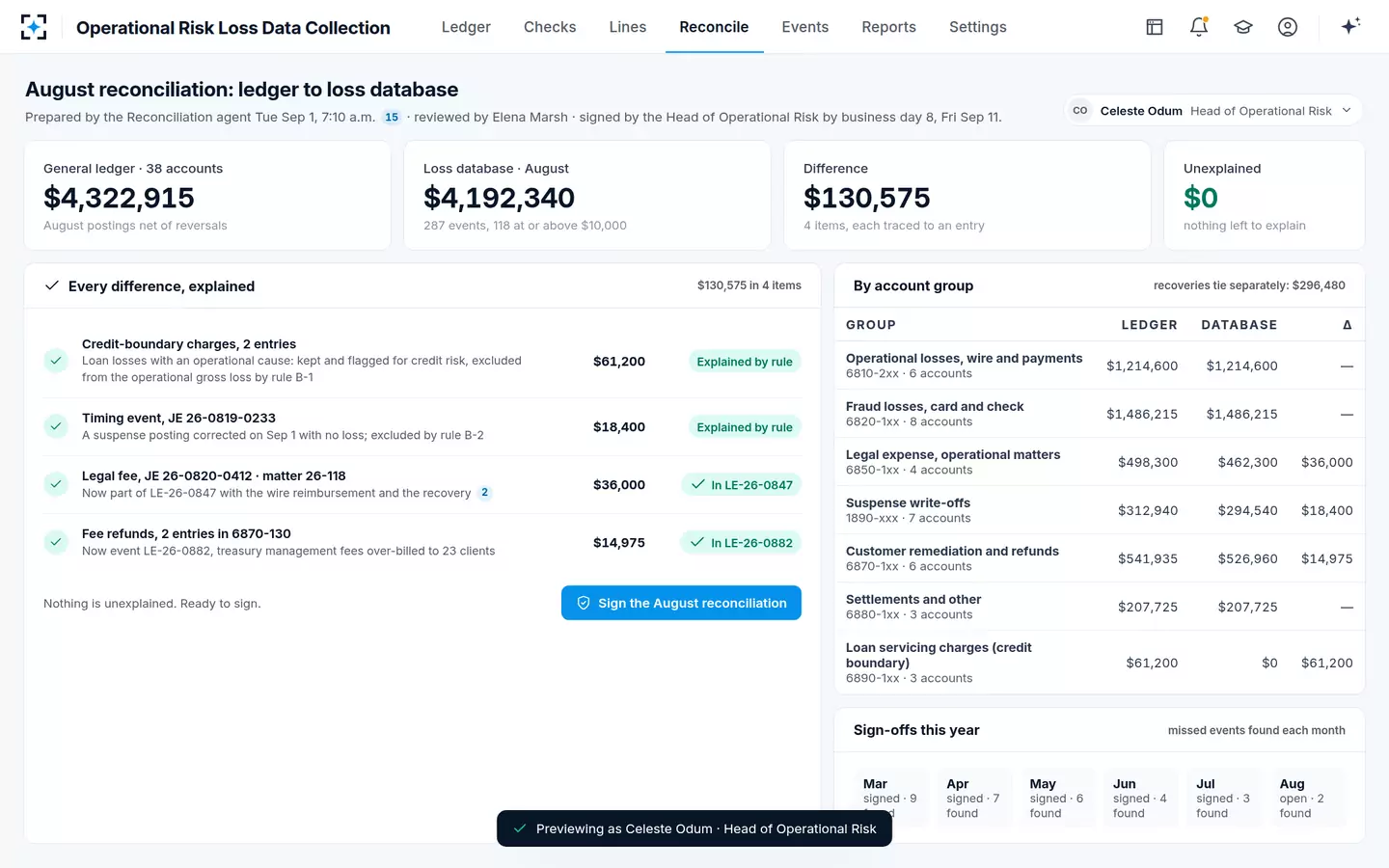
The same discipline applies to the other boundaries: timing events under rule B-2 and fraud versus process under rule B-3, which the Basel event types guide follows through one spoofed-email wire. The full solution is at Operational Risk Loss Data Collection.
Questions people ask
Why exclude credit boundary events from operational loss data?
To avoid counting the same loss twice. The credit loss is already measured in credit risk and, for capital, in credit risk-weighted assets; counting it again as operational would double the charge. The 2026 proposal makes this explicit by excluding credit losses on exposures within the credit risk-weighted assets framework.
Should credit boundary events be kept in the loss database at all?
Most banks keep them, flagged, because the operational cause is real and recurs: a lien-filing process that fails once will fail again. FR Y-14Q leaves them out of the file, but nothing in the rules stops a bank holding them in its own database for risk management.
Is first-party fraud on a loan an operational loss?
Generally not under the 2026 proposal: a borrower's fraud that ends in a charge-off is a credit loss on an exposure in the credit risk framework, and the only carve-out is for retail credit card losses from non-contractual, third-party-initiated fraud. A bank should write its treatment of borrower fraud into its boundary rule, with examples, because the cases are frequent and contested.
What about losses in the trading book?
The Basel standard treats operational losses related to market risk as operational risk for capital, so a trade booked wrongly or a limit breached by a keying error is an operational loss, not a market loss. That is the opposite of the credit boundary, and worth stating in the same rulebook.
How many boundary events does a bank have?
No public statistic exists. In the solution's sample week at a fictional $92 billion bank, 66 of 4,812 entries were set aside as credit-boundary charges, and the August reconciliation showed $61,200 of them across two entries in the month's general ledger.