Loss data collection is the process by which a bank captures every operational loss event above a threshold, with its gross amount, recoveries, dates, event type and business line, so that its loss history is complete enough to manage risk and, at the largest banks, to report and hold capital against. At most banks it starts from a form: a business line notices a loss and submits it. The weakness is completeness, the accuracy measure nobody reports, because a loss that nobody submitted leaves no trace in the loss database while it sits in the general ledger as a legal fee, a refund or a suspense write-off. Botminds' Operational Risk Loss Data Collection was built to close that gap by reading the general ledger and incident tickets every week, so the bank can measure what its forms miss rather than guess.
The figures about a bank on this page are sample data from fictional Corvane National Bank, a $92 billion regional bank, as it runs through the solution. The rules are quoted from the Federal Register, the eCFR and the Basel Framework, linked where they appear.
What forms missed in one week: 17 of 29 losses over the threshold
entries posted in a week to the 38 accounts where operational losses land, plus 214 incident tickets read alongside
entries left once reversals, reclasses, accruals, normal charges and credit-boundary charges are set aside, each by a written rule
candidate loss events once related entries are joined: 29 at or above $10,000 and 39 below, plus 6 near misses from tickets
events at or above the bank’s $10,000 collection threshold, $1,021,055 gross
of those 29 had been submitted on a loss form; 17 had not
What is loss data collection in operational risk?
Loss data collection in operational risk is the discipline of turning a bank's losses into a history: each event with its money, its dates and its classification. The March 2026 capital re-proposal, still a proposal, would make the content explicit for Category I and II banking organizations: gross loss amounts, recovery amounts, the occurrence date, the discovery date and the accounting dates, the ability to map every event to the seven event types, and "descriptive information about the drivers of operational loss events" (91 FR 14952, proposed §__.150(d)(2)).
Two other phrases recur in searches for it. "Loss data collection for operational risk" separates it from data loss in the information-security sense, which is a different subject. "Loss data collection and reporting" adds the second half: the same history feeds the risk committee and the board, and at holding companies with $100 billion or more in assets, the quarterly FR Y-14Q loss file. A form that is late or never sent breaks both halves at once.
How do banks collect operational loss data today?
Most banks combine three channels: a loss form that business line risk coordinators submit in the GRC system, a periodic comparison of the loss database with the general ledger, and links from incident management, legal and fraud systems. The form is the primary channel and the comparison is the safety net, usually run at quarter-end.
The order matters. When the form comes first, the general ledger comparison finds the misses weeks or months after the loss, by which time the people who knew what happened have moved on, and the analyst rebuilds the event from invoices and emails. When the general ledger comes first, the comparison is the capture, and the form becomes one more piece of evidence attached to an event the bank already knows about.
Form-first and ledger-first loss data collection, step by step
Form-first: Someone in the business line remembers to submit a form
General ledger first: An entry posts to one of the accounts where operational losses land, or an incident ticket opens
Form-first: From the submitter’s own records, often before later costs and recoveries post
General ledger first: From the general ledger entries, with later costs and recoveries joined to the event as they post
Form-first: At the quarter-end tie-out, if at all
General ledger first: Within the week; the monthly reconciliation proves nothing was left
Form-first: A count of forms received
General ledger first: A reconciliation in which every difference is an entry or a rule
Form-first: The capture
General ledger first: Evidence attached to an event already found
Why a form-based process misses losses
Forms miss losses because many operational losses are booked by people who are not in the loss process. A branch posts a goodwill refund. The general counsel's office pays outside counsel on a fraud matter. Wire operations writes off an unreconciled item from suspense. Each is correct accounting and each is, by definition, part of an operational loss; none of the people booking them thinks of filling in a form.
The Basel standard names one of these channels directly. Among the items to include in gross loss are "Losses stemming from operational risk events with a definitive financial impact, which are temporarily booked in transitory and/or suspense accounts and are not yet reflected in the P&L ("pending losses")", to be included within a time "commensurate with the size and age of the pending item" (Basel Framework, OPE25.26). A form-based process has no way to see a suspense account at all.
The sample week shows the pattern. Of the 29 events at or above Corvane's $10,000 threshold, 17 had no form. Among them were two wire repair write-offs from the wire operations suspense account, $26,400 in all; a lockbox vendor's misapplied client remittances, written off for $13,300; and two short ATM deposits that surfaced only as an incident ticket. Each was in the general ledger or the ticket queue before it was in the loss database. Even a loss that was reported can be incomplete: a $36,000 legal fee on a wire fraud the business line had submitted sat in legal expense, linked to nothing, until the August reconciliation.
What the rules say about complete loss data
Every text on loss data puts completeness first. The rule in force today for advanced approaches banks allows a collection threshold only if the bank can show the thresholds "are reasonable, do not exclude important internal operational loss event data, and permit the Board-regulated institution to capture substantially all the dollar value" of its operational losses (12 CFR 217.122(g)(2)). The 2011 interagency guidance on that rule tells banks to monitor that "the capture of internal and external data is accurate and complete" (SR 11-8 attachment).
Operational loss event data must be comprehensive and capture all operational loss events that resulted in operational losses equal to or higher than $20,000, as adjusted pursuant to § __.4, (before any recoveries are taken into account) from all activities and exposures
Proposed §__.150(d)(2)(i)(A), March 2026 capital re-proposal (not final)
The proposal would add two duties around that sentence: banks "must have processes to independently review the comprehensiveness and accuracy of operational loss event data", and those processes would be subject to regular independent review by internal or external audit. The Basel standard says the same in its own words: internal loss data "must be comprehensive and capture all material activities and exposures from all appropriate subsystems and geographic locations". None of these texts says a form is enough; all of them ask the bank to prove the data is complete.
What is the loss data collection threshold?
The threshold is the gross loss below which a bank does not have to collect individual events. Under the March 2026 proposal it would be $20,000, measured before recoveries and indexed to inflation; the Basel standard sets €20,000, with national discretion to raise it to €100,000 for the purpose of the loss calculation for larger banks. Today's U.S. rule sets no number: it lets each advanced approaches bank set its own, provided it captures "substantially all the dollar value".
Many banks collect below the regulatory figure, because small losses carry the cheapest information about controls. Corvane collects from $10,000. The threshold also decides how small losses are treated: on FR Y-14Q, separate events below the threshold may not be bundled into one event to clear it. Each FR Y-14Q Schedule E field has its own rules on thresholds and dates.
How do you know your loss data is complete?
You know it is complete when you can explain every dollar the general ledger says was lost, and every incident that had a financial effect, in terms of events in the database or rules that excluded them. Anything less is a count of what was reported. The tests below are how a bank, or its validator, can measure its own miss rate.
Eight completeness tests for an operational loss database
- Reconcile the database to the general ledger monthly, by account group
Every difference must be an entry or a rule: a credit-boundary charge, a timing event, a cost not yet joined to its event, or an event awaiting approval.
- Review which accounts can hold an operational loss
Legal expense, suspense, refunds, settlements and loan servicing charges carry losses as well as the operational loss accounts. An account that is not scanned is a blind spot.
- Match incident tickets with a financial effect to events
Each ticket either has an event, a near miss, or a written reason it has neither.
- Match every legal matter with spend to an event
Outside counsel invoices and legal reserves often post weeks after the loss they belong to.
- Look for orphan recoveries
A recovery that posts with no event to attach to means the loss was never captured.
- Measure the miss rate
The share of events at or above the threshold that were found in the general ledger rather than reported on a form. Track it monthly and by business line.
- Watch the discovery lag
Long gaps between occurrence and capture, by event type and line, show where the process waits for someone to notice.
- Check for silence
A business line with no events in a quarter is more likely to be unreported than loss-free.
The miss rate is the number to report. In the sample data, the monthly reconciliation found nine events in the general ledger with no event in the database in March, falling to two in August as the weekly sieve took over. That trend, not a single month, is the evidence that a capture process works.
Losses found in the general ledger with no event, month by month
How do you reconcile loss data to the general ledger?
Reconcile account by account, not in total. Take the month's postings to every account that can hold an operational loss, net of reversals; take the accounting entries of every event in the database for the same month; compare them by account group; and explain each difference with the entry behind it or the rule that excludes it. The reconciliation is finished when nothing is unexplained, not when the difference is small.
Operational Risk Loss Data Collection ties the loss database to the general ledger
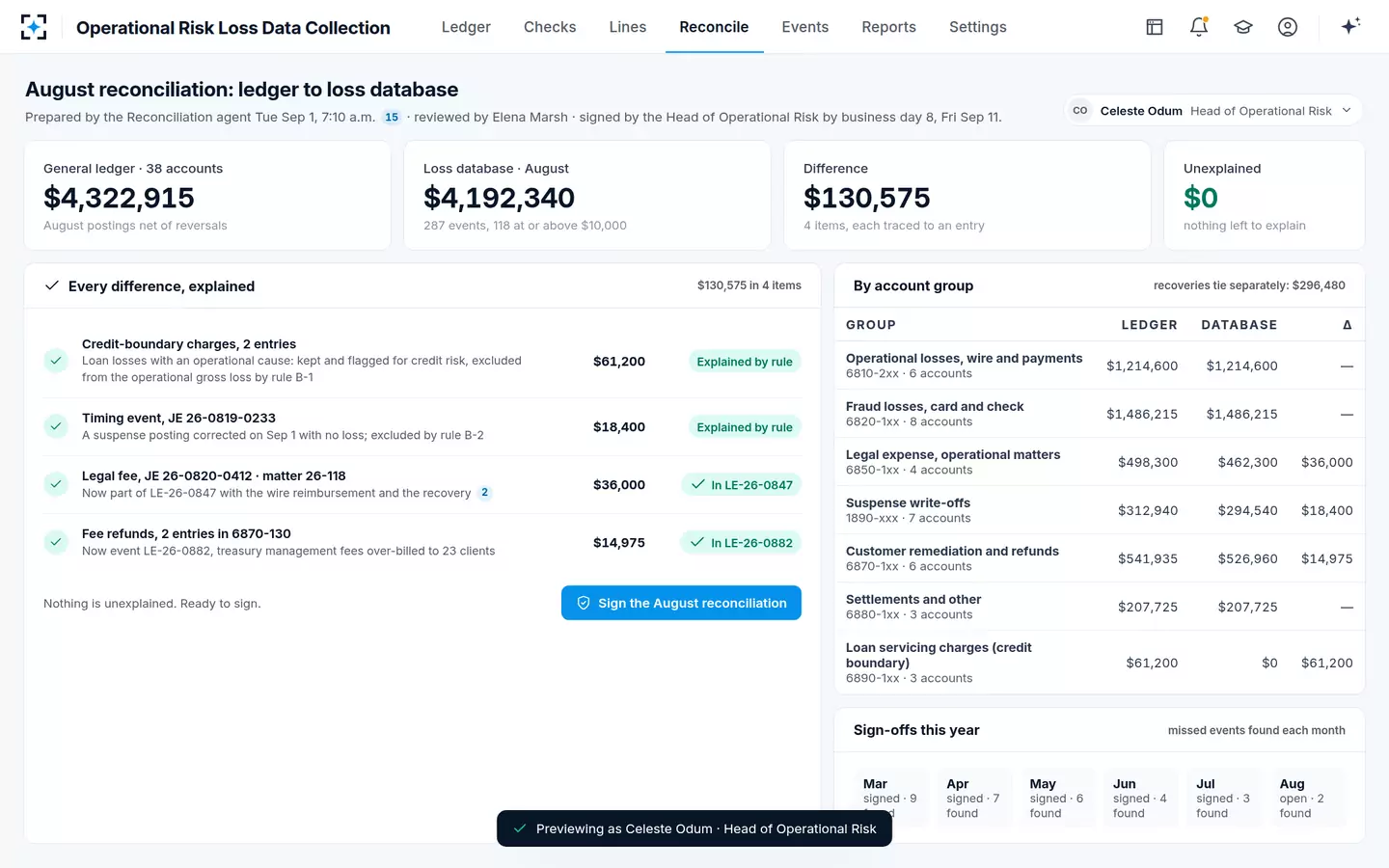
In August, Corvane's general ledger showed $4,322,915 in the 38 accounts and the loss database $4,192,340, a difference of $130,575. All of it was explained: $61,200 of loan losses with an operational cause, kept and flagged for credit risk and excluded from operational gross loss by the bank's rule; an $18,400 suspense posting corrected with no loss, excluded as a timing event; the $36,000 legal fee, now joined to its wire fraud event; and the $14,975 of fee refunds, now an event of their own. With nothing unexplained, the head of operational risk could sign.
Two design choices make the reconciliation useful rather than ceremonial. Recoveries tie separately, so a recovery can never quietly offset a missing loss; and an exclusion counts as explained only if a written rule covers it, so the rules themselves become reviewable. Which charges a credit boundary rule may exclude is a decision tree of its own.
What losses are typically missed?
The losses most often missed are the ones that post outside the operational loss accounts, post long after the event, or are too small for anyone to think worth a form. Four families recur: later costs of a known event, such as legal fees; refunds and remediation posted by the business as customer service; write-offs from suspense and reconciliation accounts; and recoveries, which are not losses but reveal the losses they belong to.
Time is the other reason. In Federal Reserve supervisory data for 35 large holding companies, the average operational loss took 1.0 quarters to discover and another 1.6 quarters to be accounted for, and Clients, Products and Business Practices events took 2.5 quarters to discover (Frame, Lazaryan, McLemore and Mihov, Dallas Fed Working Paper 2215). The same paper notes that public sources built from press accounts "miss many operational loss events". A loss history that depends on someone noticing inherits that lag; one that reads the general ledger each week does not.
Who is responsible for loss data quality?
The independent operational risk function owns it, and audit tests it. Today's advanced approaches rule makes that function, independent of business line management, responsible for the bank's operational risk data and assessment systems; the 2026 proposal would make it responsible specifically for "designing, implementing, and overseeing" internal loss data collection, with an independent review of completeness and accuracy and regular audit of both.
Business lines still own their losses: they confirm ownership, supply the evidence and explain what happened. In the solution's design each business line confirms its events within three business days and can dispute a reclassification, but the database, the rules and the monthly signature belong to the head of operational risk. The analyst's week shows how those duties divide in practice.
Loss data collection and reporting with Operational Risk Loss Data Collection
Operational Risk Loss Data Collection makes the general ledger the first channel. Each week the Finder agent reads every entry in the accounts the bank chose and every incident ticket, and sets aside reversals, accruals, normal charges and credit-boundary charges, each with its rule; an analyst can send any entry back with one click. The Grouper agent joins the rest into events and keeps recoveries apart; the Reconciliation agent ties the database to the general ledger each month and explains every difference.
Two targets define the design: no unexplained difference between the general ledger and the loss database at month-end, and five days from a general ledger posting to an approved event rather than the quarter-end. Both are design targets to be measured on a bank's own accounts. The solution does not post to the general ledger, file anything or decide an event; it makes completeness something a bank can show. The full solution is at Operational Risk Loss Data Collection.
Questions people ask
What does Basel require for loss data?
The Basel standard asks for comprehensive internal loss data above €20,000, with gross loss, recoveries, the dates of occurrence, discovery and accounting, and descriptive information about causes, collected under documented procedures that are independently reviewed. For banks whose losses enter the capital calculation, it asks for ten years of good-quality data, with five years acceptable on transition.
Is a lower collection threshold better?
A lower threshold captures more of the small, frequent losses that show control weaknesses early, at the cost of more events to process. The current U.S. rule judges a threshold by whether it captures substantially all the dollar value of losses; the 2026 proposal would set a $20,000 floor for the largest banks, and nothing stops a bank collecting below it.
How often should loss data be reconciled to the general ledger?
No U.S. rule sets a frequency. Monthly is a sound minimum because it matches the accounting close, keeps differences small enough to explain, and catches a missed loss while the people involved can still describe it; Corvane's reconciliation is signed by the eighth business day.
Do small recurring losses have to be entered one by one?
Each distinct event stays its own event: FR Y-14Q forbids bundling separate events below the threshold into one. A bank can still approve similar small events together; in the sample week, 31 events below $10,000 in four groups were approved in one action and sampled by the validator.
What is the difference between loss data collection and an RCSA?
Loss data collection records what did go wrong; a risk and control self-assessment rates what could go wrong and how well controls work. The Basel principles treat event data as an input to the self-assessment, and comparing internal losses with self-assessment results as a test of whether the assessment works; how to measure control effectiveness turns that test into a measure.