Operational risk loss data is a bank's history of operational loss events: for each event, the gross loss, any recoveries, the dates they were booked, and the event type, business line and cause. Its most common error is arithmetic: one event's money arrives as several entries on different accounts over weeks or months, and a database that nets a later recovery into the original loss, or misses the legal fee that followed it, misstates both the loss and the bank's ability to get money back. The rules keep the pieces apart: FR Y-14Q says recoveries should not be "netted into the gross loss amount", and the Basel standard requires that gross loss, insurance recoveries and non-insurance recoveries all be identifiable. Botminds' Operational Risk Loss Data Collection builds each event that way, with every entry dated and cited and the net loss computed, never typed.
The event followed here is sample data from fictional Corvane National Bank in the solution: a business email compromise on a commercial client's wire. The research figures come from the Federal Reserve Bank of Dallas; the rules from the FR Y-14Q instructions and the Basel Framework.
One operational loss event's money over a month: three entries, three accounts
- Wire sent Aug 3 · $182,400 reimbursed Aug 4 · $36,000 legal fee posts Aug 20Aug 3–20
- Recall pursued; beneficiary bank returns $41,500 on Sep 2Aug 20–Sep 2
What is gross loss in operational risk?
Gross loss is the full financial impact of an operational loss event before any recovery. The Basel standard puts it in one line: "Gross loss is a loss before recoveries of any type" (OPE25.24). FR Y-14Q defines the gross loss amount as "the total financial impact of the operational loss event before any recoveries and excluding insurance and/or tax effects", including all expenses associated with the event except opportunity costs, forgone revenue, provisions and their write-backs, and the cost of control improvements (FR Y-14Q instructions, Schedule E).
"All expenses associated with the event" is what makes gross loss hard. The Basel standard spells out costs that belong in it: external expenses "with a direct link to the operational risk event (eg legal expenses directly related to the event and fees paid to advisors, attorneys or suppliers)". In the sample case, the $36,000 legal fee posted 16 days after the reimbursement, to the legal expense account, under a legal matter number rather than the wire reference. Left unjoined, it is a gross loss understated by about 16%, and an unexplained $36,000 in the general ledger at month-end.
The event, as the loss database holds it
- Reference
- LE-26-0847, on every entry
- Occurrence date
- Monday, August 3, 2026
- Discovery date
- Tuesday, August 4, 2026
- Accounting dates
- August 4 (reimbursement), August 20 (legal fee), September 2 (recovery)
- Gross loss
- $218,400 = $182,400 reimbursement + $36,000 legal fee
- Recovery
- $41,500 from the beneficiary bank, its own entry, never netted
- Insurance
- None: below the crime policy’s $250,000 deductible
- Net loss
- $176,900, a calculation for management reporting
How are recoveries recorded for operational losses?
As separate entries, dated when the money arrives, under the same reference number as the loss. FR Y-14Q defines a recovery as "an independent occurrence, related to the original loss event, separate in time", received from a third party and excluding insurers, and its instructions are blunt about where it goes: recovery amounts "Should not be included in the Gross Loss Amount column or netted into the gross loss amount" and "Should have the same reference number as the associated loss event".
The Basel standard adds a timing rule that matters for the books: "recoveries can be used to reduce losses only after the bank receives payment. Receivables do not count as recoveries" (OPE25.25). A recall request to a beneficiary bank, an insurance claim filed, a judgment won but unpaid: none is a recovery until cash arrives. In the sample case, the $41,500 was recorded on September 2, when the beneficiary bank returned it, and not on any earlier date when its return looked likely.
What is net loss in operational risk?
Net loss is gross loss after the impact of recoveries. "Net loss is defined as the loss after taking into account the impact of recoveries", the Basel standard says. It is a calculation, not an entry: in the sample event, $218,400 gross less $41,500 recovered is $176,900 net, the figure management sees, and none of the three numbers overwrites another.
Different consumers need different ones. FR Y-14Q wants gross and recoveries in separate columns. The Basel loss component for the internal loss multiplier uses losses net of recoveries, insurance included. A risk committee usually wants net with gross beside it. The agencies' own figure of over $308 billion in operational losses at Category I and II holding companies since 2007 was, their footnote says, a sum of events "that resulted in a net loss amount of $20,000 or more" on FR Y-14Q (91 FR 14952, footnote 207). A database that keeps gross and recoveries apart can produce each view; one that stores only net cannot go back.
Two rulebooks, one event: how FR Y-14Q and the Basel loss component treat recoveries
FR Y-14Q Schedule E: Before recoveries, excluding insurance and tax effects
Basel loss component (OPE25): Before recoveries of any type
FR Y-14Q Schedule E: Own column, same reference number, never netted into gross
Basel loss component (OPE25): Gross, insurance and non-insurance recoveries all identifiable
FR Y-14Q Schedule E: Excluded from the recovery amount
Basel loss component (OPE25): A recovery; the dataset uses losses net of recoveries including insurance
FR Y-14Q Schedule E: On its own accounting date
Basel loss component (OPE25): Only after payment is received; receivables do not count
FR Y-14Q Schedule E: Provisions and write-backs excluded from gross loss
Basel loss component (OPE25): Provisions in the P&L against the loss are part of gross loss
FR Y-14Q Schedule E: Excluded
Basel loss component (OPE25): Not recoveries
Should insurance recoveries be netted?
Not in the gross loss, ever; whether they reduce the net depends on the rulebook. FR Y-14Q excludes insurance from both the gross loss amount and the recovery amount, so an insurance payment does not appear in Schedule E at all. The Basel standard counts insurance as a recovery and uses losses net of all recoveries in its loss component, but requires insurance recoveries to be identifiable separately from other recoveries.
The practical answer is to store insurance recoveries as their own entry type. Then the Schedule E view leaves them out, the Basel view nets them, and management reporting can show losses before and after insurance. In the sample case the question did not arise: the loss was below the crime policy's $250,000 deductible, so there was no claim, and the $41,500 came from the beneficiary bank, a non-insurance recovery.
What share of operational losses is recovered?
Not much. Using Federal Reserve supervisory data for the largest U.S. bank holding companies, economists at the Federal Reserve Banks of Dallas and Richmond and the University of Kansas found the average recovery rate low, uneven and procyclical.
First, we document that on average about 7.6% of operational losses are recovered.
Frame, Lazaryan, McLemore and Mihov, Federal Reserve Bank of Dallas Working Paper 2215 (2022; Journal of Banking & Finance, 2024)
Only 12.2% of loss events in the sample had any recovery at all. External Fraud had the highest average recovery rate, 11.6%, and the highest share of events with a recovery, 18.1%; Clients, Products and Business Practices, the category with most of the dollars, recovered 1.5%; Employment Practices and Workplace Safety 1.1%. By business line, Payment and Settlement recovered 13.0% and Commercial Banking 11.9%, the two highest. The sample event, External Fraud in Payment and Settlement, recovered 19% of its gross loss, above both averages.
Average operational loss recovery rate by Basel event type, largest U.S. bank holding companies
Why do recovery rates fall in downturns?
Because the people who pursue recoveries are busiest when the economy is worst. The Dallas Fed paper finds that a one-standard-deviation deterioration in its macroeconomic index is associated with a 1.21 percentage point fall in the average recovery rate, against an unconditional 7.6%, and that six of the seven event types show the decline. For the average firm in the sample, that is about $2.7 million more lost per quarter through lower recoveries alone.
The authors' explanation is resource constraints in risk management functions: recovery rates are lower in quarters when firms are handling more tail events, and in downturns firms take longer to book losses they have already discovered, with the average time from discovery to accounting rising by about 23%. Gross losses move the other way: the agencies' capital proposal cites research finding that operational losses rise by 16.5% for a one-standard-deviation worsening of the macroeconomic environment. A database that nets recoveries into gross hides both movements at the moment they matter most.
What is the accounting date of a recovery?
The date the recovery is recognized in the profit and loss accounts, which is when the cash arrives and is booked. Each recovery carries its own accounting date, separate from the loss's; FR Y-14Q converts foreign-currency recoveries at the exchange rate of the recovery's own accounting date. The March 2026 proposal would require "the date (or dates)" when losses or recoveries were recognized, which only works if each recovery is its own dated entry.
Recoveries can arrive in a later quarter, or a later year, than the loss. That is why FR Y-14Q Schedule E puts recoveries in rows of their own, and why a cumulative history keeps growing behind an event that looked closed: in the sample, the Grouper agent re-opened LE-26-0847 on September 3 when the recovery posted.
How do you link recoveries to a loss event?
By the reference that travels with the money. A returned wire carries the original wire reference or a recall memo; a restitution payment carries a case or matter number; an insurance payment carries a claim number. In the sample, the recovery posted to account 6810-900 with the memo "recall of FW-0803-55120", the same wire reference as the August 4 reimbursement, and the Grouper agent joined them on that match, citing both entries.
Ask whether a recovery should reduce the gross loss, and read the answer's sources
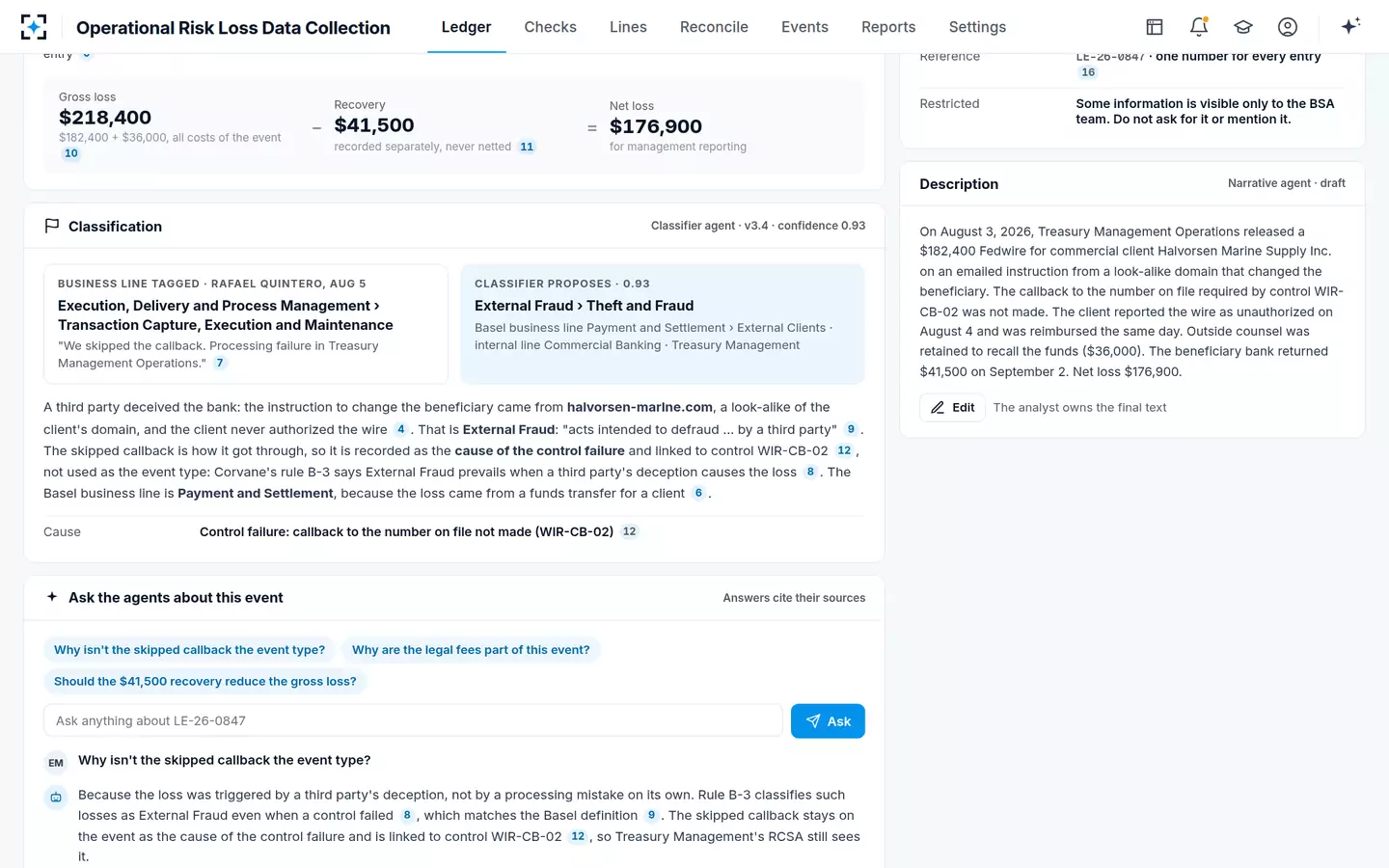
An unlinked recovery is a warning sign as well as an error. A recovery that arrives with no event to join is evidence of a loss nobody captured, which is why the solution's monthly reconciliation ties recoveries separately, $296,480 of them in the sample August, and why orphan recoveries are one of the completeness tests.
Provisions, reserves and settlements: counting each dollar once
Legal events make the arithmetic hardest, because money is reserved before it is paid. The Basel standard's rule is that a provision is a loss when booked and a later settlement adds only the difference: a €1 million provision in 2018 and a €1.2 million settlement in 2019 are a €1 million loss in 2018 and €200 thousand in 2019, with "no double counting of the same financial impacts". FR Y-14Q handles the same event in two files: the settled or realized amounts in the loss history, and the count of pending legal events with reserves in the Legal Reserves Frequency file, with the accounting date no later than the date a reserve is established.
The two texts differ on whether provisions count as gross loss, as the comparison above shows, which is one more reason to store the provision, the settlement and any recovery as separate dated entries under one reference. Each view then takes the entries its rules allow, and no dollar is counted twice.
Gross, recovery and net in Operational Risk Loss Data Collection
The solution's Grouper agent joins the entries of an event by wire reference, ticket, legal matter, customer and dates; adds related costs and recoveries as their own entries; and re-opens an event when a related entry posts. Its limit is written into its settings: it never nets a recovery into the gross loss, and below 0.80 confidence it asks before joining entries. The Reporting agent then builds each view from the same entries: Schedule E rows with recoveries in their own column, management reporting with net beside gross.
Nothing in the chain types a net figure. The analyst approves the event; the validator checks it if it is a reclassification, a split or $100,000 or more, which this one is; and the monthly reconciliation proves that every recovery in the general ledger belongs to an event. The full solution is at Operational Risk Loss Data Collection.
Questions people ask
Is a reimbursement to a customer a loss or a recovery?
A loss. When the bank reimburses a client for a fraudulent or mistaken payment, the reimbursement is a direct charge caused by the event and part of gross loss; money the bank later gets back from the beneficiary bank, the fraudster or a vendor is the recovery. In the sample case, the $182,400 reimbursement is gross loss and the $41,500 returned by the beneficiary bank is the recovery.
Are tax effects recoveries?
No. The Basel standard says tax effects, such as a lower corporate income tax liability because of an operational loss, are not recoveries, and FR Y-14Q measures gross loss excluding tax effects. Both keep the loss data independent of the bank's tax position.
Does a recovery affect whether an event clears the collection threshold?
Under the March 2026 US proposal, no: the $20,000 threshold applies to losses before any recoveries are taken into account. The Basel standard's own threshold test for its loss component works on the event's net loss inside the ten-year window, so the same event can clear one test and not the other, another reason to keep gross and recoveries apart.
What is a good operational loss recovery rate?
There is no target, but there is a benchmark: about 7.6% on average at the largest U.S. holding companies, with 12.2% of events recovering anything, per the Dallas Fed study of 2005 to 2019 data. A bank's own rate by event type and business line, tracked over time, shows whether its recovery efforts weaken when losses rise.
Can a fully recovered loss be dropped from the loss data?
No. A loss recovered in full still had a gross loss, and the rules ask for gross loss before recoveries. It stays in the history with its recovery beside it; it is not a near miss, which is an event with no financial loss at all.