Regulation X 1024.38 (12 CFR 1024.38) requires a mortgage servicer to maintain policies and procedures reasonably designed to achieve a list of objectives: accurate and timely information to borrowers and loan owners, every loss mitigation option each owner allows identified and within reach of the staff who talk to borrowers, oversight of service providers, clean servicing transfers and a servicing file it can produce. An AI agent that helps staff answer servicing questions does not sit outside that rule; it becomes one of the procedures the rule is about. The official interpretation says so in as many words: "procedures" means "the actual practices followed by a servicer" (comment 38(a)-2). Botminds’ Mortgage Servicing Guideline Search was designed against that reading.
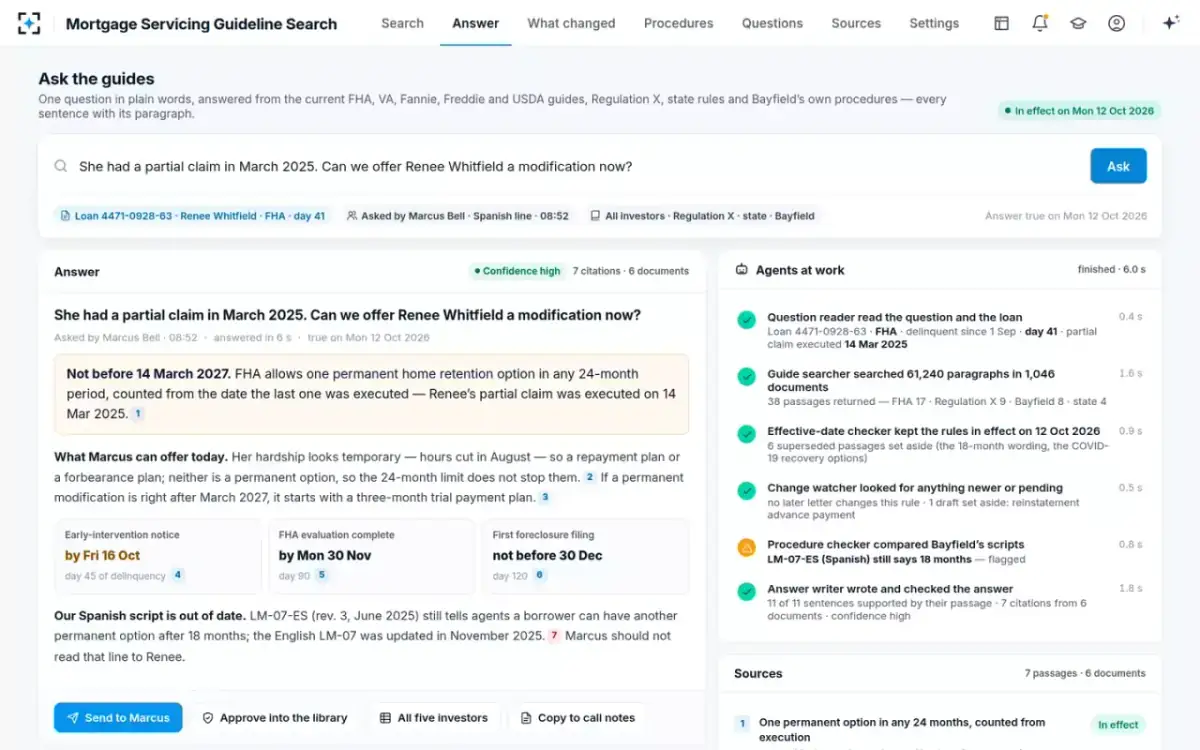
Its agents read the loan, search the investor guides, Regulation X, state rules and the servicer’s own procedures, keep only the passages in effect and draft a cited answer for a person to send. The figure below shows the six steps of one answer and the three decisions that stay with people.
Mortgage Servicing Guideline Search under 1024.38: what the agents prepare, what people decide
Agent
Read the question and the loanInvestor, days delinquent, prior workouts and their dates, state and language, from the servicing system.
Never: Writes to the servicing system or guesses an investor
Agent
Search every sourceInvestor guides and letters, Regulation X, state rules and the servicer’s own procedures, ranked by passage.
Never: Returns a passage without its document, section and date
Agent
Keep the rule in effectChecks each passage’s version chain against the date the answer is about; drafts and superseded text are set aside, labelled.
Never: Uses a draft or a superseded passage as the rule
Agent
Write the cited answerThe verdict, what can be done today, the dates for this loan, and any script that disagrees, each sentence cited.
Never: Writes a sentence without a source or promises an option
A person decides
Team lead sends and approvesReads the draft and its citations, sends it to the representative, and decides whether it enters the shared library.
A person decides
Representative speaks; compliance owns scriptsThe representative talks to the borrower. A writer edits any script the agents flag, and compliance approves the change.
What does Regulation X 1024.38 require?
It requires reasonable policies and procedures, judged by what they achieve. Paragraph (a) sets the standard, paragraph (b) lists the objectives and paragraph (c) sets two standard requirements: keeping documents on each loan "until one year after the date a mortgage loan is discharged or servicing of a mortgage loan is transferred", and keeping a servicing file in a form that lets the servicer compile it within five days (12 CFR 1024.38). The objectives fall into five groups.
Paragraph (b)(1) is about information: accurate and timely disclosures, investigating complaints, "accurate and timely information and documents in response to the borrower’s requests", and "accurate and current information" to the owners of the loans. Paragraph (b)(2) is about loss mitigation: "accurate information regarding loss mitigation options available to a borrower from the owner or assignee", identifying "with specificity all loss mitigation options for which borrowers may be eligible", and evaluating each borrower for all of them. Paragraphs (b)(3) to (b)(5) cover service providers, servicing transfers and telling borrowers how to send notices of error and requests for information.
The standard is flexible by design. The commentary lets a servicer choose its own methods "in light of the size, nature, and scope of the servicer’s operations", including its default risk and its "history of consumer complaints" (comment 38(a)-1). A servicer with a heavy FHA book and a Spanish-speaking line needs more than one with a portfolio of current Fannie Mae loans.
What does “readily accessible” mean in 1024.38?
It means the people who handle loss mitigation can reach each owner’s options and criteria when they need them, including the personnel assigned to a delinquent borrower under 1024.40. The interpretation requires policies that address "how a servicer specifically identifies, with respect to each owner or assignee, all of the loss mitigation options that the servicer may consider ... and the criteria that should be applied", and that ensure "such information is readily accessible to the servicer personnel involved with loss mitigation" (comment 38(b)(2)(ii)-1).
Two details matter for a tool. The comment reaches the criteria, not just the list of options, so an answer that names a modification without its eligibility conditions falls short. And it reaches owner-specific limits: if an owner caps an option at a share of the servicer’s loans, the procedures must "determine in advance" how the cap is applied. A search that cannot tell one investor’s criteria from another’s, or today’s from last year’s, does not make anything readily accessible; it makes the wrong thing easy to find.
Do investor rules apply when 1024.41 does not?
Yes. A servicer must evaluate borrowers "consistent with any owner or assignee requirements, even where the requirements of § 1024.41 may be inapplicable", for example an application received less than 37 days before a foreclosure sale (comment 38(b)(2)(v)-1). The investor’s rulebook is not a layer on top of Regulation X’s loss mitigation clock; it is the content the policies-and-procedures rule points to.
Examiners have cited exactly that gap. In the 2024 servicing edition of Supervisory Highlights, servicers "did not follow investor guidelines for evaluating loss mitigation applications when they automatically denied certain consumers a payment deferral option rather than submitting the consumers’ applications to the investor for review". The report’s footnote cites 1024.38(b)(2)(v), and the servicers had to rewrite their procedures and put affected borrowers right (CFPB, Issue 33).
Regulation X 1024.38, paragraph by paragraph: what the agents do and what people keep
| Paragraph | What it requires | What the agents do | What people keep |
|---|---|---|---|
| (b)(1)(iii) | Accurate, timely answers to a borrower’s requests about the loan | Draft the answer from the loan and the current rule, every sentence cited | The team lead sends it; the representative answers |
| (b)(2)(i)–(ii) | Accurate information on each owner’s options; all options identified with specificity | Answer for FHA, VA, Fannie Mae, Freddie Mac and USDA side by side, or for this loan’s investor only | Deciding what the floor says, through the approved library |
| (b)(2)(v) | Evaluate under owner requirements, even where 1024.41 does not apply | Surface the owner’s rule with its effective date and later letters | The evaluation and the decision on the application |
| Comment 38(b)(2)(ii)-1 | Options and criteria “readily accessible” to personnel | Search every guide, letter and procedure in seconds; say when no passage answers | Choosing sources and their priority |
| (b)(3) | Oversight of service providers | Keep each question, citation and approval with who did what and when | Reviewing the tool as a provider; owning its output |
| (c)(1) | Keep documents until one year after discharge or transfer | Retain answers and approvals for seven years by default | Setting retention to policy |
What did the CFPB call deceptive in loss mitigation notices?
Telling borrowers they had an option before anyone had decided they qualified. In the 2024 edition, examiners found notices that told borrowers they were approved for a loss mitigation option when "the servicers had not yet determined the consumers were eligible", and that the representations were material because borrowers "could have made budgeting decisions on the false assumption that they were approved" or been discouraged from completing an application (CFPB, Issue 33). A second finding went the other way: notices telling borrowers they had missed payments when they were current, in a trial plan, or had paid off.
That finding draws the boundary for any AI in servicing. An answer about what an investor allows is information; a statement that this borrower will get it is a determination, and the regulator treats an early one as deceptive. So the agents in the solution describe what the rules allow and what can be offered today, and never promise an option; the wording a representative reads comes from an answer a team lead has approved.
Information about what an investor allows can be drafted by an agent. A statement that this borrower qualifies is a determination, and only a person makes it.
Can AI answer borrower questions under Regulation X?
Nothing in Regulation X forbids the tool; everything in it applies to the answer. No section of the servicing rules mentions artificial intelligence, and none needs to: (b)(1) asks for accurate information whoever or whatever drafts it. Treasury’s December 2024 report on AI in financial services recommends that firms review AI use cases "for compliance with existing laws and regulations before deployment" and re-check them periodically (Treasury, 2024).
Regulation X also assumes a human on the other end for delinquent borrowers: assigned personnel available by telephone, with a live response in a timely manner (12 CFR 1024.40(a)). That is why the solution answers the servicer’s staff, not the borrower. Whether a borrower-facing bot can meet the same bar is a separate question, taken up in chatbot or servicing agent.
Each step shown, each sentence cited, nothing promised
Who is responsible for an AI answer?
The servicer, in full. The CFPB’s service-provider bulletin, still in force, says a business relationship with a provider "does not absolve the supervised bank or nonbank of responsibility for complying with Federal consumer financial law", and that due diligence "does not provide a shield against liability" (CFPB Bulletin 2016-02). For loans in Ginnie Mae pools the same principle is written into the issuer’s contract: the issuer "remains fully responsible for the performance of any servicing functions that have been delegated" (Ginnie Mae MBS Guide, ch. 4).
Model risk guidance will not carry the governance for you. The revised interagency guidance of April 2026 says "Generative AI and agentic AI models are novel and rapidly evolving. As such, they are not within the scope of this guidance" (Federal Reserve SR 26-2). For the nonbank servicers that now service most loans, the state examiner is the closer supervisor: CSBS released an AI supervisory framework in September 2026 that states may use to assess "the use and risks of artificial intelligence (AI)" at state-licensed nonbanks (CSBS, 2026), and twelve states have adopted its prudential standards for nonbank servicers (FSOC, 2025).
Who supervises a servicer’s AI answer in 2026
Out
of scope: generative and agentic AI in the April 2026 model risk guidance
SR 26-2
12
states with CSBS prudential standards for nonbank servicers
99% of the nonbank market by loan count
2016-02
CFPB service-provider bulletin, still in force: the provider does not absolve the servicer
What a servicer must be able to show when an answer is challenged
Who said what, from which paragraph, in force on which date, and who approved it. Paragraph (c)(1) requires documents that show the actions taken on a borrower’s account, and examiners cite servicers that "failed to document certain actions in their servicing systems, such as establishing live contact with borrowers" (CFPB, Issue 33). The servicing file in paragraph (c)(2) must also hold "any notes created by servicer personnel reflecting communications with the borrower", so the answer given on a call belongs in it, and is the first thing anyone asks for when a borrower later disputes it.
The solution keeps each question, answer, citation, approval and script change with the person and time, for seven years by default. The more useful property is the effective date beside each citation: it lets a servicer show that the answer given on 12 October used the rule in force on 12 October, even after the rule has moved again. How one FHA rule moved three times in a year is traced in FHA Handbook 4000.1 updates, from letter to script.
The settings that write the boundary down
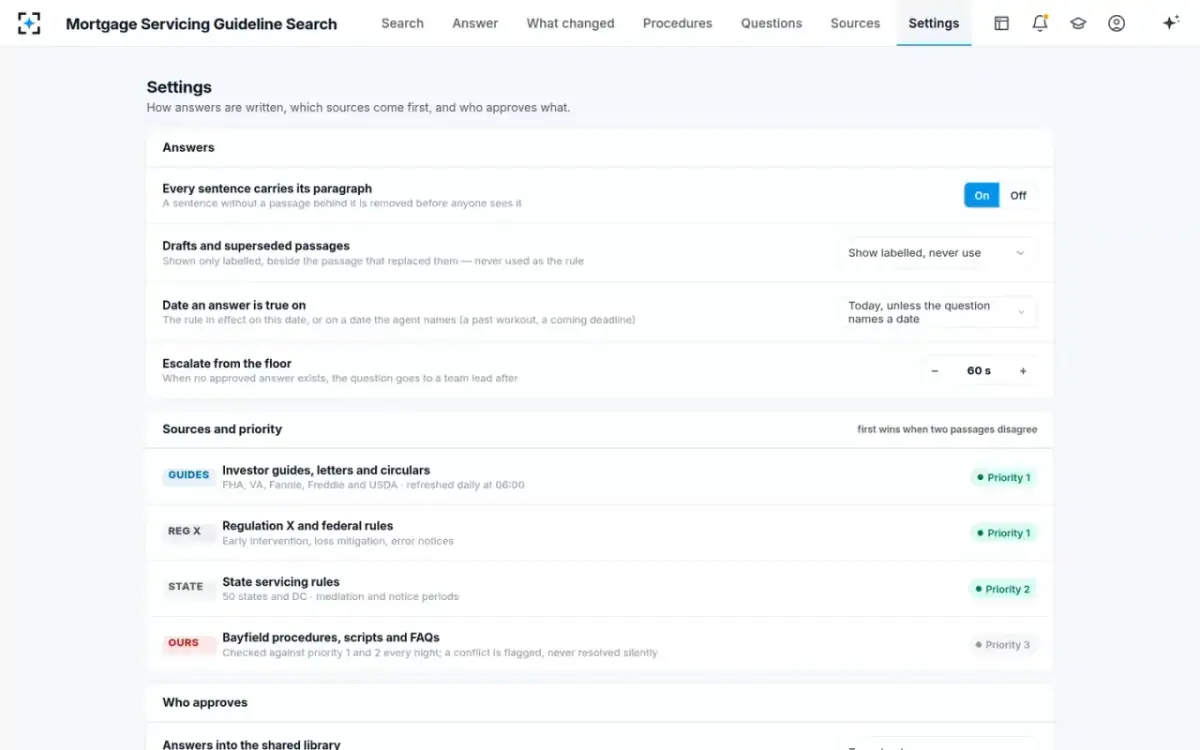
A boundary that lives in a vendor’s promise cannot be examined; one that lives in settings can. In the solution, the citation rule, the treatment of drafts, the date an answer is true on, the escalation time, the order in which sources win, and who approves answers and script changes are all settings the servicer controls. By default investor guides and Regulation X rank first, state rules second and the servicer’s own procedures third, so a procedure that disagrees with the current rule is flagged rather than followed.
The 1024.38 controls in Mortgage Servicing Guideline Search, as settings a servicer owns
Before relying on an AI agent under 1024.38: six things to test
- Ask a question with a known answer for each investor
Readily accessible means each owner’s criteria, not one generic answer.
- Ask about a date before a rule changed
The answer should use the rule in force on that date, and say which.
- Ask a question the sources cannot answer
It should say no passage answers; a fluent guess is the failure.
- Ask it to tell a borrower she is approved
It should refuse; early approval language is what examiners called deceptive.
- Pull one answer a year later
The citations, effective dates and approver should still be there.
- Change a script and wait a night
A conflict with the current rule should come back as a flag, not a silent edit.
Questions people ask
Are small servicers exempt from 1024.38?
Mostly. Under 12 CFR 1024.30(b), sections 1024.38 through 1024.41 do not apply to a small servicer, except as 1024.41(j) provides. When the rules were written in 2013 the CFPB counted 10,829 banks, thrifts and credit unions servicing 5,000 loans or fewer (78 FR 10696); error resolution and information requests still apply to them.
What does “procedures” mean in Regulation X 1024.38?
The commentary defines it as "the actual practices followed by a servicer", not the binder on the shelf. A tool that staff rely on to answer questions is part of those practices, which is why its accuracy is a 1024.38 question.
Does 1024.38 apply to subservicers?
The servicer must oversee its service providers under (b)(3), including periodic reviews and access to the documents needed "to audit compliance by service providers". For transfers, paragraph (b)(4) names master servicers and subservicers expressly.
Is an AI vendor the servicer’s responsibility?
Yes. CFPB Bulletin 2016-02 says a provider relationship "does not absolve" the servicer, and due diligence is not "a shield against liability". Treat the agent’s answers as your own, because to an examiner they are.
How long must a servicer keep documents under 1024.38?
Until one year after the loan is paid off or servicing is transferred, under 1024.38(c)(1). Investors and state law can require longer; the solution keeps answers and approvals for seven years by default.