AI in mortgage servicing is most useful, and easiest to govern, when it reads the rulebooks a servicer already works from rather than replacing them. FHA’s Handbook 4000.1 and its mortgagee letters, VA’s servicing guidance, USDA’s handbook, the Fannie Mae and Freddie Mac guides with their announcements and bulletins, Regulation X, state rules and the servicer’s own procedures remain the source of every answer. What AI adds is the reading: finding the passage that applies to this loan, confirming it is in force on the date that matters, and noticing when the servicer’s own script says something else. Botminds’ Mortgage Servicing Guideline Search does that for all five investors at once and cites every sentence. The hard part of any such project is not a new content library. It is the version chains, as the pace of change since January 2025 shows.
Loss mitigation rule changes, January 2025 to October 2026, by rulebook
How is AI used in mortgage servicing?
Mostly in three places today. Borrower-facing chat on servicers’ websites and apps, which the CFPB has reviewed critically. Automated loss mitigation reviews that investors require, which the CFPB acknowledged in 2024: servicers "may frequently and routinely review borrowers for loss mitigation, using automated processes required by investors, without a borrower request and solely based on information already on record" (CFPB proposed rule, 2024). And reading documents for staff: Treasury’s 2024 report lists "advanced document searches" among the back-office uses of generative AI it found across financial firms (Treasury, 2024).
Guideline search sits in the third group. It does not talk to borrowers and does not decide outcomes; it gives the servicer’s own staff the rule that applies, with the passage behind it. That choice keeps it inside the existing controls a servicer already runs for procedures and training, and the comparison with borrower-facing bots is drawn out in chatbot or servicing agent.
Why the guides you already have are the hard part
Because each one changes on its own schedule, in its own form, and none of them tells you which of its paragraphs your procedures copied. FHA changes servicing rules by mortgagee letter and folds them into the handbook later; in 2025 one letter, ML 2025-12, replaced another, ML 2025-06, before the first had taken effect (ML 2025-12). VA received a new statute in July 2025 creating the Partial Claim Program, with a 25% cap and one claim per loan (38 U.S.C. 3737), opened the program in June 2026, and servicers are not required to offer it until late November 2026 (NCLC). USDA’s special servicing rule took effect in February 2025 (USDA final rule).
On top sit the servicer’s own documents in two or more languages, each a restatement of some investor’s paragraph. A tool that indexes all of this text as one undifferentiated library will find passages fluently and cite the wrong one: last year’s letter, a draft posted for comment, or a Spanish script that never caught up.
The rulebooks are not the problem a servicer needs AI for. Their dates are.
Does AI replace the servicing guide subscription?
No, and it should not try. The investor’s published text is the rule; a summary written by a vendor is not. The servicer keeps its access to each guide, its announcement and bulletin feeds, and HUD’s and VA’s publications, and the solution reads from them, keeping each passage with its document, section and effective date. When an answer is challenged, the citation leads back to the investor’s own paragraph, not to anyone’s paraphrase of it.
Fannie Mae and Freddie Mac deserve a note. Their servicing guides are contracts with the servicer rather than regulations, published by the Enterprises themselves, and they change through announcements, lender letters and bulletins. The solution reads them as it reads HUD’s letters; the servicer remains responsible for following the guide as published.
How to connect AI to investor servicing guides
Source by source, with each one’s versioning rule written down before any search runs. The table lists what a servicing floor typically connects, who publishes it, and the property that makes it hard to read correctly.
What to connect for AI in mortgage servicing, and what makes each source hard
| Source | Publisher | How it changes | What the tool must keep |
|---|---|---|---|
| FHA Handbook 4000.1 and mortgagee letters | HUD | Letters first, handbook later; letters supersede letters | Effective dates; which letters the handbook has absorbed |
| VA servicing guidance (M26-4) and circulars | VA | Circulars and program launches; statute in 2025 | Program start and offer deadlines; one claim per loan |
| USDA HB-1-3555 and 7 CFR 3555 | USDA Rural Development | Rules and handbook revisions | Which servicing options and caps apply on the date |
| Fannie Mae and Freddie Mac servicing guides | The two Enterprises | Announcements, lender letters, bulletins | The guide text in force, not the announcement’s summary |
| Regulation X and state servicing rules | CFPB; 50 states and DC | Rarely federally; state by state | The federal clocks; the borrower’s state |
| Your procedures, scripts, FAQs and letters | You | Your own revision cycle, per language | Which investor passage each one restates |
| Your servicing system | You | Every day | Read only: investor, delinquency, prior workouts and their dates |
What the integration work actually is
Four pieces of work, and none of them is building a content library. The first is version chains: for every passage, what it replaced, what replaced it, and the date each took effect. The solution’s sample library keeps 4,118 superseded passages, each shown only beside the passage that replaced it and never used as the rule. The second is effective-date logic: an answer is true on a date, today unless the question names another, such as the date a past workout was signed.
The third is mapping the servicer’s own documents to the passages they restate, so a change to the passage finds every copy. The fourth is the loan: a read-only feed from the servicing system so the answer knows the investor, the delinquency and the prior workouts without the representative typing them in. Everything else, such as the approval roles, the escalation time and the order in which sources win, is settings rather than a project.
Mortgage Servicing Guideline Search reads five investors’ own guides at once
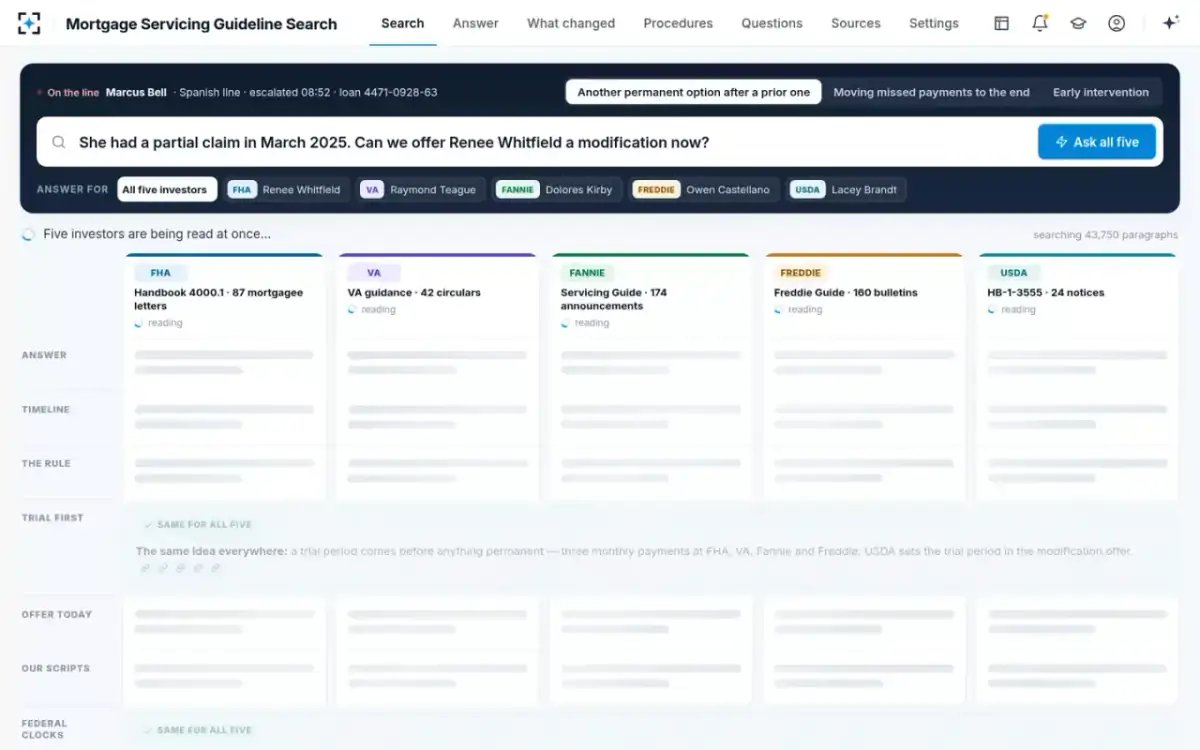
How to implement AI in a servicing call center
Start with last month’s questions, not with the floor. Replaying questions your team has already answered shows, on your own rules and scripts, where the tool agrees with your leads, where it finds something they missed, and where it says no passage answers. Only then put cited answers in front of one team, with a lead approving each before it reaches the shared library, and widen from there.
A rollout that starts from your own questions
- Load procedures, scripts and sources2 wk
- Replay last month’s questions2 wk
- One team, lead-approved answers2 wk
- Whole floor and nightly script check2 wk
Two measures decide whether to widen. Agreement on the replay: for each question, did the cited answer match what an experienced lead would say, and where it did not, who was right? And honesty: did the tool say "no passage found" when the sources were silent, rather than writing a fluent answer? A cost model for the business case, priced with your own minutes, is in what one servicing answer costs.
Build it on a general AI model, or buy it?
A servicer with an engineering team can put a general language model over its document store in weeks, and for a single investor with stable rules that may be enough. The difficulty arrives with the second investor and the first rule change. Retrieval over a pile of PDFs ranks passages by how well they match the question, not by whether they were in force on the date asked, so ML 2025-06 and ML 2025-12 come back side by side and the model chooses between them on wording. The fix is not a better model; it is the version chain, and the version chain is curation work that never ends.
Weigh four things before deciding. Who will load every new letter, bulletin and announcement on the day it appears and link it to what it replaces? Who will map each of your procedures and scripts, in each language, to the passages they restate? How will you prove to an examiner that an answer from last year used the rule in force last year? And who reviews the tool itself: the April 2026 interagency model risk guidance leaves generative and agentic AI outside its scope, so the controls are yours to design. If the answers are "a team we already have", building is reasonable. If they are "we will figure it out", the cost is in the upkeep, not the build.
AI in mortgage servicing: build on a general model, or buy a servicing-specific tool
| Question | Build on a general model | Buy a servicing-specific tool |
|---|---|---|
| First answers on your documents | Fast, often within weeks | Fast once sources and procedures are loaded |
| Rule changes and superseded text | Your team links versions by hand, or the model guesses | Version chains and effective dates kept for each passage |
| Five investors side by side | Separate prompts and indexes to maintain | Built in, with the loan’s own investor shown alone |
| Your scripts checked against the rules | A separate project | Nightly, with drafted redlines |
| Evidence for an examiner | Whatever you log | Each answer with citations, dates and approver |
| Who carries the upkeep | Your engineers and policy team, indefinitely | Shared: the vendor reads publications, your people approve |
What getting the versions wrong costs
Every read of an out-of-date copy is a chance to tell a borrower something the investor does not allow. In the solution’s fictional sample month, the two documents still quoting FHA’s replaced 18-month limit, a Spanish call script and a borrower FAQ, were read or viewed about 3,550 times. A third, a VA procedure, had no step for the VA Partial Claim, which servicers must be able to offer from late November 2026; a fourth still listed an FHA option that ended on 30 September 2025.
None of those errors is in the investor’s text. All of them sit in the servicer’s copies, which is why an AI project that only indexes the investor guides solves half the problem. Reading the servicer’s own documents against the rules, every night and in every language, is the half that keeps the floor’s answers and the investor’s rules the same.
What do regulators say about AI in mortgage servicing?
Nothing specific to servicing; general rules apply. We found no CFPB, HUD, VA, Ginnie Mae or FHFA statement aimed at AI in loss mitigation or guideline search. FHFA’s advisory bulletin on AI for Fannie Mae and Freddie Mac, revised in May 2025, "encourages the responsible innovation and use of AI/ML that is consistent with the safe and sound operations of the Enterprises" (FHFA AB 2022-02); it binds the Enterprises, not servicers, but shows what the investor side expects.
For nonbank servicers, the state examiner is the regulator most likely to ask. The CSBS framework released in September 2026 says institutions "can use the framework to assess their own AI programs, establish sound AI governance and risk management, and prepare for examinations" (CSBS, 2026). And responsibility does not move with the tool: interagency guidance says the use of third parties "does not diminish or remove banking organizations’ responsibilities" to act in compliance with law (interagency guidance, 2023). How Regulation X’s policies-and-procedures rule applies to an agent is covered in Regulation X 1024.38 and AI agents.
Questions to ask any vendor of AI for mortgage servicing
- Whose text does an answer rest on?
The investor’s own paragraph, cited, or the vendor’s summary of it?
- How are effective dates handled?
Ask for an answer about a date before ML 2025-12 took effect and one after.
- What happens to drafts and superseded text?
Kept and labelled, never used as the rule; shown beside what replaced them.
- Does it read our procedures and scripts?
In every language we use, and does it say which investor passage each one restates?
- What does it read from our servicing system, and can it write?
It should read the loan and never change it.
- Who approves what reaches the floor?
A named lead for answers; a writer and compliance for script changes.
- What does it say when the sources are silent?
That no passage answers, plainly.
- How long are questions, answers and approvals kept?
At least Regulation X’s one year after payoff or transfer; investors may ask for more.
What Mortgage Servicing Guideline Search reads, and what it leaves to you
It fits the reading: the guides, letters, rules and procedures a servicer already has, read together for the loan in question, with the versions kept straight and the servicer’s scripts checked every night. It reads the loan behind the question from the servicing system and never writes to it. It is not a borrower chatbot, a loss mitigation decision engine or a replacement for the investor’s own publications, and it does not decide eligibility. Its answers are only as complete as the sources loaded; when they are silent, it says so. The rulebooks themselves, eight of them for a typical mixed book, are mapped in mortgage servicing guidelines: the eight rulebooks.
Questions people ask
What is AI used for in loan servicing?
Borrower chat, investor-required automated loss mitigation reviews, and reading documents for staff. Treasury’s 2024 report lists customer service and back-office work such as "advanced document searches" among current uses; the CFPB notes that investors require some automated reviews.
Can AI read the Fannie Mae and Freddie Mac servicing guides?
Yes, the guides are published text and can be read like HUD’s letters. The care needed is the same: tie each passage to its announcement or bulletin and the date it took effect, and answer from the guide in force, not from a summary.
How long does it take to implement AI in a servicing call center?
We plan about eight weeks from loading procedures to the whole floor, with a replay of last month’s questions before any representative sees an answer. The pace depends on how many procedures and languages are loaded and how fast leads review the replay.
Do regulators allow AI in mortgage servicing?
No rule forbids it, and no servicing regulator has endorsed it. Existing law applies to the answer, and the servicer remains responsible for it; for state-licensed nonbanks, CSBS published an AI supervisory framework in September 2026 that examiners may use.
What does an AI tool need from our servicing system?
Read-only access to the loan: investor, days delinquent, prior workouts with their dates, state and the borrower’s language. With that, an answer can be for this loan rather than for loans in general.