A mortgage servicing call center is where investor rules meet the borrower. Under Regulation X the representative who takes a delinquent borrower’s call must give accurate information about the options the loan’s owner allows, and the servicer must keep each owner’s options and criteria readily accessible to that person. On a floor that services FHA, VA, USDA, Fannie Mae and Freddie Mac loans, that means five rulebooks, a stream of letters and bulletins, and the servicer’s own scripts, all in play on one call. Botminds’ Mortgage Servicing Guideline Search answers a representative’s question for all five investors at once, each sentence citing the paragraph it rests on. This page sets out how the call center divides the work once agents do the lookup: who answers, who checks, who escalates.
The pressure is rising. Delinquent loans take more people and more judgment than performing ones, and the FHA book, where the rules have moved most, is where delinquency is highest.
A busier floor, and every delinquent call carries a clock
11.79%
of FHA loans delinquent at the end of June 2026
All loans: 4.37%
$1,573
to service a non-performing loan in 2024, against $176 for a performing one
Fully loaded, per loan
Day 36
by which Regulation X expects live contact with a delinquent borrower
Written notice by day 45
What does a mortgage servicing call center do under Regulation X?
It keeps borrowers informed, on a federal timetable, about what the owner of their loan will and will not do. For a delinquent borrower, Regulation X expects the servicer to make good faith efforts at live contact by the 36th day of delinquency and, promptly after reaching the borrower, to tell them about loss mitigation options where appropriate (12 CFR 1024.39(a)). A written early intervention notice follows by day 45. By the same day the servicer must have assigned personnel who can be reached by telephone and who stay with the borrower until two consecutive payments under a permanent agreement are made (12 CFR 1024.40(a)).
What those people must say is written down too. Section 1024.40(b) lists it: accurate information about the loss mitigation options available from the owner or assignee of the loan, the actions the borrower must take to be evaluated, the status of any application, the circumstances under which the servicer may refer the loan to foreclosure, and "applicable loss mitigation deadlines established by an owner or assignee of the borrower’s mortgage loan or § 1024.41". Every item on that list depends on whose loan it is.
Around the delinquent borrower sits the rest of the floor’s work: payment questions, escrow, payoff requests, requests for information, which Regulation X requires a servicer to answer with "accurate and timely information and documents" (12 CFR 1024.38(b)(1)(iii)), and the complaints that turn into notices of error. The investor-rule questions are a minority of calls but carry most of the risk, because they are the ones a borrower acts on.
Why investor rules land on the person who answers the phone
Because the regulation puts them there. The official interpretation of 1024.38 requires policies and procedures that identify, "with respect to each owner or assignee, all of the loss mitigation options that the servicer may consider ... and the criteria that should be applied", and that make that information "readily accessible to the servicer personnel involved with loss mitigation, including personnel made available to the borrower as described in § 1024.40" (comment 38(b)(2)(ii)-1). The rule does not say the representative must memorise five guides. It says the servicer must put the right one within reach.
That personnel can be a team. The commentary gives the servicer discretion "to assign a single person or a team of personnel to respond to a delinquent borrower", and allows them to be single-purpose or multi-purpose staff (comment 40(a)-2). So "single point of contact" in a modern call center is usually a team with a shared answer, and the shared answer is what has to be right.
The work also gets heavier as loans go bad. The Financial Stability Oversight Council puts it plainly: "servicing delinquent loans is more labor-intensive than servicing performing loans and requires additional personnel with expertise in addressing such loans" (FSOC, 2024). MBA’s cost study counts the difference: $176 a year to service a performing loan, $1,573 a non-performing one, with collections and loss mitigation among the extra costs (MBA, 2025).
Where wrong answers come from: what examiners heard on the phone
Examiners have described the failure in detail, and it is rarely a representative who does not care. In its COVID-19 review the CFPB found that "customer service representatives provided inaccurate information regarding forbearances, including the available period for CARES Act forbearances and the interest accrued or amounts owed", and that some borrowers were told a lump sum would be due at the end of forbearance "when in fact that was not correct" (Supervisory Highlights, Winter 2021). The same report names the cause: "In many cases, staffing shortages or inaccurate training materials led to these issues."
The 2024 servicing edition found the opposite error in writing. Servicers sent notices telling borrowers they were approved for a loss mitigation option before anyone had decided they were eligible, and examiners called it deceptive: "Consumers reasonably interpreted the representations to mean that the loss mitigation option was available to them" (Supervisory Highlights, Issue 33). The same edition found servicers that "failed to make good faith efforts to establish live contact with hundreds of delinquent borrowers".
Read together, the findings describe one weakness: the answer depends on a rule that changed, the rule lives in a document the person on the call cannot search in time, and the script that should carry it has not caught up. The walk-through of one question on hold for twelve minutes shows how that plays out on a single call.
The rule never asked a representative to remember five guides. It asked the servicer to put the right paragraph within their reach, while the borrower is still on the line.
Who answers, who checks, who escalates once agents do the lookup
The representative still answers, the team lead still decides what the floor says, and compliance still owns the scripts; what moves is the search. In the model Mortgage Servicing Guideline Search is built for, agents read the question and the loan, search every guide, letter, rule and procedure, keep only the passages in effect, and draft a cited answer. People keep the three jobs the regulation and the investors hold them to. The figure follows the solution’s fictional sample servicer, Bayfield, and the five people one escalated call touches.
Five roles on the Mortgage Servicing Guideline Search floor: what moves, what stays
Today
Holds the borrower while four guides, a portal and a team chat are open, or escalates.
With agents
Gets the answer for this loan, its dates and the words to say, in the borrower’s language.
Still theirs: The conversation, and what is promised on it
Today
Fields the floor’s escalations and re-reads long letters every time a rule moves.
With agents
Reads a cited draft, sends it and approves it into the shared library for the next call.
Still theirs: What the floor is allowed to say
Today
Finds the script that contradicts the current letter at the investor review.
With agents
Gets each overnight conflict with a drafted redline to approve.
Still theirs: Approval of every script change
Today
Learns a rule changed, then hunts for the scripts it touches.
With agents
Gets the change with the teams and scripts it touches, and the smallest redline drafted.
Still theirs: The wording of procedures and scripts
Today
Hears about inconsistent answers from complaints and QC samples.
With agents
Sees what the floor asks, how fast, and which team or language needs training.
Still theirs: The operating model and its measures
The division of labour is deliberate. A drafted answer is not a determination of eligibility, which is why the representative’s words come from a reviewed answer and never from the agents directly: the CFPB’s deceptive-notice finding is about exactly that line. And a script change needs two people, a writer and compliance, because a script is read thousands of times. In the sample month, one out-of-date Spanish retention script was read about 1,240 times.
Who answers, who checks, who escalates: before and after
| Step | Typical floor today | With agents doing the lookup |
|---|---|---|
| Identify the investor and loan history | Representative, from the servicing system, by hand | Agents read the loan: investor, days delinquent, prior workouts, state, language |
| Find the current rule | Representative or lead, across PDFs, portals and chat | Agents search every source and set drafts and superseded passages aside |
| Check our own script | Rarely, on the call | Agents compare the answer with the script and flag a conflict |
| Decide what the floor says | Lead, from memory or a fresh read | Lead, from a cited draft; approved answers go to a shared library |
| Speak to the borrower | Representative | Representative, with the dates for this loan and approved wording |
| Fix the script | Found later, at QC or investor review | Drafted overnight; writer edits, compliance approves |
When should a servicing rep escalate a question?
When there is no approved answer for this investor and this situation, when the loan’s investor or history is unclear, or when the answer would commit the servicer to an option. Escalation exists to keep a guess off the phone, not to route every question to a lead. In the solution, a question with no approved answer goes to a team lead after a set time, 60 seconds by default and adjustable from 15 seconds to 5 minutes.
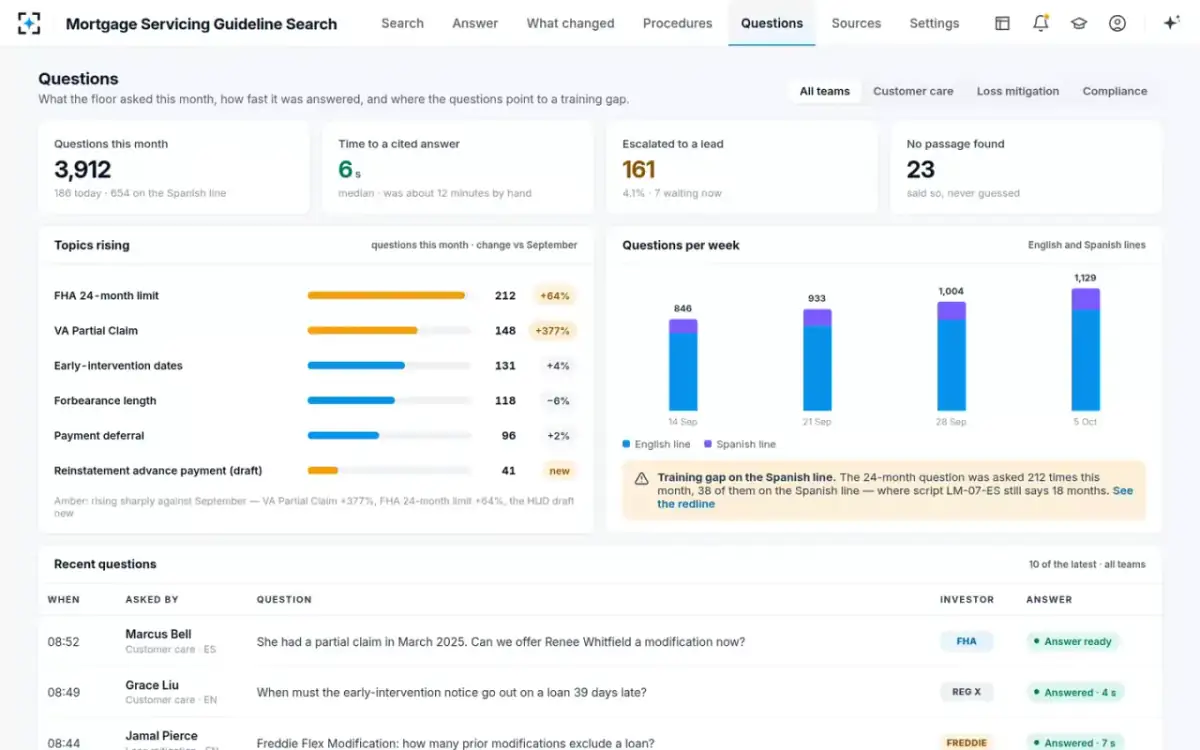
The rate of escalation is a measure of the library, not of the representatives. In the sample month the floor asked 3,912 questions and 161 went to a lead, 4.1%. Twenty-three found no passage at all, and the answer said so instead of guessing. A rising escalation rate on one topic usually means a rule has moved and the approved answer has not; a rising rate on one team or language usually means training has fallen behind.
What the floor asked in Mortgage Servicing Guideline Search, and where training is short
What training do mortgage servicing reps need now?
Less memorising of thresholds, more reading of a cited answer and knowing what it does not permit them to say. A representative who used to need the FHA waterfall in their head now needs to recognise which investor owns the loan, read a dated answer, tell a temporary option from a permanent one, and stop short of promising an outcome. Training content can follow the questions the floor actually asks: in the sample month, the VA Partial Claim questions rose sharply and the FHA 24-month limit was the most asked topic.
The same shift changes how a floor is checked. A strong representative today reads a regulation, asks which investor owns the loan before answering, and is comfortable saying "I will confirm that". The questions below are ones a QA reviewer or team lead can use in call calibration and certification, and each tests a habit the model depends on.
Call-calibration questions that test what the floor now needs
- A borrower asks if she can get another modification. What do you need to know first?
Listen for the investor, the date of the last permanent option and how long she has been delinquent.
- What is the difference between a repayment plan and a modification?
Temporary against permanent: FHA’s 24-month limit applies only to permanent options.
- The script says one thing and the team lead says another. What do you say to the borrower?
Nothing final until it is resolved; then flag the script.
- What must happen by day 36 and day 45 of a delinquency?
Live contact efforts, then the written early intervention notice and assigned personnel.
- When would you tell a borrower they are approved?
Only when a determination has been made and sent; the CFPB found early “approval” deceptive.
- How do you know a rule you learned last year is still current?
Listen for effective dates and later letters, not for the guide’s title.
Will AI replace mortgage servicing call centers?
Not under the rules as written. Regulation X requires personnel available to a delinquent borrower by telephone, and a live response in a timely manner when the borrower cannot reach them (12 CFR 1024.40(a)(2)–(3)). The CFPB’s 2023 review of chatbots warned that "there is little to no consumer choice in the case of selecting a mortgage servicer", so a borrower stuck with a bot cannot take their loan elsewhere (CFPB, Chatbots in consumer finance). The difference between a borrower-facing bot and a cited answer for staff is the subject of chatbot or servicing agent.
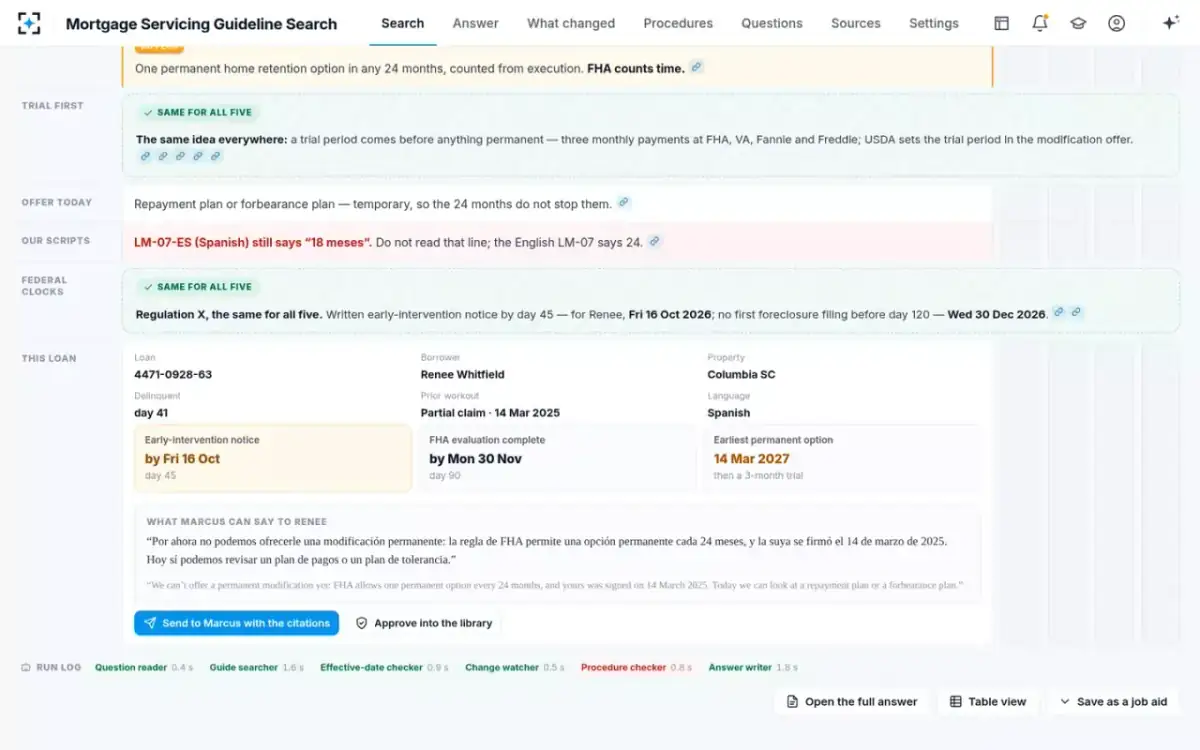
What AI can take is the search. In the sample, one escalated question took our estimated twelve minutes by hand and six seconds for a cited answer across five investors, leaving the representative’s and the lead’s time for the borrower and the decision. The headcount question is one each servicer answers for itself; BLS counts 164,790 loan interviewers and clerks nationally, without separating servicing roles (BLS OEWS, May 2025).
The representative gets the dates and the words; the lead sends and approves
What should a servicing call center measure once agents do the lookup?
Measure consistency and currency, not only speed. Average handle time will fall when the search moves to agents, but the measures that matter to an examiner and an investor are whether two representatives give the same borrower the same answer and whether that answer used the rule in effect. A floor can track both directly once each answer carries its citations and effective dates.
Measures for a mortgage servicing call center that answers from cited rules
| Measure | Why it matters | Sample month |
|---|---|---|
| Time to a cited answer | Hold time and abandoned calls | Median 6 s |
| Share escalated to a lead | Library coverage; spikes mark a moved rule | 161 of 3,912 (4.1%) |
| Questions with no passage found | Gaps in the sources, said rather than guessed | 23 |
| Scripts out of date after a change | Exposure on every call that reads them | 4 of 342 documents |
| Reads of out-of-date text | The size of that exposure | About 3,550 in the month |
| Topic and language trends | Where training is short | FHA 24-month question: 212, 38 on the Spanish line |
The measures meet the regulation at one more point. Each answer, citation, approval and script change is kept with who did it and when, which is what an examiner asks to see when a borrower says they were told something different. How the policies-and-procedures rule frames the agents’ authority is set out in Regulation X 1024.38 and the AI agent.
Questions people ask
What does a mortgage servicing call center do?
It answers borrowers about payments, escrow, payoffs and problems, and for delinquent borrowers it carries the Regulation X duties: live contact efforts by day 36, an early intervention notice by day 45, and assigned personnel who give accurate information about the owner’s loss mitigation options. Most of its risk sits in those investor-specific answers.
What is a single point of contact in mortgage servicing?
Regulation X calls it continuity of contact: personnel assigned to a delinquent borrower by day 45, reachable by phone, until two payments under a permanent agreement are made. The commentary lets the servicer assign "a single person or a team of personnel", so the contact can be a team that shares one answer.
Do servicing reps need to know every investor’s rules?
They need access, not memory. The official interpretation of 12 CFR 1024.38 requires each owner’s options and criteria to be "readily accessible" to the personnel who talk to borrowers. Searching five guides by hand during a call is the gap that requirement exposes.
Why do two reps give a borrower different answers?
Usually because they read different versions of the rule: one the current letter, one an older script or training deck. The CFPB’s 2021 review traced inaccurate answers on forbearance to "staffing shortages or inaccurate training materials", and servicers responded by updating scripts.
How many questions should go to a team lead?
There is no regulatory benchmark. In the solution’s sample month 4.1% of 3,912 questions were escalated; the useful signal is the trend by topic and language, because a spike usually marks a rule that moved before the approved answer did.