Most mortgage servicing questions take seconds: a payment date, a payoff figure, an escrow line. The ones that take minutes are questions about an investor’s rule, and the hardest of those is the one a delinquent borrower asks after a second hardship: can I have another modification? Answering it means knowing who insures the loan, what workout came before and when, which version of the investor’s rule is in force today, and whether the servicer’s own script agrees. This case follows one such question on a fictional servicer’s Spanish-language line, first answered by hand and then with Botminds’ Mortgage Servicing Guideline Search, which answers for all five investors at once and cites every sentence. The people, servicer, borrower and loan are invented; the rules are real.
One escalated question’s minutes, by hand and with Mortgage Servicing Guideline Search
- Loan1
- Finding the topic in the guide4
- Later letters and drafts3
- Our own script2
- Write-up2
- Agents + lead1.4
08:52: the question on the Spanish line
Monday 12 October 2026. Marcus Bell, a customer care representative on the Spanish line, has Renee Whitfield on the phone. Her hours were cut in August; she missed the September and October payments and is 41 days delinquent, with $3,496.28 in arrears. Her loan is FHA-insured, and in March 2025 she received a partial claim. She asks whether the servicer can offer her a modification now. Marcus does not know, and the clock is already running on her: Regulation X expects live contact efforts by day 36 and the written early intervention notice by day 45 (12 CFR 1024.39). For Renee, day 45 is Friday 16 October.
The question is ordinary. In the solution’s sample month, the FHA limit on permanent options was the most asked topic on the floor, 212 times, 38 of them on the Spanish line. What makes it hard is that its answer changed in 2025, twice on paper and once in force.
How long does one mortgage servicing question take to answer by hand?
About twelve minutes for an escalated question like this one, on our estimate, and most of it is finding and confirming rather than judging. No regulator or industry body publishes a benchmark, so the split in the figure above is ours, built from the steps the question forces. The minutes below follow those steps as they would go on a floor that answers from PDFs, a guide portal, a team chat and a lead.
Minutes 1 to 5: the investor, the loan and the first document found
Minute 1. Marcus puts Renee on hold and opens the servicing system: FHA, delinquent since 1 September, partial claim signed on 14 March 2025. He now knows whose rule applies and the date that matters.
Minutes 2 to 5. He searches for FHA’s rule on how often a borrower can receive a permanent option. The first substantial document he finds is a 2025 HUD mortgagee letter that rewrote FHA servicing and loss mitigation: ML 2025-06, dated 16 January 2025, which limits borrowers to one permanent option in 18 months (HUD, ML 2025-06). Eighteen months from March 2025 is September 2026. On that reading, Renee is eligible to be evaluated today.
That reading is wrong, and nothing in the document says so. ML 2025-06 is a genuine HUD letter, still online, with an effective date of 2 February 2026 printed on its first page. It never took effect.
Minutes 6 to 10: the later letter, and the script that disagrees
Minutes 6 to 8. Marcus checks for later letters. HUD’s index of mortgagee letters for 2025 does not list either servicing letter, because both sit in a separate list of letters the handbook has superseded (HUD mortgagee letters). A message in the team chat from last year says "it’s 24 months now". He finds ML 2025-12, dated 15 April 2025, which replaced ML 2025-06 before it ever applied and set one permanent option every 24 months from 1 October 2025 (HUD, ML 2025-12). Twenty-four months from March 2025 is March 2027.
Minutes 9 and 10. He opens the servicer’s Spanish retention script, LM-07-ES, the words he is supposed to read. It says a borrower can receive another permanent option after "18 meses". The English version of the same script says 24. Two documents of his own employer now disagree, and the borrower has been on hold for ten minutes.
One question, three documents, two numbers
18months
in ML 2025-06 and the Spanish script
A letter that never took effect
24months
in ML 2025-12, in force since 1 October 2025
The rule
14 Mar 2027
earliest permanent option for a partial claim received 14 March 2025
Minutes 11 and 12: the escalation
Marcus escalates to Priya Raman, the loss mitigation team lead. She confirms 24 months from her own reading, tells him not to use the Spanish script’s line, and writes two sentences he can say. Twelve minutes after the question, Renee hears that a permanent modification is not available before March 2027, but that a repayment plan or a forbearance plan can be reviewed now, because FHA’s 24-month limit applies only to permanent options.
The answer was right, and it cost twelve minutes of a borrower’s time, ten of a representative’s and two of a lead’s. It left nothing behind: the next representative with the same question starts from the same search, and the Spanish script still says 18.
Why do servicing reps give different answers?
Because they read different copies of the rule. On the same morning, a colleague of Marcus’s on another Spanish call reads LM-07-ES as written. Two representatives, the same rule, two answers, and the borrower who gets the first one is told something the investor does not allow. The CFPB found the same pattern across servicers in its pandemic review, on forbearance rather than modifications, and the fixes it reported were to scripts and training, not to the rules (CFPB, Supervisory Highlights, Winter 2021).
Two answers to the same borrower question, the same morning
Read from the Spanish script: “Solo puede recibir otra opción permanente después de 18 meses, contados desde la fecha en que se firmó la anterior.”
Read from the rule in force: “Por ahora no podemos ofrecerle una modificación permanente: la regla de FHA permite una opción permanente cada 24 meses.”
Read from the Spanish script: You can only receive another permanent option after 18 months, counted from the date the last one was signed.
Read from the rule in force: We can’t offer a permanent modification yet: FHA allows one permanent option every 24 months.
Read from the Spanish script: March 2025 plus 18 months is September 2026: she can be reviewed now.
Read from the rule in force: Not before March 2027 for a permanent option.
Read from the Spanish script: A modification review the borrower cannot receive
Read from the rule in force: A repayment plan or a forbearance plan, reviewed now
Read from the Spanish script: ML 2025-06, never in force
Read from the rule in force: ML 2025-12, in force since 1 October 2025
Read from the Spanish script: A hope that ends in a denial, and likely a complaint
Read from the rule in force: A temporary option now; a permanent one from March 2027
What happens when a servicing rep gives wrong information?
The borrower acts on it, and the servicer pays to undo it. A borrower told she is eligible may stop looking at the temporary options that would have helped now, and when the denial comes she has lost weeks of a delinquency that is still growing. Regulation X’s foreclosure clock does not wait: a first filing is barred only until the loan is more than 120 days delinquent (12 CFR 1024.41(f)), which for Renee falls at the end of December.
In writing, the same mistake has a name. Examiners found servicers sending notices that told borrowers they were approved for a loss mitigation option before eligibility had been decided, and called the practice deceptive. In the same report, notices wrongly telling current borrowers they had missed payments were deceptive too, because they "were likely to influence consumers’ course of conduct" (CFPB, Supervisory Highlights, Issue 33). A representative reading an out-of-date script is the spoken version of that notice.
The same call, replayed: 08:52 to 08:53
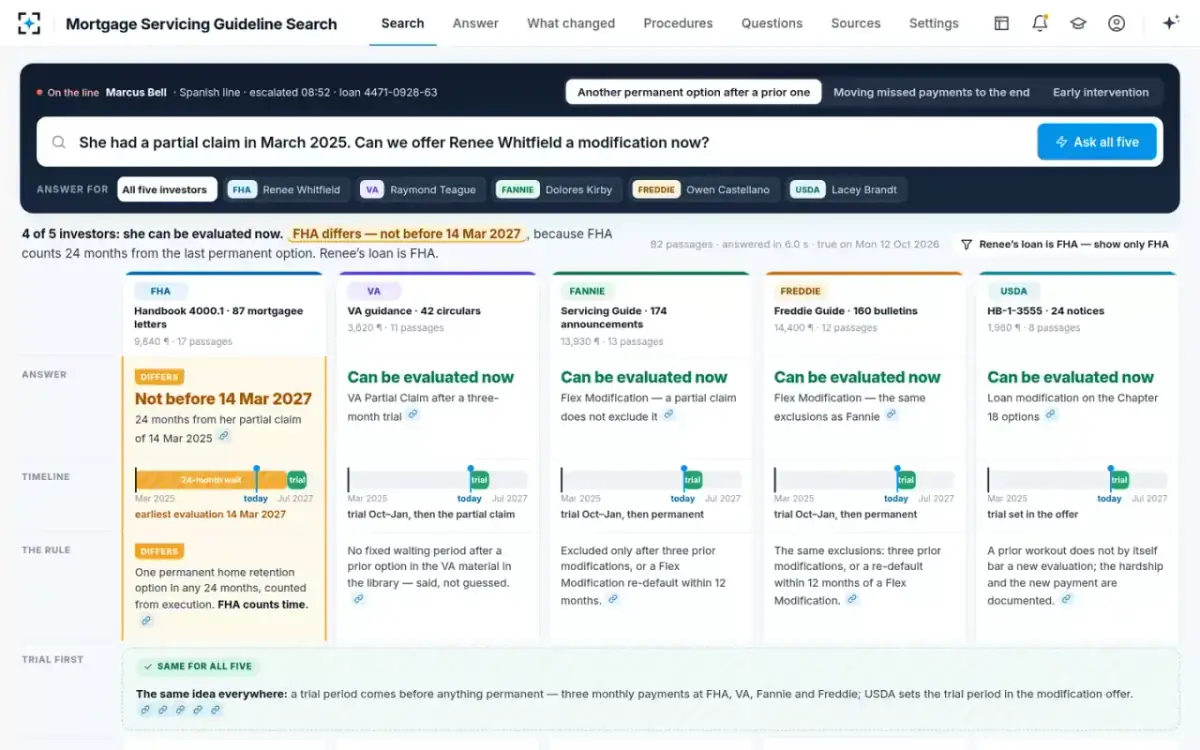
At 08:52 the question lands in Priya’s question box with Renee’s loan attached. She presses Ask all five. The question goes to FHA, VA, Fannie Mae, Freddie Mac and USDA together, each column reading its own guide and letters, and six seconds later the verdict reads across the top: four of five investors could evaluate her now; FHA differs, not before 14 March 2027, because it counts 24 months from the last permanent option.
Six seconds in Mortgage Servicing Guideline Search: five investors answered, the one that differs in amber
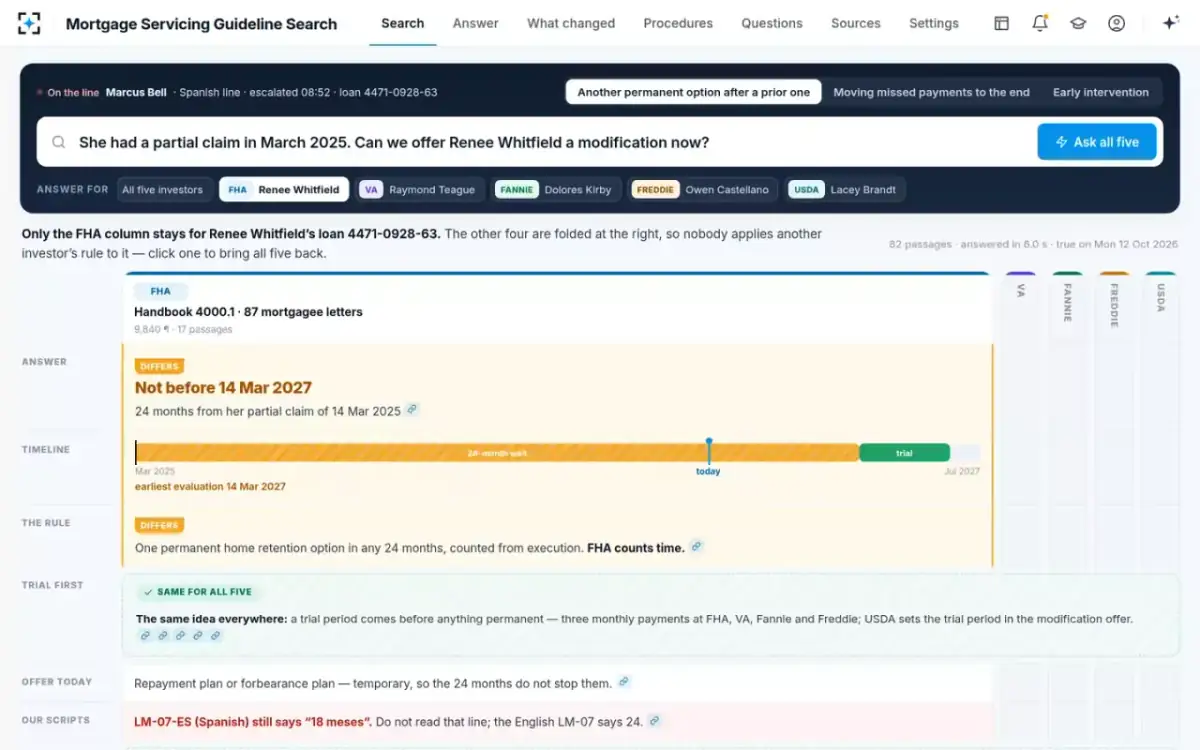
Priya picks Renee’s loan. The other four columns fold away so nobody applies another investor’s rule to it, and the FHA column widens: one permanent home retention option in any 24 months; a repayment or forbearance plan is still possible today; and the Spanish script LM-07-ES still says "18 meses", with a note not to read that line.
Her loan is FHA, so only FHA stays, with the script that disagrees
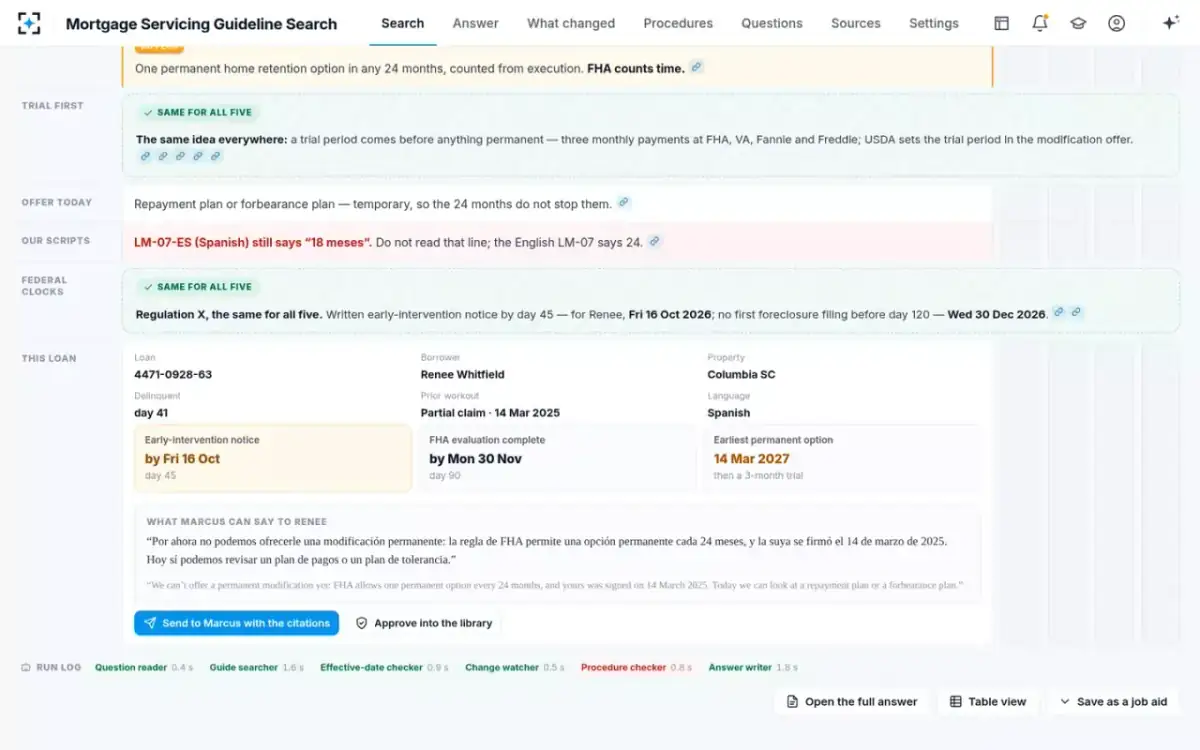
Under the column sit Renee’s three dates, the early intervention notice by Friday 16 October, the earliest permanent option on 14 March 2027 and the federal limit on a first foreclosure filing, and the words Marcus can say, in Spanish. At 08:53 Priya sends it to Marcus with seven citations and approves it into the shared library, so the next representative who meets the question gets the same answer without escalating.
Her dates and her wording, sent with the citations
How to answer a modification eligibility question
In the same order every time, and without promising an outcome. The order below is the one the case followed, by hand and with the solution; the difference is who does the searching. A floor that teaches it as a habit gives fewer different answers whatever tools it uses, and the roles behind it are set out in who answers, who checks, who escalates.
Answering “can I get another modification?” in six steps
- Identify the investor
FHA, VA, USDA, Fannie Mae or Freddie Mac; the rule differs by owner and insurer.
- Find the last permanent workout and its date
The date the prior option was received sets the clock for FHA’s 24 months.
- Use the rule in force today
Check for later letters; ML 2025-06’s 18 months never applied.
- Separate temporary from permanent
Repayment and forbearance plans are not limited by FHA’s 24-month rule.
- Check your own script before reading it
If it disagrees with the rule, do not read it; flag it.
- Say what can be done, not what will be approved
Eligibility is decided in the evaluation, not on the call.
How to escalate an investor question
Escalate when the investor or the loan’s history is unclear, when no approved answer exists for this investor and situation, or when the honest answer is "I am not sure which rule applies". Escalate with the loan attached and the question in the borrower’s words, so the lead answers this loan rather than loans in general. In the solution, a question with no approved answer goes to a team lead after 60 seconds by default, and 161 of 3,912 questions in the sample month, 4.1%, were escalated.
The escalation is also the moment to fix the cause. In this case the cause was a Spanish script carrying a number that was replaced in April 2025. How that number moved from HUD’s letters into, and out of, the servicer’s documents is traced in FHA ML 2025-12 explained.
After the call: the script, the floor and the month
That night the procedure checker read the servicer’s 342 procedures, scripts, FAQs and letters against the current rules and found four out of date. LM-07-ES, read about 1,240 times a month, came back with a drafted redline from "18 meses" to "24 meses" for Tasha Greene, the procedure writer, to make and Elena Duarte in servicing compliance to approve. The borrower FAQ that also said 18 months, viewed 2,310 times in the month, came back with it.
The month’s numbers show what one question becomes at scale. The floor asked 3,912 questions, with a median of six seconds to a cited answer; 23 found no passage and said so rather than guessing. The FHA 24-month question was asked 212 times, and the 38 times it came from the Spanish line point to where training, and the script, had fallen behind.
Questions people ask
Can an FHA borrower get another modification after a partial claim?
Not within 24 months of the last permanent home retention option, under ML 2025-12, in force since 1 October 2025. A borrower whose partial claim was signed in March 2025 can be reviewed for a repayment or forbearance plan now and for a permanent option from March 2027.
Why did our script say 18 months?
Because it followed ML 2025-06, which set 18 months but was replaced by ML 2025-12 on 15 April 2025, before its own effective date. Any script or FAQ revised from ML 2025-06 carries a number that never applied.
How long should a borrower wait on hold for an investor question?
There is no regulatory limit on hold time, but Regulation X expects assigned personnel to give a live response in a timely manner. In the solution a question with no approved answer reaches a team lead after 60 seconds by default.
What are common mortgage servicing questions borrowers ask?
Payment dates, payoffs and escrow changes come up most, and they are quick. The slow ones are about workouts: whether a borrower can get help again, what the trial period is, and what happens to missed payments, because each depends on the investor’s rule in force.
What should a rep do if two documents disagree?
Stop, say nothing final, and escalate with both documents. Then flag the one that is out of date so it is corrected; the CFPB has found inaccurate training materials and scripts behind wrong answers on servicing lines.