FHA ML 2025-12 is the HUD mortgagee letter of 15 April 2025 that "updates and replaces ML 2025-06", the January 2025 letter that had rewritten FHA servicing, loss mitigation and claims. It made three changes a servicing floor feels directly: borrowers are limited to one permanent loss mitigation option every 24 months rather than every 18, the new permanent options took effect on 1 October 2025 instead of 2 February 2026, and "certain language access provisions" were removed (HUD, ML 2025-12). Because the replacement came before the original’s effective date, ML 2025-06 never governed a single evaluation. Botminds’ Mortgage Servicing Guideline Search treats exactly this case as the norm: each passage keeps its version chain and effective date, so an answer uses the rule in force on the date asked, not the newest document or the first one found.
Two letters, one rule in force: FHA ML 2025-06 and ML 2025-12, January 2025 to October 2026
- Issued 16 Jan 2025, waiting for 2 Feb 202612.5 mo
- Would have applied: one option in 18 monthsreplaced
- Before ML 2025-123 mo
- ML 2025-12 issued, not yet in force5.5 mo
- ML 2025-12 in force: one option in 24 months12.3 mo
What did ML 2025-12 change?
It kept ML 2025-06’s new permanent loss mitigation structure, tightened it and brought it forward. The letter’s summary of changes lists the additions it carries over, among them Early Default Intervention Tools, Repayment Plans, Permanent Home Retention Options, a Borrower Affordability Attestation, Partial Claims, Loan Modifications and an Outside of the Waterfall Loan Modification. It then marks its own changes: borrower qualifications, the permanent options, the attestation and the outside-the-waterfall modification are all updated "to one in 24 months instead of one in 18 months" (ML 2025-12, Summary of Changes).
Some of what servicers notice most came with the structure rather than the tightening. The borrower "is not required to provide financial documentation to be evaluated for a Loss Mitigation Option", and the mortgagee "must not use any financial documentation about the Borrower to disqualify the Borrower" other than the required hardship documentation. The waterfall became eight questions asked in order, from a repayment plan to the home disposition options, with the 24-month test as question 3.
ML 2025-12 in four dates
15 Apr 2025
issued, replacing ML 2025-06
30 Sep 2025
COVID-19 Recovery Options, FHA-HAMP and the standard PFS and DIL expire
1 Oct 2025
remaining provisions effective
2 Feb 2026
ML 2025-06’s effective date, never reached
Was ML 2025-06 replaced?
Yes, in full. ML 2025-12’s purpose statement says it "updates and replaces ML 2025-06, Updates to Servicing, Loss Mitigation, and Claims" and "reestablishes FHA’s requirements for the servicing of FHA-insured Mortgages, including those in Default, and the filing of associated claims". There is no period in which ML 2025-06’s text was the rule: it was issued on 16 January 2025 with an effective date of 2 February 2026, and replaced on 15 April 2025.
That makes ML 2025-06 a trap for anyone searching by document. It is a real HUD letter, still online, with the same structure and much of the same text as its replacement, and it says 18 months. A search that ranks passages by relevance alone will return it; a person skimming will believe it. HUD’s mortgagee letter index adds to the confusion: letters it treats as superseded by the handbook are listed separately, so neither 2025-06 nor 2025-12 appears in the 2025 list a reader first sees (HUD mortgagee letters).
FHA ML 2025-06 against ML 2025-12, line by line where it matters
ML 2025-06, as published: 16 January 2025
ML 2025-12, the rule: 15 April 2025
ML 2025-06, as published: 2 February 2026
ML 2025-12, the rule: 1 October 2025 for the remaining provisions
ML 2025-06, as published: One in 18 months
ML 2025-12, the rule: One in 24 months
ML 2025-06, as published: Extended through 1 February 2026
ML 2025-12, the rule: Extended through and expired on 30 September 2025
ML 2025-06, as published: Summary of changes opens with “adds Language Accessibility”
ML 2025-12, the rule: “Certain language access provisions” removed as “unnecessarily burdensome”
ML 2025-06, as published: Superseded; never applied
ML 2025-12, the rule: In force, with later letters to check
When did ML 2025-12 take effect?
On 1 October 2025, with transition dates on either side. FHA-HAMP and the then-published standard pre-foreclosure sale and deed-in-lieu stayed suspended through 30 September 2025, "except for non-borrowers who acquired title through an exempted transfer", and expired that day. The COVID-19 Recovery Loss Mitigation Options were "extended through and will expire on September 30, 2025". Then: "The remaining provisions of this ML are now effective on October 1, 2025."
For a servicer, the effective date governs evaluations, not conversations. A borrower evaluated on 29 September 2025 could still be offered a COVID-19 Recovery Option; one evaluated on 2 October could not. A script or FAQ that mentions those options after 30 September is wrong whatever it says about them, which is why, in the solution’s fictional sample, a forbearance procedure that still listed an FHA option ending on 30 September 2025 was flagged out of date a year later.
The ML 2025-12 waterfall, in order
Eight questions, asked in sequence, each either leading to an option to review or passing to the next. The 24-month limit is question 3, which means it never blocks the two temporary options before it. A servicer explaining ML 2025-12 to its floor needs the order more than the detail, because the order is what tells a representative what can still be offered to a borrower who had a workout last year.
FHA loss mitigation waterfall under ML 2025-12: the eight questions
| # | Question | If yes |
|---|---|---|
| 1 | Is the borrower no more than 120 days in default and able to repay arrearages over no more than 24 months? | Review for a repayment plan |
| 2 | Does the borrower need a period of reduced or suspended payments before resuming? | Review for a forbearance |
| 3 | Has the borrower received a permanent home retention option in the past 24 months (other than for a PDMDA)? | Skip to question 8 |
| 4 | Does the borrower attest they can resume their current mortgage payments? | Review for a standalone partial claim |
| 5 | Can a standalone loan modification reach the target payment? | Review for a standalone modification |
| 6 | Can a combination loan modification and partial claim reach the target payment? | Review for the combination |
| 7 | Does the borrower qualify for a Payment Supplement? | Review for the Payment Supplement |
| 8 | Home disposition options | Pre-foreclosure sale or deed-in-lieu |
What 24 months means for a borrower who already had a workout
It moves the earliest date for a second permanent option six months later than ML 2025-06 would have, and it leaves temporary help untouched. Three cases show the arithmetic a representative now has to do on the call. A borrower who received a partial claim on 14 March 2025 can be reviewed for a repayment plan or forbearance today, but not for another permanent option before 14 March 2027; under the never-effective 18-month rule it would have been September 2026.
A borrower who received a permanent modification in November 2024 passes the 24-month test in November 2026, so a servicer evaluating her in October 2026 still skips to the home disposition options at question 3, and one evaluating her a month later does not. And a borrower whose earlier option was given for a presidentially declared major disaster area falls under the exception written into question 3. In each case the answer depends on two dates, the date the earlier option was received and the date of the evaluation, which is why an answer that does not show its dates cannot be checked.
Why HUD tightened the rule: 18 months vs 24 months
HUD gave its reasons in the letter. It "continues to see increased default rates on the COVID-19 Recovery Options, as well as the use of the COVID-19 Recovery Options in a manner inconsistent with prudent management of the MMIF", the Mutual Mortgage Insurance Fund, and "To help address both issues, HUD has determined that Borrowers should be limited to one permanent Loss Mitigation Option every 24 months versus every 18 months". It also moved the effective date forward "to swiftly address potential risks to the MMIF and taxpayers".
The letter signals more change. HUD says it "will continue its review of the entire FHA permanent loss mitigation waterfall" and "will also conduct an overall evaluation of the Payment Supplement tool ... to determine if it should remain a part of HUD’s loss mitigation program". The context is a stressed book: MBA put FHA delinquency at 11.79% at the end of June 2026, with the FHA seriously delinquent rate up 227 basis points in a year (MBA National Delinquency Survey). More borrowers asking for help means more borrowers to whom the 24-month limit applies.
ML 2025-06 is a real HUD letter, still online, that says 18 months. It was never the rule for a single day.
Did FHA remove language access requirements?
Some of them. ML 2025-12 says "HUD has also determined that certain language access provisions are unnecessarily burdensome. Accordingly, they should be removed." ML 2025-06 had listed "adds Language Accessibility (III.A.1.a.ii(D))" first in its summary of changes (ML 2025-06). The parts of ML 2025-12 we hold do not say provision by provision what was removed, so check the handbook section itself before changing a language-access procedure.
The removal does not make a servicer’s Spanish scripts optional or less risky. A servicer that serves borrowers in Spanish still has to tell them the current rule, and the copy in the second language is the one most likely to lag. In the solution’s sample, the Spanish retention script was the document that still said "18 meses" a year after the rule became 24 months.
ML 2025-12 applied to one loan in Mortgage Servicing Guideline Search, with the script that still says 18
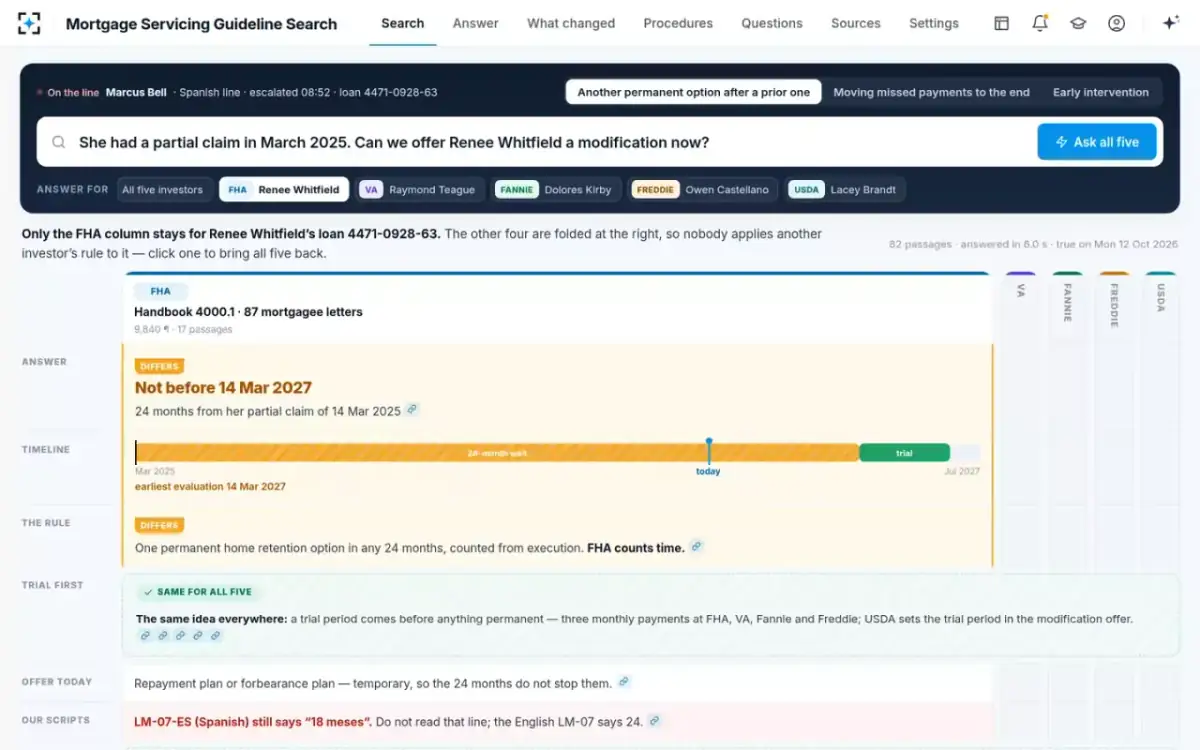
How Mortgage Servicing Guideline Search indexes answers: by effective date, not publication date
The lesson of ML 2025-12 generalises. Publication order and effective order can run in opposite directions: the later letter took effect first. A guideline search that sorts by newest document gets this right by accident and the next case wrong; one that sorts by relevance returns ML 2025-06 as readily as ML 2025-12. The robust rule is to attach to every passage the date it took effect and the passage that replaced it, and to answer for a date.
That date is not always today. A borrower disputing what she was told in August 2025, before ML 2025-12 took effect, is owed an answer about the rule then, when the COVID-19 Recovery Options were still available. How the same rule then moved into the handbook and the servicer’s scripts is traced in FHA Handbook 4000.1 updates, from letter to script, and how to tell a letter from the handbook on any date is in FHA mortgagee letters 2026.
What to re-check in FHA procedures after ML 2025-12
- Every “18 months” in any language
Scripts, FAQs, letters and training decks; the number survives longest in translations.
- Every mention of the COVID-19 Recovery Options
They expired on 30 September 2025.
- FHA-HAMP and the old standard PFS and DIL
Suspended, then expired on the same date.
- Document requests to borrowers
Financial documentation is not required to be evaluated, beyond hardship documentation.
- The order of the waterfall
Eight questions; the 24-month test is question 3, after repayment plan and forbearance.
- Language-access procedures
Confirm against the handbook which FHA provisions remain before removing anything.
What is in ML 2026-08?
HUD’s index lists ML 2026-08 as "Updates to Loss Mitigation Requirements" (HUD mortgagee letters). We have confirmed the title on HUD’s index but have not read the letter from HUD, so we do not describe its contents here. Treat it as the next link in the chain that ML 2025-12 started: read its effective date first, then which ML 2025-12 provisions it updates, then every script that restates them.
Questions people ask
What is FHA ML 2025-12?
HUD Mortgagee Letter 2025-12, "Tightening and Expediting Implementation of the New Permanent Loss Mitigation Options", dated 15 April 2025. It replaced ML 2025-06, limited borrowers to one permanent option every 24 months and made its remaining provisions effective on 1 October 2025.
Is ML 2025-06 still in effect?
No. It was replaced by ML 2025-12 on 15 April 2025, before its own effective date of 2 February 2026, so it never governed an evaluation. Its 18-month limit is not the rule.
How long must an FHA borrower wait between permanent loss mitigation options?
Twenty-four months. The ML 2025-12 waterfall asks whether the borrower "received a Permanent Home Retention Option in the past 24 months (other than for a PDMDA)"; if so, the review moves on to the home disposition options.
When did the FHA COVID-19 Recovery Options end?
On 30 September 2025. ML 2025-06 would have extended them to 1 February 2026, but ML 2025-12 set the expiry at 30 September 2025, the day before its remaining provisions took effect.
Does ML 2025-12 require financial documents from the borrower?
No, beyond the required hardship documentation. The letter says the borrower "is not required to provide financial documentation to be evaluated for a Loss Mitigation Option", and bars using other financial documentation to disqualify the borrower.
Why did FHA change 18 months to 24 months?
HUD cited "increased default rates on the COVID-19 Recovery Options" and their use "in a manner inconsistent with prudent management" of the Mutual Mortgage Insurance Fund, and limited permanent options to one every 24 months to address both.