FHA Handbook 4000.1 updates arrive in two steps: HUD first issues a mortgagee letter with its own effective date, then folds the change into a new version of the handbook. HUD’s archive lists 25 versions of the handbook between September 2014 and August 2025, four of them in 2021 alone, and no fixed schedule (HUD Handbook 4000.1 archive). For a servicer the consequence is simple to state and hard to run: the rule for an FHA loan on a given day is the handbook text, plus every later letter in force on that day, minus every draft. Botminds’ Mortgage Servicing Guideline Search keeps each passage with its version chain so an answer uses the rule in force on the date the question is about. This page traces one rule through its whole life to show where the versions go wrong.
FHA Handbook 4000.1 updates in numbers
25
versions of Handbook 4000.1 in HUD’s archive, Sept 2014 to Aug 2025
4
versions in 2021 alone; five in 2019
11
mortgagee letters issued in 2026 by early October, all programs
How often is HUD Handbook 4000.1 updated?
Irregularly, and sometimes several times a year. The archive’s dates run from 30 September 2014 to 13 August 2025: three versions in 2015, four in 2016, none in 2017 or 2018, five in 2019, one in 2020, four in 2021, one in 2022, three in 2023, one in 2024 and two in 2025. HUD publishes no cadence, so the only safe assumption is that the version on a desk may already be old.
Counting handbook versions understates the change, because the servicing rules move first in letters. ML 2025-12 reproduces the affected handbook sections in full, each page stamped "Last Revised: 04/15/2025", the date of the letter rather than of any handbook version. A servicer that waits for the next handbook to update its procedures can be months behind a rule already in force.
Handbook 4000.1 versions published each year, 2014 to 2025
How do mortgagee letters get into the handbook?
The letter comes first and says it will be folded in later. ML 2025-12 ends its effective-date section with "All updates will be incorporated into a forthcoming update of the HUD Handbook 4000.1" (ML 2025-12). Until that update, the letter is the operative text. Once it is absorbed, HUD’s index moves the letter to a separate list of letters the handbook has superseded in full, or marks it as superseded in part, as it does for ML 2024-24 on engagement with borrowers in default (HUD mortgagee letters).
That leaves three states a passage can be in on any date: in a letter not yet absorbed, in the handbook, or in a letter the handbook has replaced. A search across PDFs cannot tell them apart. How to read the index and its "superseded" labels is set out in FHA mortgagee letters 2026: letter or handbook.
The life of one FHA servicing rule, from letter to script
The rule traced below answers a question servicing floors hear every day: a borrower had a permanent workout last year; can she have another? Under the letter HUD published in January 2025 the answer turned on 18 months. Under the letter that replaced it in April, on 24. The servicer’s rows come from the solution’s fictional sample servicer, Bayfield.
One rule’s life: one permanent FHA option every 18, then 24, months
- 16 Jan 2025HUD
ML 2025-06 rewrites servicing and loss mitigation. Permanent options limited to one in 18 months; provisions effective 2 Feb 2026.
Never applied - 15 Apr 2025HUD
ML 2025-12 replaces ML 2025-06 in full: one permanent option every 24 months, not 18; effective date brought forward to 1 Oct 2025.
The rule - Jun 2025Servicer
Spanish retention script revised; it still says “18 meses”. It was out of date the day it was written.
Wrong - 13 Aug 2025HUD
A new version of Handbook 4000.1 is published, the 25th in HUD’s archive since 2014.
Consolidated text - 1 Oct 2025HUD
ML 2025-12 takes effect. The COVID-19 Recovery Options expired the day before.
In force - Nov 2025Servicer
English script and FHA evaluation procedure updated to 24 months.
Right - 12 Oct 2026Servicer
Overnight check flags the Spanish script; a redline from 18 to 24 is drafted for the writer and compliance.
Being fixed
Two things in the trace are easy to miss. ML 2025-06 never governed a single evaluation: it was replaced in April 2025 and its own effective date, 2 February 2026, never arrived. And the Spanish script was wrong under both letters, because by the time it was revised in June 2025 the 18-month figure had already been withdrawn. The full story of the replaced letter, and what else ML 2025-12 changed, is in FHA ML 2025-12 explained.
How do I know which version of Handbook 4000.1 applies?
Use the date the question is about, and the effective date of each passage, never the date a document was published. For an evaluation on 12 October 2026, the rule is whatever was in force that day; for a borrower disputing an answer given in August 2025, it is what was in force in August 2025. The publication dates of ML 2025-06 and ML 2025-12 are three months apart, but their effective dates run in the opposite order: the later letter took effect first.
Four checks settle most cases. Find the effective date stated in the letter or handbook section, not the date on its cover. Look for a later letter that "updates and replaces" it. Set aside drafts posted for comment, which are not rules. And read the transition provisions: ML 2025-12 let the COVID-19 Recovery Options run to 30 September 2025 and then expire, and kept FHA-HAMP and the standard pre-foreclosure sale and deed-in-lieu suspended to the same date.
In Mortgage Servicing Guideline Search, each cited passage carries its effective date and what it replaced
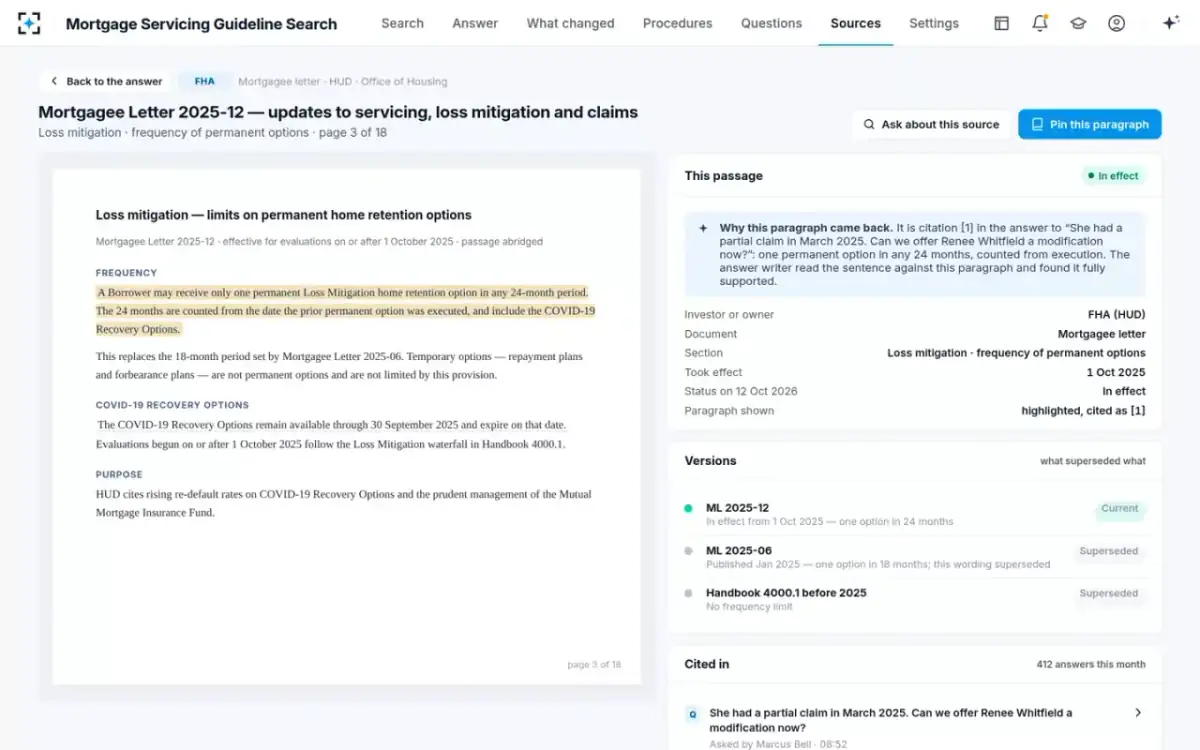
How many permanent options can an FHA borrower get?
One permanent home retention option in any 24 months, since 1 October 2025. ML 2025-12 builds the limit into the third question of FHA’s loss mitigation waterfall: a borrower who has received a permanent home retention option in the past 24 months is moved past the retention options to the home disposition questions (ML 2025-12). Options given in a presidentially declared major disaster area are excepted.
The limit does not touch temporary help. Questions 1 and 2 of the waterfall, a repayment plan for a borrower no more than 120 days in default and able to repay arrearages within 24 months, and a forbearance, come before the 24-month question. That is why, in the solution’s sample answer for a borrower whose partial claim was signed in March 2025, the verdict is "not before 14 March 2027" for a permanent option, with a repayment or forbearance plan still possible today.
FHA Handbook 4000.1 in 2026: what has changed since
HUD’s index lists eleven mortgagee letters for 2026 by early October, and one is titled "Updates to Loss Mitigation Requirements": ML 2026-08 (HUD mortgagee letters). We have confirmed its title on HUD’s index but not read its text, which HUD’s site did not serve to us, so this page does not describe its contents. The current version date of the handbook after August 2025 is likewise not in the archive we read.
That is the honest position a servicer is often in: it knows a change exists before it can read it. The useful behaviour from any tool in that position is the same as from a careful analyst. Name the letter, say its text has not been loaded, and keep answering from the rule last confirmed in force rather than guessing at the new one.
Where a rule goes after HUD: procedures, scripts, FAQs and letters
A servicing rule does not reach borrowers from HUD’s website; it reaches them through the servicer’s own documents. The evaluation procedure, the English and Spanish call scripts, the borrower FAQ on the website and the template letters each restate the rule in their own words, and each is revised on its own schedule. When the CFPB reviewed servicers in 2020, one of the commonest fixes was "updating scripts to provide accurate information to consumers" (CFPB, Supervisory Highlights, Winter 2021).
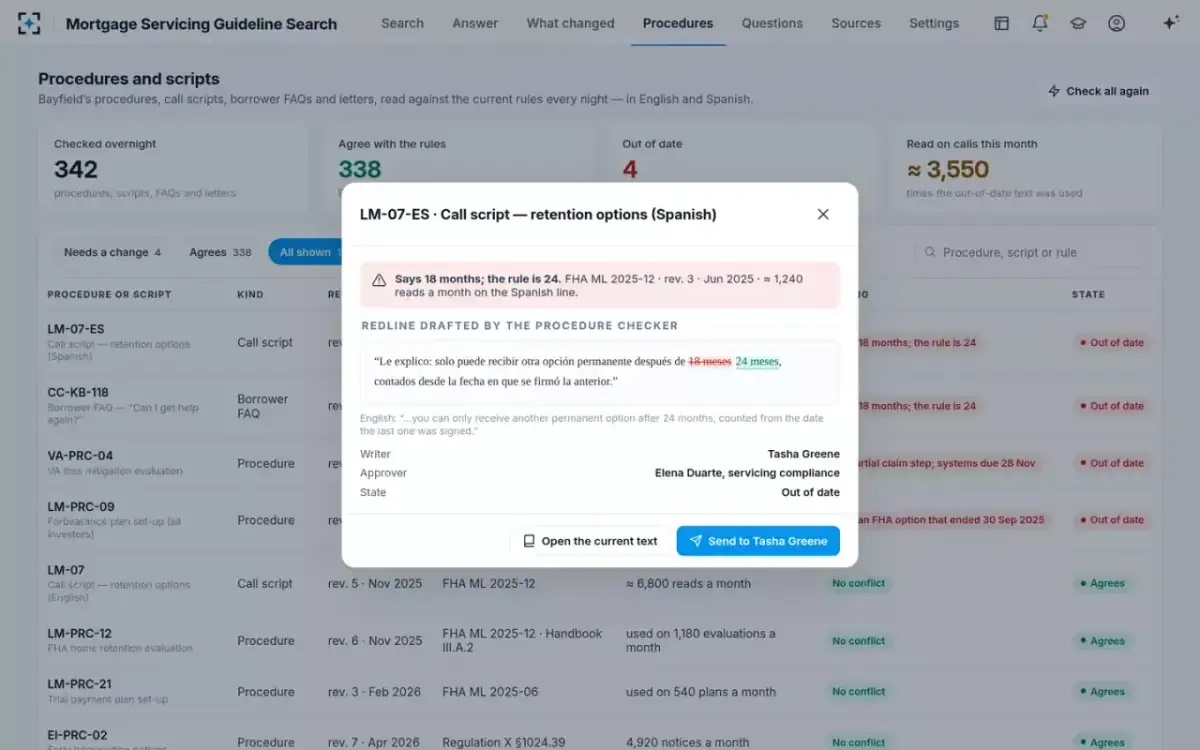
In the solution’s sample, the overnight check read 342 procedures, scripts, FAQs and letters against the current rules and found 4 out of date. Two still said 18 months: the Spanish retention script, read about 1,240 times a month, and the borrower FAQ, viewed 2,310 times. A forbearance procedure still listed an FHA option that ended on 30 September 2025. Each came back with the smallest redline that fixes it, for a writer to edit and compliance to approve.
The script that still said 18 months, with its redline drafted
Who owns an FHA rule change inside a servicer
Usually several people, each owning one step, and the change is only as fast as the slowest hand-off. In the trace above the English script was corrected within two months of the rule taking effect and the Spanish one was not corrected for a year, because nobody owned the question "which of our documents restate this passage?". The table sets out the steps a single FHA letter sets off, who typically owns each, and what the agents in Mortgage Servicing Guideline Search take on.
One FHA letter, six steps inside the servicer, and what Mortgage Servicing Guideline Search takes on
| Step | Typical owner | What the agents do | What stays with people |
|---|---|---|---|
| Notice the letter and its effective date | Policy or regulatory change team | Read each new letter the day it appears, with its effective dates | Deciding it applies to the book |
| Find the handbook text it changes | Policy analyst | Link the new passage to the passage it replaces | Interpreting unclear wording |
| Find every document that restates it | Procedure writers, often nobody | Match procedures, scripts, FAQs and letters in each language to the passage | Confirming the match |
| Draft the change | Procedure writer | Draft the smallest redline in the document’s own language | Writing the final wording |
| Approve the change | Servicing compliance | None | Approval, every time |
| Train the floor | Trainer | Show which teams and languages ask about the topic | The training itself |
How to keep call scripts current with FHA changes
Treat each script as a copy of a rule with its own version, and check the copies whenever the rule moves. The work is mechanical but has to be exhaustive, because the copy nobody remembers is the one read on the phone. The checklist below is what we would put in a procedure owner’s change routine.
Keeping FHA servicing scripts in step with Handbook 4000.1 updates
- Index every document that restates a rule
Procedures, scripts in each language, FAQs, letters and training decks, each with the rule it follows.
- Key each one to the passage, not the guide
“Follows ML 2025-12, III.A.2” can be checked; “follows FHA” cannot.
- Act on the effective date, not the handbook update
A letter in force is the rule even before the handbook absorbs it.
- Check every language version separately
Translations are revised later and less often; the Spanish copy is where the old number survives.
- Retire what a letter retires
Options that expired, such as the COVID-19 Recovery Options on 30 September 2025, must leave every script.
- Keep the old version beside the new
A disputed call is judged by the rule and the script in force that day.
Accurate means the version in force on the date asked
An answer can quote a real HUD paragraph and still be wrong, if the paragraph was not in force on the date that matters. That is the accuracy test this rule teaches: not "is the citation genuine" but "was this the rule that day". In the solution’s sample answer, the agents searched 61,240 paragraphs, set aside six superseded passages, including the 18-month wording, and one draft, and every one of the answer’s eleven sentences was checked against its passage. A reviewer can test the same property with a handful of dated questions whose answers changed in 2025.
Questions people ask
Where can I find the current FHA Handbook 4000.1?
On HUD’s HUDCLIPS site; older versions sit in HUD’s archive, which lists 25 versions from September 2014 to August 2025. Read any version together with the mortgagee letters issued after it, because letters take effect before they are absorbed.
Is a mortgagee letter binding before it is added to the handbook?
Yes, from its stated effective date. ML 2025-12 took effect on 1 October 2025 and said its updates would be "incorporated into a forthcoming update" of the handbook, so for that period the letter was the operative text.
What happened to the 18-month rule in ML 2025-06?
It never applied. ML 2025-12 replaced ML 2025-06 in April 2025, before ML 2025-06’s 2 February 2026 effective date, and set one permanent option every 24 months from 1 October 2025.
Does the 24-month limit apply to repayment plans and forbearance?
No. It applies to permanent home retention options. In the ML 2025-12 waterfall, the repayment plan and forbearance questions come before the 24-month question, so a borrower who had a recent partial claim can still be reviewed for them.
What is in ML 2026-08?
Its title on HUD’s index is "Updates to Loss Mitigation Requirements". We have not read its text from HUD, so we do not summarise it here; check HUD’s copy and its effective date before changing procedures.