Mortgage servicing guidelines are the rules a servicer must follow for each loan, and they come from whoever owns or insures the loan as well as from regulators. For a servicer with a mixed book that means eight rulebooks: FHA’s Handbook 4000.1 and mortgagee letters, VA’s servicing guidance, USDA’s guaranteed loan handbook, the Fannie Mae and Freddie Mac servicing guides, Ginnie Mae’s MBS Guide for loans in its pools, Regulation X, and the servicing law of each state, before the ninth, which the servicer writes itself. The rule for one loan is its investor’s guide plus every later letter in force, inside the federal and state floor, as restated in the servicer’s procedures. Botminds’ Mortgage Servicing Guideline Search answers a question against all of them at once and cites each sentence; this guide maps what each rulebook covers and where to find it.
Where one servicer’s rulebooks sit in the Mortgage Servicing Guideline Search sample library
All 61,240 paragraphs in the sample library
- Investor guides and letters · 71%
- Regulation X and state rules · 10%
- The servicer’s own procedures, scripts, FAQs and letters · 19%
The five investors’ 43,750 paragraphs
- Freddie Mac guide and bulletins · 33%
- Fannie Mae guide and announcements · 32%
- FHA handbook and letters · 22%
- VA and USDA · 13%
What are mortgage servicing guidelines?
They are the requirements that govern how a loan is serviced once it is made: how payments and escrow are handled, how delinquent borrowers are contacted and evaluated, which workouts may be offered, and how foreclosure and claims proceed. Some are law, such as Regulation X’s servicing rules and state statutes. Most are contract: the owner or insurer of the loan sets them as a condition of the guarantee, the insurance or the purchase, and the servicer agrees to follow them.
The distinction matters less on the phone than people expect, because Regulation X makes the investor’s rules part of the servicer’s legal duty. Its policies-and-procedures rule requires a servicer to identify each owner’s loss mitigation options and evaluate borrowers for them (12 CFR 1024.38(b)(2)), and the official interpretation applies that even where the federal loss mitigation section itself does not (comment 38(b)(2)(v)-1). An investor rule broken is a Regulation X problem too.
Which rules does a mortgage servicer follow?
The rules of whoever owns or insures each loan, inside federal and state law, as written into its own procedures. The table names the eight external rulebooks, who writes them and how they change.
The eight rulebooks of mortgage servicing guidelines
| Rulebook | Written by | Applies to | How it changes |
|---|---|---|---|
| FHA Handbook 4000.1 and mortgagee letters | HUD | FHA-insured loans | Letters with their own effective dates; handbook reissued irregularly |
| VA Servicer Handbook M26-4, circulars and 38 U.S.C. 3737 | VA and Congress | VA-guaranteed loans | Circulars; a new partial claim statute in 2025 |
| USDA HB-1-3555 and 7 CFR 3555 | USDA Rural Development | USDA guaranteed loans | Rules and handbook revisions |
| Fannie Mae Servicing Guide | Fannie Mae, under FHFA | Loans Fannie Mae owns or guarantees | Announcements and lender letters |
| Freddie Mac Single-Family Seller/Servicer Guide | Freddie Mac, under FHFA | Loans Freddie Mac owns or guarantees | Bulletins |
| Ginnie Mae MBS Guide | Ginnie Mae | Issuers of pools of FHA, VA and USDA loans | Revised chapters with their own effective dates |
| Regulation X (12 CFR 1024, subpart C) | CFPB | Most servicers of first-lien residential loans | Rarely; COVID-19 provisions added in 2021 were rescinded in 2025 |
| State servicing law and regulation | 50 states and DC | Servicers licensed or operating in the state | Statute by statute; prudential standards spreading |
FHA servicing guide and loss mitigation: Handbook 4000.1 and its letters
FHA’s servicing rules sit in section III of Handbook 4000.1, "Servicing and Loss Mitigation", with default servicing and the loss mitigation waterfall in III.A.2 (ML 2025-12). They change first by mortgagee letter: since 1 October 2025 the waterfall is the one ML 2025-12 set out, eight questions in order from a repayment plan to the home disposition options, with one permanent home retention option allowed in any 24 months.
Anyone typing "FHA guidelines" into a search engine meets the reason servicing staff struggle with it: the suggestions are about appraisals, gift funds and rental income, because most readers of the handbook originate loans. A servicing question needs section III, the letters issued since the handbook version in hand, and HUD’s index of which letters are superseded (HUD mortgagee letters). How to tell a letter in force from one the handbook has absorbed is set out in FHA mortgagee letters 2026.
VA servicing handbook M26-4, circulars and the new partial claim
VA servicing rules live in the VA Servicer Handbook M26-4 and the circulars that amend it (VA, M26-4), and since July 2025 in statute as well. The VA Home Loan Program Reform Act created a Partial Claim Program at 38 U.S.C. 3737: a claim may not exceed 25% of the unpaid principal balance, or 30% for a veteran who missed a payment between 1 March 2020 and 1 May 2025, and "the Secretary may make only one partial claim per loan", with an exception after a declared major disaster (Pub. L. 119-31).
The law also requires VA to prescribe "a mandatory sequence in which the holder of a loan ... shall offer loss mitigation options", and the program ends five years after enactment. VA opened the program on 15 June 2026; servicers "are not required to offer the new partial claim program until late November of this year", according to the National Consumer Law Center (NCLC, June 2026). A VA answer in October 2026 therefore depends on the date as much as the rule.
USDA HB-1-3555 chapter 18: servicing non-performing guaranteed loans
USDA’s guaranteed loan servicing rules are in 7 CFR part 3555 and the program’s technical handbook, HB-1-3555, whose chapter 18 covers servicing non-performing loans (USDA Rural Development handbooks). The final rule that took effect on 11 February 2025 reshaped the options: borrowers "may be eligible for multiple Mortgage Recovery Advances up to a cumulative amount that is less than or equal to 30 percent of the unpaid principal balance as of the date of the initial default", loan terms can be extended to 40 years after reamortization, and principal deferment is limited to what brings the payment to 31% of gross monthly income (USDA final rule).
Fannie Mae and Freddie Mac servicing guides, announcements and bulletins
Loans owned or guaranteed by Fannie Mae and Freddie Mac follow the Enterprises’ own servicing guides, Fannie Mae’s Servicing Guide and Freddie Mac’s Single-Family Seller/Servicer Guide. They change by announcement and lender letter at Fannie Mae and by bulletin at Freddie Mac, and the servicer is bound by the guide as published. Their regulator, FHFA, sets the shape of the main workout: its May 2024 enhancement to the Flex Modification aims at a 20% cut in principal and interest, reached by lowering the rate where eligible, extending the term and forbearing principal for borrowers above 50% mark-to-market loan-to-value, effective 1 December 2024 (FHFA).
Questions about the guides’ detailed criteria, such as how many prior modifications exclude a loan, are answered from the guide text itself. That is the sense of the common search for Fannie Mae servicing guide announcements: the announcement says what changed, and the guide says what the rule now is.
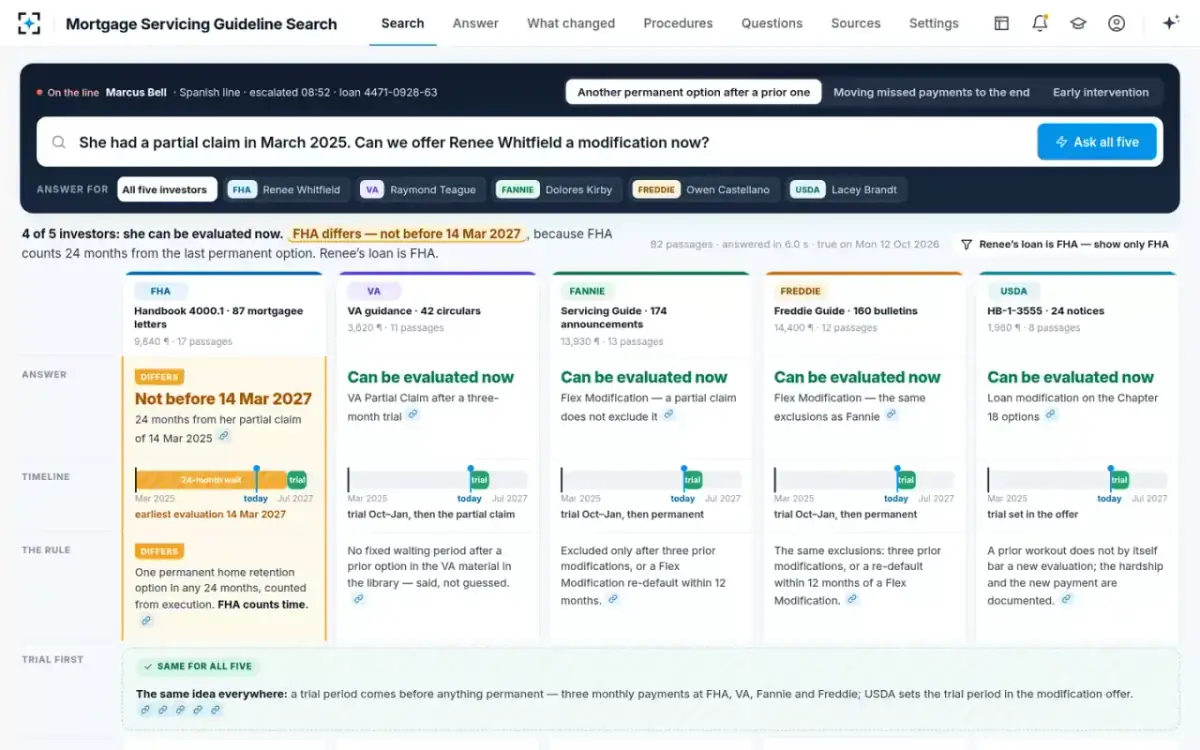
One question, five rulebooks, answered side by side in Mortgage Servicing Guideline Search
Ginnie Mae MBS Guide: the issuer’s rulebook on top of FHA, VA and USDA
A servicer that issues Ginnie Mae securities answers to the MBS Guide as well as to the insuring agency. Ginnie Mae guarantees pools of government loans, and its guide governs the issuer’s duties, including who may service them. On subservicing it is specific: "There may be only one subservicer for each pool or loan package", and the arrangement needs Ginnie Mae’s prior written approval (Ginnie Mae MBS Guide, chapter 4). The loan-level servicing rules still come from FHA, VA or USDA; Ginnie Mae adds the issuer’s obligations.
Regulation X and state law: the floor under every investor
Regulation X sets the federal servicing duties every covered servicer owes, whoever owns the loan: early intervention, continuity of contact, loss mitigation procedures, error resolution and requests for information, escrow and transfers (12 CFR 1024, subpart C). Its core took effect on 10 January 2014 and was last broadly amended in 2016; the temporary COVID-19 provisions added in 2021 were rescinded in 2025. That makes it the steadiest of the eight. Small servicers are exempt from most of 1024.38 through 1024.41.
State law is the busiest floor. For nonbank servicers, state regulators are the comprehensive supervisor, and twelve states have now adopted the CSBS prudential standards for nonbank servicers, which, FSOC says, "effectively cover 99 percent of the nonbank mortgage market by loan count" (FSOC, 2025). Notice periods, mediation programs and foreclosure steps differ state by state, so the borrower’s state is part of every default answer.
Who services, and who checks, in 2026
59%
of US mortgages serviced by nonbanks in Q2 2025, against 20% in 2013
12
states with CSBS prudential standards for nonbank servicers
2014
year Regulation X’s servicing rules took effect; still the federal floor
How often can a borrower get help again? Four rulebooks, four answers
Differently under each investor, which is why one generic answer is wrong for most of a mixed book. The question a servicing floor hears most after a borrower’s second hardship is whether she can have another workout. The table puts the four answers side by side, from the rulebooks above.
Can a borrower get another workout? The limit in each rulebook
| Investor | The limit | Where it is written |
|---|---|---|
| FHA | One permanent home retention option in any 24 months; repayment plans and forbearance are not limited by it | ML 2025-12, waterfall question 3 |
| VA | One partial claim per loan, except after a declared major disaster; capped at 25% of balance (30% for some) | 38 U.S.C. 3737 |
| USDA | Mortgage Recovery Advances may repeat, up to 30% of the balance at initial default in total | 7 CFR 3555, as amended in 2025 |
| Fannie Mae and Freddie Mac | Set in each guide’s Flex Modification eligibility; read the guide as published | Fannie Mae Servicing Guide; Freddie Mac Guide |
The rule for one loan is its investor’s guide, plus every later letter in force, minus every draft, inside the federal and state floor. Everything else is a copy.
Which rulebook wins when two of them disagree?
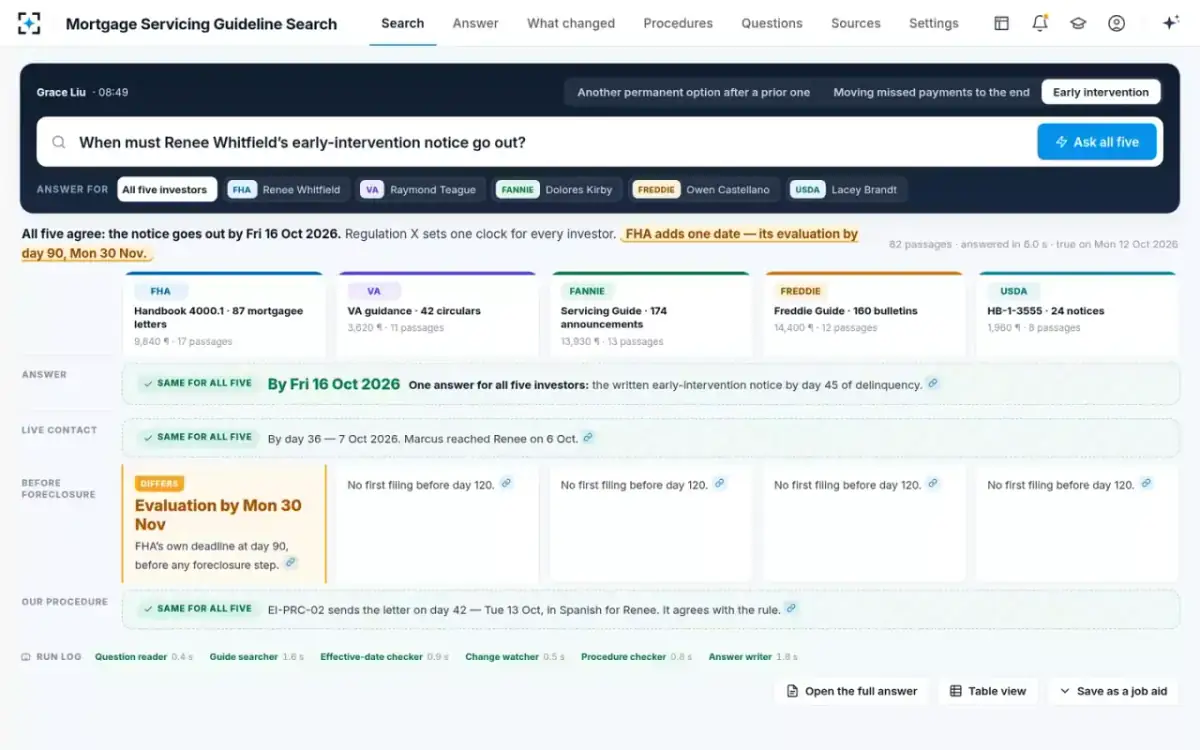
Usually none has to win, because they stack: the servicer must meet the federal and state floor and the investor’s requirements at once, and where one is stricter, the stricter one is what the servicer does. Regulation X’s early intervention clock applies to an FHA loan alongside FHA’s own default servicing steps; a state’s longer notice period applies alongside both. Real conflicts, where obeying one would break another, are rare and belong with counsel, not with a representative on a call.
The servicer’s own documents are different: they never win. A procedure or script that disagrees with the rule it restates is simply out of date. That is the order Mortgage Servicing Guideline Search applies by default, with investor guides and Regulation X first, state rules second and the servicer’s procedures third, and a disagreement flagged for people to resolve rather than settled silently. The order is a setting, because some servicers rank their state rules differently, but the servicer’s own copies never rank above the rules they copy.
The ninth rulebook: your own procedures and scripts
The servicer’s own documents are where the eight rulebooks meet the borrower, and where they most often disagree with each other. In the solution’s sample library the servicer’s procedures, scripts, FAQs and letters hold 11,260 paragraphs, more than Regulation X and state rules together. Each is a restatement of some investor’s rule, revised on the servicer’s own schedule and often in two languages. In one overnight check, 4 of 342 were out of date, two of them still quoting FHA’s replaced 18-month limit.
Holding that ninth rulebook to the other eight is most of what keeps a floor’s answers consistent. A rule that changes upstream should find every copy downstream, and the copy that disagrees should be flagged, not followed. How that looks for one call, and why Regulation X expects each owner’s rules to be "readily accessible" to the person on the phone, is covered in Regulation X 1024.38 and AI agents.
Where Regulation X sets the clock, the five investors collapse into one answer
Questions people ask
Who sets mortgage servicing guidelines?
The loan’s owner or insurer sets most of them: HUD for FHA loans, VA and USDA for their own programs, Fannie Mae and Freddie Mac under FHFA’s oversight, and Ginnie Mae for its issuers. The CFPB sets Regulation X’s federal servicing rules, and each state sets its own servicing law.
Do Fannie Mae and Freddie Mac have the same servicing rules?
They share FHFA’s framework, such as the Flex Modification’s 20% payment-reduction target, but each publishes its own guide and changes it separately, Fannie Mae by announcement and Freddie Mac by bulletin. Check the guide that applies to the loan.
Where are USDA’s servicing rules for delinquent loans?
In 7 CFR part 3555 and chapter 18 of USDA’s HB-1-3555 handbook. The 2025 rule lets borrowers receive Mortgage Recovery Advances up to 30% of the unpaid balance at initial default in total, and loan terms of up to 40 years.
Does Regulation X apply if the investor’s guide is stricter?
Both apply. Regulation X is the federal floor, and its policies-and-procedures rule requires the servicer to follow owner requirements as well, even where the federal loss mitigation section does not apply.
How many servicing rulebooks does a typical servicer follow?
A servicer with FHA, VA, USDA and GSE loans in Ginnie Mae and Enterprise pools answers to eight external rulebooks and its own procedures. Nonbanks, which serviced 59% of US mortgages in mid-2025, add a state regulator in every state where they are licensed (FSOC).