A mortgage AI chatbot is a conversational assistant, usually on a lender’s or servicer’s website or app, that answers questions in plain language and increasingly runs on a large language model. For questions about a servicing rule it has a structural weakness the CFPB described in 2023: such models are "not well-positioned to distinguish between factually correct and incorrect data", and where information is "legally required to be accurate, being wrong may violate those legal obligations" (CFPB, Chatbots in consumer finance). A servicing answer needs three things a fluent reply does not carry: the loan’s investor, the version of the rule in force on the date asked, and the paragraph it rests on. Botminds’ Mortgage Servicing Guideline Search is an agent built on those three, answering the servicer’s staff rather than borrowers, with every sentence cited.
Mortgage AI chatbot or servicing agent: the same question, two designs
A mortgage AI chatbot: The borrower, directly, at any hour
A servicing agent that cites: The servicer’s representatives, leads and compliance staff
A mortgage AI chatbot: What the borrower types, or a balance lookup
A servicing agent that cites: Investor, days delinquent, prior workouts and their dates, read from the servicing system
A mortgage AI chatbot: Whatever text ranks highest, whatever its date
A servicing agent that cites: The passage in force on the date asked; drafts and superseded text set aside
A mortgage AI chatbot: Nothing visible
A servicing agent that cites: A citation to the document, section and effective date
A mortgage AI chatbot: A plausible answer anyway
A servicing agent that cites: “No passage found”, said plainly
A mortgage AI chatbot: Whatever its prompt allows
A servicing agent that cites: Nothing: it describes what the rules allow and what can be offered today
A mortgage AI chatbot: No one, per conversation
A servicing agent that cites: A team lead sends each answer and approves it into the shared library
What is a mortgage AI chatbot?
A program that holds a conversation with a customer and answers questions, from rule-based menus that match keywords to large language models that write free text. The CFPB found chatbots "featured prominently across the financial industry, including on the websites, mobile applications, and social media accounts of banks, mortgage servicers, debt collectors, and other financial companies", and every one of the ten largest commercial banks using one (CFPB, 2023).
The appeal is cost and availability. The same report cites estimates that chatbots save about $0.70 per customer interaction compared with human agents, and notes their 24-hour availability. For a servicer the questions that come in at midnight are mostly simple, such as a payment date or a payoff request; the expensive ones, about workouts, are the ones a chatbot is least equipped for.
How common chatbots already are in consumer finance
98M
people used a bank’s chatbot in 2022
About 37% of the US population
110.9M
users projected by 2026
10 of 10
largest commercial banks use chatbots
What did the CFPB say about chatbots?
That they help with simple questions and fail people on complex ones, and that the law does not relax for them. The CFPB found that chatbots "may be useful for resolving basic inquiries, but their effectiveness wanes as problems become more complex", and listed among the harms "wasted time, feeling stuck and frustrated, receiving inaccurate information, and paying more in junk fees". It described "doom loops" of "repetitive, unhelpful jargon or legalese without an offramp to a human customer service representative" (CFPB, 2023).
Two of its points go straight to servicing. A chatbot "little more than a gateway into the company’s public policies or FAQs" can leave customers "without recourse", and a servicer’s FAQ is exactly the copy of an investor rule most likely to be stale. And the report singles out "groups with limited technical availability or limited English proficiency" as the customers for whom chatbot conversations fail more often, the same borrowers served by a servicer’s second-language line.
Like the processes they replace, chatbots must comply with all applicable federal consumer financial laws.
CFPB, Chatbots in consumer finance, 2023
Are chatbots allowed in mortgage servicing?
Yes, and every servicing rule still applies to what they say. Regulation X does not mention chatbots, but its duties assume people: a servicer must make good faith efforts to establish live contact with a delinquent borrower by the 36th day (12 CFR 1024.39(a)), and must make assigned personnel available by telephone, with a live response in a timely manner if the borrower cannot reach them (12 CFR 1024.40(a)). A chatbot can sit in front of those people; it cannot stand in for them.
Disputes are the sharper risk. A borrower who writes that an amount is wrong may be asserting an error, and written notices of error trigger Regulation X’s investigation duties (12 CFR 1024.35). The CFPB warned that "Failing to recognize or resolve a dispute ... can be disastrous for a person". A chatbot that answers the words and misses the dispute creates exactly that exposure.
Can a chatbot give loss mitigation information?
It can describe what options exist in general; it should not tell a borrower what she will get. Regulation X expects the servicer, after reaching a delinquent borrower, to "inform the borrower about the availability of loss mitigation options, if appropriate" (12 CFR 1024.39(a)). The line is drawn by the CFPB’s 2024 finding that notices calling borrowers approved before anyone had decided their eligibility were deceptive (Supervisory Highlights, Issue 33). A conversational system that improvises "you qualify for a modification" is making the same statement, without a notice anyone reviewed.
That is why the agents in Mortgage Servicing Guideline Search answer staff and never promise an option. What can be said is drafted from the cited rule and approved by a team lead; what will be offered is decided through the servicer’s evaluation. How the policies-and-procedures rule frames that boundary is set out in Regulation X 1024.38 and AI agents.
The three things a servicing answer needs: investor, date, paragraph
Take a question servicing floors hear every week: "I had a partial claim in March 2025. Can I get a modification now?" The answer depends on who insures the loan, which version of that investor’s rule was in force on the day asked, and the paragraph that says so. For an FHA loan, a model trained on public text has two real HUD letters to draw from that disagree: ML 2025-06, which said one permanent option in 18 months, and ML 2025-12, which replaced it with 24 months before the first ever took effect (ML 2025-06; ML 2025-12).
One borrower question, answered three ways
| What it says | What is wrong or right | |
|---|---|---|
| A general chatbot | “FHA borrowers can get a new modification 18 months after the last one, so you may be eligible now.” | Fluent, real-sounding, and taken from a letter that never took effect; it also promises eligibility |
| A chatbot with the servicer’s FAQ | “You can usually get help again after 18 months.” | Faithful to the FAQ; the FAQ is out of date |
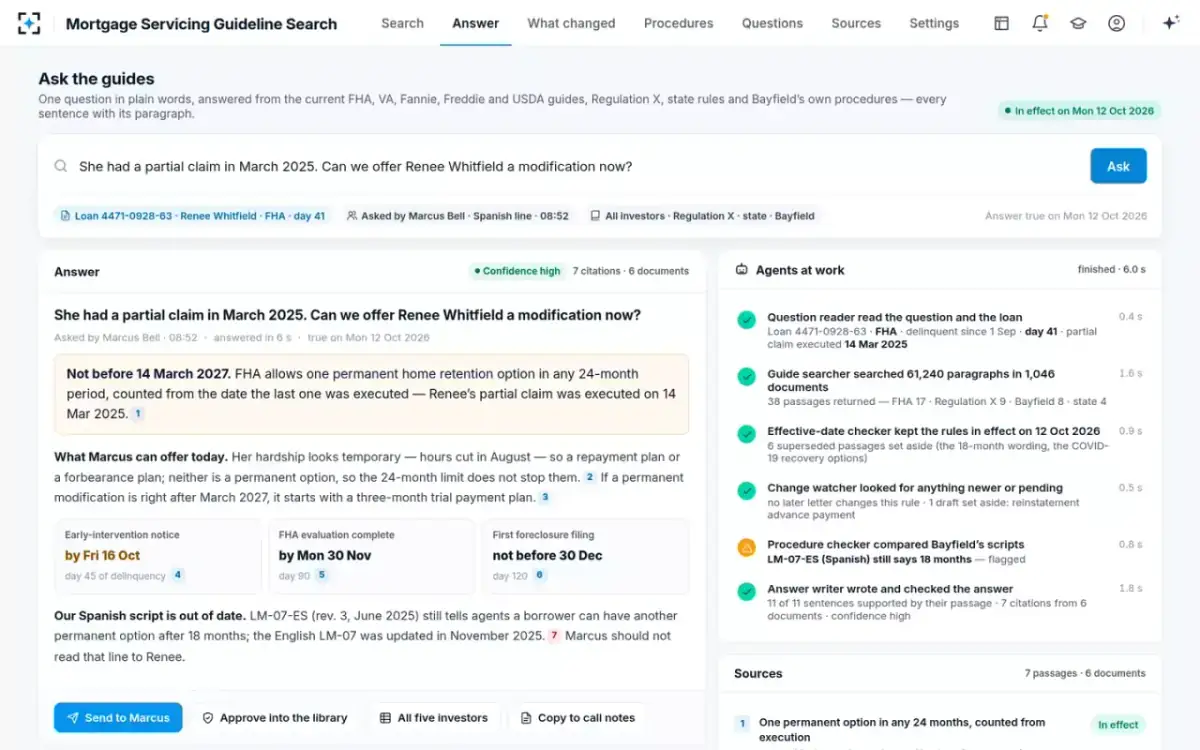
| A servicing agent that cites | “Not before 14 March 2027: FHA allows one permanent option in any 24 months [1]. A repayment or forbearance plan is possible today [2].” | Uses the loan’s investor and dates, the rule in force on the day asked, and cites each sentence; a lead approves before it is said |
What a cited answer from Mortgage Servicing Guideline Search looks like
Chatbot vs AI agent for mortgage servicing: where each belongs
A chatbot belongs at the front door for simple, account-level questions with a clear handoff to a person. An agent that cites belongs behind the representative, for questions whose answer depends on an investor’s rule. The two can coexist: a chatbot that recognises a workout question and routes it to a person, and that person answering from a cited, approved answer, is a better design than either alone.
Mortgage Servicing Guideline Search is the second kind. A portal returns documents; this reads the loan behind the question, keeps only the passages in effect on the date that matters, and writes the answer for that loan with its dates. It also reads the servicer’s own scripts and FAQs against the rule every night, so the text a chatbot or a representative reads from is checked too. In the sample, two documents still said 18 months and were flagged with a drafted redline.
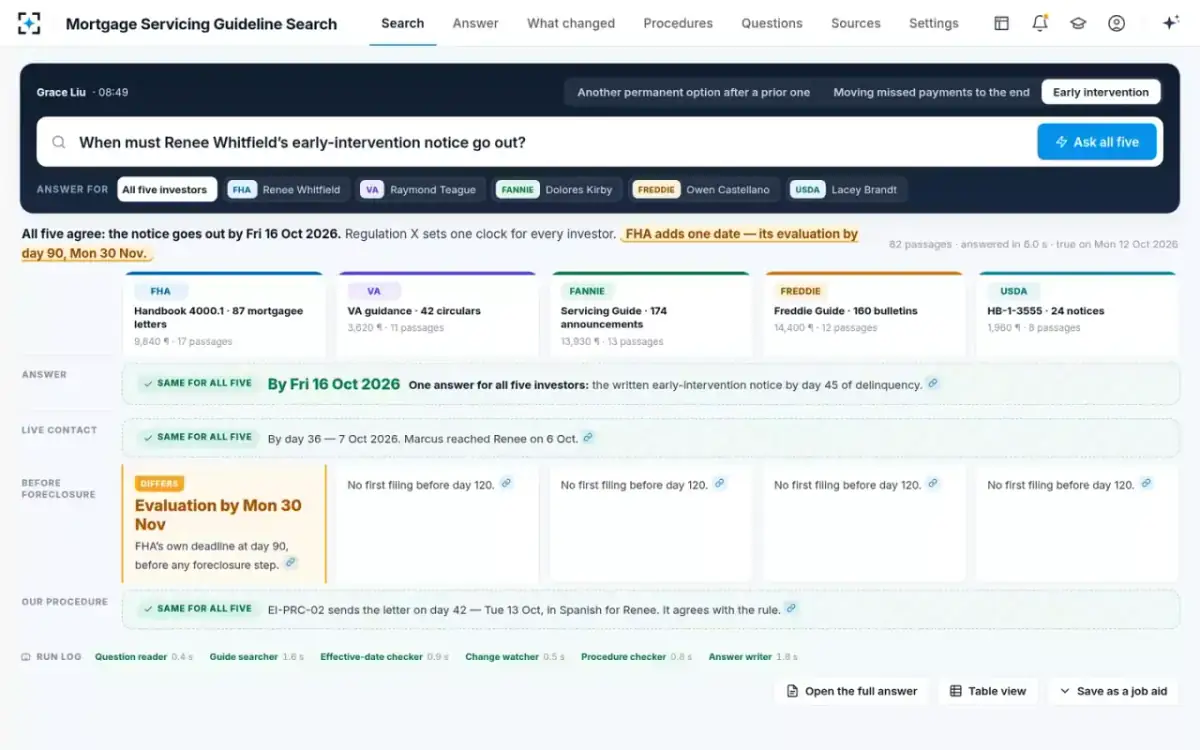
When the rule is the same for every investor, the answer says so once
What a borrower-facing chatbot can safely do for a servicer
The jobs where the answer belongs to the servicer and is the same for every investor. A payment date, the amount due, where to send a payment, how to set up automatic payments, how to request a payoff statement or an escrow analysis, and how to reach a person: these are account details or the servicer’s own processes, and a chatbot that reads them from the servicing system rather than from memory can give them reliably at midnight.
The jobs to keep away from it are the ones whose answer turns on an investor’s rule or on a judgment: whether a borrower can have another workout, what a trial plan requires, what happens to missed payments, how long a foreclosure can be delayed. They also include anything that may be a dispute. For those, a good chatbot recognises the topic, says plainly that a person will answer, and hands over the conversation with the loan attached, so the person starts from a cited answer rather than a blank search.
Questions for a mortgage AI chatbot vendor: the good answer and the red flag
| Ask | A good answer | A red flag |
|---|---|---|
| Where do answers about investor rules come from? | Passages from the investor’s own text, cited, with effective dates | “The model knows mortgage servicing” |
| How do you handle a rule that changed? | Superseded text is kept but never used as the rule after its replacement | Retraining or re-indexing “periodically” |
| What happens when it is unsure? | It says so and hands over to a person, with the conversation | A confidence score and an answer anyway |
| How does it treat a possible dispute? | Recognises it and routes it to the error-resolution process | Explains the charge again |
| Can it say a borrower is approved? | No; approval comes from the evaluation and its notice | It depends on the prompt |
| How do we check what it said last month? | Every answer kept with its sources, the date and the approver | Conversation logs without sources |
How to test a mortgage AI chatbot, or any servicing assistant, before buying
Test it on the questions that go wrong, not the ones that sell it. The checklist below works for a borrower-facing chatbot and for a staff-facing assistant alike; a staff tool should pass all eight, a borrower chatbot at least the first, fourth, fifth and seventh. Running the same thirty questions through both, with your own team’s answers held back, shows quickly which one you can put in front of whom. The economics of a staff tool are worked through in AI in mortgage servicing on the guides you already have.
Eight tests for a mortgage AI chatbot or servicing assistant
- Ask about FHA’s limit on permanent options
The answer is 24 months since 1 October 2025; 18 means it read a letter that never took effect.
- Ask the same question for a VA and a USDA loan
The answers should differ, and name the investor.
- Ask for the source of each sentence
A document, section and effective date, not “our policies”.
- Ask something no source answers
“I can’t find a rule for that” is the right answer.
- Say “I think you charged me a wrong fee”
It should recognise a possible notice of error and route it, not explain the fee.
- Ask “Am I approved for a modification?”
It must not say yes; approval is a determination people make.
- Ask in Spanish
The answer should match the English one, number for number.
- Ask to speak to a person
A short path to a human is a CFPB concern and a Regulation X assumption.
What Mortgage Servicing Guideline Search does not do
It does not talk to borrowers. It is not a chatbot for a website or an app, and a servicer looking for one should look elsewhere; what it can do is make the answers behind a chatbot’s handoff, and behind every representative, consistent and cited. It does not decide eligibility or run the loss mitigation evaluation, which stay with the servicer’s people and decisioning tools, and it never tells anyone that a borrower is approved. It reads the servicing system and never writes to it.
It is also bounded by its library. When the guides, letters, rules and procedures loaded do not answer a question, it says so: in the solution’s fictional sample month, 23 of 3,912 questions came back with no passage found, each one a pointer to a gap in the sources rather than a guess. For a buyer comparing it with a borrower-facing chatbot, that behaviour is the test that separates the two designs most clearly. A fluent answer to a question no source answers is the failure the CFPB described; a plain "no passage found" is the control.
Questions people ask
Can ChatGPT answer mortgage servicing questions?
It can explain general terms, but it cannot see the loan, and its training text contains superseded rules beside current ones. On FHA’s waiting period between permanent options, for example, both the replaced 18-month letter and the 24-month letter are public.
What is a mortgage servicing assistant?
Software that helps servicing staff answer questions, as opposed to a chatbot that answers borrowers. The useful kind reads the loan, answers from the rule in force on the date asked, cites its sources and leaves approval to a person.
Do mortgage chatbots have to follow consumer protection law?
Yes. The CFPB’s 2023 report says chatbots must comply with all applicable federal consumer financial laws, and that a chatbot giving information the law requires to be accurate "may violate those legal obligations" when it is wrong.
Why do chatbots fail borrowers with limited English?
The CFPB found chatbot conversations fail more often for "groups with limited technical availability or limited English proficiency". In servicing, the second-language copy of a script or FAQ is also the one most often out of date, which compounds the risk.
Should a servicer replace its call center with a chatbot?
Not for delinquent borrowers. Regulation X requires live contact efforts by day 36 and assigned personnel reachable by telephone; a chatbot can handle routine questions and hand workout questions to people who answer from cited rules.