Call center knowledge base software gives representatives searchable answers while the customer waits. In mortgage servicing the hardest questions are not about the servicer’s own products but about other people’s rules: what FHA, VA, USDA, Fannie Mae or Freddie Mac allows for this loan, under the letter in force today, and whether the servicer’s own script agrees. A general article library is not built for that, and the gap shows up as escalations, inconsistent answers and remediation. Botminds’ Mortgage Servicing Guideline Search is a servicing-specific alternative: it answers for all five investors at once, each sentence citing its paragraph, and checks the servicer’s scripts against the rules overnight. This guide gives a buyer a way to price the problem per question, with their own numbers, before comparing products.
The cost of answering servicing questions, as a sum you can fill in
Search time
questions × minutes saved ÷ 60 × hourly cost
Minutes: time your own escalated questions; no published benchmark exists. Hourly cost: BLS median for loan interviewers and clerks is $24.05, before benefits.
Priced by operations
Lead time on escalations
escalations × lead minutes ÷ 60 × lead hourly cost
Each escalation costs a lead’s time as well as the representative’s, and holds the borrower longer.
Priced by operations
Wrong answers avoided
wrong answers × cost to put each right
Fees refunded, credit reporting corrected, re-evaluation, complaint handling, and the cost of a workout delayed.
Priced by compliance and default management
What the tool costs
licence + integration + upkeep
Read-only loan data, the document library, your procedures in each language, and lead and compliance time on approvals.
Priced by finance and IT
What is call center knowledge base software, and why does servicing need a different kind?
It is a searchable library of answers, usually short articles written by the operation, surfaced to the representative during a call. That works for questions whose answer the servicer controls: where to send a payment, how autopay works, what a fee is for. It works badly for investor rules, for three reasons a general product does not address.
First, the answer depends on the loan: the same question has five answers on a floor that services FHA, VA, USDA, Fannie Mae and Freddie Mac loans, and Regulation X expects each owner’s options and criteria to be "readily accessible" to the people talking to borrowers (comment 38(b)(2)(ii)-1). Second, the answer has a date: a rule can be replaced before it takes effect, as FHA’s 18-month limit was in 2025. Third, the servicer’s own article is a copy of someone else’s rule, so it goes stale the day the rule moves, and nobody is told.
How to calculate the cost per question in a call center
Multiply the questions a month by the minutes each one takes to answer properly, and price the minutes at the loaded cost of whoever spends them; then add the escalations and the wrong answers. The formula above is that sum written out. The first two terms are labour, the third is risk, and the fourth is what any product costs. The figure most buyers lack is the second input of the first term, minutes per question, and it is the one that moves the result most.
For the hourly cost, the Bureau of Labor Statistics puts loan interviewers and clerks, the occupation that holds most servicing representatives, at a median of $24.05 an hour and a mean of $25.25 in May 2025, with 164,790 employed nationally (BLS OEWS). BLS does not publish a separate line for servicing or loss mitigation staff, so use your own payroll if you can, loaded with benefits and overhead.
The inputs a cost-per-question model can borrow, and the one it cannot
$24.05
median hourly wage, loan interviewers and clerks, May 2025
Mean $25.25; before benefits
$1,573
yearly cost to service a non-performing loan; $176 for a performing one
MBA, 2024 costs
None
published benchmark for minutes to answer a servicing guideline question
Measure your own
How much time do servicing reps spend searching for answers?
No regulator, academic study or industry body we could find publishes a figure, so any number in a vendor’s deck is a claim, not a benchmark. Our own estimate, for one escalated guideline question answered by hand, is about twelve minutes: identifying the investor and the loan’s history, finding the topic in the guide, checking later letters and drafts, checking the servicer’s own procedure and script, and writing the answer up for the floor. It is an estimate for a hard question, not an average call.
Measure it rather than borrow it. Pull thirty escalated questions from last month, note when each was asked and when the answer went back to the floor, and note which sources were opened. The timestamps give the minutes; the sources show where they went. Most servicers find the time goes on finding and confirming, not on judging, which is the part software can take. A minute-by-minute walk through one such question is in twelve minutes on hold.
A worked range: what the search time is worth
Because minutes saved and volume vary so widely, a range is more honest than a single return. The table prices the first term of the formula at the BLS median wage for three floor sizes and three savings per question. It is wage cost before benefits and overhead, so the real figure for your floor is higher.
Monthly search time saved, priced at the BLS median wage
| Guideline questions a month | 2 minutes saved each | 5 minutes saved each | 10 minutes saved each |
|---|---|---|---|
| 1,000 | 33 hours · $802 | 83 hours · $2,004 | 167 hours · $4,008 |
| 4,000 | 133 hours · $3,207 | 333 hours · $8,017 | 667 hours · $16,033 |
| 10,000 | 333 hours · $8,017 | 833 hours · $20,042 | 1,667 hours · $40,083 |
The search term is usually the smallest of the three gains, and the easiest to prove. The second, lead time, scales with the escalation rate: in the solution’s sample month 161 of 3,912 questions, 4.1%, went to a team lead, and every one of those took a lead away from the work only a lead can do. The third term, wrong answers, is where the money is.
What does a wrong servicing answer cost?
More than the call, because the borrower acts on it. When CFPB examiners found servicers denying a payment deferral automatically instead of following investor guidelines, the servicers "refunded or waived late charges and corrected negative credit reporting for impacted consumers" and rewrote their procedures (CFPB, Supervisory Highlights, Issue 33). In its pandemic review, which found representatives giving wrong forbearance information, the CFPB listed the fixes institutions made, among them "providing consumer remediation", "reversing fees" and "correcting account histories" (Supervisory Highlights, Winter 2021).
The larger cost is a workout that does not happen. A borrower told she cannot be helped, or offered the wrong option, stays delinquent longer, and delinquent loans are expensive to carry. MBA’s cost study puts a non-performing loan at $1,573 a year to service against $176 for a performing one (MBA, 2025). Federal Reserve research found that for FHA and VA loans the typical bank "spends about 50 times as much servicing a loan in foreclosure as a performing loan" (Kim et al., FEDS 2018-016). With FHA delinquency at 11.79% in mid-2026 (MBA), those are not rare loans on an FHA-heavy floor.
What one loan costs to service a year, by status
Three kinds of knowledge base software, compared on a servicing question
Buyers in servicing usually choose among three things: the general knowledge base the contact center already owns, the investors’ own guide portals and PDF libraries, and a servicing-specific search that reads both. Each answers a different question well, and the table shows which.
Call center knowledge base software for servicing: three approaches
| General call center knowledge base | Investor portals and PDFs | Servicing-specific cited search | |
|---|---|---|---|
| What it holds | Articles your team writes | Each investor’s own guide, letters and bulletins | The guides, letters, Regulation X, state rules and your procedures together |
| Answer for this loan’s investor | Only if someone wrote that article | Yes, one investor at a time | Yes, for all five side by side or this loan only |
| Effective dates and later letters | Not tracked | Published, but the reader must reconcile them | Each passage keeps its version chain; drafts set aside |
| Checks your own scripts | No | No | Nightly, with a drafted redline |
| Cites the paragraph | Links to the article | The reader finds it | Every sentence, with section and date |
| Who keeps it current | Your writers, by hand | The investors, for their own text only | Agents read new publications; people approve |
What should mortgage servicing knowledge base software do?
It should give the representative the rule for this loan, in force today, with the paragraph behind it, and tell the procedure owner when the servicer’s own copy disagrees. Ask any vendor to show the eight behaviours below on your own questions, not on a prepared demonstration.
Eight things to test in call center knowledge base software for mortgage servicing
- Ask one question for five investors
Each answer should be different where the rules differ, and say which investor it is for.
- Ask about a rule that changed in 2025
FHA’s permanent-option limit is a good test: 24 months since 1 October 2025, never 18.
- Open a citation
It should land on the paragraph, with its effective date and what it replaced.
- Ask something the guides do not answer
The right answer is “no passage found”, not a confident paragraph.
- Load one of your scripts with an old number
It should be flagged against the current rule, in each language you use.
- Give it a loan number
It should read the investor, delinquency and prior workouts, and only read.
- Find who approved an answer last month
Each answer, approval and change should carry a person and a time.
- Ask for the cost of upkeep
Who loads new letters, who approves answers, and how many hours a week that takes.
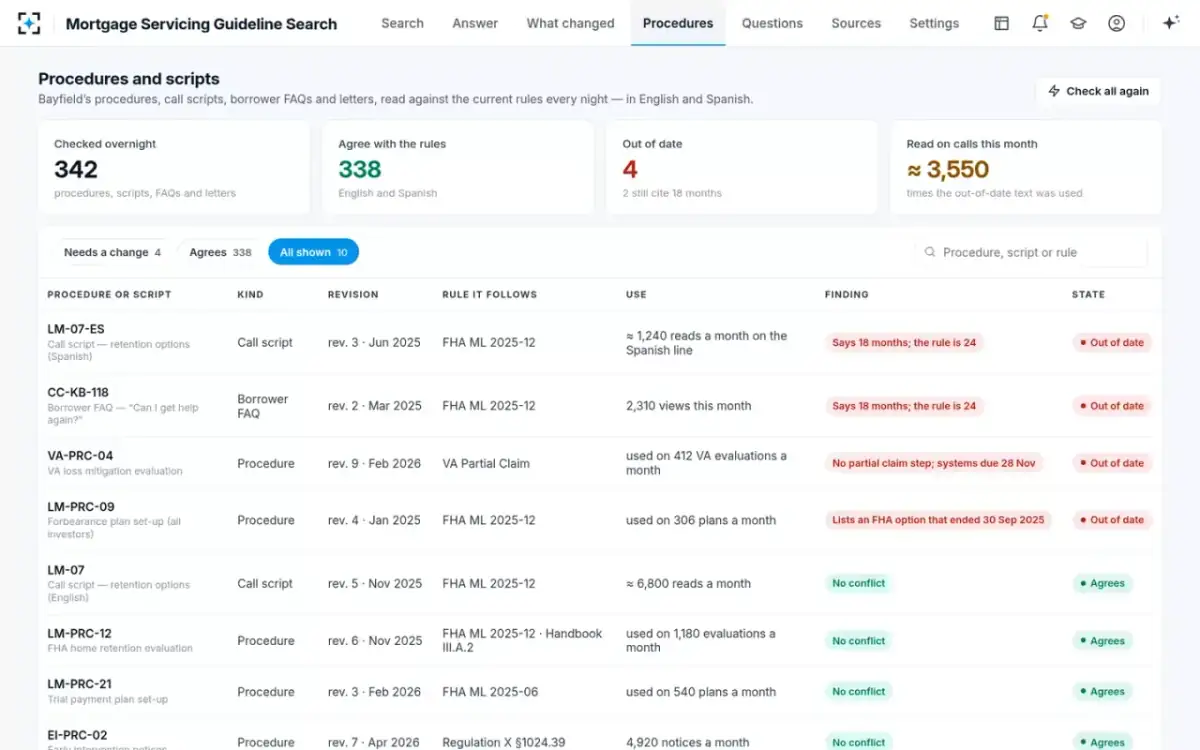
Mortgage Servicing Guideline Search checks your own copies, which a general knowledge base never does
How to measure the cost per question before you buy
Run a short trial on questions your floor has already answered, and measure the three gains in the formula rather than accepting anyone’s estimate. Two weeks is enough if the questions are chosen well: the ones that were escalated, the ones that changed in the last year, and the ones asked in a second language. The table sets out what to measure and how, and the same evidence later becomes the business case.
A two-week trial that prices one servicing answer
| Measure | How to take it | What it feeds in the formula |
|---|---|---|
| Minutes per question by hand | Timestamps on 30 escalated questions from last month: asked, answered, sources opened | Search time saved |
| Minutes per question with the tool | The same 30 questions, timed from question to an answer a lead would send | Search time saved |
| Agreement with your leads | For each question, did the cited answer match the lead’s? Where not, who was right? | Wrong answers avoided |
| Out-of-date copies found | Load your scripts and FAQs; count conflicts with the current rule, by language | Wrong answers avoided |
| Honesty when sources are silent | Include five questions no source answers; count the “no passage found” replies | Risk the tool adds |
| Lead minutes on escalations | Lead time per escalated question, before and with cited drafts | Lead time on escalations |
The fourth row tends to surprise buyers. Out-of-date copies are invisible until something reads them against the rule, and they are read constantly: in the solution’s fictional sample month, two documents still quoting a replaced FHA limit were read or viewed about 3,550 times between them. Each of those reads was a chance to give the borrower on the line the wrong number, and none of them would have shown up in a time-and-motion study of the search.
Where Mortgage Servicing Guideline Search fits, and where it does not
It fits where the cost in this guide sits: questions whose answer depends on an investor’s rule, a date and the servicer’s own procedures, asked by representatives, loss mitigation staff and compliance. It answers for FHA, VA, Fannie Mae, Freddie Mac and USDA together, reads the loan behind the question, keeps only the passages in effect, flags scripts that disagree, and leaves the decisions to a team lead and compliance. In the sample, one question was answered for all five investors in six seconds from 82 passages.
It is not a contact center platform: it does not route or capture calls or replace the CRM. It does not answer borrowers directly, decide eligibility or run the loss mitigation calculation; those stay with people and with the servicer’s decisioning tools. It is not the place for the servicer’s product FAQs, which a general knowledge base handles well. And it is only as complete as its library: the servicer brings its procedures and scripts, and access to the investor guides it already subscribes to, as described in AI in mortgage servicing on the guides you already have.
Questions people ask
What is a good escalation rate for a call center?
There is no published standard for servicing. In the solution’s sample month 4.1% of 3,912 guideline questions went to a team lead; the more useful signal is the trend by topic, because a spike usually means a rule moved before the approved answer did.
Is a call center knowledge base template enough for mortgage servicing?
A template organises articles; it does not track effective dates or later letters. For servicing, each article that restates an investor rule needs the passage it follows and a check when that passage changes, or it becomes the out-of-date script examiners find.
How do you calculate the ROI of a call center knowledge base?
Add search time saved, lead time saved on escalations and the cost of wrong answers avoided, and subtract licence, integration and upkeep. Price minutes with your own loaded wage; BLS gives a median of $24.05 an hour for loan interviewers and clerks as a floor.
Can we build this on the knowledge base we already have?
You can store investor articles there, but someone must reconcile each one with every new letter and bulletin by hand. The work a servicing-specific tool adds is that reconciliation: version chains, effective dates and a nightly check of your copies against the rule.
What does one wrong answer cost a servicer?
It varies with what the borrower does next. Examiners have required servicers to refund late fees and correct credit reporting, and a delayed workout keeps a loan in the non-performing group, which MBA costs at $1,573 a year against $176 for a performing loan.