A mortgage quality control plan template has to cover twelve things to satisfy the three rulebooks most lenders answer to: purpose and scope, governance, independence and staffing, quality standards and severity levels, sample selection, timelines, review scope and re-verification, findings and rebuttal, reporting and corrective action, self-reporting, vendor oversight, and records with an audit of the QC function. Fannie Mae lists the minimum contents of the plan in Selling Guide D1-1-01; HUD sets FHA's in section V.A of Handbook 4000.1; VA's are in 38 CFR 36.4352. The template below is written to the stricter rule on each line, so one plan can serve all three, and so that Mortgage QC Automation can run it as settings.
The plan matters more than its length suggests. It is the first document an investor, HUD's inspector general or a VA examiner reads, and it is the standard your own QC work is judged against: an audit asks whether you did what the plan says. Botminds' Mortgage QC Automation treats the plan as settings, the rules every closed loan is checked against, versioned and approved. That only works if the written plan is precise, which is the point of this template.
What a mortgage quality control plan must pin down
12
sections in a plan written to Fannie Mae, FHA and VA at once
This template
10%
minimum random sample, or a statistically valid one
Fannie Mae and FHA
30
days to self-report an ineligible loan to Fannie Mae
From the monthly report
3
years record retention, the longer of the two agency rules
FHA: 2 years from last action
What should a mortgage quality control plan include?
At a minimum, what Fannie Mae lists in D1-1-01: quality standards and measures (a QC philosophy, objectives, the risks to be measured and how independence is assured), operating procedures for everyone involved, a prefunding and post-closing file review process, a sample selection process covering every channel, product and underwriting method, reporting procedures, corrective action, vendor review, record retention for at least three years, and an audit of the QC program (Selling Guide D1-1-01). FHA adds institution-level reviews and its own clocks; VA adds a duty to report "major discrepancies". The checklist below sorts all of it into twelve sections.
The twelve sections of a mortgage quality control plan template
- Purpose, scope and philosophy
Which loans, channels and agencies the plan covers, and the risks it measures.
- Governance, ownership and approval
Who owns the plan, who approves changes, how versions are kept.
- Independence and staffing
Reporting lines away from production; minimum qualifications; training.
- Quality standards: defects, severity, targets
Defect categories, severity levels, a target defect rate for the top level.
- Sample selection
Prefunding, post-closing random and discretionary, third-party, early payment defaults.
- Timelines
Monthly selection, the 90-day Fannie Mae cycle, FHA’s 60-day clocks.
- Review scope and re-verification
Full-file and component reviews; what is re-verified and how.
- Findings, rebuttal and final grades
How a finding becomes a confirmed defect, and who decides.
- Reporting and corrective action
Monthly written reports, three-month trends, action plans with dates.
- Self-reporting to investors and agencies
Fannie Mae, FHA and VA: what, when, through which system.
- Vendor and technology oversight
The lender’s re-review of a QC vendor, and governance of any automated tool.
- Records, audit of QC and plan review
Retention, the independent audit, the annual reset of targets.
Sections 1–3: scope, governance and independence
Section 1, purpose and scope. Fannie Mae wants "a general overview of the QC philosophy", the plan's objectives and the "specific risks to be measured, monitored, and managed" (D1-1-01). FHA's program must "cover the lifecycle of an FHA-insured Mortgage" and all procedures "whether performed by the Mortgagee or outsourced" (4000.1, V.A.1.c). An FHA lender also lists its institution-level reviews here: employee and affiliate eligibility checks at least semiannually, escrow funds, premium remittance, advertising, cyber incidents and a monthly random sample of denied applications reviewed within 90 days for fair lending.
Fill-in wording · section 1
This plan governs quality control of all [first-lien / second-lien] residential mortgage loans that [Lender] originates, acquires or underwrites through its [retail / broker / correspondent] channels for sale to [Fannie Mae / Freddie Mac] or insurance or guaranty by [FHA / VA / USDA]. Its objective is to confirm that every loan is eligible as delivered, complies with applicable law and with [Lender]'s policies, and to find and correct the causes of defects. The risks measured are [income, assets, credit, collateral, occupancy, compliance, fraud, data integrity].
Section 2, governance and approval. Neither Fannie Mae nor FHA names who must approve the plan, so the plan should name it. A senior officer outside production, the head of quality or risk, typically owns it; the board or a risk committee approves material changes. FHA asks for the plan at approval ("The Mortgagee must submit a copy of its QC Plan") and requires it to be updated "as needed to ensure it is fully compliant with all applicable FHA requirements at all times" (4000.1, I.A.3). Date every version: an auditor will ask which version applied to the month under review.
Section 3, independence and staffing. Fannie Mae: QC employees "must be independent of the production, underwriting, and closing departments"; if the organization cannot separate them, the plan must give the rationale and the controls that compensate (D1-1-02). The lender must document "minimum job qualifications", and reviewers of complex files such as self-employed borrowers or collateral need the matching experience. FHA puts it in reporting-line terms (QC staff may not sit "within any chain of reporting or management that is directly connected to Loan Administration staff"), and VA says the system "should be independent of the mortgage loan production function" (38 CFR 36.4352(a)(9)). What the seat actually involves is set out in the mortgage QC analyst's real job.
Section 4: defect categories, severity levels and a target defect rate
This is the section most plans get wrong, by being vague. Fannie Mae requires a methodology to categorize every defect by severity; the lender defines its own levels, "however, the highest level of severity must be assigned to those loans with defects resulting in the loan not being eligible as delivered to Fannie Mae" (D1-1-01). A target defect rate must be set for at least that level, based on the post-closing random sample, measured at least quarterly and reset at least annually, with the rationale written down. FHA requires at least three risk categories (low, moderate, material) and month-to-month trend analysis; its own reviewers grade findings in four tiers.
Fill-in wording · section 4
Each defect is assigned one of three severity levels. Significant: the loan was not eligible as delivered (or, for FHA loans, a material finding, HUD Tier 1 or 2). Moderate: the loan is eligible but a material error must be cured, such as a tolerance refund or a missing disclosure. Minor: no effect on eligibility; counted in trends. The target rate for significant defects in the post-closing random sample is [x]%, set on [date] because [rationale], measured quarterly and reviewed each [month] by [committee].
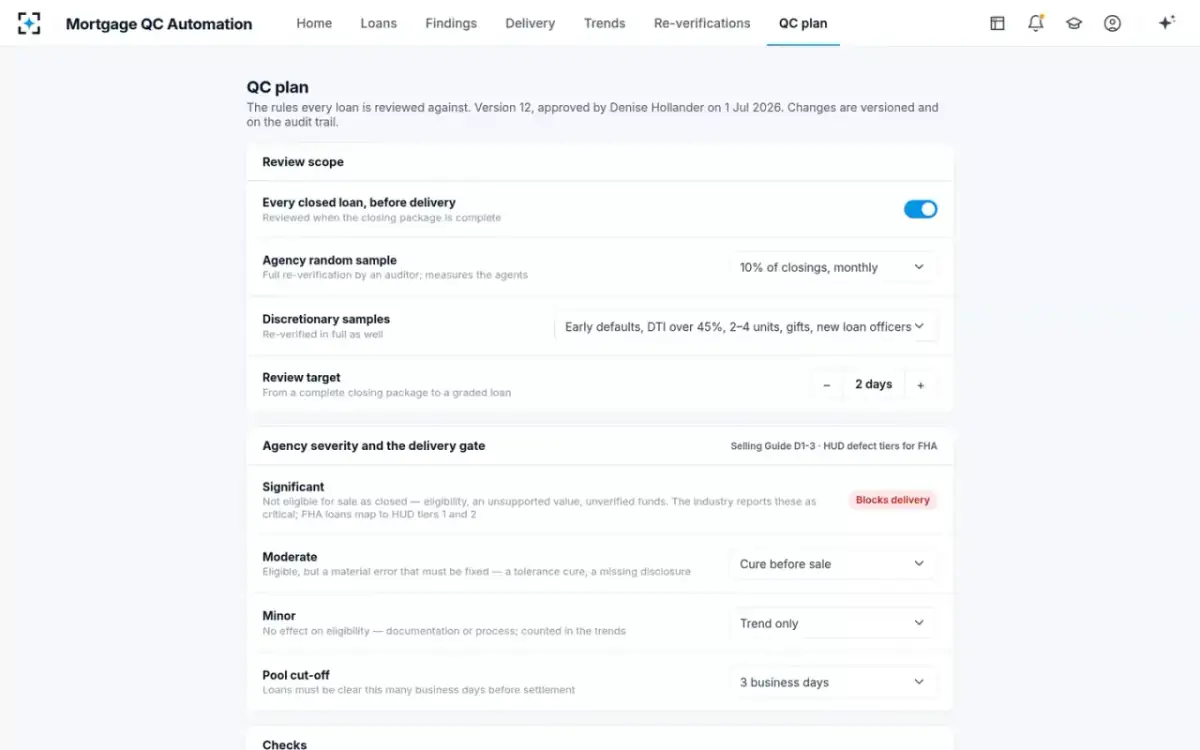
The severity scale is where the sample lender in this series, Halden Ridge Home Loans (fictional), set its rules for sale: a significant finding holds the loan from its pool, a moderate one must be cured before sale, a minor one is trended. How to choose the target number, and what the random sample can and cannot measure, is in the guide to Fannie Mae's target defect rate.
Sections 5–7: samples, timelines and what each review covers
Section 5, sample selection. Write the method so a stranger could repeat it. Post-closing: a random 10% of monthly production or a statistical sample at 95% confidence, 2% precision and a six-month statement, full-file, with retail and third-party originations stratified (D1-3-01); for FHA, 10% or a stratified sample at 95% confidence with an interval of no more than 2%, at least 90% post-closing, and every early payment default on top (4000.1, V.A.3.a). Prefunding: a monthly sample from every production channel (D1-2-01). Discretionary: the risks you target this year, including early payment defaults, and how you will change them. HUD requires that the lender "document how the sample size and selections were determined", and the inspector general checks: at Neighborhood Loans, the QC manager selected only early defaults with certain default codes, and 117 of 141 were never reviewed (HUD-OIG 2025-NY-1004).
Section 6, timelines. State each clock with its start: Fannie Mae's 90 days "from the month of the disbursement date" for selection, review, rebuttal and reporting; FHA's 60 days from the end of the month for post-closing and early payment default reviews; FHA's 60, 30 and 60 days for initial findings, senior management and the final report. Add what happens when you fall behind: Fannie Mae requires written notice if the cycle is in arrears by more than one 30-day cycle.
Section 7, review scope and re-verification. List the review areas (Fannie Mae D1-3-02 and the FHA table in V.A.3.c are the minimum) and the re-verifications: income and employment, tax transcripts by Form 4506-C, assets and gifts, a new credit report, property and value, occupancy. Say when component reviews replace full-file reviews; Fannie Mae allows them in prefunding and discretionary samples but not in the post-closing random sample.
The twelve sections, and what each rulebook asks of them
| Section | Fannie Mae Selling Guide | FHA Handbook 4000.1 | VA, 38 CFR 36.4352 |
|---|---|---|---|
| 1 Scope | Philosophy, objectives, risks (D1-1-01) | Whole lifecycle, outsourced work included (V.A.1) | Compliance with VA requirements |
| 2 Governance | Format not prescribed | Plan submitted at approval; kept current at all times | Findings furnished to VA on demand |
| 3 Independence | Independent of production, underwriting, closing (D1-1-02) | Outside any reporting chain to production (V.A.2.a) | Independent of production |
| 4 Severity, targets | Top level = ineligible as delivered; target rate, quarterly | Low, moderate, material; monthly trend (V.A.3.b) | — |
| 5 Samples | 10% or 95/2/six-month; discretionary; TPO strata | 10% or stratified 95/2; ≥90% post-closing; all EPDs | Discretionary sampling referenced for appraisals |
| 6 Timelines | 90-day cycle from disbursement month | 60-day reviews; 60/30/60 findings | — |
| 7 Review, re-verification | Full file; six re-verifications (D1-3-03) | Review table; new credit report; re-verify | Documentation and underwriting judgment |
| 8 Findings, rebuttal | Rebuttal inside the 90 days; rebuttal records kept | Material and mitigated findings defined | Prompt corrective measures |
| 9 Reporting | Monthly, written; 3-month trends; law vs eligibility | Senior management; trend analysis | — |
| 10 Self-reporting | Loan Quality Connect, 30 days | Loan Review System; fraud immediately, else 90 days | Major discrepancies reported to VA |
| 11 Vendors | Lender re-reviews 10% of vendor sample monthly | Lender fully responsible for contractor | — |
| 12 Records, audit | 3 years; independent audit of QC | 2 years from last mitigation action | — |
Sections 8–10: findings, reports and self-reporting
Section 8, findings, rebuttal and final grades. Say who raises a finding, who can rebut it, how long rebuttal lasts and who makes the final call. Fannie Mae treats rebuttal as part of the 90-day cycle and expects "successful rebuttal documentation" in the QC records; where independence is not evident, it wants loan-level documentation "that supports changes to audit decisions made during the review and rebuttal process". FHA defines a material finding as one whose disclosure "would have altered the Mortgagee's decision to approve the Mortgage". Write the definitions into the plan word for word.
Section 9, reporting and corrective action. Reports must be "in writing and shared with management monthly", use consistent categories and severity levels, trend defects over at least three months, show the top-severity rate against its target at least quarterly, and split defects under applicable law from underwriting and eligibility defects (D1-1-03). When a trend appears, the plan must require a written action plan "including the expected resolution and the time frame for implementation and completion".
Section 10, self-reporting. Fannie Mae: within 30 days of the date the loan appears in the published monthly post-closing report, through Loan Quality Connect, with the supporting documents. FHA: fraud or material misrepresentation "immediately"; other material findings the lender cannot mitigate within 90 days of the initial findings report, through the Loan Review System. VA: "Any cases involving major discrepancies which are discovered under the system must be reported to VA." Name the person who decides and signs each report.
An auditor reads the plan first and the loan files second. A plan that says "as appropriate" where the rule says "30 days" fails on the first read.
Sections 11–12: vendors, technology, records and the QC audit
Section 11, vendor and technology oversight. If a vendor does any QC reviews, Fannie Mae requires the lender to "perform a monthly review of at least 10% of the post-closing QC sample reviewed by the vendor", including loans with and without defects, done by the lender itself, and to report concurrence rates within 30 days of the final monthly QC report (D1-1-02). Extend the same logic to software. If agents or any automated tool read files or propose grades, the plan should say what they do, what they may never do, how a person confirms their output, and how their accuracy is measured. Fannie Mae's Lender Letter LL-2026-04 (April 2026) now asks sellers that use AI or machine learning in origination to govern it, vendors included.
Section 12, records, audit and plan review. Keep QC records "for at least three years" for Fannie Mae; FHA's rule is two years from the initial review or the last mitigation action, whichever is later. Fannie Mae also requires "an independent audit process" over QC itself, which must assess "whether other business units influenced or attributed to bias in the QC decision" and end in a written statement (D1-1-01). Review the plan at least once a year, when targets are reset, and whenever a rulebook changes. FHA's Handbook Update 18 is one such change, with a 10 November 2026 implementation date.
The QC plan as settings in Mortgage QC Automation
Do mortgage brokers need a quality control plan?
A broker that holds no agency approval of its own is not bound by these sections directly, but its loans are. Fannie Mae requires sellers to sample third-party originations separately each month and report their defects to management (D1-1-01); FHA makes a lender "responsible for the actions of its sponsored TPOs" (4000.1, I.A). Sponsoring lenders therefore ask their brokers for a written QC plan, and state licensing rules may require one too; check your state regulator's. A broker's plan is shorter: scope, independence, a monthly sample, findings and corrective action, and records.
Searches for a free broker template are common. A downloaded template is a starting point, never a finished plan, because the test of any plan is whether it describes what your staff actually do. Fill in every bracket with your own numbers, delete what you do not do, and date it.
From written plan to daily work
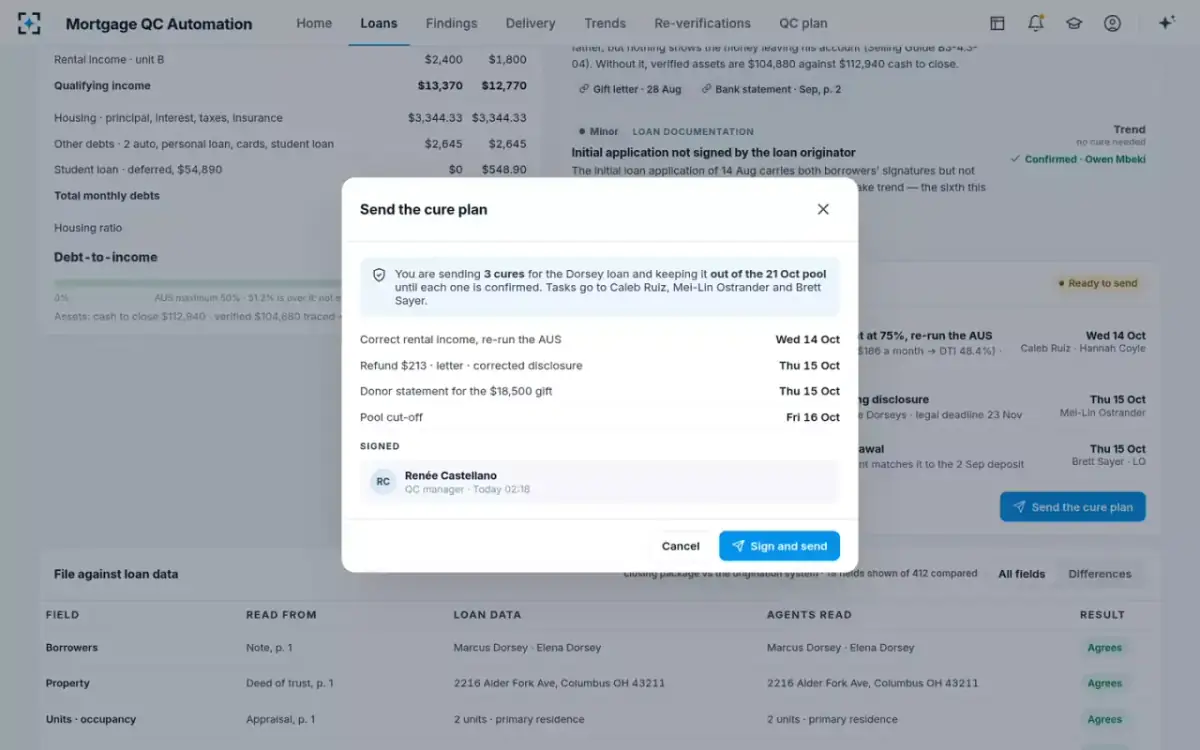
A plan written this precisely can be run, not just filed. In Botminds' Mortgage QC Automation the plan's settings decide what every closed loan is checked against, what each grade does to its sale, and who may release a held loan. When agents find a significant defect, the plan's corrective-action and cure rules turn into tasks with owners and dates, signed by the QC manager.
Sections 8 and 9 in Mortgage QC Automation: a cure plan with owners
Questions people ask
Is there a free mortgage quality control plan template?
Neither Fannie Mae nor HUD publishes a fill-in plan; Fannie Mae lists required contents in D1-1-01 and leaves the format to the lender. The twelve sections on this page cover those contents and FHA's and VA's, and can be copied as an outline. Any template must be rewritten to describe your own process.
Who must approve a mortgage QC plan?
The rulebooks do not name an approver. Common practice is a senior officer independent of production owning the plan and a board or risk committee approving material changes. FHA requires the plan with an approval application, and Fannie Mae can ask for QC records, reports and audit materials at any time.
How often must a mortgage QC plan be updated?
Whenever requirements change, and at least once a year in practice. Fannie Mae requires target defect rates to be evaluated and if necessary reset at least annually, and FHA requires the plan to stay fully compliant "at all times", which means updating it for each Handbook change.
What does HUD require in a quality control plan?
A written plan covering the full FHA loan lifecycle and any outsourced work: independent staff, sample size and selection, pre- and post-closing reviews, every early payment default, a loan sample risk assessment, findings timelines, self-reporting through the Loan Review System, institution-level reviews and records kept at least two years.
What does VA require in a quality control plan?
For lenders with automatic authority, a written quality control system independent of production that keeps VA underwriting standards in each office, takes prompt corrective action, reviews underwriting decisions for compliance and soundness, reports major discrepancies to VA, and furnishes its findings to VA on demand.