Mortgage QC vendors are firms that perform a lender's quality control reviews under contract: post-closing full-file reviews of the random and discretionary samples, prefunding reviews, re-verifications, appraisal reviews and the monthly reporting. Outsourcing is allowed by Fannie Mae and FHA, but neither lets the lender outsource the responsibility. Fannie Mae "holds the lender fully accountable for its overall QC program ... regardless of whether the work is performed by the lender itself or by an outsourced QC vendor", and requires the lender to re-review at least 10% of the vendor's work every month (Selling Guide D1-1-02). The same rules apply whether the reviewer is a vendor, your own staff or Mortgage QC Automation.
That re-review is also the fairest way to test anything new. Botminds' Mortgage QC Automation uses agents to review every closed loan before it is sold; the honest way to decide whether to rely on it is to run it for one month beside the vendor you already pay, on the same loans, and count. This page explains what vendors do, what you owe when you use one, and how to run that month.
What Fannie Mae requires of a lender that uses a mortgage QC vendor
100%
of accountability stays with the lender, vendor or not
D1-1-02
10%
or more of the vendor’s post-closing sample re-reviewed by the lender each month
Loans with and without defects
30
days to report the re-review after the final QC management report
With concurrence rates
0
parts of that re-review that may be contracted out
“performed by the lender itself”
Who are the mortgage QC vendors, and what do they sell?
The market sorts into five kinds of service, and most firms offer several. Outsourced post-closing QC, the core product, puts the vendor's auditors on your monthly random and discretionary samples, to your QC plan, with findings and a monthly report. Prefunding QC reviews a sample before closing. Re-verification services handle employment, deposit and transcript requests. Appraisal review services provide desk and field reviews. And QC software platforms, some sold by the same firms, run the workflow. This page names categories, not companies: searches for "mortgage QC companies" and "mortgage quality control companies" return firms of every kind, and the questions below apply to all of them.
What every vendor sells, underneath, is trained reviewer capacity that flexes with your volume. That is valuable: a QC department sized for the peak month is idle in the slow one, and the cycle has hard clocks. It is also the vendor's limit. Its reviewers face the same queue, the same re-verification waits and the same hiring market as yours. When HUD's inspector general audited Flat Branch in 2025, the staffing constraints behind its late reviews "impacted both Flat Branch and its contractor for post-closing reviews, resulting in backlogs" (HUD-OIG 2025-NY-1003).
Should I outsource mortgage QC?
Outsource the capacity if you need it, never the program. Fannie Mae is explicit that "The lender's contract for services is not a substitute for the lender establishing and maintaining its own QC plan", that the vendor must review "in accordance with the lender's QC plan", and that the lender "must fully incorporate the results of the vendor's reviews into its QC reporting and remediation processes", assigning severity levels and corrective actions "the same as it would for defects identified by the lender's own QC staff" (D1-1-02). FHA's version: the lender "assumes full responsibility for the contractor's conduct of QC reviews", needs a contract setting out roles, and must keep contractor staff out of the loan processes they review (4000.1, V.A.2.a).
In practice outsourcing works best for lenders too small to staff a specialist bench (self-employed income, collateral review) or too seasonal to staff the peak, and worst when the lender treats the vendor's monthly report as its QC program. The required 10% re-review is where the difference shows: Fannie Mae wants it to include "loans for which the vendor identified defects and for which no defects were identified", and the report on it must show "a description of the sample selected for review, concurrence rates, and discrepancies identified by the lender". A lender with low concurrence and no follow-up has a vendor problem and a QC problem.
How do I compare mortgage QC vendors?
On the things the rules make you answer for, measured on your own loans. Price per file matters, but a cheap review that misses a significant defect is the most expensive thing a QC department can buy, because the finding then arrives as a repurchase request or an FHA indemnification demand. The questions below apply equally to a vendor, a software product or agents.
Seven questions for any mortgage QC vendor or tool
- Do they review to your QC plan, or to theirs?
Fannie Mae requires your plan; their checklist must map to your severity scale and defect categories.
- What is their concurrence with your own re-review?
Ask for the rate by severity, on your loans, and what they changed when you disagreed.
- How long from selection to a reported finding?
Inside Fannie Mae’s 90-day cycle and FHA’s 60-day review clock, with room for rebuttal.
- Who are the reviewers, and how qualified?
You must document minimum qualifications, and confirm the vendor’s staff meet them.
- Does every finding cite its evidence?
A finding without its page slows your re-review and weakens a rebuttal.
- What happens at volume peaks?
Backlogs at a contractor are your backlog; ask for last year’s peak-month turnaround.
- If they use AI, who governs it?
Fannie Mae’s LL-2026-04 asks you to manage the risks of your vendors’ AI use, not just your own.
Can I run AI QC alongside my QC vendor?
Yes, and alongside is the right way to start. Nothing in the rules prevents a lender from reviewing more loans than the sample, and running agents on every closed loan while the vendor reviews the sample as usual gives you a controlled comparison on the loans both reviewed. It also tells you what the vendor never sees: the defects in the other 90%. The vendor and the agents do different jobs, and the comparison should be read that way.
Mortgage QC vendors and Mortgage QC Automation do different jobs
Your mortgage QC vendor: The random and discretionary samples you send: 10% or a statistical sample, plus targets
Agents in Mortgage QC Automation: Every closed loan, as soon as its closing package is complete
Your mortgage QC vendor: Within the vendor’s turnaround, inside the 90-day Fannie Mae cycle
Agents in Mortgage QC Automation: Before the pool cut-off; median 1.4 days from a complete package to a graded loan in the sample data
Your mortgage QC vendor: Done by the vendor’s staff or your own
Agents in Mortgage QC Automation: Ordered and tracked by an agent for the samples; exceptions go to people
Your mortgage QC vendor: Vendor reviewers propose; you assign final severity
Agents in Mortgage QC Automation: An agent proposes with the evidence; your auditor confirms or rebuts
Your mortgage QC vendor: Experienced reviewers, at their capacity
Agents in Mortgage QC Automation: Your auditors, starting from the recalculation and the page
Your mortgage QC vendor: Re-review ≥10% of their sample monthly; incorporate results
Agents in Mortgage QC Automation: Draw and fully re-verify the random sample yourself; measure the agents on it
How to run a one-month mortgage QC pilot on your own loans
Pick one month of closed loans, ideally a normal month with your usual product and channel mix, and set up three things before it starts. First, load your QC plan as settings: severity levels, defect categories, the overlays your underwriters apply. Second, agree with your vendor that nothing changes on their side; they review their usual sample to their usual turnaround. Third, name the auditor, independent of both, who will adjudicate every disagreement. Then let the month run.
A one-month pilot runs as long as your vendor's cycle
- Set up: plan, severity scale, sample files2 wk
- Pilot month: loans graded as packages complete1 month
- Auditor confirms or rebutsongoing
- Same set-up period2 wk
- Pilot month closes1 month
- Vendor selection, review, rebuttal, report≈75 d
- Waiting for both sides≈4 months
- Adjudicate and decide2 wk
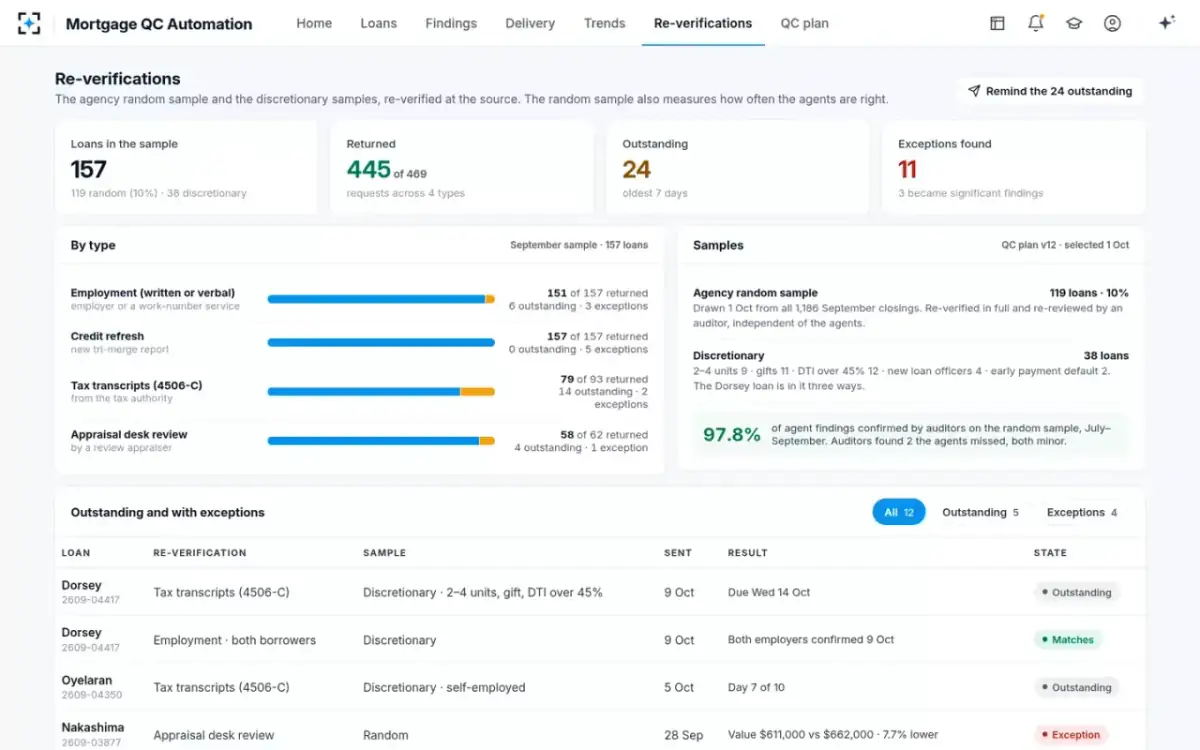
Take Halden Ridge Home Loans, the fictional sample lender in this series, as a worked example. It closes 1,186 loans in September, so its random sample is 119 loans, plus 38 discretionary. The agents grade all 1,186 as their packages complete; the vendor and the lender's auditor review the sample as usual. On the 119 random loans, three comparisons become possible, and on the other 1,067, a fourth.
What should a mortgage QC pilot measure?
Four numbers, each with counts, not just rates. Adjudicate every disagreement with an independent auditor before counting it; the vendor is not automatically right, and neither are the agents.
The four measures of a side-by-side QC pilot, and the marks to set before it starts
| Measure | Where it is counted | How to read it | Mark to set in advance |
|---|---|---|---|
| Agreement on significant defects | The sample both reviewed | Of loans the auditor confirms as significant, how many each side found | No confirmed significant defect missed by the agents |
| Agreement on all findings | The sample both reviewed | Concurrence by severity, as in Fannie Mae’s vendor re-review | At least your current vendor concurrence |
| Additional confirmed findings | The loans outside the sample | Findings the auditor confirms on loans no sample read | Reported, not scored: this is what the sample never saw |
| False flags | Every loan | Agent findings the auditor rejects, per 100 loans, with reasons | Low enough that confirming them costs less than reading files |
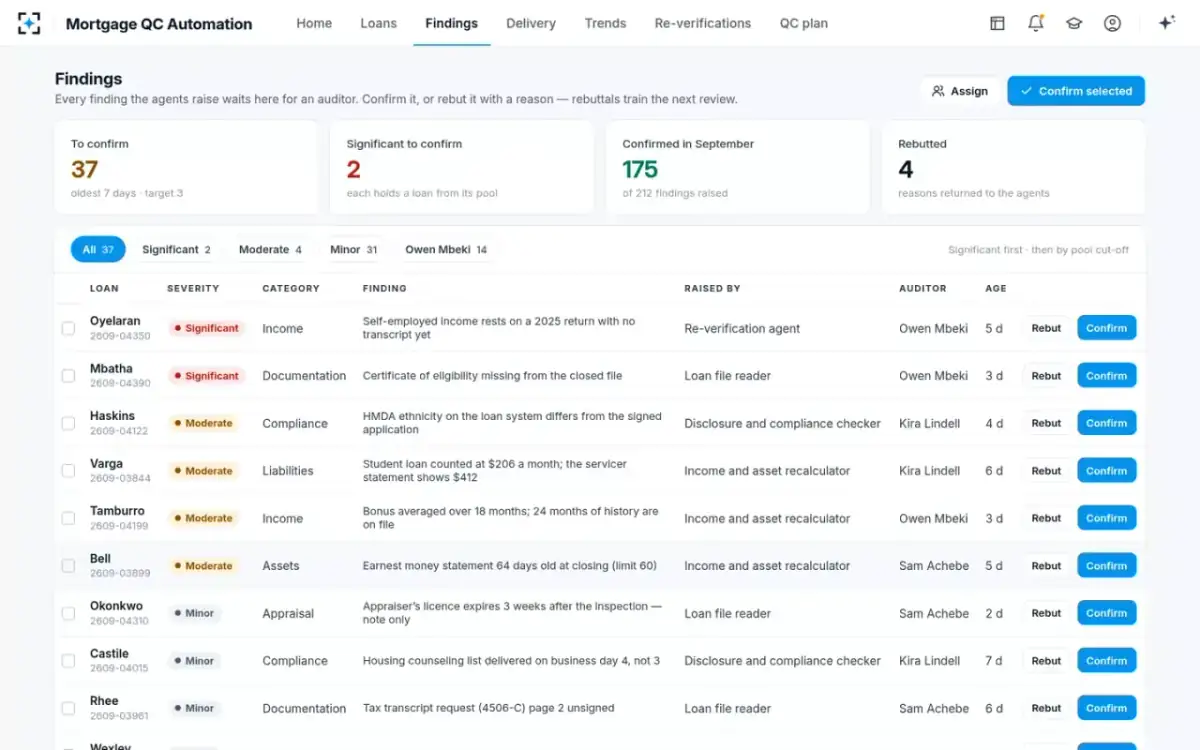
The third measure is the reason to run the pilot at all, and it needs care: findings on loans outside the sample are real only once your auditor confirms them, and each one should be graded on your scale. In the sample lender's September, the agents held 14 loans with significant defects from their pools; a 10% sample would have been expected to contain about one or two of them. The fourth measure is the cost side. In the sample data the auditors rebutted 4 of the September findings and returned the reasons to the agents; the solution's findings queue shows the count so it can be trended.
The random sample measures the agents during the pilot
How long does a mortgage QC pilot take?
One month of closings, plus however long your vendor takes to report that month, plus a couple of weeks to adjudicate: in practice three to four months elapsed, of which the lender's own effort is concentrated in set-up and adjudication. You will have early signals much sooner, since the agents grade loans within days of the closing package, but resist deciding on them. The point of the pilot is the comparison, and the comparison needs the vendor's finished results.
Two things lengthen pilots unnecessarily. One is choosing an unusual month, such as a refinance surge, a new product launch or a channel change, which makes neither side's numbers representative. The other is changing the vendor's scope during the pilot. Keep everything the same except the extra reviewer.
After the pilot: vendor, agents, or both
Three outcomes are common, and all are legitimate. Keep the vendor and add agents to review every loan before sale, with the vendor's sample as the independent check. Bring the sample in-house, with agents doing the reading and your auditors the judgment, and keep a vendor for specialist work such as appraisal field reviews. Or keep things as they are, if the agents missed what your auditor confirmed. Whatever you choose, write it into the plan: Fannie Mae's reporting rule expects the monthly report to "include the final results of the 10% QC vendor review" if you use one (D1-1-03), and automated tools deserve a section of their own.
Model risk and internal audit will want the pilot's evidence, and the Federal Housing Finance Agency's guidance to the agencies explains why: uses of AI that "invoke compliance with laws and regulations" warrant "more robust risk management" (FHFA Advisory Bulletin 2022-02). The four measures above, kept running every month on the random sample, are that evidence. Neighborhood Loans moved its early payment default reviews from a third-party vendor in-house in 2022, its management response to HUD-OIG notes (HUD-OIG 2025-NY-1004); whichever way a lender moves, the inspector general audits the result against the same Handbook. The QC plan section on vendors and technology is drafted in the mortgage QC plan template, and the agents' division of labor is in six agents, and the grade none of them gives.
In Mortgage QC Automation every finding waits for your auditor
Questions people ask
What are mortgage quality control companies?
Firms that perform QC work for lenders under contract: post-closing and prefunding file reviews, re-verifications, appraisal reviews, reporting and sometimes QC software. They work to the lender's QC plan, and the lender remains fully accountable for their results under Fannie Mae and FHA rules.
Can a QC vendor do the lender's 10% re-review?
No. Fannie Mae requires the lender to review at least 10% of the vendor's post-closing sample every month itself, and says that review "may not be contracted out". The sample must include loans with and without vendor-identified defects.
How many loans does a mortgage QC pilot need?
A full month of closings gives the agents the whole population and leaves the vendor's usual sample as the overlap. For a lender closing about 1,200 loans a month, that overlap is around 120 random loans; smaller lenders may need two months for enough significant defects to compare.
Do FHA rules allow outsourcing QC to a contractor?
Yes, if the lender assumes full responsibility for the contractor's reviews, has a contract defining each party's role, keeps its own written QC Plan and ensures contractor staff do not take part in the loan processes they review.
What is a good concurrence rate with a QC vendor?
Fannie Mae does not set one; it requires the lender to report the rate and the discrepancies. Track it by severity: disagreement on minor findings is a calibration issue, while a missed significant defect calls for a root-cause review of the vendor's process.