Fannie Mae's post-closing QC requirements ask a lender to select loans for review at least every month, to draw a random sample of 10% of monthly production or a statistically valid sample, to review every random selection as a full file with re-verification at the source, and to finish the whole cycle (selection, review, rebuttal and reporting) within 90 days from the month the loans were disbursed. A loan found ineligible as delivered must then be self-reported to Fannie Mae within 30 days. The rules sit in chapter D1-3 of the Selling Guide, with the program rules in D1-1, and they apply to every lender that sells loans to Fannie Mae. They are also the rules Mortgage QC Automation is configured to.
The work is hard because it is slow by design: re-verifications go out to employers, banks and the IRS and come back on their schedule, not the lender's, and a full-file review of a 1,000-page closing package takes an experienced auditor most of a day. Mortgage QC Automation is Botminds' answer to that: agents that read every closed loan before it is sold and grade each defect, while the Fannie Mae sample is still drawn and re-verified by people. This page explains the requirements first; the solution comes in where it changes the work.
Four numbers carry most of Fannie Mae's post-closing QC requirements
10%
random sample of monthly production, or a statistically valid sample
Selling Guide D1-3-01
90
days for the entire cycle: selection, review, rebuttal and reporting
From the month of disbursement
30
days to self-report a loan found ineligible as delivered
From the monthly report date · D1-1-01
3
years minimum retention of QC findings, reports and re-verifications
D1-1-01
What are Fannie Mae's post-closing QC requirements?
They are the rules for checking loans after they close: which loans to pick, what to check on each, how fast, and what to do with what you find. Fannie Mae puts the program-level rules in chapter D1-1 (the written QC plan, severity levels, target defect rates, reporting, self-reporting, records and audit) and the post-closing review itself in chapter D1-3, in three topics: D1-3-01 on timing and selection, D1-3-02 on the review of the underwriting decision and the data, and D1-3-03 on re-verification. All three topics carry the date 04/01/2026 in the current Guide.
The purpose is stated plainly in D1-1-01: the program must "guard against fraud, negligence, errors, and omissions" by everyone in the mortgage process, from officers and employees to brokers, appraisers and vendors, and "Lenders that fail to maintain an effective QC program will be in breach of their contractual obligations with Fannie Mae" (Selling Guide D1-1-01). Post-closing QC is a contract term, not a best practice. That is why practitioners search the topic numbers: "d1-3-01" is itself an autocomplete suggestion.
How many loans must be sampled for Fannie Mae post-closing QC?
At least 10% of each month's production, chosen at random, or a statistically valid random sample; the lender picks the method. If you choose the statistical route, the model must use "a 95% confidence level with a 2% precision rate and a statistical statement of six months" (D1-3-01). Either way the random selections "must be completed using full-file reviews", and if 10% is less than one loan, one loan is reviewed.
The 10% sample is not a free draw from a hat. The loans selected must represent the whole book: every loan type, every branch, manually underwritten loans and loans run through each automated underwriting system. Retail and third-party originations are sampled separately, as two strata, and D1-1-01 adds a monthly full-file stratified sample of third-party originations unless they number 100 loans a year or fewer. Take Halden Ridge Home Loans, a fictional lender whose September runs through Botminds' Mortgage QC Automation on this page: 1,186 closings make a 10% sample of 119 loans.
On top of the random sample sits the discretionary sample. Its selections "supplement, but do not replace" the random sample. It must target the areas the lender sees as error-prone and loans at high risk of misrepresentation or fraud, "including early payment defaults" (D1-3-01). The sample lender's September discretionary sample is 38 loans: 2–4 unit homes, gift funds, debt-to-income ratios over 45%, new loan officers and early defaults. The random sample is the one that counts for the defect rate; the discretionary sample is where you look for trouble. What the random sample can and cannot tell you about your defect rate is a page of its own.
What is the timeline for post-closing QC per Fannie Mae?
Loans are selected at least monthly, and "The entire QC cycle (selection, review, rebuttal, and reporting) must be completed within 90 days from the month of the disbursement date" (D1-3-01). For loans the lender buys from others, the clock runs from the acquisition month. Rebuttal is inside the 90 days, which surprises teams who treat the review as done when the auditor finishes: a finding argued with production for three weeks uses three of the twelve.
The Guide also covers falling behind. "If the lender's QC cycle is in arrears more than one 30-day cycle, the lender must provide written notice to its Fannie Mae customer account team or QC Specialist." A QC department that is two months behind is a reportable condition, which is why staffing for the peak month matters more than staffing for the average.
Ninety days is the whole cycle, and re-verification eats most of it
- Select and order re-verifications10 d
- Waiting on employers, banks, IRS35 d
- Full-file review20 d
- Rebuttal with production15 d
- Report to management10 d
- Select and order10 d
- Waiting on re-verifications30 d
- Review20 d
Lenders that also sell FHA loans run two clocks at once. FHA's Handbook 4000.1 requires post-closing reviews "within 60 Days from the end of the prior one-month period" (HUD Handbook 4000.1, V.A.3.a), so a mixed shop that plans to Fannie Mae's 90 days will be late on its government loans. The differences go further than the clock; FHA quality control requirements in 4000.1 sets them side by side.
What does a full-file post-closing review cover?
A full-file review re-underwrites the loan from its documents. D1-3-02 asks the reviewer to confirm the loan was underwritten to Fannie Mae's requirements with "adequate support for the underwriting decision" in the file, and lists what must be evaluated, from the accuracy of the loan application to flood insurance and mortgage insurance coverage. It is the closest thing the Guide offers to a post-closing QC audit checklist.
What a Fannie Mae full-file post-closing review must evaluate
| Area | What the reviewer checks | Where the rule sits |
|---|---|---|
| Application and data | Accuracy and completeness of the loan application; data entered into DU; output of any third-party data tools | D1-3-02 |
| Underwriting decision | The decision is supported; every approval condition and DU verification message was satisfied | D1-3-02 |
| Credit, income, assets | Documents exist and are accurate; re-verified at the source | D1-3-02, D1-3-03 |
| Property | Appraisal or other collateral data; property and project eligibility; a collateral risk assessment | D1-3-02, D1-3-03 |
| Insurance | Property and flood insurance; mortgage insurance coverage required for the transaction | D1-3-02 |
| Legal and closing documents | Sales contract, note, recorded security instrument, assignment, title, final settlement statement | D1-3-02 |
| Data integrity | Final terms match the data used to underwrite; red-flag messages and SSNs resolved | D1-3-02 |
| Compliance with law | Applicable federal, state and local law, per A3-2-01 | D1-3-02 |
Two lines in D1-3-02 do more work than their length suggests. The first is the data check: "The lender must review the final terms of the loan to ensure they align with the data used to support the underwriting decisions." A loan whose note rate, loan amount or debts moved after the last DU run is a loan whose approval may no longer stand. The second is the instruction for that case: determine whether the difference is within the DU tolerances, resubmit to DU if it is not, decide whether the loan "remains eligible as delivered", and self-report it if it does not. If a loan that exceeds the tolerances is not resubmitted, the Guide says the DU limited waiver of representations and warranties "is invalidated".
What must be re-verified in Fannie Mae post-closing QC?
For every loan in the random sample, D1-3-03 requires re-verification of six things: "income and employment, income tax returns, assets, credit history, property eligibility and property value, and occupancy" (Selling Guide D1-3-03). And it states the consequence in one sentence: "If the reverification process reveals information that differs from what was used in underwriting, the lender must re-underwrite the loan to confirm its eligibility for delivery to Fannie Mae."
The Fannie Mae re-verification requirements, as a post-closing QC audit checklist
- Income and employment, for every employer in the documented period
If the file used a year of W-2s and a paystub, re-verify all of it. A verbal re-verification counts if you record the date, name, title and contact of the person.
- Tax returns, through IRS Form 4506-C
Required where returns supported income. Transcripts already pulled before closing can be reused instead of ordering new ones.
- Every source of funds for down payment, closing costs and reserves
Re-verified against the original documents to catch alterations. Gift funds are the classic gap.
- Credit history, with a new tri-merge report
It need not create a new inquiry. Reconcile its debts with the report used to underwrite.
- Property eligibility and value
A collateral risk assessment: LTV/CLTV/HCLTV, comparables, the reconciliation of value, CU flags. A desk or field review if you cannot complete it.
- Occupancy
From the insurance policy, appraisal, returns or leases; investigate red flags, for example with public listing data.
- The exceptions you are entitled to
Income, employment or assets validated by the DU validation service, with enforcement relief met and closing by the Close-by date, need not be re-verified.
- Failed attempts, written down
If a re-verification cannot be obtained, file the request date and the fact that nothing came back, and track the result.
The waiting in the timeline above is this checklist. Each item depends on a third party: an employer's payroll office, a bank, the IRS, an appraiser for a desk review. In the sample lender's September, the solution sent 469 re-verification requests for 157 loans (the 119 random and 38 discretionary). By the screen below, 445 had come back, 24 were outstanding with the oldest at 7 days, and 11 exceptions had been found, 3 of which became significant findings.
The random sample, re-verified at the source in Mortgage QC Automation
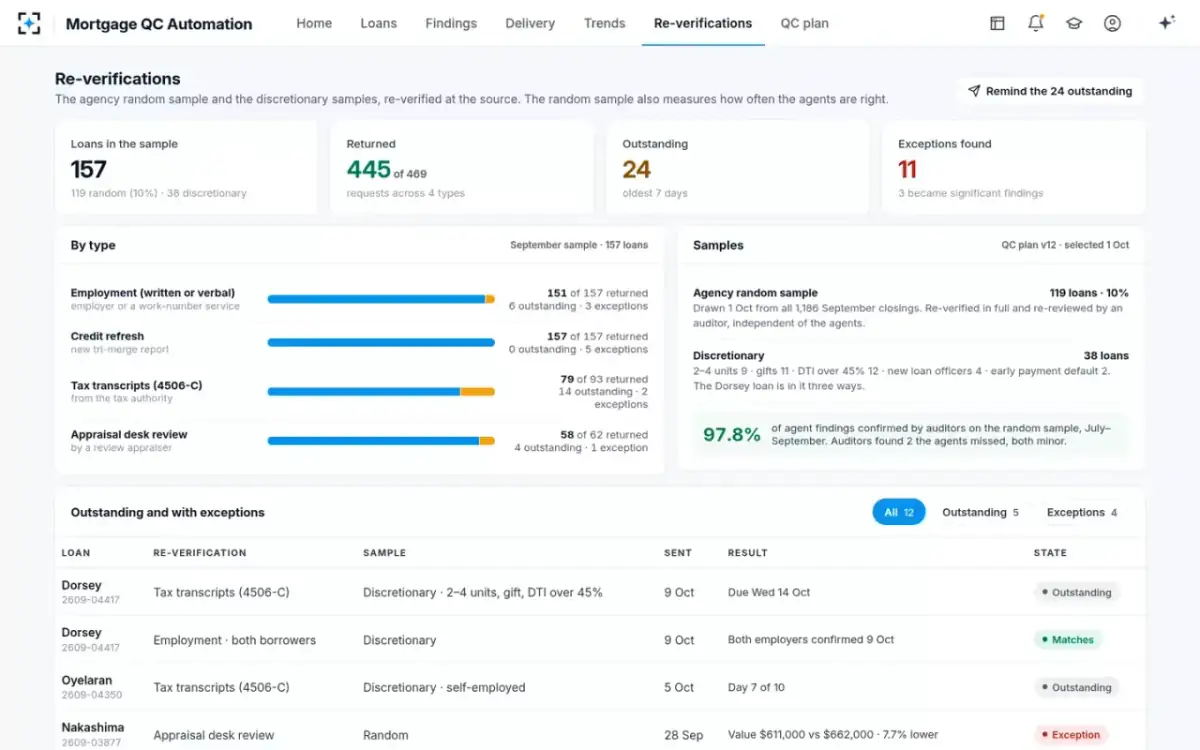
The panel on the right also shows how the random sample is used to check the agents themselves: 97.8% of agent findings confirmed by auditors from July to September in the sample lender's data.
When must defects be self-reported to Fannie Mae?
Within 30 days of the "date of confirmation" that a defect makes the loan ineligible as delivered, through the self-report function in Loan Quality Connect. The date of confirmation is defined: it "is the date the lender publishes its monthly post-closing report to management, and the loan is included in that report" (D1-1-01). The self-report must carry a summary of the findings and the documents that support them. Fannie Mae's own examples are telling: tax transcripts that show qualifying income was wrong, and a collateral risk assessment showing the property is not in acceptable condition.
The definition puts the self-reporting clock in the hands of the QC calendar. A significant defect found on day 20 of the cycle is not reportable until it appears in a published monthly report; one found on day 88 must still be in a report before the cycle closes. The severity scale matters here: D1-1-01 lets each lender define its own levels, but "the highest level of severity must be assigned to those loans with defects resulting in the loan not being eligible as delivered to Fannie Mae." That top level is the one that triggers the self-report. Suspected fraud runs on a separate track: under A3-4-03 a seller must notify Fannie Mae within 30 days once a reasonable basis exists to conclude misrepresentation or fraud occurred.
The self-report clock starts when the finding reaches a published monthly report, not when the auditor finds it. The 90-day cycle decides when Fannie Mae hears.
What goes in the monthly QC report?
D1-1-03 requires written monthly reporting to management, with consistent defect categories and severity levels. Post-closing reports must show the date published, how each sample was selected and what share of eligible loans it covered, results of random, discretionary and component reviews, "defect trending for at least three months", and, at least quarterly, the top-severity defect rate "benchmarked against its defined target rate" (Selling Guide D1-1-03). They must also separate defects under applicable law from underwriting and eligibility defects, and include the lender's own 10% re-review of any QC vendor's work.
When trends appear, D1-1-01 asks for a written action plan "including the expected resolution and the time frame for implementation and completion". In the sample lender's September that was the Westlake branch: 24.3 findings per 100 loans against 17.9 for the company, led by rental income on 2–4 unit homes counted in full, and a training action with a named owner and a due date.
How long must QC records be kept?
At least three years, for "all written and electronic records that are created as part of the QC review process", including QC reports, findings, re-verification documents, "successful rebuttal documentation" and corrective actions, and a copy goes to Fannie Mae on request (D1-1-01). FHA's retention rule is shorter but counted differently: two years from the initial review or the last action to mitigate a finding, whichever is later (4000.1, V.A.1.d). Keep the longer of the two for any loan both rules could reach.
Rebuttal documentation is the item teams forget. A finding that production argued away is still a decision someone made, and Fannie Mae can ask to see why. D1-1-02 goes further where QC is not clearly independent of production: the lender must keep "documentation at the loan level that supports changes to audit decisions made during the review and rebuttal process" (D1-1-02).
Where Fannie Mae's rules leave the other 90%
The requirements are a floor built for measurement. A 10% random sample tells a lender, with known error, how good its production is; it does not find the defects in the other 90%. And because the cycle runs 90 days from the month of disbursement, the review of a sampled loan often ends after the loan has been delivered. At the sample lender, the last September file closed on Thursday 24 September and was slotted for a pool settling on 21 October, weeks before a sampled review of it would have finished.
Nothing in D1-3 stops a lender from doing more. The Guide calls the random sample "a critical measure of loan quality", and that is the role it keeps in Botminds' Mortgage QC Automation: the agents read every closed loan as soon as its closing package is complete, run the lender's own checks, and propose a grade on the lender's severity scale, and an auditor confirms each finding. The Fannie Mae sample is still drawn, re-verified and reviewed in full by people, and it doubles as the test of the agents. The screen below shows the month both ways.
Mortgage QC Automation grades every loan; a 10% sample reads one in ten
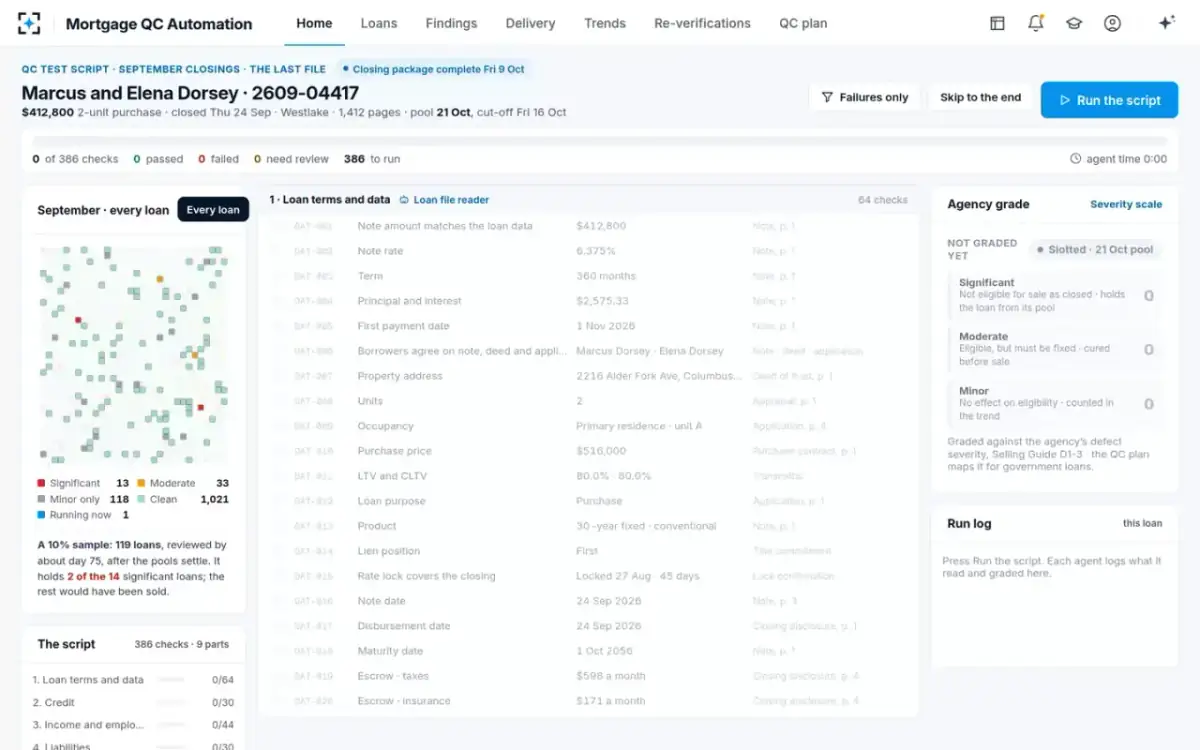
Whether to check every loan before sale is a business decision, not a Guide requirement, and it has costs of its own: the agents' findings must be confirmed by people, and the program has to be governed like any other tool that shapes QC results. QC before the sale explains why the timing changes which remedies are open to you.
Questions people ask
What is the industry standard timeline for post-closing QC per Fannie Mae?
Ninety days for the whole cycle of selection, review, rebuttal and reporting, counted from the month the loan was disbursed (or acquired). Loans must be selected at least monthly. A lender more than one 30-day cycle in arrears must notify its Fannie Mae customer account team or QC Specialist in writing.
Is a 10% sample enough for Fannie Mae post-closing QC?
It meets the minimum for the random sample, provided the 10% represents every loan type, branch and underwriting method, and retail and third-party loans are sampled separately. A discretionary sample must be added on top. The statistical alternative uses 95% confidence, 2% precision and a six-month statement.
What is a full-file review in mortgage QC?
A comprehensive re-underwrite of the loan from its documents: application, DU data and conditions, credit, income, assets, collateral, insurance, closing documents and compliance with law, with re-verification at the source. Fannie Mae requires full-file reviews for every loan in the random post-closing sample; component reviews of a single element are allowed in discretionary and prefunding samples.
How do lenders self-report to Fannie Mae?
Through the self-report function in Loan Quality Connect, within 30 days of the date the loan appears in the published monthly post-closing report. The report must include a summary of the findings and copies of the supporting documents, such as the original income documents and the tax transcripts that contradict them.
Does Freddie Mac have the same post-closing QC requirements?
Freddie Mac sets its own QC rules in its Seller/Servicer Guide, and many lenders run one QC program to the stricter of the two. The figures on this page are Fannie Mae's; check Freddie Mac's chapter on quality control before applying them to loans sold to Freddie Mac.
Can a QC vendor do the post-closing reviews?
Yes, but the lender stays fully accountable. It must review at least 10% of the vendor's post-closing sample itself each month, including loans with and without defects, and report concurrence rates. That re-review cannot be contracted out.