FHA quality control requirements live in section V.A of HUD Handbook 4000.1, and after Update 18 (issued 12 August 2026) they still ask an FHA lender for a written QC plan, a monthly sample of 10% of its FHA loans or a stratified random sample at 95% confidence and a 2% interval, at least 90% of those reviews after closing, every review done within 60 days, every early payment default reviewed, and every finding of fraud or unmitigated material finding self-reported to FHA through the Loan Review System. Update 18 folds in Mortgagee Letters 2026-09 and 2026-10, which trim training and pattern rules, revise the early payment default standard and make appraisal field reviews optional. Changes not tied to a Mortgagee Letter must be in place by 10 November 2026, and Mortgage QC Automation maps its severity scale to the Handbook for FHA loans.
For FHA lenders the stakes are set by how the program works: "Under the DEL program, the FHA does not review a loan for compliance with FHA requirements before it is endorsed for FHA insurance", so lenders must keep a QC program "that can prevent and correct deficiencies" and "self-report any deficient loans identified by their quality control program" (U.S. Department of Justice, 2016). Botminds' Mortgage QC Automation reads every closed loan with agents, grades each defect on the lender's scale (mapped to HUD's tiers for FHA loans) and leaves every confirmation and release to people. First, the rule.
FHA quality control in 4000.1, in five numbers
10%
of FHA loans, or a stratified sample at 95% confidence, 2% interval
Above 3,500 loans a year · V.A.3.a.iii
90%
or more of the required sample reviewed after closing
Pre-closing 10% or less
60
days to review post-closing and EPD selections
From the end of the selection month
100%
of early payment defaults the lender underwrote
60 days late within six payments
What are FHA quality control requirements?
They are the rules every FHA-approved lender's QC program must meet across the whole life of an FHA loan: origination, underwriting, closing, endorsement and servicing, whether done in-house or by a contractor. The Handbook states nine purposes, among them to "determine the root cause of any deficiencies", to "alert Mortgagee management to patterns of deficiencies" and to "ensure compliance with fair lending laws" (4000.1, V.A.1.a). The QC Plan is "the written element" of the program, and the lender "must maintain and update its QC Program as needed to ensure it is fully compliant with all applicable FHA requirements at all times."
Independence is stricter than many lenders assume. QC employees must be "independent of all Loan Administration processes" and "not within any chain of reporting or management that is directly connected to Loan Administration staff" (V.A.2.a). A contractor can do the reviews, but the lender "assumes full responsibility" for them, and a QC contract does not satisfy the obligation to have a written plan. Beyond loan files, the plan must cover institution-level checks: employee eligibility against the exclusion lists at least semiannually, affiliate reviews, escrow funds, premium remittance, advertising, cyber incidents, and a monthly random sample of denied applications reviewed within 90 days.
What changed in FHA Handbook Update 18 for quality control?
Less than the 1,870-page document suggests. The transmittal lists five quality control changes in section V, three of them from Mortgagee Letter 2026-09 ("Eliminating Unnecessary Requirements for FHA Mortgagee Approval and Quality Control") and one from ML 2026-10 (4000.1 Update 18, transmittal). The sample size, the pre- and post-closing split, the 60-day clocks, the findings timeline and the self-reporting rules are the same.
What Update 18 changed in FHA quality control, and what it left alone
Before Update 18: Field reviews required on a share of reviewed loans: at least 10% of the EPD loans reviewed, as HUD’s inspector general applied the rule in 2025.
Handbook 4000.1 after Update 18: The lender "may obtain appraisal field reviews if needed" and "should use valuation tools, Automated Valuation Models (AVM), multiple listing service data, public records data" to find valuation errors (ML 2026-10).
Before Update 18: All EPDs reviewed; disaster relief came through separate temporary waivers, such as FHA INFO 2024-88 for Helene and Milton.
Handbook 4000.1 after Update 18: All EPDs the lender underwrote, whoever services them, with a standing exception for loans in a Presidentially-Declared Major Disaster Area that closed before the incident period (ML 2026-09).
Before Update 18: Separate requirements on training content and access to FHA guidance.
Handbook 4000.1 after Update 18: Trimmed under ML 2026-09; a duty to train staff on current FHA requirements and keep a training list remains.
Before Update 18: A separate section on identifying patterns of deficiencies.
Handbook 4000.1 after Update 18: Removed as a section; month-to-month trend analysis in the Loan Sample Risk Assessment remains.
Before Update 18: 10% or stratified 95%/2%; ≥90% post-closing; 60-day reviews.
Handbook 4000.1 after Update 18: Unchanged.
Before Update 18: Initial report 60 days; senior management 30; final 60; fraud immediately; unmitigated material findings within 90 days.
Handbook 4000.1 after Update 18: Unchanged in substance; the section now carries the 10 November 2026 implementation date.
The appraisal change is the one with operational weight. A field review means an appraiser on the FHA roster inspecting the property; the new text lets a QC department use desk tools first and order a field review where they point to a problem. That moves property review from a vendor queue to something a QC team can run on every loan in the sample, and it raises the bar for documenting why no field review was needed. The Handbook asks the lender to "retain all results from the property and appraisal QC reviews", including "any reports from valuation tools".
What is the FHA QC sample size?
It depends on volume, and it is calculated separately for loans a lender originates or underwrites and loans it services. A lender with 3,500 or fewer FHA loans a year reviews at least 10%. Above 3,500, it reviews either 10% or "a stratified random sample that is of sufficient size to ensure a 95 percent confidence level with a confidence interval not to exceed 2 percent on an annual basis, based on the defect rates for FHA-insured Mortgages recently reviewed by the Mortgagee" (V.A.3.a.iii). For origination, the strata are product type and the source of origination.
Of that sample, pre-closing reviews may be 10% or less and post-closing reviews must be 90% or more. A lender closing nine or fewer loans in a month must still pick at least one for pre-closing review. Only random and discretionary selections count toward the sample size; early payment defaults are reviewed on top of it. The random sample must give each FHA loan "an equal chance of being selected"; discretionary samples go to high-risk "programs, participants, or sources", such as disproportionate volume, default rates, new relationships or soft markets. The lender "must document how the sample size and selections were determined". The arithmetic behind a stratified sample is worked through in the guide to target defect rates.
How fast must FHA QC reviews and findings move?
Every review has 60 days. Post-closing selections come from "loans closed in the prior one-month period" and "must be reviewed within 60 Days from the end of the prior one-month period"; EPDs selected each month are reviewed "within 60 Days from the end of the month in which the loan was selected" (V.A.3.a.i). Pre-closing reviews happen after the Direct Endorsement underwriter approves the loan and before it closes. Then the findings run on their own sequence of clocks.
After the review, FHA findings run on three more clocks
- Initial findings report60 d
- To senior management30 d
- Final report60 d
- Self-report to FHA if not mitigated90 d from initial report
- Investigate and documentas found
- Report to FHA immediatelynow
The initial findings report is due "within 60 Days of the date of selection"; initial findings go to senior management "within 30 Days of completion of the initial Findings report"; the final report follows "within 60 Days of the date the initial review Findings were reported to senior management", naming the corrective and curative actions and a timetable. Senior management "must review and respond to each instance of fraud, material misrepresentation, or other Material Finding." HUD's inspector general tests exactly these dates: at Neighborhood Loans it found 276 of 489 post-closing reviews completed late, by 1 to 57 days (HUD-OIG 2025-NY-1004).
What must an FHA QC review cover, and what must be re-verified?
The Handbook's table for origination and underwriting reviews lists the areas in rows, with a tick for pre-closing and post-closing review. Most areas are reviewed in both; occupancy, closing documents and the Closing Disclosure are post-closing only. Post-closing reviews add a deeper layer: a new credit report "in the same form as the original", compared with the original, and re-verification "in writing or electronically" of employment, income, assets, gift funds, source of funds and mortgage or rent payments, with a telephone attempt if a written request is not returned (V.A.3.c).
The FHA QC review areas in 4000.1, pre-closing and post-closing
| Area | Pre-closing | Post-closing | What post-closing adds |
|---|---|---|---|
| Appraisal and property | Yes | Yes | Completeness, technical accuracy, overall quality; valuation tools; field review if needed |
| Application, eligibility, underwriting documents | Yes | Yes | Re-verification of the documents behind the decision |
| Credit reports and debts | Yes | Yes | A new credit report compared with the original |
| Employment, income, deposits, self-employment | Yes | Yes | Written, electronic or telephone re-verification |
| Source of funds and gifts | Yes | Yes | Re-verified gift funds and source of funds |
| Disclosures, legal compliance, QM, Loan Estimate | Yes | Yes | — |
| Property flipping, restrictive covenants | Yes | Yes | — |
| Borrower occupancy | — | Yes | Only reviewable once the borrower lives there |
| Closing documents, Closing Disclosure, timely insurance submission | — | Yes | Only exist after closing |
| Data integrity | Yes | Yes | Every data element sent through AUS, TOTAL and FHA Connection |
How must FHA findings be graded?
Each sampled loan gets a Loan Sample Risk Assessment in at least three categories: low risk ("No issues or minor variances"), moderate risk (unresolved questions or missing documentation, "but none were material") and material risk ("Material Findings which represent an unacceptable level of risk"), and the lender "must compare one month's QC sample to previous QC samples in order to conduct trend analysis" (V.A.3.b). A finding is material if its disclosure "would have altered the Mortgagee's decision to approve the Mortgage or to endorse or seek endorsement from FHA". It is mitigated if the deficiencies have been remedied so that the decision is "acceptable to FHA".
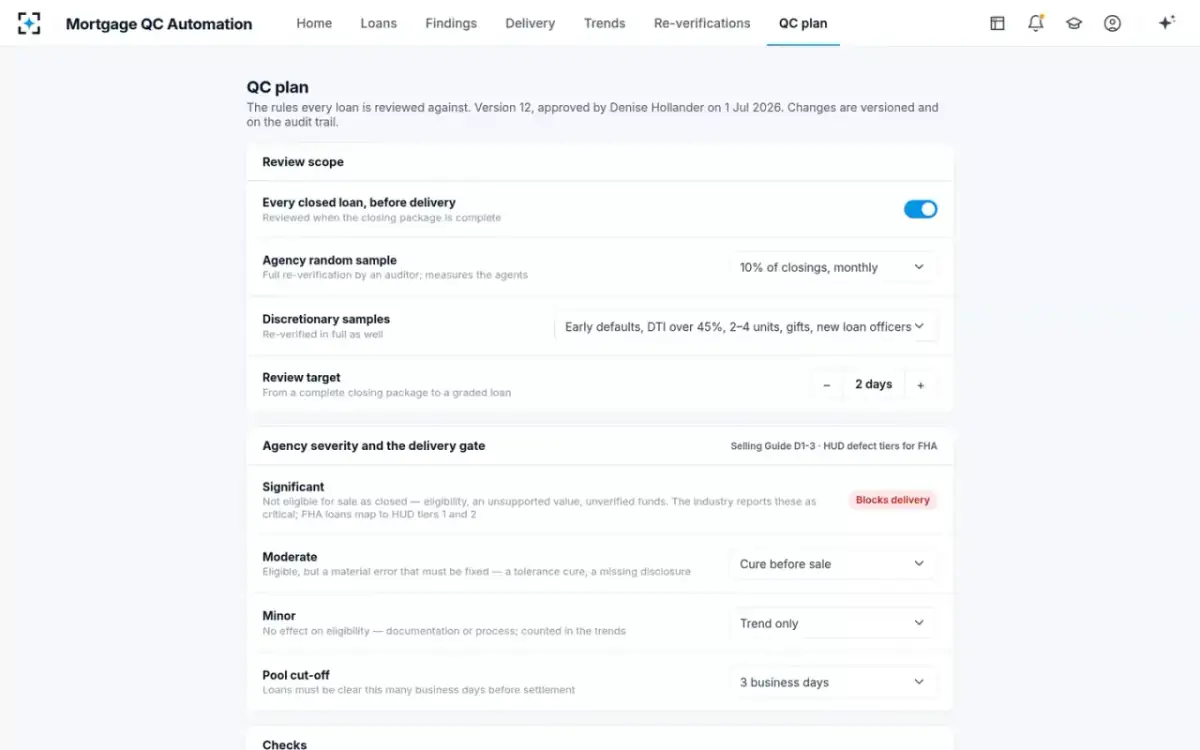
FHA's own reviewers grade on a different, finer scale, and a lender's QC plan should map to it. HUD's Defect Taxonomy sorts underwriting findings into nine defect areas, from Borrower Income to Lender Operations, and assigns one of four severity tiers: "Tier 1 and 2 Findings are unacceptable, requiring a lender response", with remedies from mitigating documentation to "financial remediation or indemnification", while Tier 3 and 4 findings "do not impact a loan's eligibility for FHA insurance" (HUD, Loan Review System Basics, 2023). The taxonomy replaced "99 different codes" in 2015 (HUD press release 15-078). When other remedies are exhausted, an unacceptable finding ends in a five-year or life-of-loan indemnification agreement.
Mortgage QC Automation maps one severity scale to HUD's tiers
What are FHA self-reporting requirements?
Report "all Findings of fraud or material misrepresentation to FHA immediately", and "all other Material Findings that the Mortgagee is unable to mitigate to FHA no later than 90 Days after the completion of the initial Findings report" (V.A.2.c.iv). Findings that involve no fraud and were already mitigated do not have to be reported. Title II lenders use the Self-Report feature in the Loan Review System, and each report must say what was done to mitigate the finding and what follow-up is planned.
HUD's training material puts the decision as three questions: is it fraud, is it material, and was it mitigated in time, then "Document your decisions" and "When reporting, be prepared for indemnification or other remedy" (Loan Review System Basics). The questions are simple; the record of how each was answered is what an auditor reads. The inspector general picked Neighborhood Loans for audit partly because its rate of self-reporting "was below average for 5 of the last 6 years", and found that for 3 of 11 sampled loans with material findings the lender had neither mitigated nor reported them (2025-NY-1004). How unreported findings have turned into False Claims Act cases is the subject of what unreported QC findings cost.
FHA and Fannie Mae QC side by side
Lenders that sell both kinds of loan run one QC department under two rulebooks, and the differences are in the details. FHA's review clock is 60 days from the end of the month; Fannie Mae's 90-day window covers the whole cycle, rebuttal and reporting included (Selling Guide D1-3-01). FHA requires every early payment default reviewed; Fannie Mae names early payment defaults as a target of the discretionary sample. FHA keeps QC results for two years from the initial review or the last mitigation action; Fannie Mae, three years. FHA reports through the Loan Review System, Fannie Mae through Loan Quality Connect. A plan written to the stricter rule on each line passes both; Fannie Mae's post-closing QC requirements sets out the other half.
Getting ready before 10 November 2026
Update 18's general implementation date is 10 November 2026, and HUD's inspector general audits QC programs against the Handbook text. Five things are worth doing now. Each is a change to the written plan as much as to the work, because the first thing an examiner reads is the plan.
Five changes to make to an FHA QC plan for Update 18
- Rewrite the property review section
Name the valuation tools you use, when a result triggers a field review, and where the tool output is kept.
- Restate the EPD selection rule word for word
Every loan 60 days delinquent within six payments that you underwrote, whoever services it, with the disaster-area exception and how you document it.
- Prove the 60-day clocks from your own data
Report each month the share of post-closing and EPD reviews done inside 60 days, and the oldest open one.
- Map your severity scale to HUD’s tiers
Low, moderate and material risk at minimum; say which of your levels corresponds to Tiers 1 and 2.
- Keep the self-report decision with its reasons
For every material finding: fraud or not, mitigated or not, by when, who decided, and the LRS reference if reported.
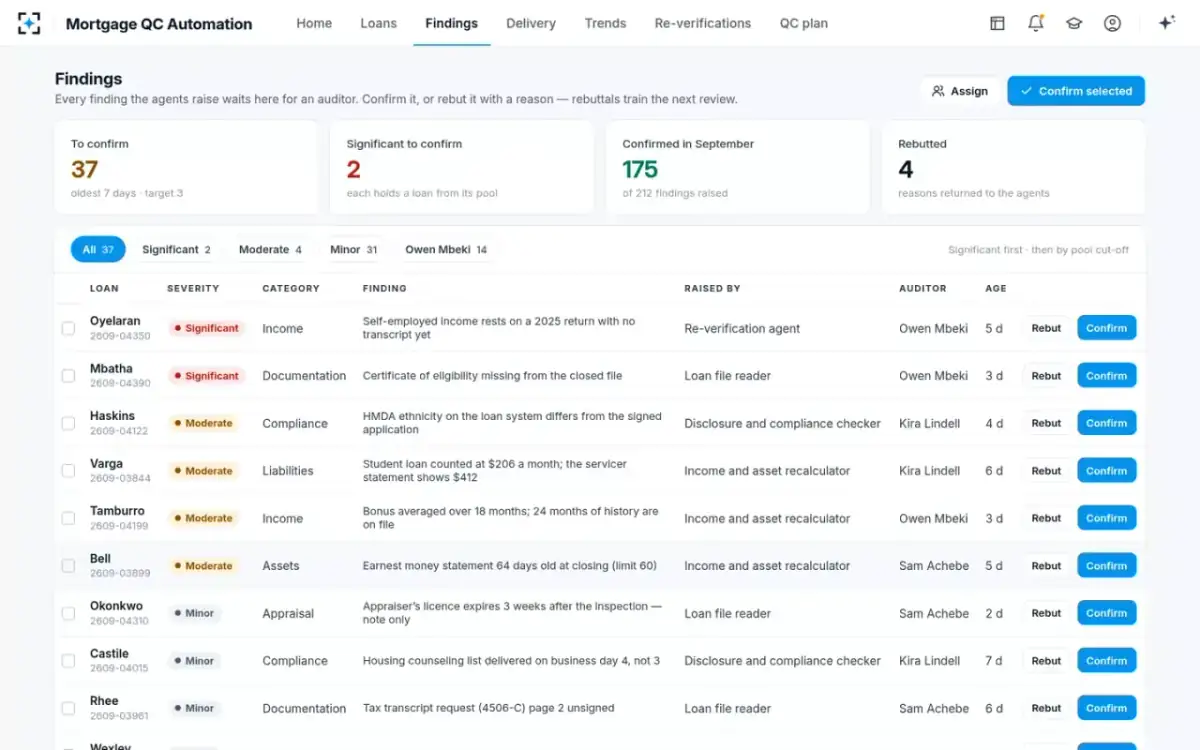
The solution's part in this is narrow and specific. The agents read every closed FHA loan, recompute income, debts and assets, flag a missing gift transfer or an unverified deposit with the page that shows it, and propose a grade mapped to HUD's tiers; an auditor confirms or rebuts each finding, and the QC manager decides what is mitigated and what is reported. The screen below is that queue.
Every finding in Mortgage QC Automation waits for an auditor
Questions people ask
Does FHA require pre-closing QC reviews?
Yes. The required sample must combine pre-closing and post-closing reviews, with pre-closing reviews at 10% or less of the sample. They are done after the Direct Endorsement underwriter approves the loan and before closing, and a lender closing nine or fewer loans a month must still review at least one before closing.
What is an early payment default for FHA QC?
A loan that becomes 60 days delinquent within its first six payments. The lender must review every EPD it underwrote, regardless of who services the loan, within 60 days from the end of the month it was selected. HUD's Neighborhood Watch system can help identify them.
How long must FHA QC records be kept?
Two years from the initial QC review or from the last action taken to mitigate findings, whichever is later. The record covers selection criteria, review documentation, findings and mitigation, and must be available to FHA at any time on request.
What is the HUD Loan Review System?
The Loan Review System is FHA's electronic platform for most single-family quality assurance reviews. Lenders use it to respond to FHA's findings, to sign indemnification agreements and to self-report findings from their own QC.
Can an FHA lender outsource QC?
Yes, to a contractor under a written agreement that sets out each party's role. The lender stays fully responsible for the reviews, still needs its own written QC Plan, and must ensure contractor staff take no part in the loan processes they review.