The False Claims Act reaches FHA lending because an FHA Direct Endorsement lender certifies each loan as eligible for insurance, and FHA does not check before it insures. When a lender knowingly certifies ineligible loans and FHA later pays claims on them, the Department of Justice can recover three times the government's damages plus a penalty per false claim. In the FHA cases DOJ settled between 2014 and 2016, the knowledge came from the lender's own quality control: QC had found the defects, management had seen the rates, and the loans were not self-reported to HUD. Wells Fargo paid $1.2 billion, "the largest recovery for loan origination violations in FHA's history". Mortgage QC Automation is built to find such defects before sale and keep a signed reason for every grade.
The cases are a decade old, but the rule they enforce is current: HUD Handbook 4000.1 still requires lenders to report fraud immediately and unmitigated material findings within 90 days. Botminds' Mortgage QC Automation works at the other end of the chain, finding defects on every closed loan before sale and keeping a signed reason for every grade. The cases explain why both halves matter.
FHA False Claims Act settlements over QC findings, 2014–2022
$1.2B
Wells Fargo, 2016: about 3,000 FHA loans with material QC findings, one self-report
DOJ
$418M
SunTrust, 2014: audits told management up to 50% or more of its FHA loans did not comply
DOJ
321
of 1,097 loans with a “significant” QC finding that MetLife self-reported
DOJ, 2016
0
loans First Tennessee self-reported after a 47% significant-findings month
DOJ, 2016
What is the False Claims Act in FHA lending?
The False Claims Act makes liable anyone who "knowingly presents, or causes to be presented, a false or fraudulent claim for payment or approval" or uses "a false record or statement material to a false or fraudulent claim", for a civil penalty "plus 3 times the amount of damages which the Government sustains" (31 U.S.C. 3729(a)). In FHA lending the false statement is the lender's certification that a loan meets FHA's rules; the claim is the insurance claim paid when the loan defaults. FHA's design makes the certification decisive: "Under the DEL program, the FHA does not review a loan for compliance with FHA requirements before it is endorsed for FHA insurance" (DOJ, M&T Bank, 2016).
Two words limit it. "Knowingly" covers actual knowledge, deliberate ignorance and reckless disregard; "material" means capable of influencing payment. DOJ spelled out the consequence for lenders in 2016: "no lender will face False Claims Act enforcement based on an unknowing mistake or an immaterial requirement" (DOJ, The False Claims Act & Federal Housing Administration Lending). The material defects in its cases were ordinary underwriting failures: not verifying employment, assets or credit, overstating income, understating liabilities, inadequate collateral. What turned them into fraud cases was what the lender knew.
How did QC findings become the evidence?
Because a QC program produces a written record of what the lender knew, when, and what it did next. In each case below, DOJ's description of liability runs through the lender's own QC department: findings identified and not reported, error rates computed to look smaller, findings "cured" after the fact, or early payment defaults left unreviewed.
Six FHA False Claims Act cases, and the QC fact at the center of each
| Lender, year | Amount | What its own QC knew | What it did with it |
|---|---|---|---|
| Wells Fargo, 2016 | $1.2 billion; admitted conduct | About 3,000 FHA loans with material findings, 2002–Oct 2005; more than 2,900 more by 2010 | One self-report in 2002–2005; about 300 loans reported from Oct 2005 to 2010 |
| SunTrust, 2014 | $418 million | Audits told management that "as many as 50 percent or more" of its FHA loans did not comply | Failed to self-report "even the defective loans it did identify" |
| First Tennessee, 2015 | $212.5 million | A "significant findings percentage of 47 percent" in February 2008 | "Failed to report even a single deficient mortgage to FHA" |
| MetLife Home Loans, 2015 | $123.5 million | 1,097 loans with a "significant" finding, 2009–2011 | Self-reported 321; "more frequently downgraded" defects to "moderate" |
| M&T Bank, 2016 | $64 million | "Numerous" loans with major errors, 2006–2011 | No report until 2008, then "only seven loans"; error rates computed to look lower |
| Regions Bank, 2016 | $52.4 million | "Numerous" loans with material deficiencies in monthly reviews | "Curing" findings with documents the underwriter never had; no self-reports until 2011 |
How much did Wells Fargo pay for FHA loans, and why?
$1.2 billion, in April 2016, and it "admitted, acknowledged and accepted responsibility" for certifying loans as eligible for FHA insurance from May 2001 through December 2008 when they were not (DOJ, 2016). The QC facts were the heart of it. Between 2002 and October 2005, Wells Fargo "made only one self-report to HUD", while its internal quality assurance reviews had identified about 3,000 FHA loans with material findings. From October 2005 to December 2010 it self-reported about 300 loans and identified more than 2,900 additional loans with material findings that it did not report.
The release also sets out the QC duties Wells Fargo was measured against, and they read like a QC plan: a full review of "all loans that go 60 days into default within the first six payments", "prompt and adequate corrective action", and disclosure to HUD in writing of all loans "containing evidence of fraud or other serious underwriting deficiencies". All three remain in the Handbook today. The first is FHA's early payment default rule, covered in early payment defaults first; the second is self-reporting.
Serious defects the lender's own QC found, against loans it self-reported to HUD
The grade is where the risk enters
The MetLife facts are the ones a QC manager should read twice. As its "significant" error rate fell in 2010 and 2011, MetLife Bank "more frequently downgraded FHA loan defects from 'significant' to 'moderate'". DOJ quoted a QC employee's email about the practice: "Why say Significant when it feels so Good to say MODERATE." M&T's version was arithmetic: it built a QC process that produced "preliminary major error rates that were significantly lower (sometimes below one percent)" than dividing loans with errors by loans reviewed would have given. Regions' version was documentation: it cured findings with "documentation that was not available to the underwriter at the time the loan was approved", so the defect rate reported to senior management "was understated" (DOJ, Regions, 2016).
Why say Significant when it feels so Good to say MODERATE.
Quality control employee email, quoted by the Department of Justice (MetLife Bank)
Each is a failure of the same control: a grade that can be changed without a reason anyone else can read. The defense is not cleverness but a written trail. A finding should keep its first grade, every change should carry a reason and a name, and a cure should be judged by what the underwriter had at the time. That is what FHA's rule implies when it defines a mitigated finding as one whose deficiencies "have been remedied so that the Mortgagee's decision to approve the Mortgage ... is acceptable to FHA" (4000.1, V.A.2.c).
What is FHA self-reporting, and when is it required?
FHA self-reporting is the lender telling FHA, through the Loan Review System, about defective loans its own QC found. Findings of fraud or material misrepresentation go to FHA "immediately"; other material findings the lender cannot mitigate go no later than 90 days after the initial findings report; mitigated findings without fraud need not be reported. HUD's guidance to lenders is short: ask whether it is fraud, whether it is material and whether it was mitigated in time, "Document your decisions", and "be prepared for indemnification or other remedy" (HUD, Loan Review System Basics, 2023). The full timeline sits in FHA quality control requirements in 4000.1.
The inspector general still tests it. In its July 2025 audit of Neighborhood Loans, HUD-OIG found that for 3 of 11 sampled loans with material findings the lender's records "did not show that it acceptably mitigated the findings or self-reported the loans to HUD", including one where a monthly car payment had been left out without verification (HUD-OIG 2025-NY-1004). The recommendation was a review of every such file.
What is an FHA indemnification agreement, and what comes before the courts?
It is the usual price of an unacceptable finding, long before anyone mentions fraud. When FHA's reviewers find a Tier 1 or 2 defect, the lender responds with mitigating documents or financial remediation; when those are exhausted, it signs "either a 5-year or Life-of-Loan indemnification agreement" (HUD, Loan Review System Basics), promising to cover FHA's loss if the loan goes to claim. The loss is not small: HUD-OIG uses FHA's average loss on a claim of "about 34 percent" when it estimates what a lender's indemnification saves the fund.
Conventional loans have their own ladder. When Fannie Mae finds a significant defect it may demand repurchase or offer an alternative such as a pricing adjustment, recourse, indemnification or loss sharing, and the lender may appeal in writing within 60 days (Selling Guide A2-3.2-03). FHFA's director warned lenders in 2023 that "the losses associated with repurchasing low interest rate loans can be quite steep" (FHFA, October 2023). The figure below sets the four levels side by side.
The cost of a QC finding rises at each step it travels
- 1
Before the loan is sold or endorsed
A defect found by the lender
A cure: a corrected document, a re-run AUS, a refund to the borrower, or a loan kept off the pool
The lender decides
- 2
After sale to Fannie Mae or Freddie Mac
A significant defect found by the investor
Repurchase, or an alternative the investor offers: price adjustment, recourse, indemnification, loss share
The investor elects; the lender may appeal within 60 days
- 3
After FHA endorsement
An unacceptable (Tier 1–2) finding
Mitigating documents, financial remediation, or a 5-year or life-of-loan indemnification agreement
FHA decides through the Loan Review System
- 4
When findings were known and not reported
Knowing, material false certification
False Claims Act liability: a civil penalty per claim plus three times the government’s damages, usually settled
The Department of Justice, often after a whistleblower
Can a lender be liable for underwriting mistakes?
For mistakes, through the contract: indemnification, repurchase or a remedy in its place. For knowing violations, under the False Claims Act. DOJ's line was that "a lender that tries to adhere to FHA requirements and makes an immaterial error, or otherwise acts in good faith, will not be subject to liability". The cases show where good faith stops being plausible: when a lender's own QC has reported high defect rates to management, and the self-reports do not follow. The later cases were settled without admissions: Quicken Loans paid $32.5 million in 2019 and "The settlement was neither an admission of liability" (HUD-OIG, 2019), and Academy Mortgage paid $38.5 million in 2022 in a case brought by a former underwriter, with "no determination of liability" (DOJ, 2022).
What this means for a QC program today
Three practices follow from the cases. Find defects early, while a cure is still the lender's choice. Keep the grade honest, with every change explained and signed. And make the self-report decision on the record, loan by loan. Botminds' Mortgage QC Automation is built around the first two and supports the third: agents read every closed loan before sale, the defect grader proposes a grade with its evidence, an auditor confirms or rebuts it with a reason, and a loan with an open significant finding is held from its pool until the QC manager releases it. Using the fictional sample lender from this series, the hold list below is what secondary marketing receives before the pool cut-off.
Mortgage QC Automation holds defective loans before the pool
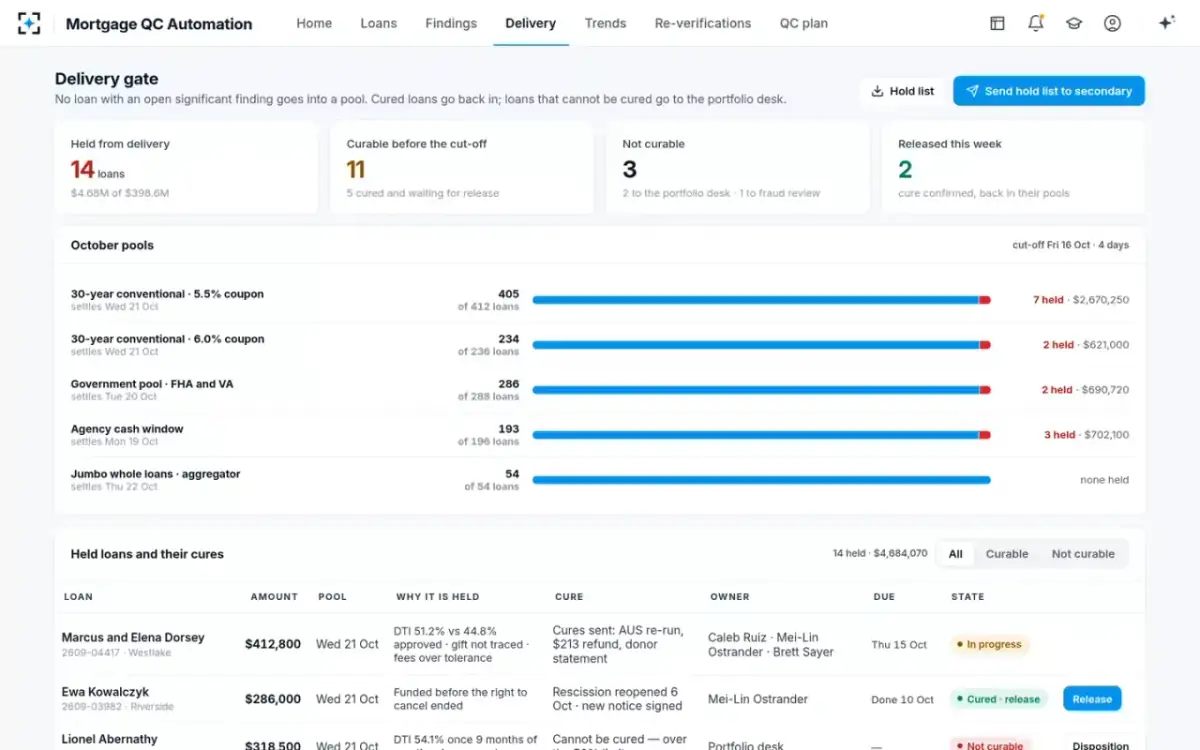
None of this replaces the self-report. A held loan that cannot be cured is still a QC finding, and if it is an FHA loan already insured, or a conventional loan already sold, the reporting rules apply in full. What changes is how many defects reach that stage. In the sample lender's data, 0.25% of September loans were sold with a significant defect after cures, against 1.52% in May, when only the 10% sample was reviewed, after sale. The decisions remain with people, and each carries its evidence.
A finding becomes a signed cure plan in Mortgage QC Automation
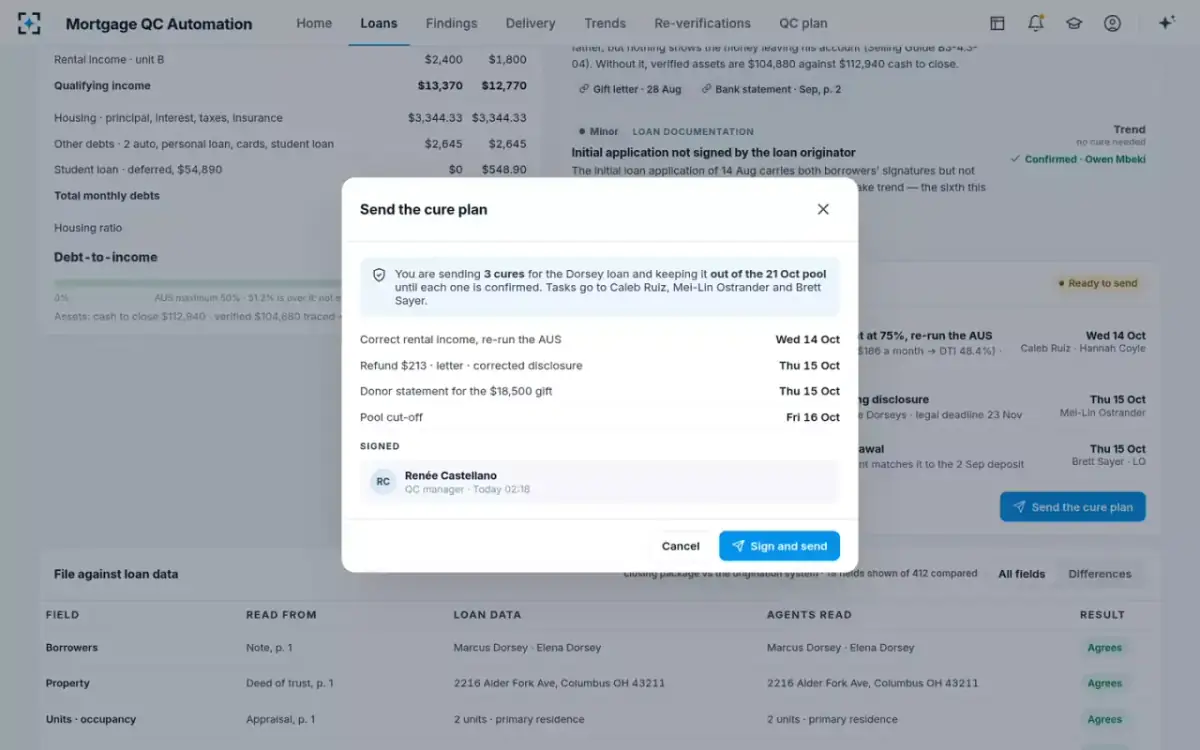
Questions people ask
What triggers a False Claims Act case against an FHA lender?
Usually a whistleblower suit or a HUD inspector general referral, followed by a DOJ investigation of whether the lender knowingly certified ineligible loans. M&T's and Academy's cases began with former employees; private plaintiffs can sue on the government's behalf and share in the recovery.
Does self-reporting protect a lender from the False Claims Act?
It is the behavior the rules require, and every major case cited its absence. Reporting does not erase a defect; FHA may still seek indemnification. But a lender that finds, grades honestly, mitigates or reports is acting as DOJ described a good-faith lender.
What is a repurchase demand?
A request by Fannie Mae or Freddie Mac that the lender buy back a loan with a significant defect. Under Fannie Mae's remedies framework the investor may instead offer an alternative such as a price adjustment, recourse or indemnification, and the lender can appeal within 60 days, then use impasse, escalation and independent dispute resolution.
How long does FHA indemnification last?
Five years for most underwriting defects on performing forward loans, or the life of the loan for more serious findings. Indemnified loans stay insured, and if lenders merge, the surviving institution inherits the liability.
Are FHA False Claims Act cases still being brought?
The large wave of settlements came in 2014–2016, and later cases such as Quicken Loans in 2019 and Academy Mortgage in 2022 followed. HUD's inspector general continues to audit lender QC programs, as its three 2025 audits of FHA lenders show, and those audits recommend reviews that can lead to indemnification.