Fannie Mae early payment default quality control works through the discretionary sample: Selling Guide D1-3-01 says a lender's discretionary post-closing selection "must target areas the lender identifies as having a higher potential for errors and loans that may have a high risk of misrepresentation or fraud, including early payment defaults". The Guide does not define an early payment default for QC purposes and does not require every one to be reviewed. FHA does both: an early payment default (EPD) is a loan "60 Days delinquent within the first six payments", and an FHA lender must review every EPD it underwrote within 60 days. Many lenders apply FHA's definition to their conventional loans too, and this guide, from the makers of Mortgage QC Automation, sets out both rulebooks.
The reason to read these loans first is in FHA's own numbers: early payment defaults were rated net material 9.12% of the time in fiscal 2022, against 3.40% for random selections. They are the loans most likely to show what the underwriting missed, and the ones auditors most often find unreviewed. Botminds' Mortgage QC Automation puts early defaults into the discretionary sample by default and has already reviewed every loan before sale, so an EPD review starts from findings on file.
Early payment default QC in four numbers
60
days delinquent within the first six payments: FHA’s definition of an EPD
4000.1, V.A.3.a.iv
100%
of EPDs a lender underwrote must be reviewed, whoever services them
FHA; Fannie Mae: a discretionary target
9.12%
of FHA EPD reviews rated net material, vs 3.40% of random selections
FHA, fiscal 2022
24
of 141 EPDs one lender reviewed, because it filtered by default code
HUD-OIG 2025-NY-1004
What is an early payment default?
An early payment default is a mortgage that goes seriously delinquent soon after it is made. The standard definition in QC is FHA's: "Early Payment Defaults (EPD) are all Mortgages that become 60 Days delinquent within the first six payments" (HUD Handbook 4000.1, V.A.3.a.iv). In plain terms: two missed payments somewhere in the first six months of repayment. Investors and loan buyers write their own versions into purchase contracts, often with different payment counts, so a lender's QC plan should state which definition it applies to which loans.
An EPD is not proof of a bad loan. Borrowers lose jobs and fall ill in the first six months like any other. What makes the EPD a QC priority is that a loan failing that fast is more likely than a random one to have been approved on income that was not there, debts that were missed or funds that were not the borrower's, and the review is how a lender tells the difference.
How does Fannie Mae define early payment default?
For quality control purposes it does not; it names EPDs as a risk to target. D1-3-01 places them in the discretionary sample, which adds to the random sample rather than replacing it (D1-3-01), and connects them to fraud: the reference in that sentence is to Selling Guide A3-4-03, which requires sellers to "aggressively sample loans that have a high risk for fraud as part of the quality control process" and to self-report suspected fraud within 30 days of finding a reasonable basis for it (A3-4-03).
Where Fannie Mae's rules do count early payments is in representations and warranties. A loan earns relief from enforcement of certain underwriting and eligibility representations based on payment history only once the borrower has paid "the first 36 monthly payments due following the loan acquisition date", with "no more than two 30-day delinquencies" and "no 60-day or greater delinquencies" (Selling Guide A2-3.2-02). A loan that goes 60 days delinquent early can never earn that relief. Unless it qualifies another way, such as a satisfactory Fannie Mae full-file QC review, the lender's underwriting representations on it stay open, which is the commercial case for reviewing it before Fannie Mae does.
Must every early payment default be reviewed?
For FHA, yes: "The Mortgagee must review all EPDs underwritten by the Mortgagee, regardless of which Mortgagee services the Mortgage", selecting them monthly, with Neighborhood Watch as an aid to finding them (4000.1, V.A.3.a.iv). EPDs are reviewed on top of the sample size: "Only random and discretionary samples may be included in the sample size standard." The one exception, written into the Handbook under Update 18, is for loans in a Presidentially-Declared Major Disaster Area that closed before the incident period and went delinquent after it began. Before that standing exception, FHA granted case-by-case relief, such as the waiver for Hurricanes Helene and Milton in FHA INFO 2024-88 (FHA INFO 2024-88), which restated that "FHA policy requires that mortgagees select all EPDs for review monthly".
For Fannie Mae, the rule is to target them, not to review them all. Our recommendation is to review them all anyway: the volume is small next to production, the defect yield is high, and a lender that runs one QC program for both agencies already has the FHA machinery. The plan should say so in words, because an auditor will compare the plan with the EPD list.
What causes early payment defaults, and what do EPD reviews find?
FHA's review data is the best public evidence of what sits inside defective FHA loans. Of 9,667 EPD reviews completed in fiscal 2022, 882 (9.12%) were rated net material; of 5,761 random selections, 196 (3.40%) (HUD, FHA Quality Assurance Update, January 2023). Across all of FHA's underwriting reviews that year, three defect areas caused more than half of the material findings: borrower income, credit and assets. The breakdown below covers all reviews, not EPDs alone; FHA does not publish it by selection reason.
Where FHA's material underwriting findings came from, fiscal 2022
Share of net material findings, by defect area
- Borrower income · 22.17%
- Borrower credit · 19.12%
- Borrower assets · 15.91%
- Lender operations and property eligibility · 22.95%
- Appraisal, LTV, mortgage and borrower eligibility · 19.85%
The frequent examples FHA lists are the ones an EPD review should test first. Income: two years of employment not documented, variable hours not averaged, self-employment income not averaged over two years, self-employment losses not subtracted. Credit: accounts missing from the analysis, unresolved conflicting information about debts. Assets: "Evidence of Gift transfer from the donor to the Borrower was not provided", large deposits unexplained, unverified funds used to qualify. A borrower who defaults in month four and whose qualifying income does not survive recalculation is the classic early payment default finding.
How fast must early payment default reviews be done?
For FHA, within 60 days of the end of the month in which the loan was selected, and selection is monthly (4000.1, V.A.3.a.i). For Fannie Mae, an EPD in the discretionary sample sits inside the post-closing cycle, which must finish within 90 days of the month the loan funded, a window that has usually closed by the time the loan defaults. In practice an EPD review is often the second QC look at a loan, months after the first, if the loan was sampled at all.
The early payment default clock: from closing to a finished FHA review
- To first payment due≈1 mo
- Payments 1–2 missed, 60 days late2 mo
- Selected at month-end≤1 mo
- Review within 60 days60 d
- To first payment due≈1 mo
- Delinquent by the sixth payment≈6 mo
- Selected≤1 mo
- Review60 d
What happens if early payment default reviews are missed?
They become audit findings, and historically they have been part of False Claims Act cases. HUD's inspector general audited three FHA lenders' QC programs in 2025, each over October 2020 to September 2022, and early payment default coverage ranged from nearly complete to barely begun. The causes are mundane: a data feed, a filter, a staffing gap.
Required early payment default reviews actually performed: three 2025 HUD-OIG audits
Why EPD selection fails: a filter, a feed, a staffing gap
The Neighborhood Loans case is the instructive one. Its prior QC manager "selected for review only EPD loans with certain default status and reason codes instead of selecting all EPD loans", so 117 of 141 EPDs, with original amounts above $25.8 million, went unreviewed; it also did not keep the monthly Neighborhood Watch data its selection came from (HUD-OIG 2025-NY-1004). A filter that seemed sensible (skip defaults with an obvious life-event reason) broke a rule that has no exceptions except disasters. Older cases show the same pattern: DOJ's 2016 settlements with M&T Bank and Regions Bank both cited EPD reviews that were skipped before 2010 or limited to loans 90 days past due rather than 60 (DOJ, M&T; DOJ, Regions). What followed in those cases is covered in what unreported QC findings cost.
Early payment defaults first: how to run EPD quality control
Treat the EPD list as a control with its own reconciliation, not a by-product of the sample. Five practices cover the rules and the audit findings above.
Five practices for early payment default quality control
- Select from the definition, not a filter
Every loan 60 days delinquent within six payments; apply only the written disaster exception, and document each one.
- Reconcile two sources every month
Your servicing data and HUD’s Neighborhood Watch (or your subservicer’s report); keep the monthly extract you selected from.
- Cover loans you underwrote but do not service
FHA’s rule follows the underwriter. Agree a delinquency feed with each servicer that bought your loans.
- Start from the original review
Re-test income, credit and assets first; FHA’s data puts most material findings there.
- Close each review with a reporting decision
Fraud to FHA immediately; unmitigated material findings within 90 days; ineligible Fannie Mae loans within 30 days of the report.
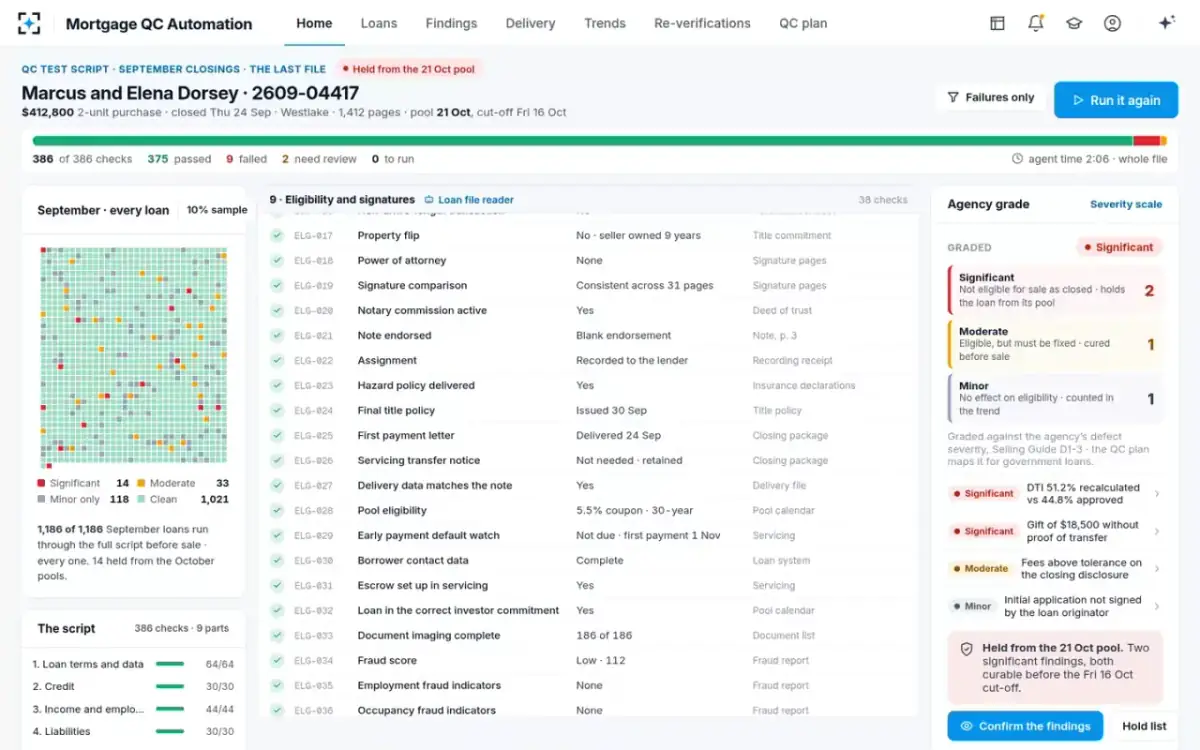
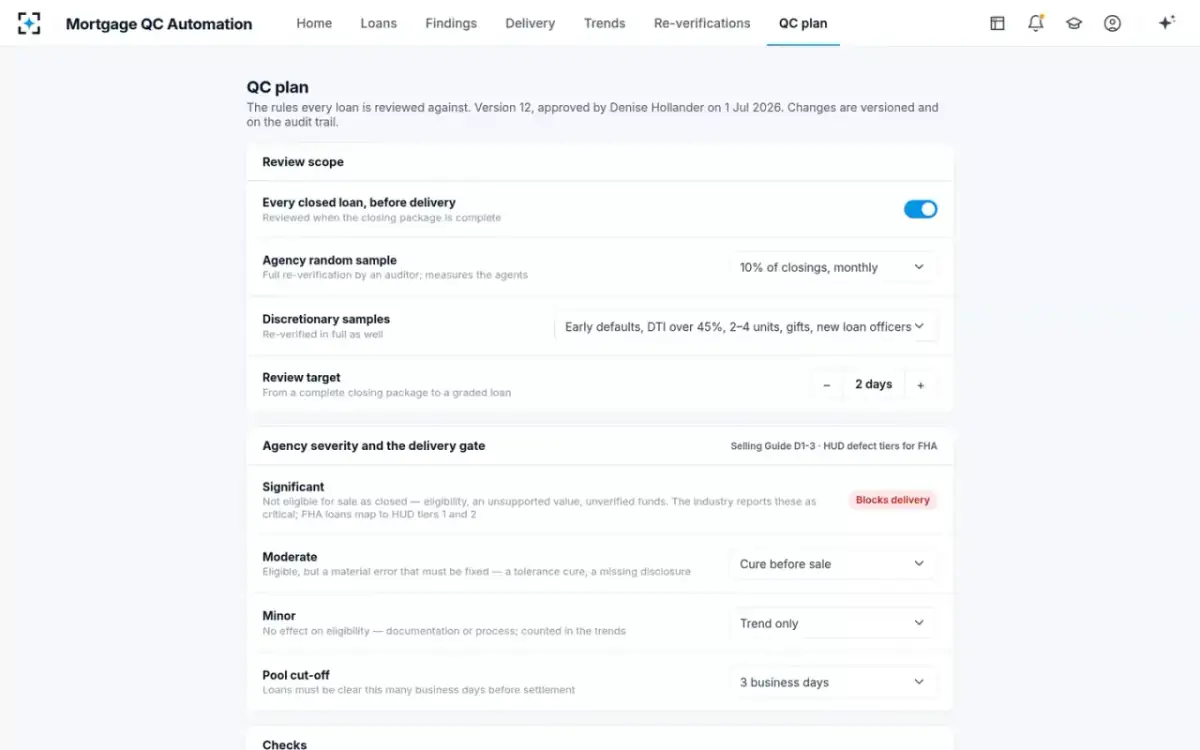
In Botminds' Mortgage QC Automation, early payment defaults are one of the discretionary samples the QC plan selects by default, alongside 2–4 unit homes, gifts, debt-to-income over 45% and new loan officers; in the fictional sample lender's September, two of the 38 discretionary loans were early payment defaults. Because the agents also review every loan before sale, a loan that defaults early arrives at its EPD review with a full first review, its findings and the pages behind them already on file. The QC test script also carries an early payment default watch on each loan from its first payment date.
Mortgage QC Automation keeps an early payment default watch on every loan
Early defaults head the discretionary samples in Mortgage QC Automation
The other half of "first" is the random sample's view. FHA's 9.12% against 3.40% says EPDs are where a sample finds the most per review; it also says three in a hundred random loans carried material findings that nobody would have looked for if the borrower had kept paying. What your sample can and can't see looks at that second number.
Questions people ask
What is the difference between an early payment default and a first payment default?
A first payment default is a loan that misses its very first payment, often a fraud signal. An early payment default, in FHA's QC definition, is a loan 60 days delinquent at any point within the first six payments. Purchase contracts between lenders and loan buyers may define both differently.
Does an early payment default mean the loan must be repurchased?
Not by itself under Fannie Mae's rules; a repurchase follows a significant defect, not a delinquency. But an early 60-day delinquency prevents payment-history relief on underwriting representations, so any defect found later remains enforceable. Many correspondent purchase agreements add their own EPD terms.
Can a lender exclude EPDs caused by hardship from QC review?
Not for FHA. The only written exception is for loans in a Presidentially-Declared Major Disaster Area that closed before the incident period and became EPDs after it began. A lender that filtered by default reason was cited by HUD's inspector general in 2025.
Who finds early payment defaults on loans the lender no longer services?
The underwriting lender remains responsible under FHA's rule, so it needs a delinquency feed from each servicer or HUD's Neighborhood Watch data. loanDepot's 2025 audit traced most of its 37 missed EPD reviews to selection errors and to not being notified through Neighborhood Watch when the defaults happened.
Should conventional EPDs be reviewed the same way as FHA EPDs?
Fannie Mae requires only that the discretionary sample target them. Applying FHA's definition and 100% review to conventional loans is a lender choice, and a common one, because it keeps one process, one list and one standard for the plan and its auditors.