In the mortgage QC review process, the analyst's work is usually summed up as: review closed loan files for compliance with agency and investor guidelines, re-verify borrower information, identify and categorize defects, and report findings to management. The real job is heavier and more consequential than that. A QC analyst (also called a QC auditor or QC underwriter) re-underwrites a sampled loan from its documents, orders and reconciles re-verifications with employers, banks and the IRS, assigns each defect a severity that decides whether the loan was eligible as sold, argues the grade with production, and does it inside a 90-day Fannie Mae cycle or FHA's 60-day review clock. Mortgage QC Automation is built around that seat.
The seat is under strain in a way regulators have written down: HUD's inspector general traced missed and late FHA QC reviews at two lenders in 2025 to staffing. Botminds' Mortgage QC Automation exists because of that: agents do the reading, re-keying and recalculation on every closed loan, and the analyst starts from findings with the page attached. This page describes the work as it is, for the QC managers who staff it and the executives who answer for it.
The mortgage QC analyst's job, in rules and numbers
6
things re-verified on every random-sample loan
Fannie Mae D1-3-03
90
days for the Fannie Mae cycle, including rebuttal and reporting
FHA reviews: 60 days
21%
of required EPD reviews missed at one lender, for lack of staff
HUD-OIG 2025-NY-1003
0
BLS occupations for “QC analyst”: the role is counted elsewhere
Bureau of Labor Statistics
What does a mortgage quality control analyst do?
Five things, in roughly this order of time spent. First, assemble and read the file: a closed loan package runs to hundreds or more than a thousand pages, and the analyst sorts and bookmarks it before judging anything. Second, re-underwrite: recompute income, debts, the debt-to-income ratio, assets and reserves, and check every approval condition and automated underwriting message was satisfied. Third, re-verify at the source, which for Fannie Mae's random sample means "income and employment, income tax returns, assets, credit history, property eligibility and property value, and occupancy" (Selling Guide D1-3-03). Fourth, write each finding and grade it. Fifth, defend it in rebuttal and feed the monthly report.
The fourth step is where the job carries weight. A grade at the top of the lender's scale means the loan was "not being eligible as delivered" to Fannie Mae (D1-1-01), which starts a 30-day self-report clock, or a material finding under FHA, which must be mitigated or reported. An analyst who downgrades a significant finding to moderate under pressure has changed what the lender tells its investor. That is why the rules put the seat outside production.
Four seats in mortgage QC, before and after agents read the files
Today
Sorts and bookmarks a long closing package, re-keys values, recalculates income and DTI, then finally judges a defect.
With agents
Starts from findings with the page and both numbers attached; confirms or rebuts each with a reason.
Still theirs: The grade, and the reason for it.
Today
Sends employment, deposit and transcript requests, logs them by hand, chases the outstanding ones.
With agents
Works the exceptions: a returned VOE that disagrees, a transcript that does not match the return.
Still theirs: Who to call when the paper does not come back.
Today
Reviews complex files (self-employment, 2–4 units, collateral) in the sample only.
With agents
Sees the complex findings from every loan, with the recalculation shown, not just the sampled ones.
Still theirs: Judgment on income stability and collateral.
Today
Signs a monthly report on a 10% sample and decides self-reports weeks after the sale.
With agents
Sees every loan graded before its pool; releases held loans once cured; signs the report.
Still theirs: Every release, report and self-report decision.
What is a QC underwriter, and how is the seat different?
A QC underwriter is a QC analyst with underwriting authority-level knowledge, assigned the files that need it. Fannie Mae makes the distinction itself: the lender must ensure that "reviewers conducting more complex or specialized reviews (for example, collateral risk assessments or evaluations of self-employed borrowers) have the requisite knowledge and experience" (D1-1-02). In practice the QC underwriter takes self-employed income, rental income on 2–4 unit homes, manual underwrites and anything where the analyst's recalculation disagrees with the underwriter's by more than rounding.
The work matters because it is where FHA's own reviewers find most problems. In HUD's review data for fiscal 2022, borrower income was the defect area behind 22.17% of net material findings, credit 19.12% and assets 15.91%; one of the frequent income examples was self-employment income "not calculated based on the average gross self-employment income earned over the previous two years" (HUD, FHA Quality Assurance Update, January 2023). Those are QC underwriter files.
What the rules require of the seat
Independence comes first. Fannie Mae: "all QC employees (including those related to establishing, monitoring, and enforcing procedures) must be independent of the production, underwriting, and closing departments" (D1-1-02). FHA is more specific: QC staff must not be "within any chain of reporting or management that is directly connected to Loan Administration staff" (4000.1, V.A.2.a). A QC analyst who reports to the head of lending fails both tests, whatever the org chart calls the role.
Minimum qualifications, training and certification
Qualifications are the lender's to set but must be written: Fannie Mae requires "minimum job qualifications" for everyone managing and performing QC reviews, including vendor oversight, and that reviewers be "adequately trained and have sufficient experience levels relative to the reviews being conducted". FHA requires the lender to train all QC staff on current FHA requirements and keep a list of the training given. Neither body certifies QC analysts; "mortgage quality control certification" is a common search, but no agency requires one.
What a lender’s written QC role definition should say
- Reporting line
Reports to the QC manager, who reports outside production, underwriting and closing.
- Review scope
Full-file post-closing reviews, prefunding reviews, early payment default reviews, component reviews.
- Rulebooks
Fannie Mae Selling Guide, Freddie Mac Guide, HUD Handbook 4000.1, VA and USDA, plus the lender’s overlays.
- Re-verification
Orders and reconciles employment, income, tax transcripts, assets, credit and property; documents verbal re-verifications.
- Grading and rebuttal
Assigns severity under the QC plan; defends or revises it in rebuttal with a written reason.
- Clocks
Works to the 90-day Fannie Mae cycle and FHA’s 60-day reviews; escalates anything at risk of running late.
- Minimum qualifications
Years of underwriting or QC experience, with named specialties for self-employed income and collateral.
- What it is not
No production goals, no say in which loans close, no contact with the borrower outside re-verification.
How many files does a mortgage QC auditor review?
There is no rule, and no regulator publishes a norm. The number follows from volume and sample design: a lender closing 1,186 loans in a month, as the fictional sample lender in this series does, owes Fannie Mae at least 119 random full-file reviews, plus its discretionary sample (38 loans that month), plus prefunding reviews and every FHA early payment default. Divide by the analysts you have and by the working days inside the cycle, and the workload is set before anyone opens a file.
Where the hours go inside a file is the more useful question, and most of them are not judgment. The split below is our estimate for a full-file conventional review done by hand, against the same review when agents have already read the file and recalculated it.
Where a QC analyst's hours on a file go (our estimate)
Full-file review, by hand
- Sorting, bookmarking, re-keying · 35%
- Recalculating income, debts, assets · 20%
- Chasing re-verifications · 20%
- Judging and writing findings · 25%
Same review, agents read first
- Checking cited pages · 25%
- Re-verification exceptions · 20%
- Judging, confirming or rebutting · 55%
Why missed QC reviews come down to staffing
Because the clocks do not move when people are out. HUD's inspector general audited three FHA lenders' QC programs in 2025 and found staffing behind the misses in two. Flat Branch "did not perform approximately 21 percent of the required EPD reviews because it had insufficient staff to meet the extraordinarily high volume of EPD loans during the COVID-19 pandemic", and finished 335 of 1,011 post-closing reviews late (HUD-OIG 2025-NY-1003). At Neighborhood Loans, late reviews were attributed to rising volume "combined with staffing constraints, such as staff on leave and layoffs" (HUD-OIG 2025-NY-1004).
Two FHA lenders audited in 2025: share of QC reviews late or never done
The pattern is structural. QC volume follows production and defaults, both of which rise faster than a team can hire and train analysts who meet the plan's minimum qualifications. A contractor helps until the contractor has the same problem: at Flat Branch the staffing constraints hit "both Flat Branch and its contractor for post-closing reviews, resulting in backlogs". The fix is to move the hours that need no judgment off the analyst, which is the case for agents in mortgage QC software.
Why the QC seat is getting more valuable, not less
The direction of the work favors analysts who would rather be right than fast. QC is one of the few lending seats where the rules require independence from production goals, and its skills are deep: a good QC underwriter knows the Fannie Mae, Freddie Mac, FHA and VA rulebooks side by side, which makes the seat hard to staff and costly to lose. The demand driver is stable, since every seller and FHA lender must run the program every month.
The part of the job that resembles clerical work (sorting, bookmarking, re-keying, logging requests) is the part software takes over first. The part that resembles credit analysis (judging income stability, deciding whether a defect made the loan ineligible, writing a finding that holds up in rebuttal) is the part that remains.
What changes is the daily mix. In Botminds' Mortgage QC Automation the analyst's queue is findings, not files: every finding the agents raise waits for an auditor to confirm or rebut it, significant ones first, each with its evidence. The analyst's question changes from "where is the lease?" to "is this a defect?"
The analyst's queue in Mortgage QC Automation: findings, not files
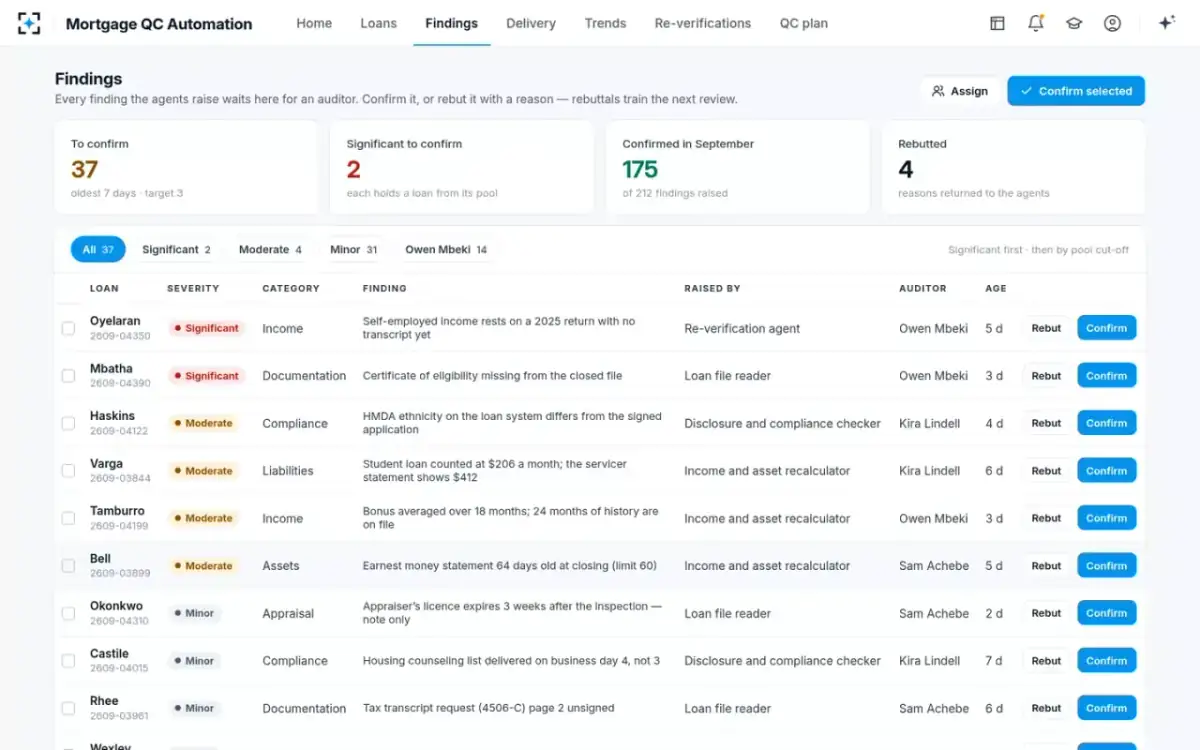
The evidence travels with the finding. In the sample lender's last September file, the income recalculation stopped on rental income counted in full from a lease; one click opens the lease with the rent highlighted. The analyst decides whether the rule was broken; nobody has to find the page first.
Mortgage QC Automation opens the page behind each finding
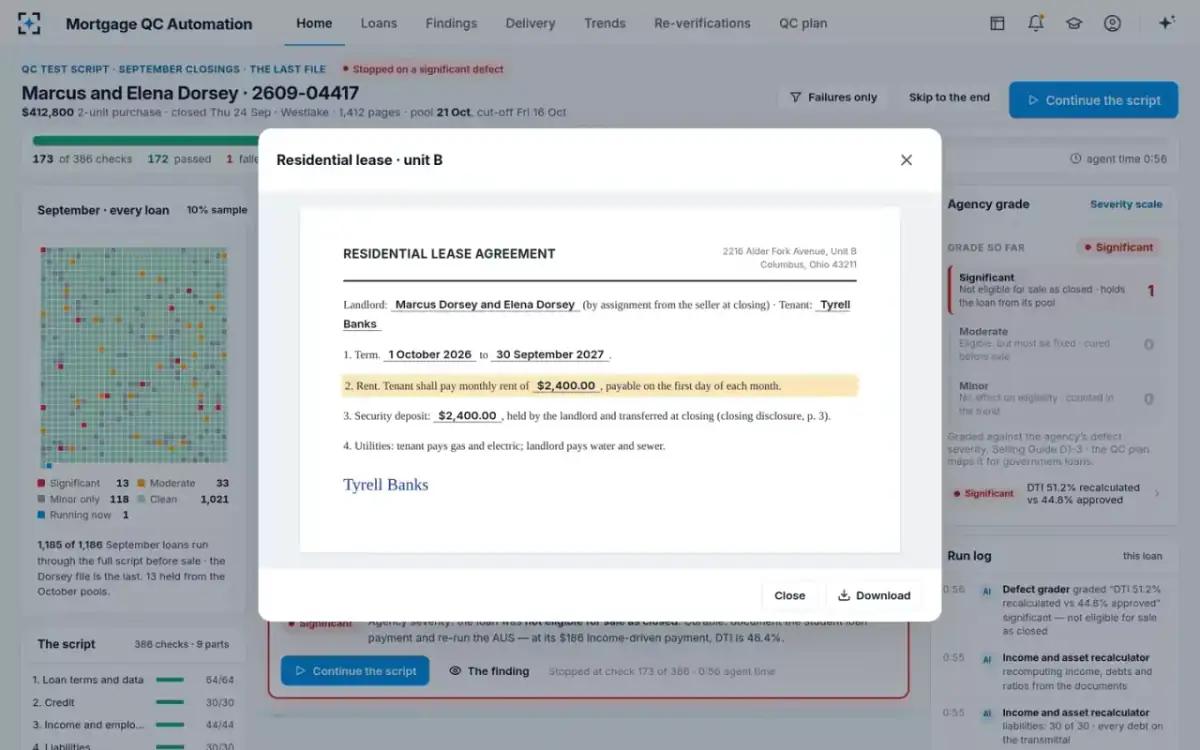
Questions people ask
What is a QC re-verification specialist?
The person who sends and tracks re-verification requests for sampled loans: written or verbal employment checks, tax transcripts through IRS Form 4506-C, deposit verifications and new credit reports. Fannie Mae requires failed attempts to be documented with the request date, and FHA requires a telephone attempt when a written request is not returned.
What qualifications must a lender set for QC analysts?
No license or certification is required by Fannie Mae or FHA. Lenders must document minimum job qualifications and match reviewers to the complexity of the files, so lenders typically require several years of underwriting or QC experience, knowledge of agency guidelines and, for senior seats, self-employed income and collateral review.
Can a QC analyst report to the head of lending?
Not without a written exception under Fannie Mae's rules, and not at all for FHA. Fannie Mae requires QC staff to be independent of production, underwriting and closing, or the plan must explain the compensating controls; FHA bars QC staff from any reporting chain directly connected to loan production.
Will automation replace mortgage QC analysts?
It replaces the clerical part of the job, not the decision. Agents can read files, recompute ratios and cite pages, but the rules make the lender responsible for every grade and self-report, so a person still confirms each finding and a QC manager signs. What shrinks is the time spent before the judgment starts.
What does a mortgage QC auditor find most often?
In FHA's own fiscal 2022 reviews, income, credit and assets together accounted for about 57% of net material findings. Typical examples were income not averaged over two years, debts missing from the credit analysis and gift funds with no evidence of transfer from the donor.