Mortgage QC software is software that runs or supports a lender's quality control review of closed loans: it selects the sample, holds the checklist, tracks re-verifications and findings, and produces the monthly report. The newer kind also does the review itself, reading every page of the closing package, recomputing income, debts and fees, and proposing a grade for each defect. What it should never do is give the final grade. Under Fannie Mae's and FHA's rules the lender owns every finding, every self-report and every decision about a loan's sale, so in any software worth buying a person confirms each grade and a QC manager releases each held loan, which is how Mortgage QC Automation divides the work.
Botminds' Mortgage QC Automation is built that way. Six agents divide the review of every closed loan, from reading the file to drafting the monthly report, and each has written limits; QC auditors confirm or rebut every finding and the QC manager signs. "What is QC in mortgage?" is itself a common search, so here is the short answer: quality control is the lender's own check, after the fact and independent of production, that its loans meet the investor's and insurer's rules and the law. Software changes how much of that check gets done, and when.
Mortgage QC software on one closed loan, in the sample lender's data
1,412
pages in one closing package, read and classified
Fictional sample loan
386
checks in nine parts, each headed by the agent that runs it
The sample lender’s QC script
2
minutes of agent time to read the file and run every check
Sample data
97.8%
of agent findings confirmed by auditors on the random sample
Sample data, July–September
What is mortgage QC software, and what kinds are sold?
Four kinds of product are sold under the name, and they differ in one way that matters: whether they read the loan file or only manage the people who do. Workflow tools organize the QC department; checklist and rules tools encode the questions; document tools extract data from the file; agents read the file, apply the rules and propose findings. Most lenders use more than one, and most QC vendors run their reviewers on the first two.
Four kinds of mortgage QC software, by what they actually do
| Kind | What it does | Reads the loan file? | What stays manual |
|---|---|---|---|
| QC workflow and case management | Draws samples, assigns files, tracks re-verifications, findings, rebuttals and reports | No | The whole review |
| Checklist and rules tools | Holds the review questions; calculates ratios from values a reviewer enters | No | Finding and keying every value |
| Document classification and extraction | Sorts the package and pulls values from documents | Yes, for data | Applying the rules, judging and grading |
| Agents | Read the file, compare it with the loan data, recompute, check, cite the page, propose a grade | Yes, every page | Confirming each finding; every release, report and self-report |
What should mortgage QC software check?
At least what Fannie Mae's full-file review requires: the accuracy of the application, the support for the underwriting decision, every approval condition and DU message, credit, income and assets, collateral, property and project eligibility, flood and mortgage insurance, the legal and closing documents, and compliance with law. It must also check that "the final terms of the loan ... align with the data used to support the underwriting decisions" and, where they do not, whether the loan still qualifies (Selling Guide D1-3-02). For FHA loans, add HUD's review table: self-employed income, source of funds, flipping and restrictive covenants, the Loan Estimate and Closing Disclosure, and every data element sent through FHA Connection.
The most valuable checks are the ones that find what FHA's reviewers find. In HUD's fiscal 2022 data, income, credit and assets caused about 57% of net material findings, and the frequent examples are arithmetic and documentation: variable hours not averaged over two years, self-employment losses not subtracted, gift funds with no evidence of transfer, deposits above 1% of the adjusted value unexplained (HUD, FHA Quality Assurance Update, 2023). Software that cannot recompute income from the documents misses the largest category.
Which QC checks each agent runs, and where it must stop
The solution divides a QC review the way a QC department does, by kind of judgment, and gives each agent a narrow job. The design rule is that an agent may read, compute, compare, cite and propose, and may not change anything or decide anything a person is accountable for. The chain below follows one closed loan from a complete closing package to a signed monthly report.
Mortgage QC software as six agents and two people: who does what, and what each never does
Agent
Loan file readerClassifies every document in the closing package, extracts its data and compares it with the loan data in the origination system; checks required documents are present and signed.
Never: edits the file or the loan data; every difference cites a page.
Agent
Income and asset recalculatorRecomputes qualifying income, debts, DTI, assets, gifts and large deposits from the documents: salary, overtime and bonus with history, self-employed and rental income.
Never: changes the underwriting decision; it reports the difference with both numbers.
Agent
Disclosure and compliance checkerLines up every Loan Estimate and Closing Disclosure, tests tolerances and changes of circumstance, timing, APR and right to cancel, and computes any cure and its deadline.
Never: sends a cure; it drafts it for the compliance officer.
Agent
Re-verification agentOrders and reads re-verifications for the samples: employment, a refreshed credit report, tax transcripts, an appraisal desk review.
Never: contacts the borrower; requests use only the signed authorization.
Agent
Defect graderMaps each finding to the defect categories and the lender’s severity scale, says whether and how it can be cured, and holds a significant loan from its pool.
Never: sets the final grade, or releases a held loan.
A person decides
QC auditorConfirms each finding or rebuts it with a reason; the reason goes back to the agents.
Agent
Trend and report writerTracks defect rates by branch, product, underwriter and category, finds root causes and drafts the monthly QC report.
Never: sends the report without the QC manager’s signature.
A person decides
QC managerSigns cure plans, releases held loans once a cure is confirmed, signs the monthly report and decides every self-report.
One closed loan through the six agents
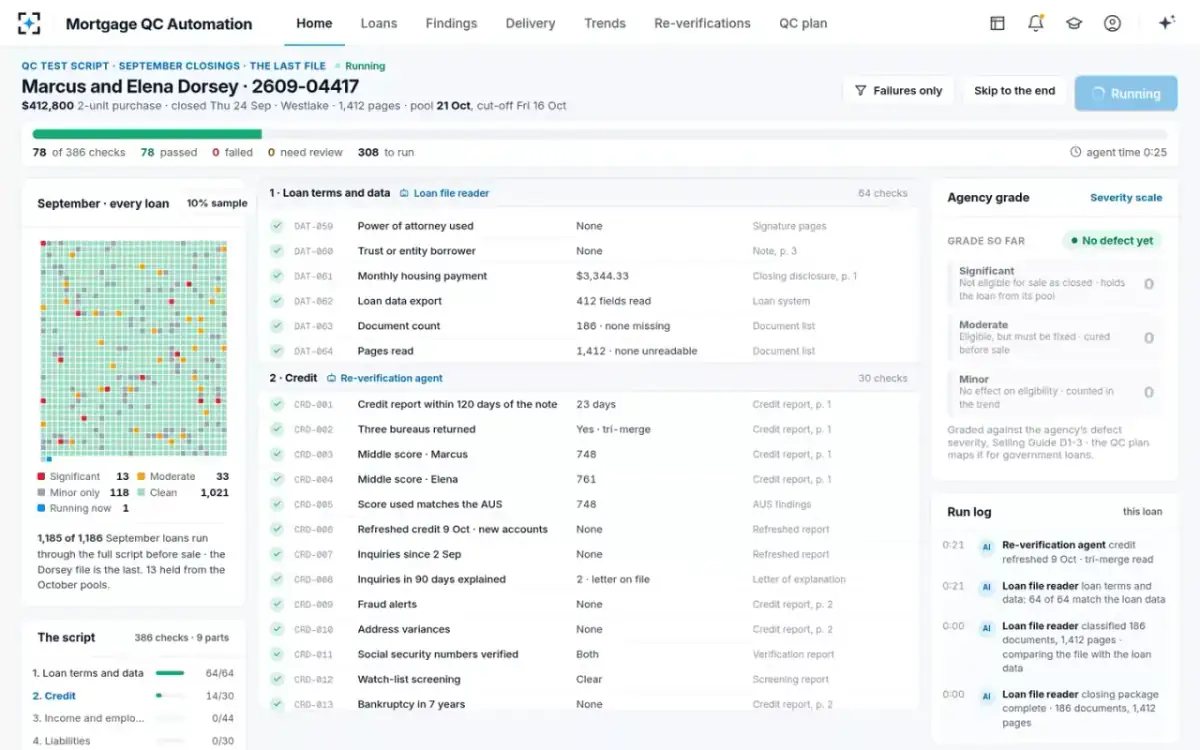
Take the last of the sample lender's 1,186 September closings: the Dorsey purchase, a $412,800 2-unit home, closing package complete on Friday 9 October, its pool cut-off a week later. The file reader read 1,412 pages and compared 412 data points with the loan system. The recalculator stopped the script at check 173: rent from unit B counted at 100% of a $2,400 lease where the plan counts 75%, and a deferred student loan counted at $0, which moved qualifying income from $13,370 to $12,770 and debt-to-income from 44.8% to 51.2%, over the 50% maximum the approval was given under.
Mortgage QC Automation running: every check with its value and page
How is a mortgage defect graded, and why does no agent give the grade?
A defect is graded on the lender's own severity scale, which Fannie Mae requires to put at the top any defect that leaves the loan "not being eligible as delivered" (D1-1-01); for FHA loans the scale should map to HUD's four tiers. Fannie Mae's own reviewers sort defects into a "finding", a "price-adjusted loan" and a "significant defect", the last being one that changes the price or makes the loan "unacceptable for purchase had the true and accurate information about the loan been known" (Selling Guide D2-1-03). A lender's top grade should line up with that last category.
The grade is where QC's consequences start: a self-report clock, a hold from the pool, a cure owed to a borrower, a trend line in the report to management. That is exactly the kind of use the Federal Housing Finance Agency singles out. Its guidance on artificial intelligence for Fannie Mae and Freddie Mac says that "high-risk AI/ML use cases—such as those that affect the Enterprise's critical business functions, invoke compliance with laws and regulations, or involve highly complex and opaque methods—warrant more robust risk management" (FHFA Advisory Bulletin 2022-02, revised May 2025). For sellers, Fannie Mae's Lender Letter LL-2026-04 (April 2026) requires governance of AI and machine learning used in origination, including a lender's vendors' and subcontractors' use.
The agent proposes the grade and shows its arithmetic. An auditor confirms it. Only the QC manager can let a held loan go.
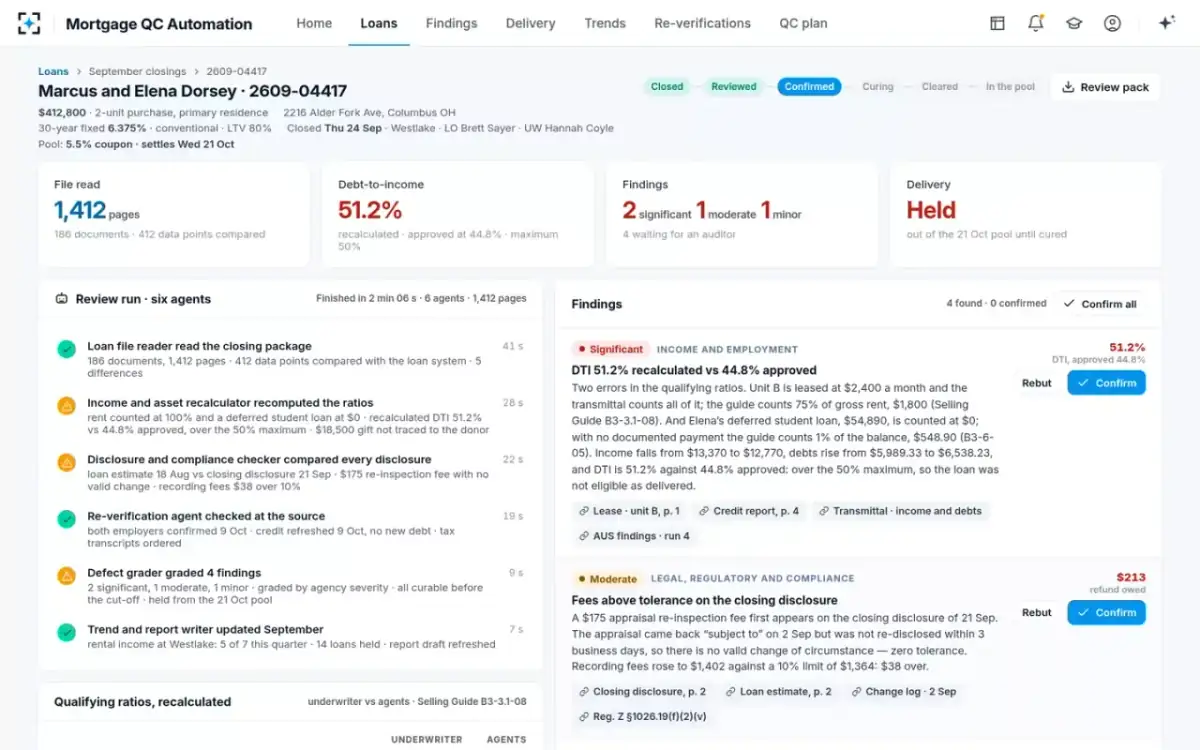
In the Dorsey file the grader proposed four findings: two significant (the DTI defect, and an $18,500 gift from Elena Dorsey's father with no proof of transfer, which left the file $8,060 short of cash to close without it), one moderate (a $175 re-inspection fee with no valid change of circumstance and recording fees $38 over the 10% tolerance, a $213 refund), and one minor (the initial application unsigned by the loan originator). Owen Mbeki, the senior QC auditor, confirmed all four.
The loan review in Mortgage QC Automation: six agents and every finding
Can AI do mortgage quality control?
It can do the reading, the arithmetic and the comparison, which is most of the hours, and it can do them on every loan rather than a sample. It cannot carry the accountability, and nothing in the rulebooks lets it: the lender remains responsible for every grade and every self-report whether the review is done by staff, a vendor or a tool. HUD's Handbook now leans toward tools in one area, telling lenders to use valuation tools, automated valuation models, listing and public records data to find appraisal problems in QC, with field reviews when needed (4000.1, V.A.3.c, Update 18).
The measure of whether it works is the lender's own random sample. In the solution, the Fannie Mae and FHA samples are still drawn and re-verified in full by auditors, independent of the agents, and their results are compared with what the agents found on the same loans. On the sample lender's data, auditors confirmed 97.8% of the agents' findings on the random sample from July to September and found two the agents missed, both minor. How to run that comparison on your own loans before you rely on it is the subject of a one-month pilot beside your QC vendor.
Can mortgage QC software hold a loan from sale?
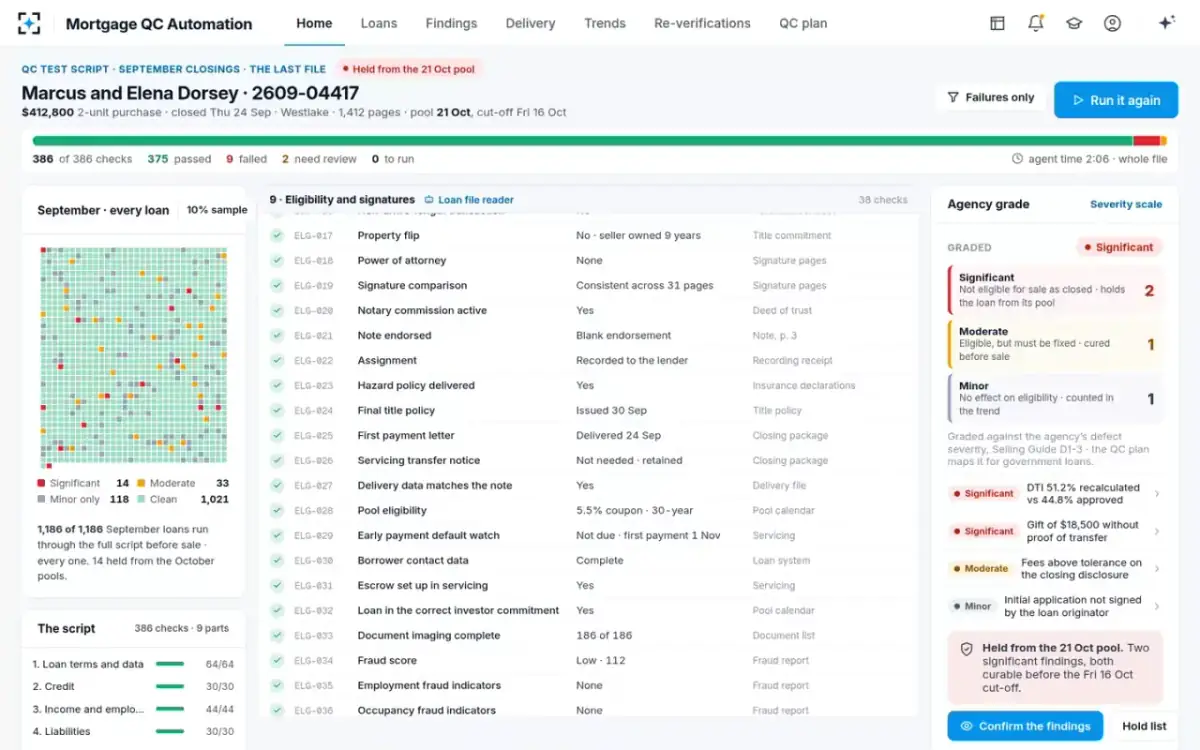
It should be able to, and only a person should be able to undo it. In the solution, a loan with an open significant finding is held from its pool; the hold list goes to secondary marketing before the cut-off with each held loan's cure, owner and due date, and the QC manager releases a loan once its cure is confirmed. For the Dorsey loan the cure plan had the AUS re-run with corrected income by Wednesday 14 October, the refund and the donor's statement by Thursday 15 October, one day ahead of the cut-off. Why that timing matters to the remedies available is set out in QC before the sale.
Graded by severity, and held from its pool until cured
What to ask any mortgage QC software vendor
Ask to see each answer on one of your own closed loans, not the vendor's sample file. A demonstration file has been run many times; your file has your overlays, your document names and your origination system's quirks.
Eight questions for mortgage QC software, answered on your own loan
- Does it read every page, or values someone entered?
If a person keys the values, the software checks the person, not the file.
- Does every finding cite a page?
A finding without its source page cannot be confirmed quickly or defended in rebuttal.
- Does it recompute income, debts and assets from the documents?
Income, credit and assets cause most material findings in FHA’s own reviews.
- Whose severity scale does it grade on?
Yours, mapped to Fannie Mae’s significant defect and HUD’s tiers, set in your QC plan.
- Who confirms a grade, and is the reason kept?
Every confirmation and rebuttal should be signed and stored with the loan.
- What can it never do?
Change loan data, change an underwriting decision, contact a borrower, send a cure, release a loan.
- How is its accuracy measured, continuously?
Against your random sample, re-verified by people independent of the tool.
- What will Fannie Mae’s AI governance rules ask of you?
Policies, an owner, annual review, vendor oversight and disclosure on request (LL-2026-04).
Questions people ask
Who is responsible for mortgage QC software results?
The lender. Fannie Mae holds the lender fully accountable for its QC program whether the work is done in-house or outsourced, and FHA requires the lender to assume full responsibility for a contractor's reviews. A tool's finding becomes the lender's finding the moment it is used, which is why each one needs a person's confirmation.
Does QC software replace the 10% random sample?
No. The random sample is required by Fannie Mae and FHA and is the basis of the lender's defect rate. Software can review every other loan as well, and the random sample becomes the independent check on the software's accuracy.
Can mortgage QC software catch TRID tolerance problems?
It should compare every Loan Estimate and Closing Disclosure, test each fee against its tolerance and the change of circumstance behind it, and compute any refund. Under Regulation Z a tolerance refund is due no later than 60 days after consummation (12 CFR 1026.19(f)(2)(v)), so a check that runs before the loan is sold still leaves time to cure.
How long does mortgage QC software take on one loan?
It depends on the file and the checks. On the solution's fictional sample loan, agents read 1,412 pages and ran 386 checks in about two minutes of agent time; the median time from a complete closing package to a graded loan in the sample data was 1.4 days, most of it waiting for people to confirm.
Does AI in mortgage QC need model risk review?
Expect it to. FHFA's guidance treats uses that touch compliance or critical functions as high risk, and Fannie Mae's LL-2026-04 asks sellers using AI in origination for policies, an accountable owner, annual review and oversight of vendors. Measuring the tool against the random sample gives model risk the evidence it needs.