Fannie Mae's prefunding QC requirements, in Selling Guide D1-2-01, oblige a lender to "maintain and implement a written prefunding QC plan" for reviewing a sample of loans before closing (or, for loans bought from a delegated third party, before acquisition); to select loans every month, with "selections from each of the lender's production channels"; to include full-file reviews, with component reviews allowed on top; and to use reviewers "who have no involvement in the origination, processing or underwriting functions of the loan being reviewed". Fannie Mae sets no percentage for the sample. The review must happen early enough for production to correct the loan before it closes; Mortgage QC Automation adds a review of every loan after closing and before sale.
Prefunding and post-closing QC are both samples, and between them sits the moment that decides the cost of any defect: the sale. Botminds' Mortgage QC Automation reviews every loan after its closing package is complete and before it is pooled, a stage the rulebooks do not require and do not prevent. This guide covers the prefunding rules first, then why the space between closing and delivery matters.
Fannie Mae prefunding QC requirements, in four rules
12×
a year: a documented monthly selection, with loans from every production channel
D1-2-01
Full file
reviews required in the plan; component reviews may be added
D1-2-01
No %
set by Fannie Mae: sample size follows the lender’s risk assessment
Fannie Mae may impose a minimum
30
days to share each prefunding report with management after completion
D1-1-03
What are Fannie Mae prefunding QC requirements?
A prefunding QC review, in Fannie Mae's words, "is an evaluation of a sample of loans prior to closing or, in the case of loans acquired from third parties, prior to acquisition" (D1-1-01). The plan must cover three things at a minimum: the timing of reviews, the selection process and the verification of data and documents (D1-2-01). The process must run independent of production "if practical", and at a minimum the reviewer cannot have worked on the loan.
The purpose is stated outright: prefunding reviews give "important and timely feedback" so the lender can find "loans with defects (such as analysis or calculation errors, inaccurate data, or inadequate documentation) prior to closing or acquiring the loan", which "prevents the lender from selling ineligible loans to Fannie Mae". Reviews must happen "early enough in the origination process to allow adequate time to make loan selections, complete the reviews, and properly inform the loan production staff so that corrections can be made prior to loan closing or acquisition", and once the file holds enough documentation to review.
Fannie Mae prefunding QC checklist: what a full-file prefunding review must assess
- Data entered into the automated underwriting system
Every DU input against the documents in the file.
- Borrower Social Security numbers
Consistent across the file and validated where required.
- Income calculations and supporting documentation
Not required to be recalculated where DU validated the income, but the verification report ID and expiry must be confirmed.
- Employment, including the verbal verification of employment
The VOE is part of the prefunding scope, not only post-closing.
- Assets needed to close or for reserves
DU-validated assets need not be recalculated; others must be supported.
- The appraisal or other collateral data
Including reconciliation of Collateral Underwriter flags and messages.
- Mortgage insurance coverage
Adequate for the transaction under B7-1-02.
- Occupancy
Consistent with the documents in the file.
How many loans need a prefunding QC review?
Fannie Mae does not set a number. The monthly selection "should take into account the lender's assessment of the risks inherent in its origination processes, business sources, production channels, volume, and product mix", and Fannie Mae "reserves the right to require the lender to make adjustments or impose minimum sampling requirements if a lender's approach does not provide adequate representation or effectively identify risk" (D1-2-01). Component reviews are the lever for coverage: a review of one element, such as income or assets, done on more loans, "can enable lenders to review more loans and provide a broader comprehensive risk review than simply performing a full review on all loans sampled".
What must a prefunding QC report include?
Reporting is lighter than post-closing but not optional. Prefunding reports must give the date published, how each sample was selected and what share of eligible loans it covered, summaries of random, discretionary and component reviews, defect trending for at least three months, and must be "shared with management within 30 days of completion" (D1-1-03).
What are FHA prefunding QC requirements?
FHA calls them pre-closing reviews and caps them. Of the required QC sample, "Pre-closing Review 10% or less" and "Post-closing Review 90% or more"; a lender closing nine or fewer loans in a month must still select at least one for pre-closing review (HUD Handbook 4000.1, V.A.3.a). Pre-closing reviews happen "after the Mortgage is approved by an FHA Direct Endorsement (DE) underwriter, and prior to closing". They cover most of the same areas as post-closing reviews, but a new credit report and re-verification are not required, and discrepancies found "must be resolved prior to closing". Freddie Mac has its own prefunding rules in its Seller/Servicer Guide; check them for loans sold there.
What is the difference between prefunding and post-closing QC?
Prefunding QC samples loans before closing so production can fix them; post-closing QC samples closed loans to measure quality and find defects to report. They differ in timing, depth, required size and what they feed. Neither covers every loan, and neither is required to happen between closing and the sale.
Prefunding and post-closing QC: two samples on either side of closing
Prefunding QC (Fannie Mae D1-2): Before closing or acquisition, once the file can be reviewed
Post-closing QC (Fannie Mae D1-3): After closing; selected at least monthly; whole cycle within 90 days of the disbursement month
Prefunding QC (Fannie Mae D1-2): Lender’s risk-based monthly sample, every channel; no set percentage
Post-closing QC (Fannie Mae D1-3): 10% random or statistical (95%, 2%, six months), plus discretionary
Prefunding QC (Fannie Mae D1-2): Full-file required in the plan; component reviews allowed
Post-closing QC (Fannie Mae D1-3): Random sample: full-file only; discretionary: full-file or component
Prefunding QC (Fannie Mae D1-2): Not listed; verifies data and documents in the file, including the verbal VOE
Post-closing QC (Fannie Mae D1-3): Required: income, tax transcripts, assets, a new tri-merge credit report, property, occupancy
Prefunding QC (Fannie Mae D1-2): Fixing loans before they close; feedback to production
Post-closing QC (Fannie Mae D1-3): Measuring the defect rate against target; self-reporting ineligible loans
Prefunding QC (Fannie Mae D1-2): Pre-closing review: ≤10% of the sample, after DE approval
Post-closing QC (Fannie Mae D1-3): Post-closing review: ≥90% of the sample, within 60 days of month-end
Can QC be done before a loan is sold?
Yes; nothing in the Selling Guide limits QC to the required samples or the required times. A lender can review any closed loan before delivering it, and hold it back if it finds a defect. What the Guide requires is the floor: a prefunding sample before closing and a post-closing sample after. The question is whether the post-closing cycle finishes before or after the loan has been sold, and on Fannie Mae's clock it frequently cannot finish before. A loan closed late in September may be delivered in October, while its month's QC cycle has until about the end of December.
Take the fictional sample lender in this series, Halden Ridge Home Loans. Its last September file, the Dorsey purchase, closed on Thursday 24 September; its closing package was complete on Friday 9 October; the pool it was slotted for settled on Wednesday 21 October, with the lender's cut-off three business days before. The timeline below sets that loan's path against the review a random sample would have given it.
QC before the sale: one September loan, two review clocks
- Closing to complete package15 d
- Graded, cured, pooled 21 Oct12 d
- Rest of September7 d
- Loan sold 21 Oct while QC cycle runssold
- Review, rebuttal, report until late December≈70 d
What happens if a defect is found after the loan is sold?
The remedy stops being the lender's choice. Before delivery, a lender that finds a significant defect can correct the file, re-run the AUS, refund a fee, keep the loan in portfolio or sell it elsewhere. After the sale, the loan's eligibility was fixed at delivery: a defect that made it ineligible must be self-reported within 30 days of the report that confirms it, and if Fannie Mae finds a significant defect, "Fannie Mae will require repurchase of the mortgage loan or may offer the lender a repurchase alternative" (Selling Guide D2-1-04).
The Guide defines the two words precisely. A "remedy" is "an action elected by Fannie Mae to resolve a significant defect"; a "correction" is an action by the lender showing the defect did not exist at purchase or has been corrected as the contract allows, including a "de minimis correction" of up to $500. And correction documents must rest on information "available at the time of underwriting (and no later than the note date)", or covering that time. Both limits bite harder after sale, when the lender is arguing with the buyer rather than fixing its own file.
After the sale: the remedies Fannie Mae may elect for a significant defect
| Remedy | What the lender owes | Who decides |
|---|---|---|
| Repurchase | Buys the loan back from Fannie Mae | Fannie Mae, or the lender may choose it over an alternative |
| Pricing adjustment | A guaranty fee adjustment, risk fee or added loan-level price adjustment | Fannie Mae, if the loan is retainable |
| Recourse, or collateralized recourse | Covers losses for the life of the loan or a set period | Fannie Mae, based on counterparty status |
| Indemnification | Holds Fannie Mae harmless from losses on the loan | Fannie Mae |
| Make-whole payment | Pays so that Fannie Mae incurs no loss | Fannie Mae |
| Split loss or loss reimbursement | Shares or reimburses specified losses | By agreement |
FHFA built this framework so remedies would be predictable: "When mortgages don't comply, the Enterprises may require remedies, including issuing a repurchase request" (FHFA, Representation and Warranty Framework). Predictable is not cheap. The last time demands piled up, FHFA's inspector general counted outstanding repurchase demands of "as much as $19.6 billion for Fannie Mae" between 2009 and 2012 (FHFA-OIG AUD-2014-009), a historical figure, but a reminder of what an unresolved backlog becomes.
Before delivery, a defect is the lender's problem to fix. After delivery, it is the investor's remedy to elect.
QC before the sale: what it takes
Reviewing every closed loan between a complete closing package and the pool cut-off is a scheduling problem as much as a review problem. In the sample lender, that window was a week for the last September file. The review must therefore finish in days, which means the reading, comparison and recalculation cannot wait in a queue for an auditor. In Botminds' Mortgage QC Automation the agents read each loan as its package completes, grade it on the lender's severity scale and hold any loan with an open significant finding from its pool, and an auditor confirms each finding; the median from complete package to graded loan in the sample data was 1.4 days.
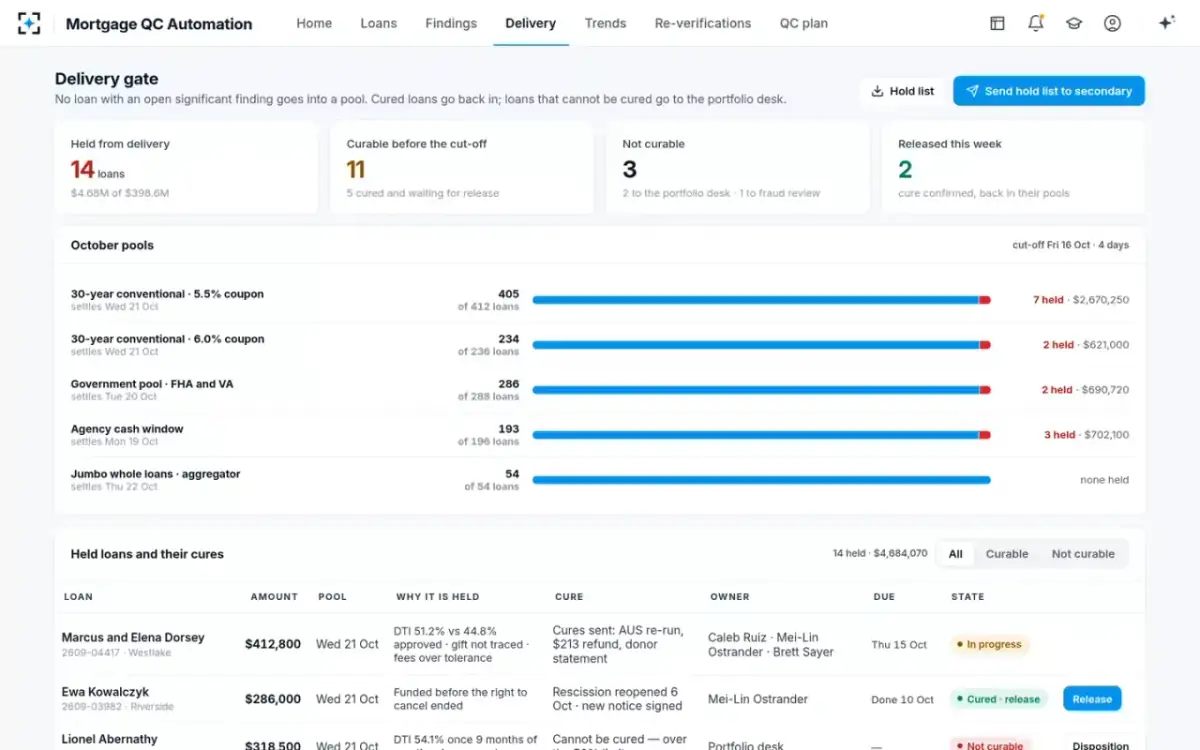
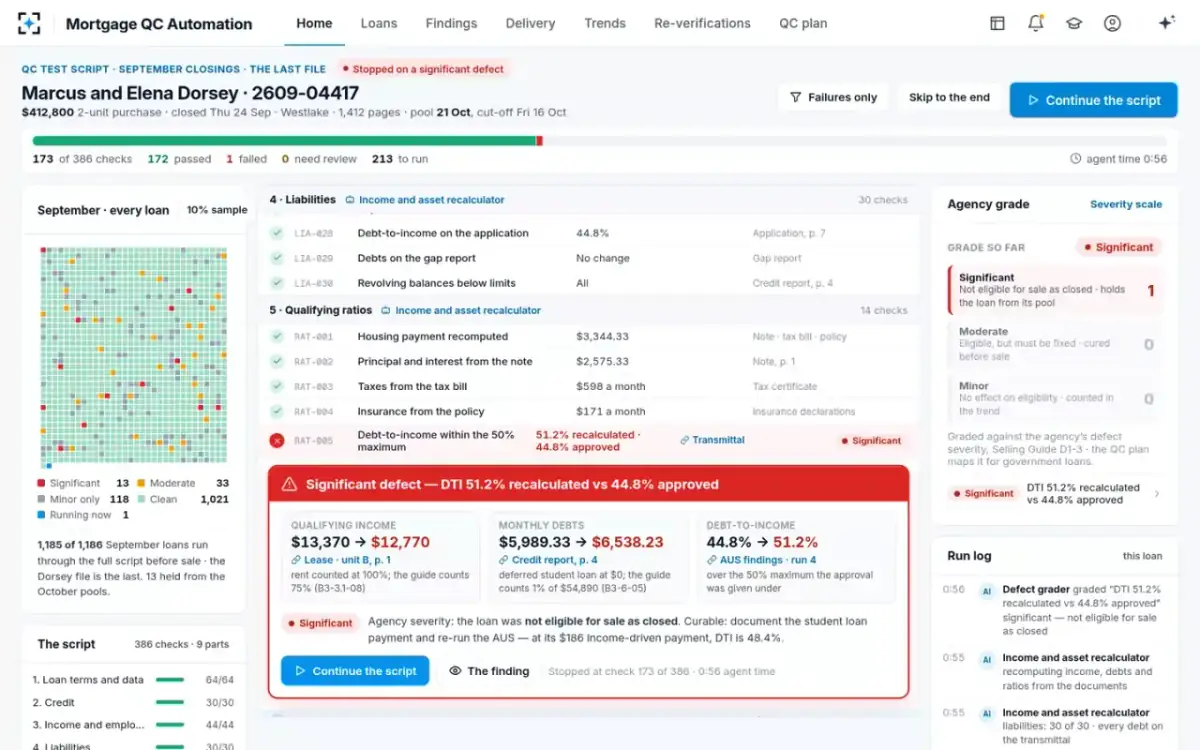
For the Dorsey loan the review found two significant defects (debt-to-income recalculated at 51.2% against 44.8% approved, and an $18,500 gift with no proof of transfer) and a $213 tolerance refund. All were curable with documents that existed at closing, and the cure plan set them for Wednesday 14 and Thursday 15 October, one day before the cut-off. Secondary marketing received the hold list for all October pools: 14 loans held, 11 curable before the cut-off, 3 not curable, with 2 sent to the portfolio desk and 1 to fraud review.
Mortgage QC Automation sends the hold list before the pools close
This review does not replace either required sample. The prefunding sample still runs before closing, and the post-closing random sample is still drawn, re-verified at the source and reviewed in full by auditors, because it is the basis of the defect rate Fannie Mae asks lenders to measure (the target defect rate explains how). What changes is that the post-closing sample confirms quality rather than discovering it after the sale. The required post-closing process itself is read line by line in Fannie Mae post-closing QC requirements.
In Mortgage QC Automation, a significant defect stops the review
Questions people ask
Is prefunding QC required by Fannie Mae?
Yes. The QC plan must include a process for prefunding and post-closing file reviews, and D1-2-01 requires a written prefunding QC plan with a documented monthly selection process covering every production channel. The sample size is the lender's to justify by risk.
Can component reviews satisfy prefunding QC?
Not entirely. The prefunding plan must contain requirements for full-file reviews; component reviews of one element, such as income or assets, can be added to cover more loans or test a control. Fannie Mae describes a mix of the two as giving broader risk coverage than full reviews alone.
Who can perform prefunding QC reviews?
Anyone qualified who had no involvement in originating, processing or underwriting the loan being reviewed. Fannie Mae asks for the whole prefunding process to run independently of production where practical.
Does prefunding QC replace post-closing QC?
No. Post-closing QC is separately required, with its own random sample, re-verification and 90-day cycle, and it is the basis of the lender's defect rate. Prefunding reviews feed production; post-closing reviews measure and report.
What is a de minimis correction under Fannie Mae's remedies framework?
A correction of a significant defect by a payment, refund or credit of no more than $500, unless the lender and Fannie Mae agree to more. It cannot be used if it would leave a required minimum borrower contribution unmet or to correct a Charter violation.