PTD conditions in a mortgage are "prior to docs" conditions: items the underwriter must clear before the lender draws the closing documents and sends the Closing Disclosure. PTF, "prior to funding", conditions may stay open until just before the loan funds, and a few items can even be satisfied after closing. No regulator defines PTD or PTF; they are labels lenders put on a conditional approval. But each bucket exists because of a hard rule: the borrower must receive the Closing Disclosure at least three business days before consummation, and Fannie Mae lets the final verbal verification of employment wait until delivery. Botminds' Mortgage Condition Management marks each condition with its bucket, watches the closing date and the date the Closing Disclosure must be received, and books the late checks inside their windows.
The worked dates come from the solution's fictional sample file for Marcus and Elena Whitaker, closing Tuesday 20 October. The rules are quoted from Regulation Z and the Fannie Mae Selling Guide.
Three clocks decide which bucket a condition belongs in
3days
business days: the Closing Disclosure must be received before consummation
3days
business days after mailing, when a disclosure not handed over is deemed received
10days
business days before the note: the window for a verbal VOE on employment income
What are PTD conditions in a mortgage?
PTD conditions are the conditions a lender requires to be cleared before it will prepare closing documents. They are usually everything that could change the loan's terms or the credit decision: income, assets, credit explanations, the appraisal, title and the insurance binder. Clear them all and the underwriter issues clear to close; until then, the closer cannot finalise the figures the Closing Disclosure has to show.
"PTD" is sometimes read as "prior to documents" or "prior to drawing docs"; the meaning is the same. Some lenders use "prior to closing" (PTC) for a middle bucket that must be met before the signing appointment but not before documents are drawn, such as a final walk-through item or a signed payoff authorisation. The labels vary by lender, which is why a processor moving between shops relearns them.
PTD vs PTF vs prior to closing: who clears what, and when
The buckets differ by the event they must precede, and therefore by the rule that sets their deadline. The comparison below uses the sample file's conditions.
Three condition buckets, the event each must beat, and the rule behind it
What sits in it: Paystubs, bank statements, gift letter and transfer, large deposit source, letters of explanation, appraisal, title commitment, insurance binder, HOA certificate. 13 of the sample file's 14 conditions.
Why it sits there: Anything that can change the loan amount, rate, costs or approval must be settled before the Closing Disclosure is final, because the borrower must receive it three business days before consummation.
What sits in it: Items the closer needs at the table: a final signed figure from the title company, a power of attorney approved by the lender, identification.
Why it sits there: They do not change the disclosed terms, but closing cannot happen without them.
What sits in it: Verbal verification of employment, final insurance declarations, the wire, signed documents back from the settlement agent. 1 of the sample file's 14.
Why it sits there: Some checks are meant to be made as late as possible. Fannie Mae wants employment confirmed "as late in the process as possible."
What sits in it: Verbal VOE in Fannie Mae's allowed case; trailing documents such as the recorded mortgage.
Why it sits there: Fannie Mae lets the verbal VOE follow closing up to delivery; without it the loan cannot be sold to Fannie Mae.
Why prior to docs is really "prior to the Closing Disclosure"
The PTD deadline is set by the Closing Disclosure. Under TRID, the lender must "ensure that the consumer receives" the Closing Disclosure "no later than three business days before consummation" (12 CFR 1026.19(f)(1)(ii)). Every figure on it, the loan amount, the rate, the cash to close, depends on conditions being resolved. A gift that arrives for a different amount changes the cash to close; a new debt can change the loan's eligibility. So the lender clears those conditions first, then issues clear to close, then prepares the disclosure.
Receipt is not the same as sending. "If any disclosures … are not provided to the consumer in person, the consumer is considered to have received the disclosures three business days after they are delivered or placed in the mail" (1026.19(f)(1)(iii)), unless the lender can show earlier receipt, which e-signature logs often do. A Closing Disclosure put in the post on a Monday is presumed received on the Thursday; the borrower can then sign the following Monday at the earliest, because Saturday counts as a business day for these rules and Sunday does not.
That is why a PTD condition still open on the Wednesday of the week before a Tuesday closing is a closing at risk. In the sample file, the closing is Tuesday 20 October, so the Closing Disclosure must be received by Friday 16 October; the lender plans to send it Wednesday 14 October; so every PTD condition must be cleared on Tuesday 13 or early on the 14th.
One closing date, and the days that must come before it
- Clear PTD conditionsTue 13
- CD sentWed 14
- CD receivedby Fri 16
- Waiting period; verbal VOE on MondaySat–Mon
- ClosingTue 20
- Clear PTD conditionsTue
- CD sentWed
- CD receivedThu–Fri
- Corrected CD hand-delivered MondaySat–Mon 19
- New three-day waitTue–Wed
- ClosingThu 22
What restarts the clock: three changes that need a new waiting period
Most changes after the Closing Disclosure do not restart the three days; they need a corrected disclosure at or before consummation. Three changes do. The rule lists them: "(A) The annual percentage rate … becomes inaccurate, as defined in § 1026.22. (B) The loan product is changed … (C) A prepayment penalty is added" (12 CFR 1026.19(f)(2)(ii)). For a regular transaction, 1026.22 treats the APR as accurate only within "1/8 of 1 percentage point" of the correct figure.
This is the practical reason PTD conditions include anything that could move the rate: a lower appraisal that moves the loan-to-value band, a credit event that changes pricing, or a change from fixed to adjustable. A condition cleared late that changes one of those three items costs at least three more business days, and the closing date with it.
What are prior to funding conditions?
Prior to funding conditions are checks the lender wants made as close to the money moving as possible, or paperwork that only exists at closing. The best known is the verbal verification of employment. Fannie Mae requires it for each borrower who uses employment, Schedule K-1 (under 25% ownership) or self-employment income, "intended to help the lender mitigate risk by confirming, as late in the process as possible, that the borrower remains employed as disclosed on the loan application" (B3-3.1-04).
For employment income the check must fall "no more than 10 business days on or before the note date", which is why it cannot be cleared with the other conditions a week earlier. In the sample file it is booked for Monday 19 October, the day before closing. Other common PTF items are final homeowners insurance declarations with the premium paid, the settlement agent's wiring instructions verified, and the signed documents back for the funder's review.
Can conditions be cleared after closing?
A few can, and Fannie Mae says so for the verbal VOE: "The lender may obtain the verbal VOE after closing, up to the time of loan delivery. If the verbal VOE cannot be obtained prior to delivery, the loan is ineligible for sale to Fannie Mae." That is not an invitation to leave credit conditions open. A condition that could change the credit decision belongs before docs, because discovering a lost job or a new debt after closing leaves the lender holding a loan it may not be able to sell.
Other post-closing items are "trailing documents": the recorded security instrument, the final title policy, sometimes a corrected form. They are not underwriting conditions in the credit sense; they are delivery and custody requirements, tracked by post-closing staff against the investor's deadlines.
Who clears PTD conditions?
The underwriter clears PTD conditions that bear on credit, and the processor often clears the rest. Many lenders let processors clear title, insurance, property and compliance conditions where the test is whether a document says what it should, and reserve income, asset and credit conditions for the underwriter. Clear to close itself is issued by the underwriter.
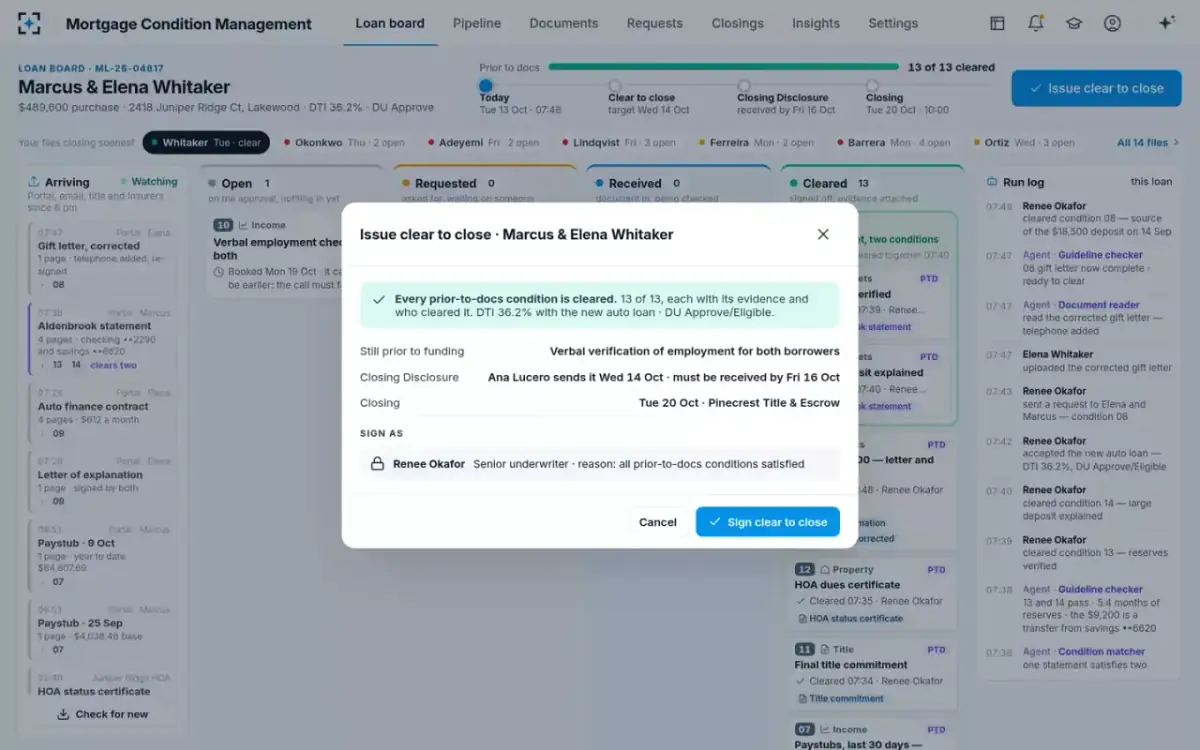
In the solution that split is a setting, and the agents never clear anything: they place each document on the condition it satisfies, test it, and propose. The difference from a hand process is where the time goes. The sample file's underwriter cleared seven PTD conditions between 07:33 and 07:48 on the Tuesday and signed clear to close at 07:50, a day ahead of the target.
Clear to close: every prior-to-docs condition cleared, one prior-to-funding item left
What happens if a PTF condition isn't met?
If a prior to funding condition is not met, the loan does not fund: the documents may be signed, but the lender holds the wire until the condition clears or the loan is re-underwritten. On a purchase that can cost the borrower the day, and the seller's patience. If the condition reveals a change, such as a borrower who has left the job, the underwriter must decide on the new information, and the loan may be denied after documents were signed.
The safer pattern is to clear early whatever can be cleared early, and to schedule the late checks rather than discover them. Closing watch in the solution books the verbal VOE inside its window and flags any file with open PTD items and seven days or less to closing, so a PTF item never becomes the surprise on closing morning.
Sorting a conditional approval into buckets
The bucket follows from two questions: can the item change the terms or the credit decision, and is there a rule that wants it late? The table sorts common conditions on that basis; lenders draw some lines differently.
Which bucket a condition usually goes in, and the reason
| Condition | Usual bucket | Why |
|---|---|---|
| Paystub, W-2s, tax transcripts | Prior to docs | Sets qualifying income and the ratios |
| Bank statements, reserves, large deposit | Prior to docs | Sets cash to close and reserves; a reduction can change eligibility |
| Gift letter and transfer | Prior to docs | A different gift amount changes cash to close and may need a DU resubmission |
| Letter of explanation for an inquiry | Prior to docs | May disclose a new debt that changes the ratios |
| Appraisal or appraisal update | Prior to docs | Sets loan-to-value, pricing and mortgage insurance |
| Title commitment, insurance binder, HOA certificate | Prior to docs | Figures and names on the disclosure and the deed of trust depend on them |
| Verbal verification of employment | Prior to funding (or before delivery) | Fannie Mae wants it within 10 business days on or before the note date |
| Final insurance declarations, wire verified, signed package | Prior to funding | Exist only at closing, or must be confirmed then |
The age limit is the hidden third clock. A bank statement cleared as a PTD condition in September can expire before an October closing that slipped, and then it is an open condition again. Which documents expire, and when, has the full calendar; one file from conditional approval to clear to close shows the buckets on a real calendar.
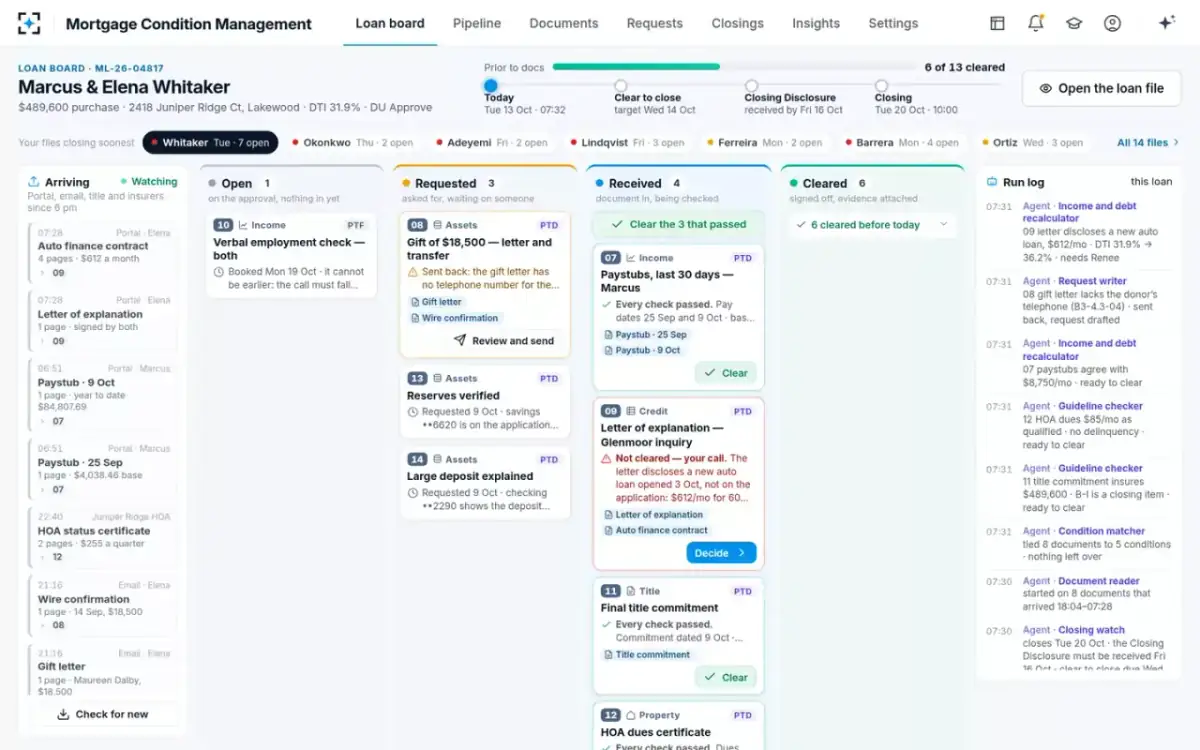
Each condition carries its bucket: PTD or PTF
Questions people ask
What does "prior to docs" mean?
It means the condition must be cleared before the lender prepares the closing documents. In practice it is the condition set that must be resolved before clear to close and before the Closing Disclosure, which the borrower must receive three business days before consummation.
Is "prior to closing" the same as "prior to docs"?
Not always. Some lenders use "prior to closing" for items needed at the signing table that do not change the disclosed figures, such as an approved power of attorney. Others use it loosely for everything before closing. Check the lender's own condition codes.
Can a PTD condition be moved to PTF?
The underwriter can move a condition when its outcome cannot change the terms or the credit decision. Moving an income or asset condition to prior to funding to save a closing date is risky: if the document fails, the Closing Disclosure may be wrong and the loan may not close as disclosed.
Do conditions have to be cleared before the Closing Disclosure is sent?
No rule says so in those words, but the Closing Disclosure must show accurate terms, and an APR change, product change or new prepayment penalty restarts the three business days. Lenders therefore clear conditions that could change the terms first.
How long after clear to close is closing?
At least long enough for the Closing Disclosure to be prepared, delivered and received three business days before consummation. With a Closing Disclosure hand-delivered on a Tuesday, closing can be Friday; with mailing on a Tuesday, receipt is presumed on Friday and closing can be the following Tuesday.