A notice of incompleteness under Regulation B is the written notice a creditor sends when an application lacks information the applicant can supply: it must specify the information needed, designate a reasonable period to provide it, and say that without it the application will get no further consideration. The creditor must send it, or decide the application, within 30 days of receiving the incomplete application (12 CFR 1002.9(c)). Mortgage lenders meet the rule most often after a conditional approval, when a condition asks for a pay stub or a bank statement that never arrives. A condition request can be the notice, but only if it is written and carries all three elements. Botminds' Mortgage Condition Management drafts condition requests in plain words for a processor to send; whether a given request is also the lender's Reg B notice is the lender's decision, and this page sets out what that decision turns on.
This page explains the rule, not legal advice for a particular file. The rule text is quoted from Regulation B and the official interpretations of Regulations B and C.
From a missing document to a closed file: where Reg B applies
A person decides
UnderwriterApproves subject to conditions, including documentation or verification of income or assets the lender needs to make the credit decision.
Agent
Request writerDrafts a request for the missing document in plain words, addressed to the borrower.
Never: Sends it, or decides whether it is the lender's Reg B notice.
A person decides
ProcessorSends the request. If it is to serve as the notice of incompleteness, it goes in writing and names the information, a reasonable deadline and the consequence.
A person decides
BorrowerSends the document within the period, sends it late, or does not respond.
A person decides
Underwriter and complianceDecide the application on the document; or, with a written notice unanswered, close the file for incompleteness; or take adverse action and give reasons.
What is a notice of incompleteness?
A notice of incompleteness is one of two ways a creditor can answer an incomplete credit application under the Equal Credit Opportunity Act's Regulation B. The rule reads: "If additional information is needed from an applicant, the creditor shall send a written notice to the applicant specifying the information needed, designating a reasonable period of time for the applicant to provide the information, and informing the applicant that failure to provide the information requested will result in no further consideration being given to the application" (12 CFR 1002.9(c)(2)).
The other way is to take action on the incomplete application, approving or denying it, and to give the applicant the notice of action taken that Reg B requires. A creditor that chooses the notice of incompleteness has "no further obligation" if the applicant does not respond in time; if the information arrives in time, the creditor decides and notifies as for any completed application.
When must a notice of incompleteness be sent?
Within 30 days after the creditor receives an application that is incomplete as to matters the applicant can complete. Section 1002.9(c)(1) gives the creditor two options inside that window: notify the applicant of action taken, or notify the applicant of the incompleteness. The window opens when the creditor receives the application, not when someone notices a document is missing.
Reg B's clocks for an application, complete or not
- Send a notice of incompleteness, or decide30 days
- Period the notice gives (our example)15 days
- Notify approval, counteroffer or adverse action30 days
- Notice of adverse action, if the applicant does not accept or use the credit offered90 days
An oral request does not stop the clock. The official interpretation is explicit: "If an applicant fails to provide the information in response to an oral request, a creditor must send a written notice to the applicant within the 30-day period specified in §§ 1002.9(c)(1) and (2)" (comment 9(c)(3)-1). A processor's phone call asking for a missing statement is good service; it is not the notice.
Is a condition request a notice of incompleteness?
A condition request can be a notice of incompleteness, but it is not one by default. It becomes one when it asks for information the lender needs to make the credit decision, is in writing, and carries the rule's three elements. A friendly email asking for "the gift letter with your mother's phone number" is a request; the same email with "by 30 October" and "if we do not receive it, we cannot consider your application further" is a notice.
Federal rules confirm that conditional approvals can end this way. The official commentary to Regulation C, which governs mortgage reporting, explains how to classify a conditional approval that does not close. Where "the conditions involve submitting additional information about underwriting or creditworthiness that the institution needs to make the credit decision, and the institution has sent a written notice of incompleteness under Regulation B, 12 CFR 1002.9(c)(2), and the applicant did not respond within the period of time specified in the notice", the file is reported as closed for incompleteness (comment 4(a)(8)(i)-13).
The same commentary separates those conditions from customary commitment or closing conditions, such as clear title or an acceptable insurance binder. A missing title commitment is not an incomplete application in the Reg B sense: the credit decision is made, and if the closing condition fails, the loan is approved but not accepted. The list of common conditions sorts them into the two kinds.
What a written notice must say
A notice of incompleteness must do three things, and a lender that wants its condition requests to double as notices should build them in. The checklist adds what makes the notice useful to a borrower, which is a separate matter from what makes it compliant.
Elements of a notice of incompleteness, and what makes it work
- The specific information needed
Required. "Your most recent bank statement for savings ending 6620, all pages" beats "updated asset documentation".
- A reasonable period to provide it
Required. A date, not "as soon as possible"; reasonable for the item asked.
- The consequence of not providing it
Required: no further consideration will be given to the application.
- In writing
Required where an oral request went unanswered (comment 9(c)(3)-1).
- How to send it
Good practice: the portal, a photo from a phone, or the processor's address.
- Plain words, no rule numbers
Good practice: the borrower acts on what they understand, not on a section citation.
What happens if the borrower doesn't send documents?
If a written notice of incompleteness goes unanswered within its period, the lender may stop: Reg B says it then has "no further obligation under this section." The file is closed for incompleteness, and a lender may instead give a notice of adverse action on the basis of incompleteness. Either way, the application is over.
If the documents arrive after the deadline, the lender may treat them as a new application. "If information requested by a creditor is submitted by an applicant after the expiration of the time period designated by the creditor, the creditor may require the applicant to make a new application" (comment 9(c)(2)-1). In practice many lenders accept late documents on a live file, but the right to start again is theirs, and with it a fresh set of disclosures and dates.
Can a file be closed for incompleteness? Often, in the national data
Yes, and it happens on a large scale. Lenders reported 695,006 mortgage applications as closed for incompleteness in 2025, about one for every ten loans originated. On home purchase loans the figure was 199,434, about one for every eighteen originated.
Mortgage applications closed for incompleteness, 2025
695,006
applications closed for incompleteness, all purposes
6.83M
loans originated, all purposes
199,434
home purchase applications closed for incompleteness
581,940
closed for incompleteness in 2024, all purposes
Every one of those files had a written notice behind it, by the reporting rule's own definition. Some were applicants who had already gone elsewhere; others were borrowers who did not understand what was asked, or asked the loan officer and waited. The second group is the one a clearer request reaches.
Four ways a conditional approval can end without closing
A conditional approval that does not close ends in one of four ways, and which one depends on the kind of condition left open and on whether a written notice went out.
How a conditional approval ends when it does not close
| What happened | How it ends | What Reg B requires |
|---|---|---|
| Credit conditions not met, for a reason other than missing information | Denied | Notice of adverse action with specific reasons, within 30 days |
| Information needed for the credit decision never arrived after a written notice of incompleteness | Closed for incompleteness | No further notice once the period lapses |
| Only customary closing conditions left, not met; or all met and the borrower did not close | Approved but not accepted | The approval was the notice of action taken |
| Borrower expressly withdrew before meeting the credit conditions | Withdrawn | No notice of action required |
The table explains why borrowers search "denied after conditional approval". A conditional approval is a decision with strings; if a credit condition fails, such as a debt-to-income ratio that no longer works once a new car loan is counted, the result is a denial, with reasons.
Reg B counteroffer requirements, and when a condition is one
A condition that changes the terms the borrower asked for is a counteroffer, and Reg B gives it its own clock. A demand for a larger down payment, for example, is listed in the Regulation C commentary among conditions that constitute a counteroffer. Reg B requires notice of a counteroffer within 30 days of a completed application, and if the applicant neither accepts nor uses the credit offered, a notice of adverse action within 90 days of the counteroffer (1002.9(a)(1)(iv)).
One more Reg B rule touches conditional approvals: when an applicant is expected to inquire about status and has not done so within 30 days of applying, a creditor that has approved the application "may treat the application as withdrawn" (1002.9(e)). That is rarely the case on a mortgage in active processing, but it is the rule for an approval that simply goes quiet.
Where a plain-language request fits
Whatever the lender decides about notices, the request should be one a borrower can act on the day it arrives. In the solution, the request writer turns the condition into two or three sentences addressed to the right person, the processor reads it and presses Send, and replies land on the condition. On the sample lender, the median reply time fell from 1.9 days to 5.1 hours after requests were rewritten in plain words; that is sample data, not a customer's result.
What the condition says, and what the borrower reads
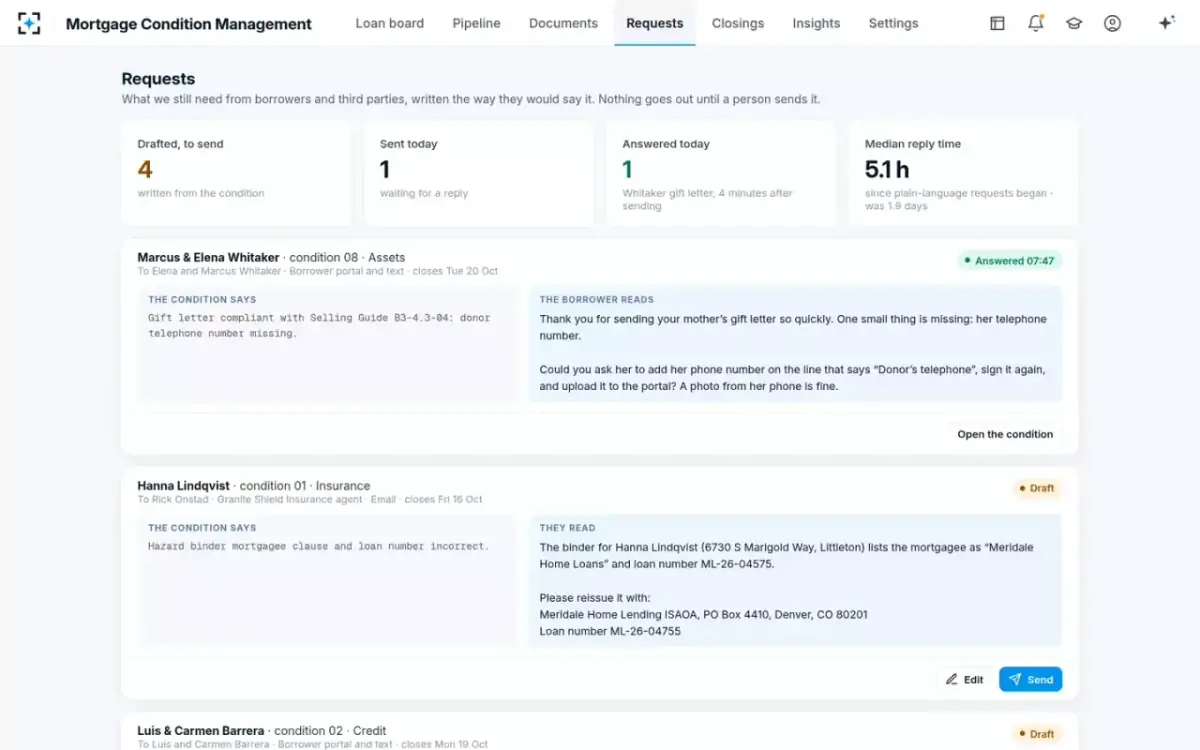
A lender that uses condition requests as its notices should make the deadline and the consequence part of its own template, and have compliance approve it once. The request writer's job is the plain-words part; the legal effect is the lender's. For the clocks that follow clear to close, see PTD and PTF conditions; for one file end to end, conditional approval to clear to close. The solution itself is at Mortgage Condition Management.
Questions people ask
Does a notice of incompleteness have to be in writing?
Yes. Section 1002.9(c)(2) requires a written notice, and a creditor that asked orally and got no answer must still send one within the 30-day period. Creditors that received no more than 150 applications in the preceding year may give Reg B notifications orally under 1002.9(d).
How long must the notice give the borrower?
Reg B says "a reasonable period of time" and sets no number. The period should fit the item: a bank statement can be downloaded in minutes, a corrected tax transcript cannot. Whatever the lender chooses, it should be a date on the notice.
Is a notice of incompleteness the same as adverse action?
No. It is the alternative to adverse action on an incomplete application. If the applicant does not respond in the period, the creditor has no further notice duty; a creditor may also choose to take adverse action on the basis of incompleteness instead and give that notice.
Does the 30-day clock apply to a preapproval?
The official interpretation says the notice of incompleteness requirement "does not apply to preapprovals that constitute applications" under the regulation's definition. Other Reg B notice duties for preapprovals still apply.
Can a lender deny instead of sending a notice?
Yes. Section 1002.9(c)(1) lets the creditor either take action on the incomplete application, with the usual notice of action taken and reasons, or send the notice of incompleteness. Both must happen within 30 days of receiving the application.