A credit report expires for Fannie Mae when it is more than four months old on the note date. The rule, Selling Guide B1-1-03, covers all "credit documents", which it defines as credit reports and employment, income and asset documentation, so the bank statements and pay stubs in the file run on the same clock. FHA uses 120 days counted to the disbursement date, and the verbal verification of employment for a salaried borrower must be no more than 10 business days old on the note date. The practical problem is slippage: a condition cleared in September with a document that is fine on the planned closing date can be out of date when the closing moves. Botminds' Mortgage Condition Management checks each document's age against each file's note date and re-requests what will be too old.
Rules are quoted from the Fannie Mae Selling Guide as published October 7, 2026 and HUD Handbook 4000.1, Update 18. We could not read Freddie Mac's Guide text for this page, so it does not state Freddie Mac's limits.
How long each document stays usable, and the date it is counted to
How long is a credit report good for a mortgage?
A credit report is good for four months on a loan sold to Fannie Mae, measured to the note date, and for 120 days on an FHA loan, measured to the disbursement date. After that, the lender must pull a new report, or update it, before closing. The same limit applies to the income and asset documents in the file, which surprises borrowers who assume only the credit report expires.
The search "fannie mae credit report expiration 120 days" mixes up the two rules. Fannie Mae's limit is stated in months, not days; 120 days is FHA's limit. In most months the difference is two or three days, but on a tight closing those days decide whether a report must be pulled again.
Fannie Mae's allowable age of credit documents, in full
Selling Guide B1-1-03 sets one rule for every credit document: "For all mortgage loans (existing and new construction), the credit documents must be no more than four months old on the note date." For a run of statements, the newest one counts: "When consecutive credit documents are in the loan file, the most recent document is used to determine whether it meets the age requirement" (B1-1-03). The section's own example is two monthly bank statements, where the more recent must be no more than four months old on the note date.
The remedy is just as plain: "If the credit documents are older than allowed, the lender must update them." The appraisal is excluded and has its own rule, as are loans in a disaster area, which the Guide treats separately. Pay stubs are covered twice: the paystub rule (B3-3.2-01) requires the most recent stub to be "dated no earlier than 30 days prior to the initial loan application date", and then says "Paystubs must comply with B1-1-03" (B3-3.2-01).
Four clocks, four starting points
4months
credit documents, counted to the note date (Fannie Mae)
120days
underwriting documents, counted to disbursement (FHA)
30days
before the application: the oldest a paystub may be dated (Fannie Mae)
10days
business days on or before the note: the verbal VOE (Fannie Mae)
Four months or 120 days? Fannie Mae and FHA count differently
Fannie Mae counts calendar months to the note date; FHA counts days to the disbursement date, starting the day after the document's date. HUD's handbook says documents "may not be more than 120 Days old at the Disbursement Date", and for counting, "Day one is the Day after the effective or issue date of the document, whichever is later" (HUD Handbook 4000.1, II.A.1).
The same credit report, pulled on Tuesday 2 June 2026, under each rule
Fannie Mae: Four months.
FHA: 120 days.
Fannie Mae: The note date.
FHA: The disbursement date.
Fannie Mae: Calendar months from the document's date; the Guide states no separate day-one rule.
FHA: Day one is the day after the document's issue or effective date, whichever is later.
Fannie Mae: A note dated Friday 2 October.
FHA: Disbursement on Wednesday 30 September.
Fannie Mae: Appraisals (own rule); disaster-area loans.
FHA: Appraisals (own rule); documents not affected by time, such as divorce decrees and tax returns.
Two days is not much, until the closing is a Thursday and the funds move on a Friday. In states where the note is signed one day and the money moves another, FHA's disbursement date can fall after the note date, so an FHA file is checked against a later date than a Fannie Mae file closing the same day.
FNMA 10-day VOE, and the cases that allow longer
For a borrower using employment income, Fannie Mae's verbal VOE must fall within the 10 business days that end on the note date (B3-3.1-04). The section was revised and renumbered on October 7, 2026; its web address still carries the old number, B3-3.1-07. Its purpose is to confirm, as close to closing as the lender can, that the borrower still has the job the income came from.
The window stretches in defined cases. "The lender may obtain the verbal VOE up to 15 business days prior to the note date when they are relying on documentation dated within 15 business days that reflects information from the most recent pay period prior to the date of the documentation." For military service members, a Leave and Earnings Statement dated within 120 days of the note date serves. For self-employed borrowers and those using Schedule K-1 income with under 25% ownership, the verbal VOE may be up to 120 calendar days before the note. And where Desktop Underwriter validated employment, the DU message gives its own close-by date.
The VOE can even come after closing, up to the loan's delivery to Fannie Mae, which is why many lenders treat it as a prior-to-funding item; PTD and PTF conditions explains the buckets. In the solution's sample file, the verbal VOE for both borrowers is booked for the day before a Tuesday closing, and the condition says why it cannot be done earlier.
When Desktop Underwriter sets the date instead
When Fannie Mae's Desktop Underwriter validates income, assets or employment through its validation service, DU sets its own deadline. For employment, the verbal VOE section says: "When employment is validated by DU, DU assesses the age of the information in the vendor's database. The DU message will include a date by which the loan must close. This may differ from the age of data and timing requirements below." Compliance with the DU message satisfies the verification requirement.
That close-by date is a fourth clock, and it does not always fall where the manual rules would put it. Where employment was validated from an asset verification report and the loan will not close by the close-by date, the section lets the lender keep the validation by obtaining a supplemental asset report and resubmitting to DU. B1-1-03 also lets lenders rely on DU's own method for the age of tax transcripts when income is validated by DU.
For a processor the lesson is to read the DU findings for dates, not only for conditions. A file can meet every age limit in the Guide and still need work because the close-by date in the findings passed while the closing moved. Tracking every document's last usable date, and the DU date beside them, against the current note date is the only way to see it before the closer does.
Do bank statements expire for a mortgage?
Yes. A bank statement is a credit document under B1-1-03, so for Fannie Mae the most recent statement in the file must be no more than four months old on the note date. Lenders usually ask for the most recent two months; if closing slips past the four-month mark of the newer one, a new statement is needed.
A new statement brings new questions. It can show a fresh large deposit, which for Fannie Mae means any single deposit above 50% of monthly qualifying income on a purchase (B3-4.2-02), or a balance lower than the one used for reserves. Updating an expired document is therefore not a formality; it is a new condition with its own checks.
Appraisals and tax returns run on their own clocks
An appraisal for Fannie Mae must be within 12 months of the note date, and if its effective date is more than four months before the note, the appraiser must update it with an exterior inspection and a review of the market (B4-1.2-04). A new appraisal is required after 12 months.
Tax returns follow the IRS filing calendar rather than an age limit. Fannie Mae defines the most recent year's return as "the last return scheduled to have been filed with the IRS", and B1-1-03 sets which year is required by the application and disbursement dates: for an application from October 15 to April 14 that disburses by April 14, the most recent year's return is required and an extension is not accepted; between April 15 and October 14, the prior year's return can be acceptable, with a signed IRS Form 4506-C or, from July, evidence of an extension and of the IRS transcript response.
One file, one slipped closing, five documents
The calendar matters most when a closing moves. Take an illustrative file: application on Tuesday 2 June 2026, credit report the same day, closing planned for Friday 25 September, then moved to Friday 9 October because the seller asked for two more weeks.
What a two-week slip does to a Fannie Mae file's documents
| Document | Dated | Usable to (Fannie Mae) | Note on 25 Sep | Note on 9 Oct |
|---|---|---|---|---|
| Credit report | Tue 2 Jun | Fri 2 Oct | Fine | Expired: new report or update |
| Bank statement, latest of two | Period ending Sun 31 May | Wed 30 Sep | Fine | Expired: new statement, new deposit review |
| Paystub | Fri 29 May | Tue 29 Sep | Fine | Expired: new paystub |
| Appraisal | Effective Sat 20 Jun | Update needed after Tue 20 Oct | Fine | Fine, no update |
| Verbal VOE | Done Fri 18 Sep | 10 business days on or before the note | Fine | Too early: redo in the last two weeks |
Four of five documents that were fine for 25 September fail on 9 October. None of them was wrong; the date moved under them. Each becomes an open condition again two weeks before closing, with a borrower who believed the paperwork was done. The case from conditional approval to clear to close shows how these clocks sit together on one real calendar.
Document age as a setting, tied to the Guide section
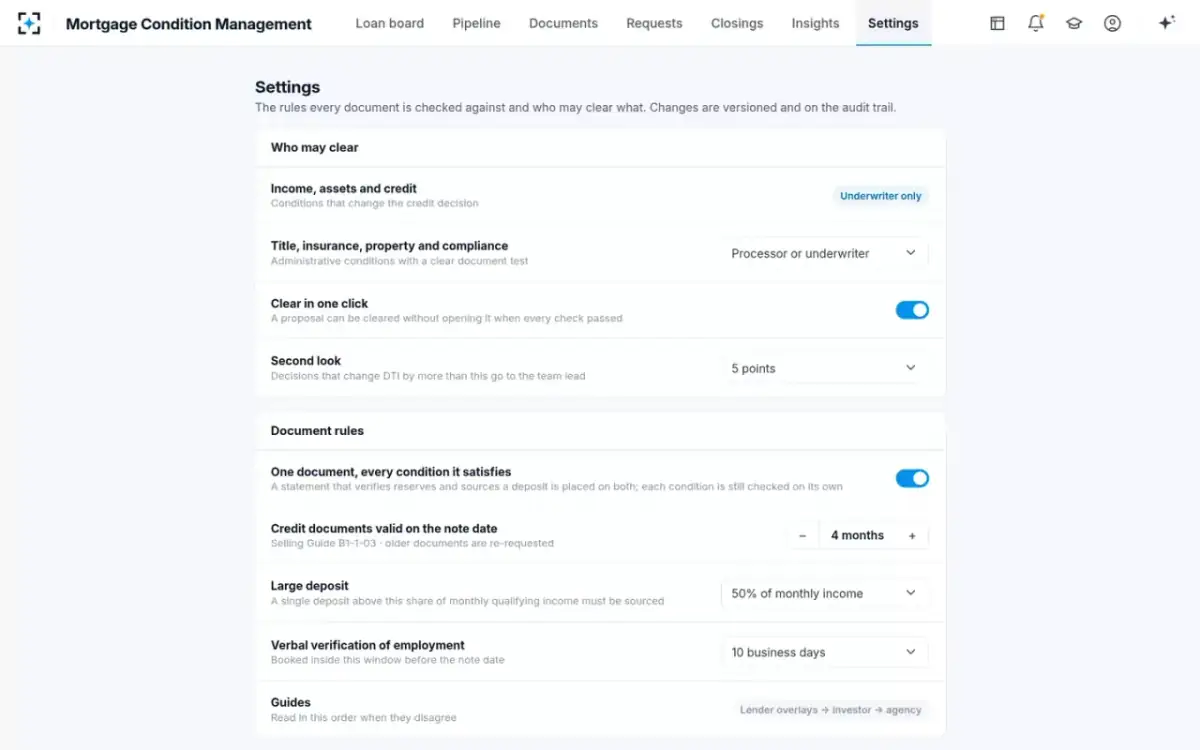
What happens if documents expire before closing?
The lender must update them before the note is signed, and in practice the condition they cleared is reopened. For Fannie Mae, B1-1-03 says so directly. For FHA, a document more than 120 days old at disbursement does not meet the handbook, and the loan is at risk at endorsement and in quality control.
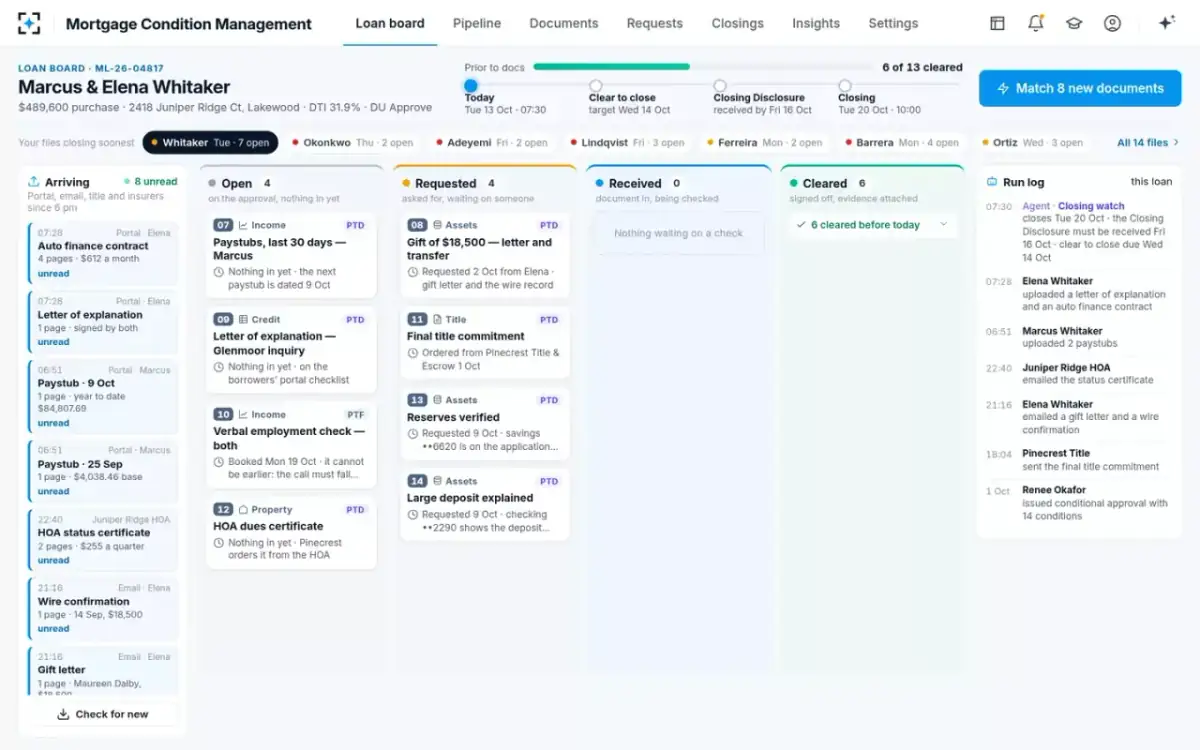
The cost is time at the worst moment. A new bank statement must be requested, received, matched and checked; a new credit report can show a new inquiry that needs its own letter of explanation. The solution watches each open file's note date against each document's age and re-requests what will be too old, so the request goes out when the closing moves, not when the closer finds it. On the board, the verbal VOE card carries its booked date and the reason it cannot be earlier.
The verbal VOE booked for the day before closing, and why
For the full list of conditions these documents clear, see the list of mortgage underwriting conditions; the solution is at Mortgage Condition Management.
Questions people ask
Does Fannie Mae accept a credit report that is 120 days old?
Fannie Mae's limit is four months on the note date, not 120 days. A report pulled on 2 June is usable for a note dated up to 2 October, which is 122 days later; in a 30-day month the two limits are closer.
Does the credit report expire on the closing date or the funding date?
For Fannie Mae, the note date. For FHA, the disbursement date. Where funds move after signing, the FHA date is the later one, and the check must be made against it.
Can a lender use a soft pull to refresh an expired credit report?
The Guide requires the lender to update expired credit documents; how it updates the credit report depends on the automated underwriting system and the credit vendor. Any new account or inquiry the update shows must be addressed, often with a letter of explanation.
Do pay stubs expire for a mortgage?
Yes, twice over for Fannie Mae: the most recent stub must be dated no earlier than 30 days before the application date, and like every credit document it must be no more than four months old on the note date.
How long is an appraisal good for with Fannie Mae?
Up to 12 months before the note date, with an update by the appraiser if the effective date is more than four months before the note. After 12 months a new appraisal is required.