The difference between a loan processor and an underwriter is the difference between assembling a mortgage file and deciding it. The processor collects the borrower's documents, orders the appraisal, title and verifications, matches what arrives to what the approval asked for, and chases what is missing. The underwriter reads the file against the investor's rules, approves it subject to conditions, clears the conditions that bear on credit, and issues clear to close. At the loan processor–underwriter handoff sit the borrower, the loan officer, the title company, the insurer and the employer, and a file waits on each in turn. Botminds' Mortgage Condition Management works in those handoffs: agents read each arriving document and place it on the condition it clears, so the processor stops sorting mail and the underwriter stops reopening whole files to clear one item.
The roles below are described from research and from the solution's fictional sample lender, whose people and quotes are invented. Labour-cost figures come from the Bureau of Labor Statistics.
Five people carry one conditional approval to the closing table
Today
"Half my day goes on asking for the same gift letter twice and matching attachments to conditions."
With agents
Gets the few documents nobody could place, and requests already drafted in plain words to read and send.
Still theirs: Every message to a borrower or third party; clearing title, insurance and property conditions where the lender allows.
Today
Reopens the whole file to clear one paystub, with 40 to 60 documents landing overnight across 14 files.
With agents
Starts from documents already on their conditions, clears what passed, and spends the time on the calls only she can make.
Still theirs: Income, asset and credit conditions; every judgment; clear to close.
Today
Gets the borrower's call about a condition written in guideline language he has to translate.
With agents
Reads the same request the borrower reads: what is missing and how to send it.
Still theirs: The relationship, and the conversation when a condition changes the deal.
Today
Learns on Wednesday that Tuesday's closing will move because a condition is still open.
With agents
Sees every file against the date its Closing Disclosure must be received.
Still theirs: The Closing Disclosure and the closing package.
Today
Hears about a slow condition when the borrower calls the loan officer.
With agents
Sees document-to-clear time by week, what is re-requested most and who clears what.
Still theirs: Staffing, the rules on who may clear what, and turn times.
What is the difference between a loan processor and an underwriter?
A loan processor prepares and completes the file; an underwriter decides whether it meets the lending rules. The federal occupation that covers processors describes the job as to "Review loan papers to ensure completeness, and complete transactions between loan establishment, borrowers, and sellers upon approval of loan" (BLS, Loan Interviewers and Clerks). There is no federal occupation called underwriter; the closest is credit analyst, who will "Analyze credit data and financial statements … to determine the degree of risk involved in extending credit".
In a mortgage shop the line is drawn by authority, not by tasks. Both read pay stubs and bank statements. Only the underwriter can say whether the income is stable and the assets sufficient, and only the underwriter signs the credit decision the investor will rely on. The processor's authority is over completeness: is the document the right one, current, signed, for the right borrower, and does it say what the condition asked?
Who talks to the borrower?
The loan officer and the processor talk to the borrower; the underwriter usually does not. That is deliberate. The underwriter's job is to judge the file as documented, and many lenders keep the underwriter away from borrowers and from sales staff so the decision rests on documents, not persuasion.
The consequence is a relay. The underwriter writes a condition in guideline language; the processor turns it into a request; the borrower sends something back, often to the loan officer; the processor matches it and puts it back in the underwriter's queue. Each pass costs a day if it is quick. A 2018 study of the U.S. market by economists at the Federal Reserve Bank of New York and New York University described processing as "verification of all supporting documentation, often involving many interactions between the processor, loan officer and borrower, and can take from 1-2 days to several weeks or more (known as the 'turn time')" (Fuster, Plosser, Schnabl and Vickery, NBER w24500).
The waiting chain: where a condition spends its days
A condition spends most of its life waiting for someone to pick it up, not being worked. The solution's own estimate for one condition handled by hand puts the working hours at about 20: eight waiting for someone to match the document to its condition, four checking it, two re-running numbers that moved, two writing a request if something is missing, and four reopening the file to clear it. Time spent waiting on the borrower or a third party comes on top.
One condition's relay: who hands it to whom
A person decides
UnderwriterWrites the condition when approving the loan, in the guide's terms.
A person decides
ProcessorTurns it into a request to the borrower, title company, insurer or employer, and sends it.
A person decides
Borrower or third partySends a document back, by portal, email or through the loan officer, often overnight.
Agent
Document reader and condition matcherReads it on arrival and places it on the open condition, on any file, that it could clear.
Never: Discards a document or clears a condition; what it cannot place goes to a processor.
Agent
Guideline checkerTests it against each element of the condition and the guide section, with the page.
Never: Waives a requirement.
A person decides
Processor or underwriterClears it, sends it back with a reason, or decides on what it changed.
Why do files keep going back to underwriting?
A file goes back to underwriting every time a returned document is incomplete, out of date, or raises a new question. Each return restarts the relay. The common reasons are mechanical: a gift letter without the donor's telephone number, an unsigned letter of explanation, a bank statement missing a page, a homeowners binder naming the wrong mortgagee. Others are substantive: a letter of explanation that reveals a new debt, or a deposit that turns out to need a source of its own.
On the solution's sample lender, 16% of conditions needed a second request in one quarter, and assets ran highest at 27%. That rate is a property of the documents, not of the people: the borrower cannot know the rule, and the processor cannot check every element of every document the hour it lands. The underwriter often finds the miss days later, when the file reaches the top of the queue.
How many files does a processor handle?
No public data count files per processor or per underwriter. The nearest research measure is for loan officers: using Mortgage Bankers Association data, a study of the 2020 boom found that "Monthly originations per employee jumped from 5.3 in 2020:Q1 to 7.5 in Q2, and then exceeded 8 until 2021:Q2" (Fuster et al., NBER w28843), counting sales employees only. Processor loads vary with the product, the share of self-employed borrowers and how much the lender automates.
The useful number for a manager is not files per head but condition clearances per day and where they queue. On the sample lender, the senior underwriter clears about 41 conditions and makes about 9 decisions a day across 14 files once documents arrive already matched. The point of the measure is to see whether the underwriter's day goes on decisions or on paper.
Where the queue forms when volume rises
The handoffs are why volume hurts. A doubling of applications "raises the loan processing time by 13.5 days (or 26%) for traditional lenders, compared to only 7.5 days for FinTech lenders", the same 2018 study found, and it traced the gap to lenders that gather documents online and partly automate underwriting. When applications surged in 2020, processing times rose by 11 to 13 days at the peak against a pre-pandemic average of about 48.
Days a doubling of applications adds to processing, and what the 2020 surge added
Nothing in those figures says processors or underwriters work slower in a boom. They say the queue between them grows faster than headcount can follow. A document that waits eight working hours for someone to match it in a normal week waits two days when the mailbox triples.
What an underwriter's hour costs against a processor's
On federal data an underwriter's hour costs about twice a processor's. The Bureau of Labor Statistics counts processors and closers among loan interviewers and clerks, with a mean annual wage of $48,660 in May 2023 (BLS 43-4131), and underwriters among credit analysts, at $94,750 (BLS 13-2041). Neither category is specific to mortgage lending.
That gap is a reason the split of work matters. An hour of an underwriter's day spent finding the right page of a bank statement costs about twice an hour of a processor's day, and it is an hour not spent on a decision.
Who may clear which condition: the authority line
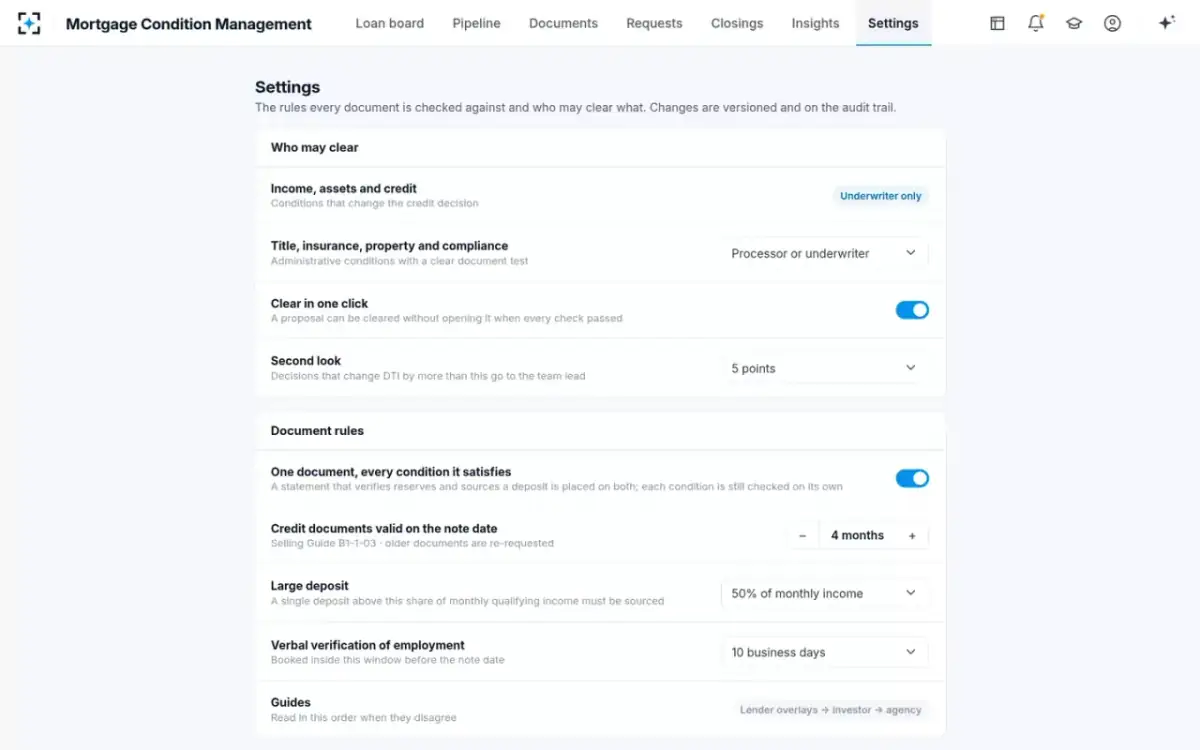
The usual line gives the underwriter every condition that could change the credit decision and lets the processor clear the rest. Lenders set it in their procedures; the table shows a common version and the setting the solution offers for each.
Who clears what, and who decides what follows
| Item | Processor | Underwriter | In the solution |
|---|---|---|---|
| Income, asset and credit conditions | Requests and checks completeness | Clears | Underwriter only |
| Title, insurance, property and compliance conditions | Clears where allowed | Clears | Processor or underwriter, by setting |
| A document that changes the ratios | Flags it | Decides: accept, ask for more, or refer | Underwriter; a change over 5 points of DTI goes to a team lead, by setting |
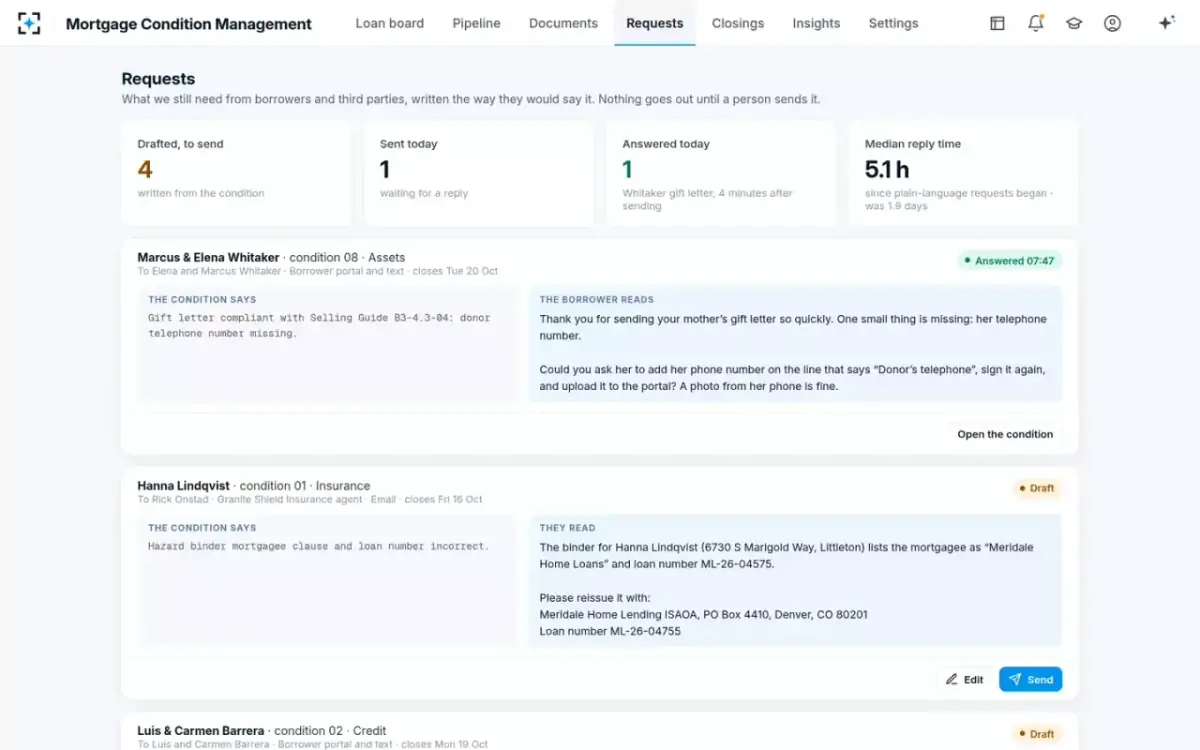
| Request to a borrower or third party | Writes and sends | Approves the wording if it changes the condition | Drafted by an agent; sent only when a person presses Send |
| Clear to close | — | Issues | Underwriter only |
The authority line, written as settings
Who is accountable when a condition is cleared wrongly?
The lender is accountable to the investor, and inside the lender, whoever cleared the condition. On a loan sold to Fannie Mae, the Selling Guide states that "The lender remains responsible for representations and warranties for the life of the loan related to misstatements, misrepresentations, omissions, and data inaccuracies" (A3-4-02). A condition cleared on a document that did not meet the rule is one of those inaccuracies, and the remedy can be a repurchase request years later.
On FHA loans the stakes are higher because nobody checks first. In settling a False Claims Act case with M&T Bank in 2016, the Justice Department explained that "the FHA does not review a loan for compliance with FHA requirements before it is endorsed for FHA insurance", so lenders must underwrite properly, run quality control and self-report deficient loans (DOJ, May 2016).
That is why the authority line matters more than the task list. A processor who clears an income condition the lender reserved for underwriters has not saved time; the lender has created a loan whose file says a credit judgment was made by someone without authority to make it. Signing every clearance with the name and time is how a lender shows, later, that the right person made each call.
Shortening the chain without removing a seat
The fastest way to shorten the relay is to remove the waits, not the people. Three of the five working blocks in a condition's 20 hours are mechanical: matching the document, checking it element by element, and writing the request when something is missing. Those are what the agents do, in the solution's estimate cutting the working time on one condition from about 20 hours to under two. The decisions stay where they were.
The processor's role changes most. Instead of matching attachments, the processor reviews the handful of documents nobody could place, reads and sends drafted requests, and clears the conditions the lender lets processors clear. The processor's tasks, re-divided one by one, and what underwriters need to see before they trust the agents, take each seat in turn.
Requests in plain words, beside the condition as written
See the whole relay on Mortgage Condition Management.
Questions people ask
Does the underwriter talk to the borrower?
Usually not. Most lenders route borrower contact through the loan officer and the processor so the underwriter judges the documented file. The borrower sees the underwriter's conditions as requests from the processor.
Is a loan processor the same as a loan officer?
No. The loan officer takes the application, advises the borrower and sells the loan; the loan officer must be licensed or registered as a mortgage loan originator. The processor works the file after application. Some small lenders combine the roles, but the tasks differ.
Can a processor clear conditions?
Many lenders let processors clear conditions that test whether a document says what it should, such as title, insurance and property items. Conditions that bear on income, assets or credit are normally reserved for underwriters because they can change the credit decision.
How should a lender split work between processors and underwriters?
By authority: processors assemble, match and chase; underwriters clear what bears on credit. Because an underwriter's hour costs about twice a processor's on federal data, every hour an underwriter spends finding a page rather than deciding is the most expensive hour in the file.
Will AI replace loan processors or underwriters?
The research so far points to faster lenders, not fewer decisions: lenders that automate more took about 10 days, or 20%, less to process loans, with no higher defaults. What changes is the processor's day, which moves from matching and chasing to reviewing and sending; the underwriter's decisions stay with the underwriter.