Average mortgage cycle time, the number of days to close a mortgage, is about 50: Federal Reserve economists put the average at 50.8 days from application to a lender's decision in a March 2026 study, and earlier research on the near-universe of U.S. loans found 52 days for purchase loans and 51 for refinances from application to closing. The figure moves with demand: when applications surge, lenders' queues lengthen and files take days longer, because capacity, not technology, sets the pace. A good share of the time is the stretch after conditional approval, when conditions wait for documents and documents wait for someone to read them. Botminds' Mortgage Condition Management works on that stretch, and this page shows what a day there is worth.
Research figures are linked where they appear. Arithmetic that combines them is ours and labelled. Figures about a lender's own files come from the solution's fictional sample lender.
How long a mortgage takes, from four studies
50.8days
average from application to the lender's decision
Federal Reserve, 2026
52days
average purchase loan, application to closing, 2010–2016
48days
average processing time before the 2020 surge
+3–5days
from a one-standard-deviation jump in demand
How long does it take to close a mortgage?
It takes about 50 days on average to close a mortgage, counted from application. The best measures come from Home Mortgage Disclosure Act data, which record the application date and the date of the lender's action for nearly every U.S. loan. On data from 2010 to 2016, economists at the Federal Reserve Bank of New York and New York University found an average of 52 days for home purchase loans and 51 for refinances (NBER w24500).
Averages hide a wide spread. The same study describes processing as a stage that "can take from 1-2 days to several weeks or more", depending on the file and on how many times documents go back and forth. A salaried borrower with a clean file and a lender with spare capacity can close in under a month; a self-employed borrower in a busy season can take two.
Average days to close a mortgage in 2026: the newest estimate
The newest estimate is 50.8 days to a decision. "Since it takes lenders, on average, 50.8 days to reach a decision (Table 1), this effect increases processing times by about 3 to 5 days," Akos Horvath and Benjamin Kay of the Federal Reserve Board wrote in March 2026, measuring how a jump in demand slows lenders (FEDS 2026-017). The "effect" is a one-standard-deviation rise in mortgage demand, which in their estimates also raises rate spreads by 3 to 8 basis points.
We found no regulator or independent study that publishes a monthly average closing time for 2026. Figures that circulate under that name are usually from software vendors' customer bases, which measure their own clients and change definitions often. The HMDA-based research is slower to arrive but counts the whole market the same way each year.
Why averages for closing time disagree
Published averages for days to close differ because they measure different things. The research figures on this page come from HMDA data, which record the date the lender received the application and the date it took action, and so run from application to origination for loans that closed. The Federal Reserve's 50.8 days is time "to reach a decision" in the same data. Figures that start the clock at the accepted offer, or at a borrower's first contact with a lender, give different answers again. Figures from software vendors count their own customers' files, often from a later starting point, and change with their client mix.
The mix of loans matters as much as the definition. Purchase loans wait on the sale contract's closing date, which the buyer and seller set, so a lender that could close in 25 days may close in 30 because the contract says 30. Refinances have no such anchor and speed up or slow down with the lender's queue. The 2020 study notes that median processing time "moves closely with application volume, especially for refinances".
For a lender, the comparable number is its own: days from application to closing, and days from conditional approval to clear to close, by month and by loan purpose. The second is the stretch the lender controls most, and the one where a day saved does not depend on a seller's moving date.
Why do mortgages take so long? Capacity, not only paperwork
Mortgages take long mainly because files queue for the same people, and the queue grows faster than staff when applications rise. The 2020 refinancing boom was the clearest test: processing times rose "initially by about 6 days, rising to 11-13 days at the peak from July to September 2020", and the authors concluded that capacity constraints "have not yet been significantly mitigated by recent technological change" (NBER w28843).
What adds days to a mortgage, by research estimate
Paperwork is how the queue shows up. Each condition is a small queue of its own: the request waits for the borrower, the document waits to be matched, the matched document waits for the underwriter. When the mailbox triples, the eight working hours a document waits to be matched in a normal week become days. Closings slip too: in the second half of 2020, "the estimated incidence of any delay is 30-50% higher" than before the pandemic, the same study found from borrower survey data.
What one day costs, first: the files a lender must carry
Every day added to the average adds a day's worth of files to the pipeline. The relationship is arithmetic, not opinion: the number of loans in progress equals the number closing per day times the days each takes. Take the Mortgage Bankers Association's average independent mortgage bank of 2025, which closed 7,273 loans, about 20 a calendar day.
Files in flight at an average lender, at today's pace and five ways faster or slower
Today, at the research average
Loans a day19.9
Days52
Files in flight1,036
Five days faster
Loans a day19.9
Days47
Files in flight937
Ten days faster, the automation gap in the research
Loans a day19.9
Days42
Files in flight837
Applications double, traditional lender (+13.5 days)
Loans a day39.9
Days65.5
Files in flight2,610
Applications double, more automated lender (+7.5 days)
Loans a day39.9
Days59.5
Files in flight2,371
Five days off the average removes about a hundred files from the pipeline at the same output, ten days about two hundred. Those are files nobody has to open, chase or explain to a loan officer that day. The doubling rows show why the gap matters most in a surge: the lender that adds 7.5 days instead of 13.5 carries about 240 fewer files at the worst moment, with the same staff.
What one day costs, second: the borrower's price when queues grow
When lenders run short of capacity, borrowers pay for it in the rate. Measuring the gap between what borrowers pay and what the loans fetch in the securities market, Andreas Fuster, Stephanie Lo and Paul Willen found that "the price of intermediation, measured as a fraction of the loan amount at origination, is large—142 basis points on average over the 2008–2014 period", and that "a one standard deviation increase in applications for new mortgages leads to a 30–35 basis point increase in the price of intermediation" (NBER w23706).
On a $400,000 loan, 30 basis points is $1,200. The authors attribute the rise to capacity constraints: when the pipeline is full, lenders ration by price. A lender whose files move faster has capacity to spare in exactly the weeks when competitors are raising margins to slow their own intake.
What one day costs, third: the rate lock and the margin
A day also costs against the rate lock and against a thin profit. The Federal Reserve study notes that lenders offer "standard 30-, 45-, and 60-day locks", and that the average lock found in an earlier study was about 46 days; a file that runs past its lock needs an extension or a relock, priced by the lender's secondary desk and often absorbed by the lender when the delay was its own.
The margin leaves little room for that. In 2025, independent mortgage banks earned an average of $785 per loan on production, the MBA reported, and the costs rose despite higher volume because of "rising wage growth, increases in third-party charges, and reduced application pull-through" (MBA, April 2026). Pull-through is the share of applications that close; a file that stalls on an open condition and is withdrawn is pure cost.
Three prices of a day, and who pays each
| Price | Measured by | Who pays |
|---|---|---|
| Files in flight | About 20 more files in progress per day of cycle time, at the average lender's volume | The lender, in staff time and attention |
| Intermediation markup | 30–35 basis points per one-standard-deviation rise in applications | The borrower, in the rate |
| Rate lock and pull-through | Extensions past a 30-, 45- or 60-day lock; applications that do not close | Usually the lender, against $785 of average profit per loan |
How much does it cost to originate a mortgage?
Independent mortgage banks spent $11,094 per loan on production in 2025, according to the MBA's annual performance report, counting commissions, compensation, occupancy, equipment and corporate allocations. The figure was up slightly from $11,076 in 2024, and the average net production profit was $785 per loan.
Two things follow for anyone weighing a faster process. A cost per loan that rose in a year of higher volume means the fixed-cost leverage lenders expect in a busy year did not arrive: the extra loans brought their own work. And a profit of $785 on $11,094 of cost means that a 7% rise in cost per loan, from rework or slippage, would erase the margin entirely.
Do faster lenders have more defaults?
No, on the evidence available. The study that found lenders with more automated processes were about 10 days, or 20%, faster also checked the loans' performance, and found that "Faster processing times by FinTech lenders do not result in riskier loans": on FHA loans, their default rates were about 25% lower than traditional lenders', controlling for loan characteristics, with no significant difference in interest rates.
The reasonable reading is that speed and care are not opposed when the speed comes from removing waits rather than skipping checks. A condition cleared the morning its document arrives, with every element of the rule tested, is not less careful than the same condition cleared three days later.
Where the days go after conditional approval
After conditional approval, days go on three waits: the borrower or third party sending the document, someone matching it to its condition, and the underwriter reopening the file to clear it. The first is outside the lender's control; the other two are not. In the solution's own estimate, a condition handled by hand takes two to three days from the document arriving to the condition being cleared.
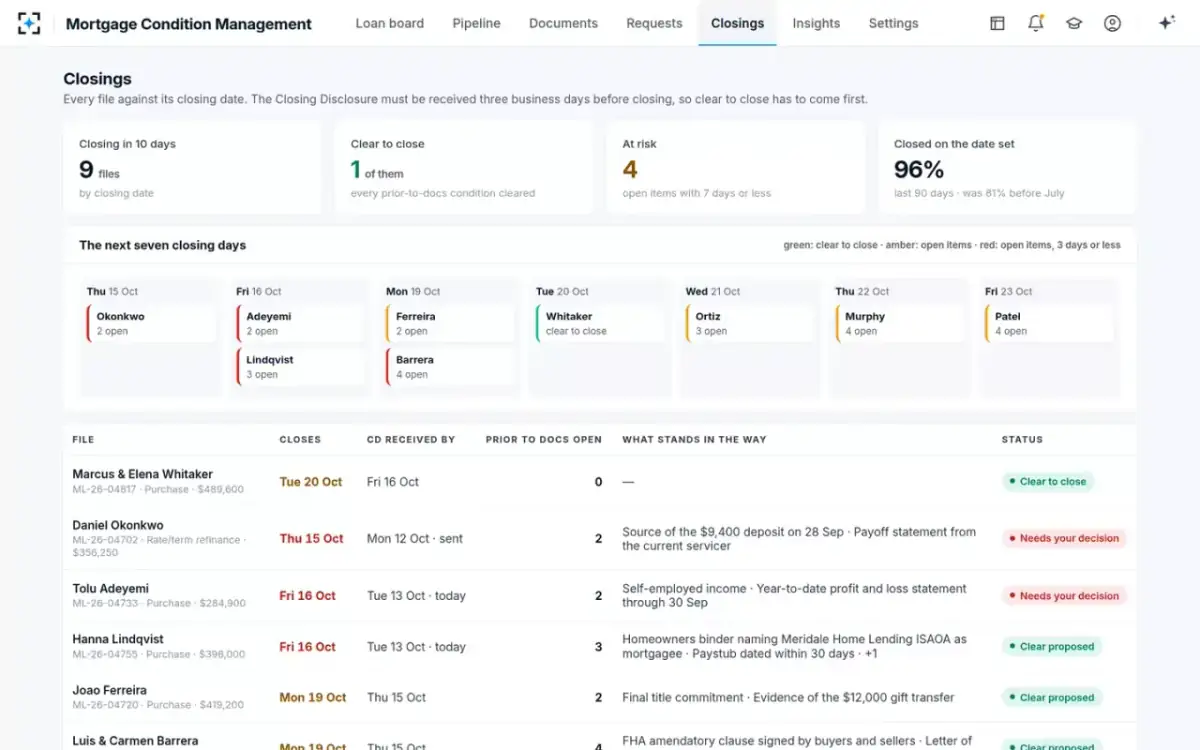
The fictional sample lender shows what changes when matching and checking move to agents: the median from document to cleared condition fell from 2.6 days to 0.3 over twelve weeks, and the share of files closing on the date set rose from 81% to 96%. These are sample data, not a customer's results, but the mechanism is the one the research describes: fewer days in the queue, not fewer checks. One file from conditional approval to clear to close follows the days on a calendar.
Every file against its closing date, with what stands in the way
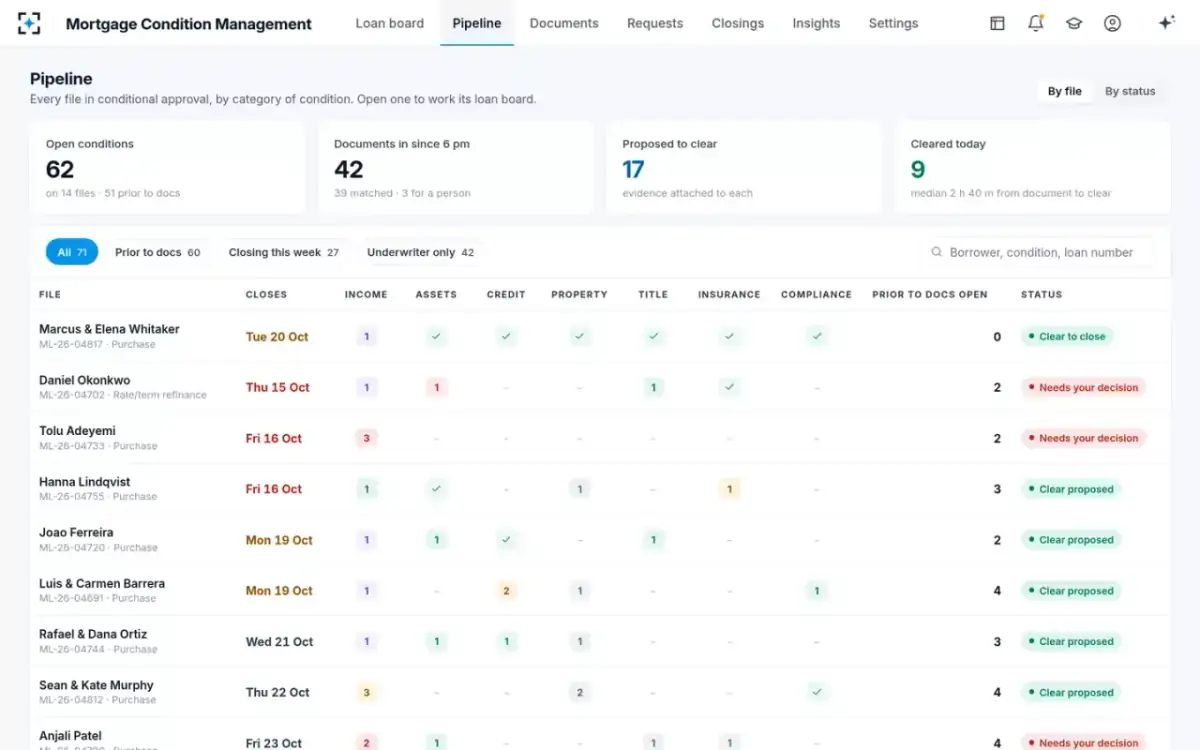
Every file in conditional approval, by family of condition
For the people side of the same queue, see who waits on whom between processor and underwriter; for the solution, Mortgage Condition Management.
Questions people ask
How long does underwriting take?
Research does not time the underwriting decision on its own; it measures the whole cycle, at about 50 days from application. Most of that is the work around the decision: collecting documents, ordering the appraisal and title, and clearing the conditions the approval sets.
Is it faster to close a refinance or a purchase?
In the 2010–2016 data they were close, 51 days for refinances and 52 for purchases. Refinances gain the most from automation, the same study found, with automated lenders 9 to 15 days faster on refinances, but slow down most when rates fall and applications surge.
Why does closing take longer in a busy market?
Because files queue for the same processors, underwriters, appraisers and title staff. Doubling applications added 13.5 days at traditional lenders in the research, and lenders also raised their margins when capacity was tight.
Can a mortgage close in two weeks?
It can when the borrower's documents are complete, the appraisal is quick or waived, and the lender has capacity. The Closing Disclosure alone needs three business days before signing, so the last few days are fixed by rule.
What does a day of delay cost a lender?
There is no single published figure. It can be measured three ways: about 20 more files in progress per day at an average lender's volume, rate-lock extensions on files past their lock, and applications that do not close at all, against an average profit of $785 per loan in 2025.