AI mortgage processing means software agents doing the reading and paperwork of loan processing: classifying each document that arrives, matching it to the condition it could clear, checking it against the guide, recalculating income and ratios when a number moves, and drafting the request when something is missing. It does not mean software clearing conditions or approving loans. The case for it is time: a mortgage takes about 50 days from application to decision, and much of that is documents waiting to be matched and read. Botminds' Mortgage Condition Management is built on that division. Six agents do the reading, matching, checking, recalculating and drafting; the processor and underwriter clear, decide and press Send.
Examples come from the solution's fictional sample lender. The research on processing time is from Federal Reserve and university economists, linked where used.
Where one condition's working hours go, by hand and with agents
By hand · about 20 hours
- Waiting to be matched · 8 h · 40%
- Checking · 4 h · 20%
- Re-running numbers · 2 h · 10%
- Writing a request · 2 h · 10%
- Reopening to clear · 4 h · 20%
With agents · about 1.8 hours
- Matched · 0.1 h · 6%
- Review the check · 0.5 h · 28%
- Confirm the numbers · 0.5 h · 28%
- Read and send · 0.2 h · 11%
- Clear · 0.5 h · 27%
What is AI mortgage processing?
AI mortgage processing is the use of models that read documents and language to do the processor's mechanical work on a loan file. The word "processing" covers a lot: taking in documents, ordering third-party reports, matching what arrives to the conditions, chasing what is missing, and preparing the file for the underwriter and the closer. The part that consumes the most hours, and that AI is now good at, is reading: knowing that a four-page PDF is an Aldenbrook Savings combined statement for two accounts, for which borrower, for which months, and with which deposits.
Older automation handled the same work by rules and templates. It could route a document labelled "bank statement" to an asset folder, but not tell a borrower's own transfer from an unsourced deposit, or notice that a letter of explanation discloses a car loan. The difference with current agents is that they read the content, compare it to the condition's wording and the guide, and say why a document does or does not meet it.
What tasks can AI do for a processor?
AI can do the reading, matching, checking, recalculating and drafting; people keep every decision that changes a loan or reaches a borrower. The table splits a processor's common tasks on that line.
The processor's tasks, and who does each once agents are in
| Task | Agent | Person |
|---|---|---|
| Name each arriving document: type, borrower, dates, amounts | Does it on arrival | Places the few the agent cannot |
| Match a document to the condition it could clear, on any file | Proposes, including one document on two conditions | Sees every match on the board |
| Check a document against each element of the condition and the guide | Checks, citing the section and the page | Reviews the check before clearing |
| Re-run income, debts, ratios and reserves when a number moves | Recalculates and prepares the automated underwriting re-run | Underwriter decides whether to accept and resubmit |
| Write the request for what is missing | Drafts in plain words, to the right person | Reads, edits, presses Send |
| Clear a title, insurance or property condition | Proposes clear when every check passes | Processor or underwriter clears, as the lender allows |
| Clear an income, asset or credit condition | Proposes | Underwriter clears |
| Watch closing dates and the Closing Disclosure clock | Flags files at risk; books the verbal VOE inside its window | Closer and underwriter act |
The tasks that stay with people have something in common: each either commits the lender (a clearance, a credit decision, clear to close) or speaks for it (a message to a borrower). Everything that only prepares a decision can move to agents without moving accountability.
Can AI clear underwriting conditions?
It can test whether a condition is met, and in a well-built system it should not clear it. A clearance is a representation the lender makes to an investor, and the person who makes it should be someone the lender has given that authority. In the solution, no condition is cleared until a person presses Clear, and income, asset and credit conditions are underwriter only.
The sample file shows why the line matters even when the test is easy. Eight documents arrived overnight. The agents placed them on five conditions; three passed every check. The gift letter matched the September wire but lacked the donor's telephone number, which Selling Guide B3-4.3-04 requires, so it went back with a drafted request. The letter of explanation disclosed a $612-a-month car loan that was not on the application, moving the debt-to-income ratio from 31.9% to 36.2%. An agent can compute that; whether to accept the new debt, ask for more or refer the file is the underwriter's call.
One night's documents on the sample lender
42
documents arrived between 6 pm and the morning, from portal, email, title companies and insurers
39
matched to an open condition by the agents
3
matched nothing and went to a person
38s
median from arrival to a proposal on the condition
What is agentic AI loan processing?
Agentic AI loan processing means several specialised agents, each with a narrow job and written limits, passing work along a chain that ends with a person. It differs from a single assistant answering questions: the agents act on their own when a document arrives, and each one's output is the next one's input. The limits matter as much as the jobs.
Six agents, each with a job and a line it does not cross
Agent
Document readerReads every document that arrives and names its type, borrower, dates and key amounts.
Never: Discards a document; one it cannot place goes to a processor.
Agent
Condition matcherTies each document to the open condition, on any file, that it could clear; one document may satisfy two.
Never: Clears a condition.
Agent
Guideline checkerTests the document against each requirement of the condition and the guide, with the page.
Never: Waives a requirement; proposes clear only when every requirement is met.
Agent
Income and debt recalculatorRe-runs income, debts, ratios and reserves when a document changes a number.
Never: Resubmits a changed loan without the underwriter.
Agent
Request writerTurns a condition into a short, plain request addressed to the right person.
Never: Sends on its own, or puts guideline numbers in a message to a borrower.
Agent
Closing watchWatches open prior-to-docs conditions against each closing date and the date the Closing Disclosure must be received.
Never: Issues clear to close.
A person decides
Processor and underwriterClear, send, decide, and issue clear to close.
Everything that arrived overnight, and the condition each one landed on
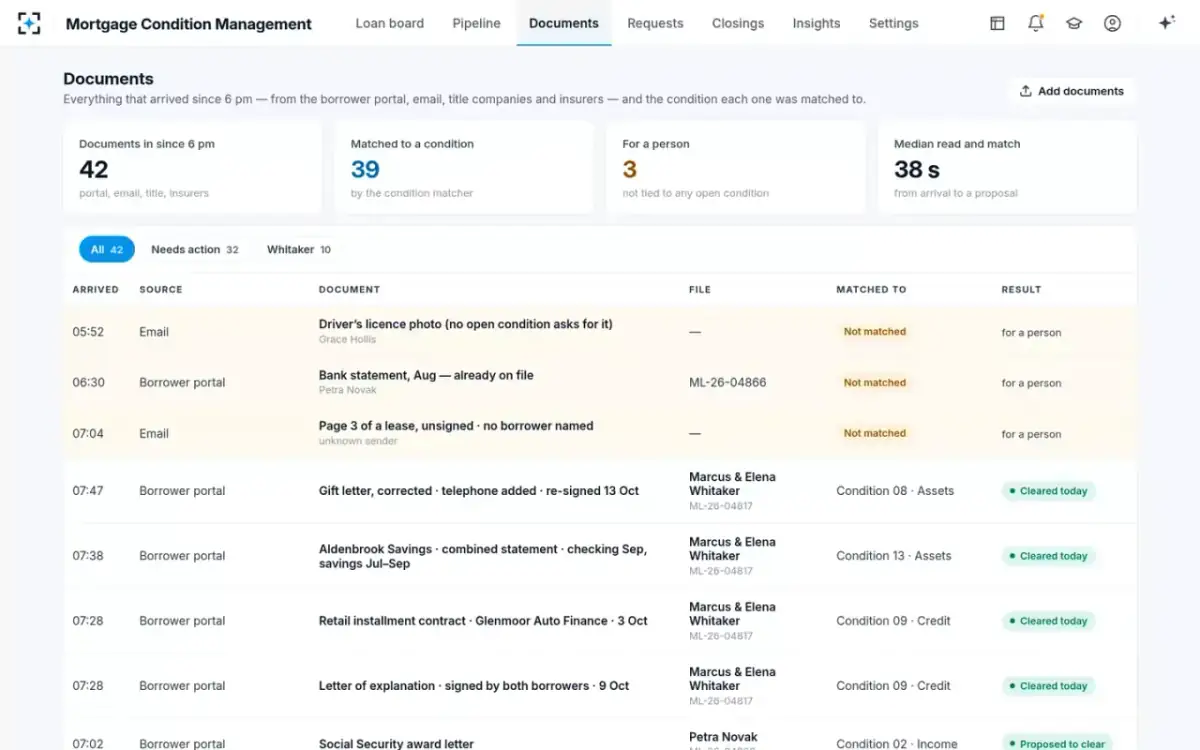
A processor's morning with agents, document by document
With agents, a processor's morning starts from exceptions instead of from the mailbox. On the sample lender, 42 documents had arrived since 6 pm across 14 files. Thirty-nine were already on conditions; the processor's queue held three. One was a photo of a driver's licence that no open condition asked for. One was an August bank statement already on file, sent again by a borrower who was not sure it had arrived. One was page three of an unsigned lease, from an unknown sender, with no borrower named. Each needs a person: to file the licence, to tell the borrower the statement is in, to find out whose lease it is and whether a condition should ask for the rest.
The second part of the morning is reading drafts. A homeowners binder for another file named the lender without its successors-and-assigns clause and with the wrong loan number; the request writer had drafted a note to the insurance agent giving the exact mortgagee wording and the right number. The processor reads it, edits if needed, and presses Send. The third part is clearing what the lender lets processors clear, the title, insurance and property conditions whose every check passed, with the evidence on the screen.
What disappears is the sorting: opening each attachment, working out whose it is and which of 62 open conditions it answers, and copying the condition into an email in words the borrower will follow. That is the 8 hours of waiting in the estimate above, and most of the 2 hours of writing.
Will AI replace loan processors?
The evidence points to faster files, not empty desks. A study of the near-universe of U.S. mortgages from 2010 to 2016 found that lenders it classed as fintech "reduce processing time by about 10 days, or 20% of the average processing time", with no higher default rates, and traced the edge to how such lenders "collect information electronically and centralize and partially automate their underwriting operations" (Fuster, Plosser, Schnabl and Vickery, NBER w24500). Nothing in that work suggests the files process themselves.
What changes is the shape of the processor's day. About 204,000 people work as loan interviewers and clerks, the federal occupation that includes processors (BLS, May 2023). Matching attachments and rewriting guideline language for borrowers is a large part of what they do. With agents, the processor reviews the documents nobody could place, reads and sends drafted requests, clears the conditions the lender allows, and spends the rest on the borrowers whose files are hard. How the processor and underwriter divide a file sets out the authority line in detail.
Who is responsible for AI decisions in mortgage?
The lender is. An investor or regulator does not accept "the model did it" for a defective loan, and Fannie Mae has made the point explicit. Its Lender Letter LL-2026-04, published April 8, 2026 and effective 120 days later, requires any seller using AI or machine learning in originating loans it sells to Fannie Mae to keep policies for it with a named owner, review them at least annually, govern vendors' use of AI no less strictly, and disclose on request what AI it uses and how (Fannie Mae LL-2026-04).
That is easier to meet when the software already separates proposals from decisions. If every clearance carries a person's name and the evidence, and every agent action is on the loan's log, the lender can answer the disclosure question from the system rather than from interviews. What underwriters need before they trust the agents turns the Lender Letter into a rollout checklist.
Where AI mortgage processing goes wrong
The failures are specific, and a buyer can test for each. The first is the wrong file: a document placed on a condition for a different borrower with the same surname, or a co-borrower's paystub on the primary borrower's income condition. The second is the stale document: a bank statement that passes every content check but will be more than four months old on the note date. The third is the single-condition view: a statement that verifies reserves and also shows the large deposit, matched to one condition while the other stays open for days.
The fourth is tone. A request that quotes "B3-4.3-04" to a borrower produces a phone call to the loan officer, not a corrected letter. On the sample lender, the median reply to a request fell from 1.9 days to 5.1 hours after requests were rewritten in plain words; the corrected gift letter in the sample file came back four minutes after it was sent.
The condition as written, and the message the borrower reads
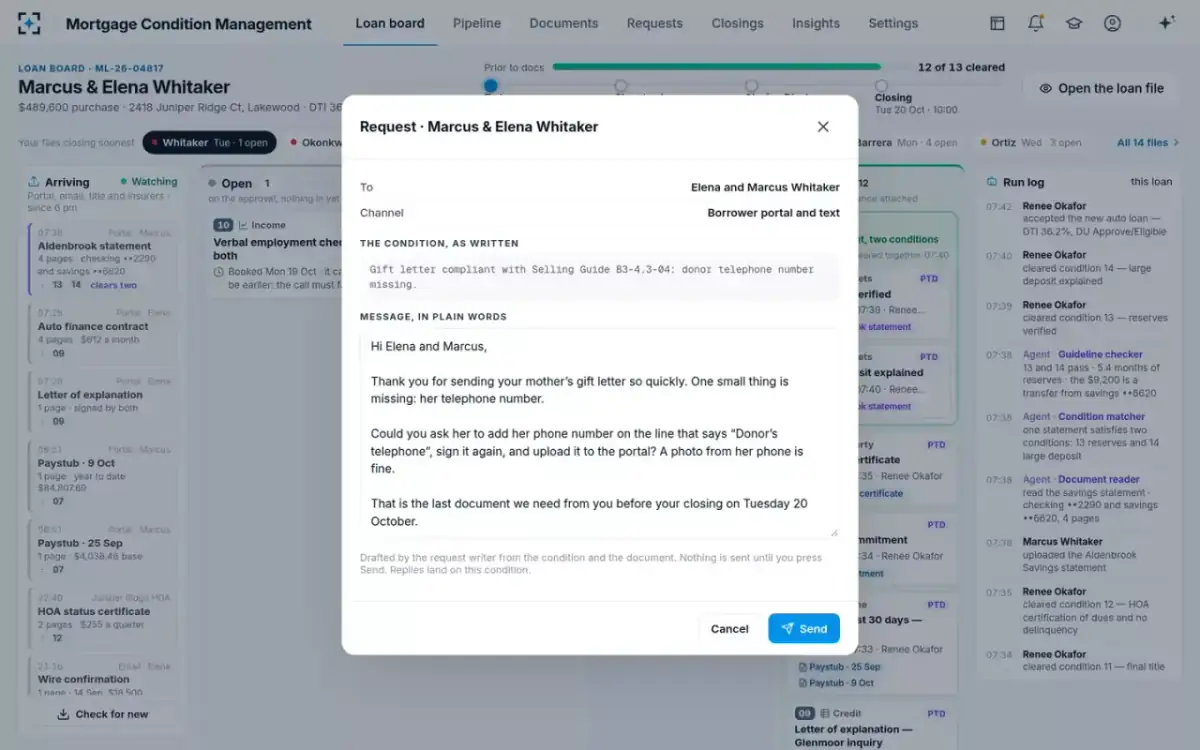
What to ask before you buy AI mortgage processing
Ask the questions that expose the four failures, on your own files rather than a vendor's demonstration. How to test mortgage processing software on last month's cleared files turns these into a replay with scores.
Eight questions for any AI mortgage processing vendor
- Which decisions can the software make on its own?
The right answer for clearances, credit decisions and borrower messages is none.
- What happens to a document it cannot place?
It should go to a named person, never be discarded or parked.
- Can one document land on two conditions, each checked separately?
A bank statement often verifies reserves and sources a deposit.
- Does every check cite the guide section and the page in the document?
Without it, your QC reviewer redoes the work.
- Does it test document age against the note date?
Four months for Fannie Mae; 120 days at disbursement for FHA.
- Can our overlays outrank the agency guide?
Guides should be read in your order when they disagree.
- Can our settings decide who may clear what?
And are setting changes versioned?
- Can you show us how it meets Fannie Mae LL-2026-04?
Owner, annual review, vendor governance, disclosure on request.
To see the split on a file, start from Mortgage Condition Management.
Questions people ask
Can AI approve a mortgage loan?
Automated underwriting systems such as Desktop Underwriter have issued recommendations for decades, but the lender still makes and owns the decision. AI processing agents prepare the file and test conditions; in Mortgage Condition Management only a person clears a condition and only the underwriter issues clear to close.
Is AI loan processing accurate enough to trust?
Accuracy depends on the documents and the rules, so measure it on your own closed files: how often the software placed each document on the condition your underwriter actually cleared, how often it missed one, and how often it would have passed a document your underwriter sent back. A false pass is the number that matters most.
What does AI mortgage processing cost to run against a file?
Pricing varies by vendor and volume. The comparison that matters is with the cost of the file: independent mortgage banks spent $11,094 per loan on production in 2025, according to the Mortgage Bankers Association, much of it in people's time.
Does AI mortgage processing work for FHA and VA loans?
It works for any program whose rules can be read, but the rules differ: FHA counts document age as 120 days at disbursement under HUD Handbook 4000.1, while Fannie Mae counts four months to the note date. The software must hold each program's guide and apply the right one to each file.
How long does it take to start using AI for mortgage processing?
The work is configuration more than integration: your condition templates, overlays, request style and who may clear what, plus connections to the borrower portal, the shared mailbox and the loan origination system. A replay on a sample of your own closed files should come before any live use.