Mortgage processing software is anything that helps move a loan from application to clear to close: the loan origination system that holds the file, the portal that collects documents, and the newer agents that read each document, match it to the condition it clears and check it against the guide. Choosing among them by demonstration is unreliable, because a demonstration uses the vendor's files. The test that predicts what you will get is a replay: take last month's cleared files, hide the outcomes, let the software process the documents, and score its proposals against what your underwriters actually did. Botminds' Mortgage Condition Management is built to be judged that way, since every proposal names the condition, the document page and the guide section an underwriter can compare.
The figures below that describe a lender come from the solution's fictional sample lender; the scoring method and pass lines are our recommendation, not an industry standard. Industry figures are linked where used.
A 50-file replay draws about 700 conditions; this is where they fall
What should mortgage processing software do?
Mortgage processing software should get every document onto the right condition, tell you whether it meets the rule, and leave a trail an investor's reviewer can follow, without taking decisions away from your processors and underwriters. That breaks into six jobs: take in documents from every channel; identify each one; match it to the open condition it could clear, across files; test it against the condition and the guide, including its age on the note date; recalculate when a number moves; and draft the request when something is missing.
The loan origination system remains the system of record for the loan and its conditions. Processing software of this kind reads from it and writes back the outcome; it should not ask you to rekey conditions or keep a second file. The reason to buy is cost and time: independent mortgage banks spent "$11,094 per loan in 2025" on production, against an average profit of $785 per loan (MBA, April 2026), and a purchase loan took 52 days on average from application to closing in the research data (NBER w24500).
Why a few days and a few hours per file are worth testing for
$11,094
production expense per loan, independent mortgage banks, 2025
$785
average net production profit per loan, 2025
52days
average purchase loan from application to closing, 2010–2016
20%
less processing time at lenders that automated more, with no higher defaults
How do I test mortgage processing software? Replay last month's cleared files
Replay a month of files your team has already cleared, with the answers hidden. You know what each condition said, which documents arrived and in what order, which one the underwriter used to clear it, which ones were sent back and why. The software sees only the conditions and the documents, in arrival order, and proposes. You compare.
A replay has three advantages over a live pilot. It costs your borrowers nothing, because no message is sent and no file waits on the test. It is complete, because every outcome is already known. And it contains the hard cases in their real proportions: the gift letter missing a line, the statement with a page missing, the letter of explanation that reveals a debt. A live pilot on the next month's files cannot be scored until those files close.
A vendor demonstration and a replay on your files, side by side
Vendor demonstration: Prepared by the vendor, usually clean.
Replay on your cleared files: Your last month, including fallouts and the borrower who sent the wrong statement twice.
Vendor demonstration: Agency guide as the vendor configured it.
Replay on your cleared files: Your overlays and investor guides, in your order of precedence.
Vendor demonstration: None; you judge by eye.
Replay on your cleared files: What your underwriter cleared, sent back and decided, condition by condition.
Vendor demonstration: That the software can work.
Replay on your cleared files: How often it would have agreed with your people, and where it would have been wrong.
Vendor demonstration: None.
Replay on your cleared files: None: nothing is sent and no live file waits.
How accurate is document matching? Four scores to keep
Document matching is as accurate as your replay shows; no published benchmark measures it on mortgage conditions, and a vendor's accuracy claim on its own files says little about yours. Keep four scores, by condition family, because a 98% overall figure can hide a weak asset family behind easy title documents.
Four scores for a replay, and the line we would set for each
| Score | What it counts | Line we suggest |
|---|---|---|
| Placement agreement | Documents placed on the same condition the underwriter cleared them with, including both conditions when one document cleared two | High, by family; look at every miss in assets and income |
| Unplaced, correctly | Documents no condition needed (a duplicate, an unrequested ID) that the software sent to a person rather than forcing a match | All of them; a forced match is worse than none |
| False pass | Documents the software would have proposed to clear where your underwriter sent them back or asked for more | Zero on income, asset and credit conditions; every one reviewed |
| Same reason, same rule | For each document sent back, whether the software gave the underwriter's reason and cited the same guide section | High; a right answer for the wrong reason fails on the next file |
The false pass is the score that decides the purchase. A document the software calls compliant when it is not, cleared by a busy person in one click, is a loan defect waiting for a quality-control review. In the sample lender's quarter, about one condition in six needed a second request; a 50-file replay should therefore contain around a hundred real sent-back documents to test against, more in assets and income.
Do not forget the clock. A replay must also check document age as of each file's note date, four months for Fannie Mae under B1-1-03. A statement that passes on content in September and fails on age at an October closing is a correct send-back the software must catch.
Which files should a pilot use?
Use one month of files that closed, plus the ones that did not, drawn to match your mix. Fifty files is enough to see each condition family several dozen times; the mix matters more than the count.
Building the replay set
- One recent month of conditionally approved files, about 50
Recent, so the guide versions in force match what the software holds.
- Your program mix
Conventional, FHA, VA, jumbo in their real shares; the rules and document ages differ.
- Your borrower mix
Salaried, self-employed, retired, gift-funded; self-employment and gifts generate the hard conditions.
- Some fallouts
Files withdrawn or denied after conditional approval test whether the software would have spotted the problem.
- Every document as it arrived
Including duplicates, wrong documents and blurred photos, in arrival order.
- The answer key, kept apart
What was cleared, with which document, by whom; what was sent back and why.
One statement, two conditions: the case to include on purpose
Include files where one document cleared two conditions, because that is where simple matching fails. A savings statement that verifies reserves can also explain a large deposit; a tax return can document income and a liability. Software that files a document on one condition and closes the case leaves the second condition open until someone notices.
One statement, placed on two conditions and checked against each
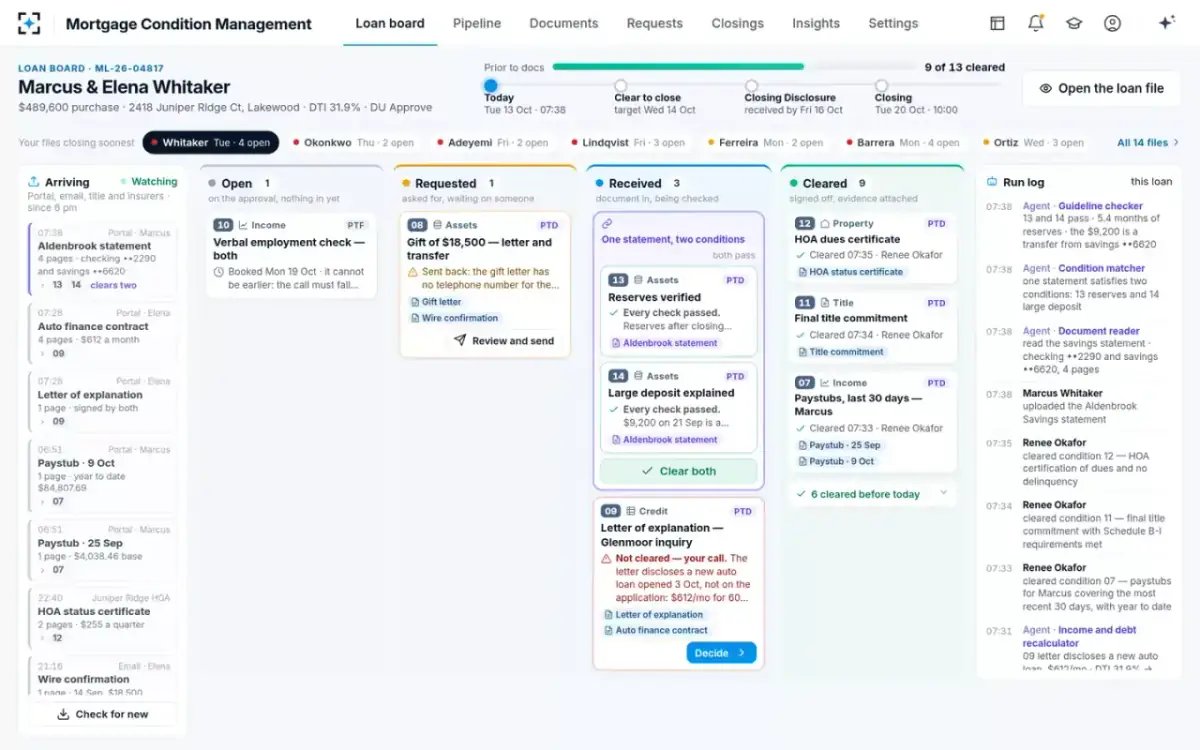
In a replay, count this as two placements, and check that each condition was tested against its own rule. The large deposit has its own definition, a single deposit over 50% of monthly qualifying income, and its own exception for transfers between verified accounts printed on the statement; reserves have their own required months.
What to do with the disagreements
Every disagreement between the software and your underwriter falls into one of five kinds, and each points to a different fix. Sorting them is most of the value of a replay.
Five kinds of disagreement in a replay, and what each tells you
| Kind | Example | What it tells you |
|---|---|---|
| Software stricter, guide allows judgment | Underwriter accepted a written explanation for a deposit; software asked for documents | Fine, if the software asks rather than fails; note the judgment the guide allows |
| Software missed an element | Passed a gift letter with no donor telephone number | A false pass: fix before going further |
| Wrong rule version | Applied a verbal VOE rule from before the October 2026 update | Ask how the vendor keeps guide versions and dates |
| Overlay missing | Applied the agency rule where your overlay is stricter | Load the overlay and set the order of precedence |
| Document unreadable | A blurred phone photo of a bank statement | Should go to a person, never be guessed |
The first kind is not an error, and a good replay report says so. The second is the one that matters, and the third and fourth are configuration rather than capability, which a vendor can fix in days. The fifth is a test of honesty: software that guesses at an unreadable document will guess at a readable one too.
How long does a software pilot take?
The replay itself is fast; the review is not. Processing 50 files of documents takes software hours. Scoring takes your underwriters time, because every disagreement needs a person to say who was right: sometimes the underwriter cleared on judgment that a guide allows, and the software was too strict. In our estimate a replay of this size needs a few days of a senior underwriter's time to score properly, and a lender should budget for that rather than skip it.
Plan for one more step after the replay: a short period running beside your team on live files, with the software proposing and nobody relying on it, to check channels and volumes. The decision to rely on it should rest on the replay's false-pass score, not on enthusiasm from the live run.
What to ask the vendor while the replay runs
Ask how the software will help you answer Fannie Mae. Since its Lender Letter LL-2026-04 took effect, a seller using AI in origination must be ready for this: "Upon request by Fannie Mae, the seller/servicer must promptly disclose the types of AI/ML used, the purpose and manner for such use, the safeguards the seller/servicer has implemented to mitigate risks related to the use of AI/ML, and such other information as Fannie Mae may require" (LL-2026-04). A replay report, kept with the scores and the settings used, is a large part of that answer.
Ask also what the software will not do. A vendor that cannot list the decisions its software never makes has not thought about where its errors land. The processor's tasks, split between agents and people, and a rollout checklist for underwriters give the questions in full; the list of common conditions and their rules is a ready answer key format.
Where Mortgage Condition Management fits, and where it does not
Mortgage Condition Management covers the stretch from conditional approval to clear to close: documents in, matched to conditions, checked against the guide and your overlays, ratios re-run, requests drafted, closing dates watched. It does not replace the loan origination system, which keeps the loan and its conditions, the automated underwriting system, which it prepares re-runs for, or the borrower portal, which it reads from and sends requests through. It does not price loans, prepare disclosures or underwrite the initial application.
After the clear: two conditions signed off together, each with its evidence
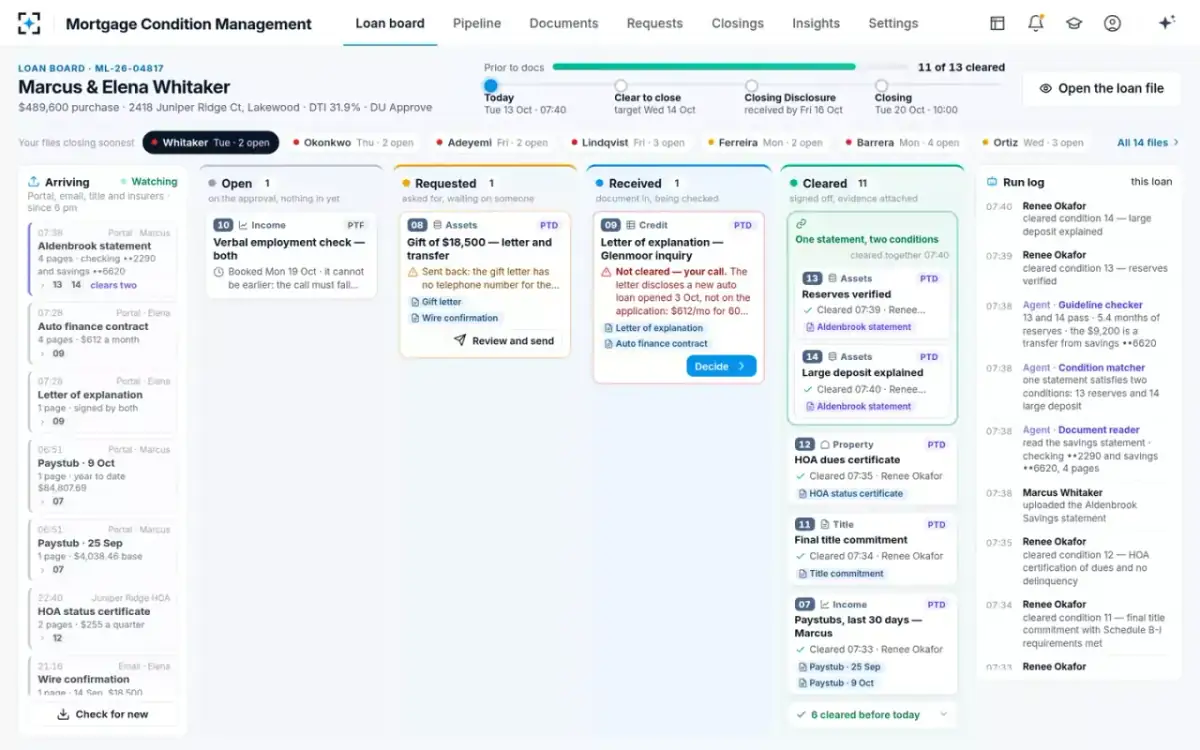
Every proposal carries the condition, the document page and the guide section, and every clearance a name and a time, which makes it straightforward to score. We run it on a sample of a lender's own conditionally approved files before anything goes live; start from Mortgage Condition Management.
Questions people ask
What is the best mortgage processing software?
There is no single best; there is the one that agrees most with your underwriters on your own files and never passes what they would send back. Compare candidates on the same replay, by condition family, and weigh the false-pass score above everything else.
Is mortgage processing software the same as a loan origination system?
No. The loan origination system holds the loan, its data and its conditions, and runs the workflow. Processing software of the kind described here works on top of it, reading documents and conditions and writing back proposals and outcomes.
How many files should a replay use?
About 50 conditionally approved files gives several dozen conditions in each family at a typical mix. Fewer files can work if they are chosen to include gifts, self-employment, large deposits and fallouts.
Should the replay include FHA and VA files?
Yes, in their real share. FHA counts document age as 120 days at disbursement rather than four months at the note date, and gift and asset rules differ, so a program the software handles weakly will only show up if it is in the set.
Who should score the replay?
A senior underwriter, with a processor for the administrative conditions. Every disagreement needs a ruling on who was right, and only someone with clearing authority can make it.