Conditional approval to clear to close is the stretch in which every condition the underwriter set must be met, and it usually decides whether a mortgage closes on time. In the file on this page it took twelve days: conditional approval on Thursday 1 October, clear to close at 07:50 on Tuesday 13 October, closing a week later. Almost all of those days were spent waiting for documents from the borrowers, a title company and a homeowners association; the matching, checking and clearing of thirteen conditions took twenty minutes once the last documents arrived. The file runs through Botminds' Mortgage Condition Management, where agents put each document on the condition it clears and the underwriter clears, decides and signs.
Take the solution's sample file as it runs: Marcus and Elena Whitaker, a $489,600 purchase at 2418 Juniper Ridge Ct, Lakewood, underwritten by Renee Okafor at a fictional lender. The borrowers, lender, people and companies are invented, and every figure about the file is sample data. The rules are linked where they apply.
Twelve days to clear to close, seven more to the closing table
- Requests out; documents trickle in1–9 Oct
- Last documents arrive9–13 Oct
- Matched, checked, cleared on 13 Oct20 min
- Closing Disclosure sentWed 14
- Must be receivedby Fri 16
- Waiting period; verbal VOE on MondaySat–Mon
- Closing at 10:00Tue 20
How long from conditional approval to clear to close?
No public data measure this stretch on its own. The research measures the whole cycle, about 50 days from application to a lender's decision in a 2026 Federal Reserve study (FEDS 2026-017), and the stretch after conditional approval is part of it. In this file it took twelve days, which is about what the dates allowed: the borrowers needed time to gather a gift letter, the title company needed time to issue its final commitment, and the closing was set for 20 October.
The useful question is not how long it took but where the time went. Waiting on someone outside the lender is mostly irreducible. Waiting on someone inside, for a document to be matched, read and cleared, is not. In this file the inside wait was twenty minutes; on the same lender before the agents, the median from document to cleared condition was 2.6 days.
What happens after conditional approval? Day one: fourteen conditions
After conditional approval, the processor sends out requests, orders what third parties must supply, and waits. Renee Okafor issued the Whitakers' approval on Thursday 1 October with fourteen conditions: thirteen prior to docs and one, the verbal verification of employment, prior to funding. Six were cleared in the days that followed; eight were still open or requested on the morning of 13 October.
The Whitakers' file, from approval to closing
| When | What happened | Who |
|---|---|---|
| Mon 14 Sep | $18,500 gift wired from Elena's mother, Maureen Dalby | Donor |
| Mon 21 Sep | $9,200 moved from the borrowers' savings ••6620 to checking ••2290 | Borrowers |
| Thu 1 Oct | Conditional approval with 14 conditions; final title commitment ordered from Pinecrest Title & Escrow | Underwriter, processor |
| Fri 2 Oct | Gift letter and wire record requested | Processor |
| Sat 3 Oct | The borrowers buy a car on a 60-month loan, $612 a month | Borrowers |
| Fri 9 Oct | Reserves and the large deposit requested; Marcus's latest paystub dated | Processor, employer |
| Mon 12 Oct, evening | Title commitment (18:04), gift letter and wire confirmation (21:16), HOA certificate (22:40) arrive | Title, borrowers, HOA |
| Tue 13 Oct, 06:51–07:28 | Two paystubs, a letter of explanation and the auto finance contract uploaded | Borrowers |
| Tue 13 Oct, 07:30–07:50 | Eight documents matched; 13 of 13 prior-to-docs conditions cleared; clear to close signed | Agents, underwriter |
| Wed 14 Oct | Closing Disclosure sent | Closer |
| Mon 19 Oct | Verbal verification of employment, both borrowers | Lender |
| Tue 20 Oct, 10:00 | Closing at Pinecrest Title & Escrow | Everyone |
Days two to nine: requests out, and a car bought on day three
The first week belonged to other people. The gift letter needed Elena's mother to write and sign it; the title company needed to run its search; the HOA needed to certify dues. The processor's job was to ask clearly and wait. Fannie Mae's gift rules make the letter a short list of required items, the amount, a no-repayment statement, and the donor's name, address, telephone number and relationship (B3-4.3-04), which is easy to request and easy to get slightly wrong.
On day three the borrowers bought a car. Nothing in the file knew yet. A new loan between approval and closing is one of the classic reasons a conditional approval goes bad, and the only way a lender learns of it before closing is a fresh credit check or the borrower saying so. Here the borrowers said so, in a letter of explanation for a credit inquiry, with the contract attached.
The night before: eight documents from five directions
Between 18:04 on Monday and 07:28 on Tuesday, eight documents arrived: the final title commitment from Pinecrest, the HOA certificate by email, the gift letter and wire confirmation from Elena by email, two paystubs from Marcus through the portal, and the letter of explanation and auto finance contract from Elena through the portal. That is a normal night for a file a week from closing. By hand, a processor sorts them in the morning, works out which condition each belongs to, and puts them in the underwriter's queue.
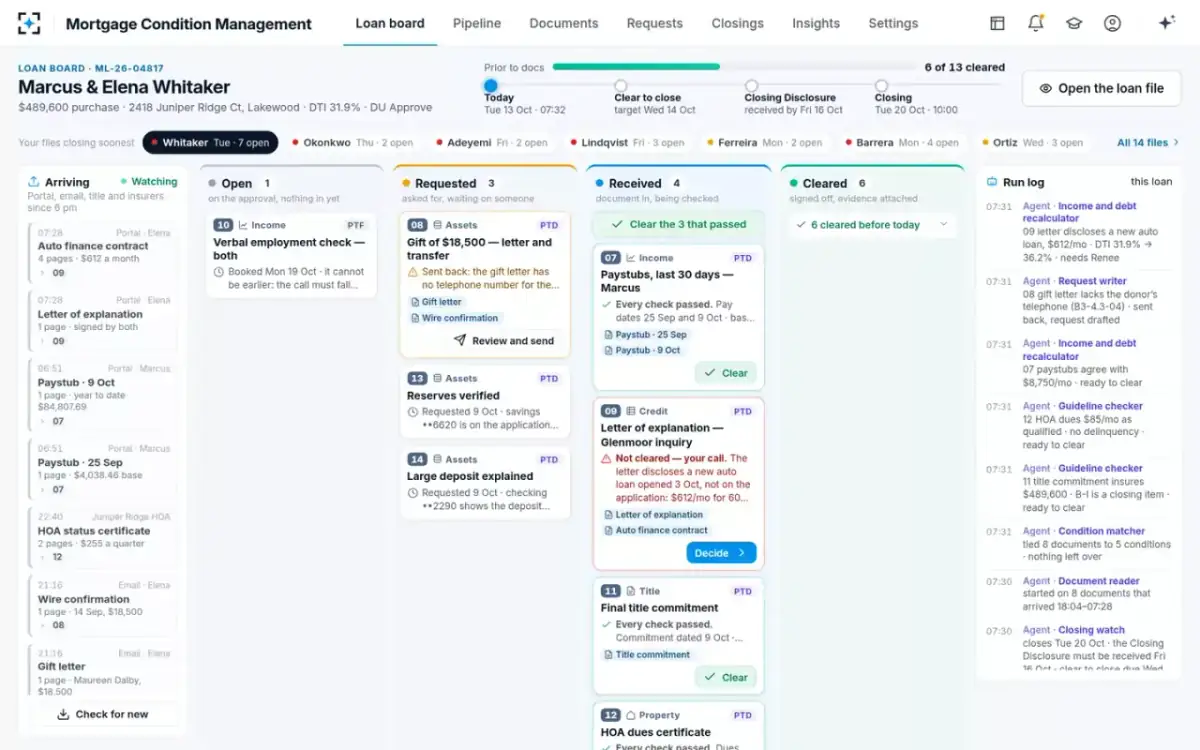
At 07:31 Renee pressed one button. The agents read the eight documents, placed them on five conditions with nothing left over, and tested each. The paystubs, title commitment and HOA certificate passed every check. The gift letter matched the September wire but had no telephone number for the donor, so it went back to Requested with a request already drafted. The letter of explanation stayed with Renee, marked "Not cleared — your call".
07:32: eight documents on five conditions, three ready to clear
07:30 to 07:50: thirteen conditions cleared
Renee cleared the paystubs, the title commitment and the HOA certificate at 07:33, 07:34 and 07:35. At 07:38 Marcus uploaded a savings statement covering both accounts. The agents placed it on two conditions at once: reserves, with 5.4 months left after closing against 2 required, and the large deposit, because the $9,200 on 21 September was a transfer from the borrowers' own savings printed on the statement. Fannie Mae needs no further explanation for a transfer between verified accounts shown on the statement (B3-4.2-02). She cleared both by 07:40.
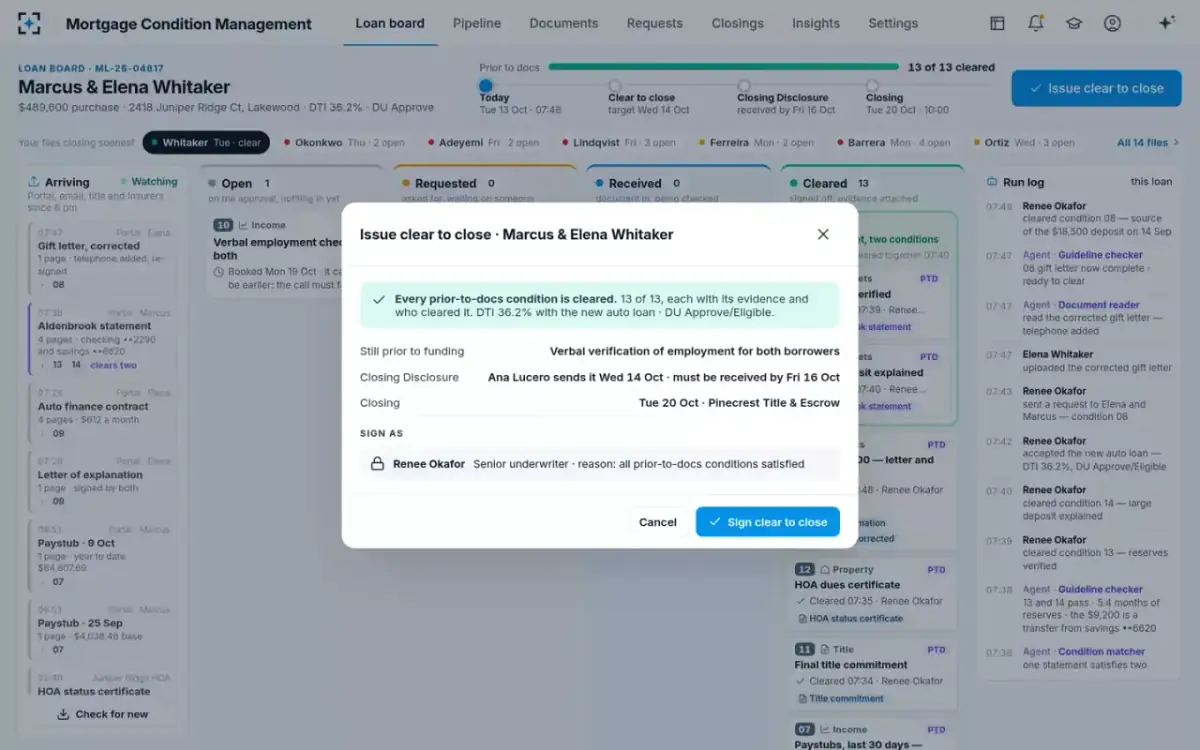
At 07:42 she decided on the car. At 07:43 she sent the gift letter request. At 07:47 the corrected letter came back through the portal with the donor's telephone number added and the letter re-signed, four minutes after the request went out; it passed every check, and she cleared it at 07:48. At 07:50, with 13 of 13 prior-to-docs conditions cleared, she signed clear to close, a day ahead of the target.
The last morning, by the numbers
8
documents arrived overnight, matched to 5 conditions with none left over
20min
from opening the file to signing clear to close
4min
from the gift letter request to the corrected letter
1day
ahead of the clear-to-close target
Can a lender deny a loan after conditional approval? The car loan
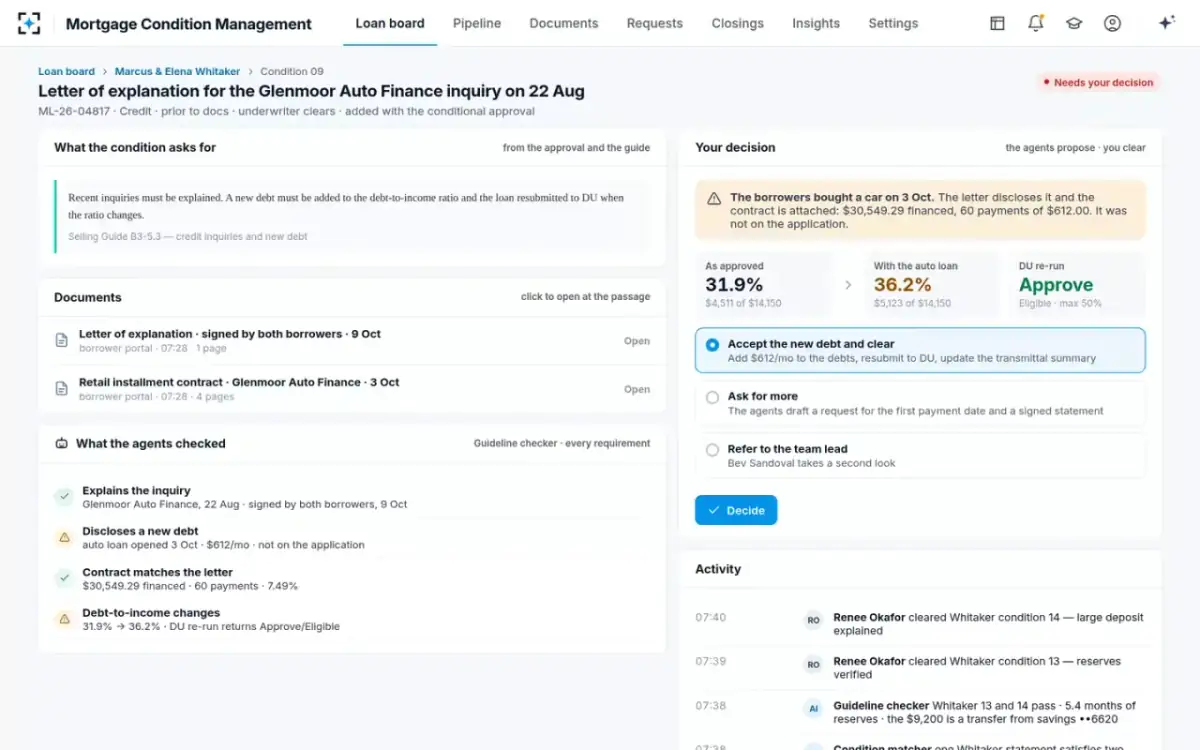
Yes: a conditional approval can still end in denial if a condition fails or new information changes the decision. The car loan was the test. The letter disclosed a loan of $30,549.29 over 60 months at $612 a month, not on the application. Added to the debts, the debt-to-income ratio moved from 31.9% ($4,511 of $14,150 monthly income) to 36.2% ($5,123). The agents re-ran the numbers and prepared the automated underwriting re-run, which returned Approve/Eligible against a 50% maximum.
Had the ratio crossed the line, the outcome would have been different: a denial on the new figures, with reasons, a week before closing. Renee chose "Accept the new debt and clear": the loan was added to the debts, the file resubmitted, the transmittal summary updated. Her other choices were on the same screen: ask for more, or refer to the team lead.
07:42: the decision only the underwriter could make
What is clear to close, and what still comes after it?
Clear to close is the underwriter's sign-off that every condition due before closing documents is met, so the closer can prepare the final figures. It is not the end. Three things remained for the Whitakers: the Closing Disclosure, the waiting period, and the verbal VOE.
The Closing Disclosure had to be received by Friday 16 October for a Tuesday closing, because the borrower must receive it three business days before consummation (12 CFR 1026.19(f)). For that rule, Regulation Z defines a business day as "all calendar days except Sundays and the legal public holidays specified in 5 U.S.C. 6103(a)" (1026.2(a)(6)), so Saturday 17 and Monday 19 counted and Sunday did not. The verbal VOE was booked for Monday 19, inside the 10 business days Fannie Mae allows before the note. PTD and PTF conditions explains why it waits; the document-expiry calendar shows what else would have needed redoing had the closing slipped.
07:50: clear to close, with what remains before funding
The other files on the board that morning
The Whitakers were the easy file. Nine files on the sample lender were closing within ten days, and on the morning of 13 October only theirs was clear to close. Four were at risk, with open items and seven days or less to go. The closings screen listed what stood in the way of each, and it reads like a list of the conditions underwriters see every week.
Daniel Okonkwo, refinancing, closed on Thursday 15 October; his Closing Disclosure had gone out on the 12th, and two items were still open: the source of a $9,400 deposit on 28 September, and a payoff statement from his current servicer. Tolu Adeyemi, buying, closed on Friday 16; her self-employed income needed a year-to-date profit and loss statement through 30 September, and her Closing Disclosure had to be received that same day. Hanna Lindqvist, also closing Friday, had a homeowners binder naming the wrong mortgagee and a paystub that needed to be dated within 30 days. Joao Ferreira, closing Monday 19, was waiting on a final title commitment and evidence of a $12,000 gift transfer.
Two of those files needed an underwriter's decision; two had proposals waiting to be cleared. None needed anyone to open a mailbox to find out where it stood. The value of a board like this is less in any one file than in seeing, at 07:30, which four of nine closings could slip and what each one is waiting for.
Why does clear to close take so long? Where the days could have gone
Clear to close usually takes long for one of three reasons: a document is still with the borrower or a third party, a document arrived but has not been matched and read, or it was read and found short and went back. Only the first is outside the lender. On this file the second and third would have cost the most by hand.
The solution's estimate puts one condition handled by hand at about 20 working hours, most of it waiting to be matched and reopening the file to clear, and two to three days from the document arriving to the condition cleared. Eight documents arriving on the evening of 12 October would then have cleared around 15 or 16 October. The Closing Disclosure had to be received on the 16th. The file would have reached clear to close on the day its buffer ran out, and any second request, such as the gift letter's missing telephone number, would have moved the closing.
One condition's working hours, by hand and with agents
By hand · about 20 hours
- Waiting to be matched · 8 h · 40%
- Checking · 4 h · 20%
- Numbers and request · 4 h · 20%
- Reopening to clear · 4 h · 20%
With agents · about 1.8 hours
- Matched · 0.1 h · 6%
- Review check and numbers · 1 h · 55%
- Request · 0.2 h · 11%
- Clear · 0.5 h · 28%
Three lessons travel beyond this file. Ask for everything the moment the approval issues, because the outside waits are the long ones. Check every element of a document the hour it lands, so a missing telephone number costs four minutes, not two days. And keep the closing calendar in view, because clear to close has to beat the Closing Disclosure, not the closing. For what a saved day is worth to a lender, see average days to close a mortgage; the solution is at Mortgage Condition Management.
Questions people ask
How long does underwriting take after conditional approval?
The underwriter's own time can be minutes per condition once documents are matched; in this file thirteen conditions took twenty minutes. The calendar time is set by how fast documents arrive and how quickly someone reads them, which is days or weeks.
Is clear to close the same as final approval?
In most lenders' usage, yes: clear to close means every prior-to-docs condition is met and the file can go to closing. Some conditions, such as the verbal verification of employment, can remain until funding.
Should the lender re-check credit after conditional approval?
Many lenders do, and a new account found then must be explained and counted. In this file the borrowers disclosed the car loan themselves, and the ratio was re-run before clear to close rather than discovered at closing.
What should a processor warn borrowers about between conditional approval and closing?
New debt, large unexplained deposits and job changes, and documents sent incomplete or unsigned. Each of those can reopen a condition or change the decision, and a document sent back costs at least a day.
How long after clear to close is the closing?
At least three business days after the borrower receives the Closing Disclosure, with Saturdays counting and Sundays not. Here clear to close was Tuesday and closing the following Tuesday, which left a day of buffer.