Mortgage underwriting conditions are the items an underwriter still needs after approving a loan "subject to" them: a recent paystub, a gift letter, a source for a large deposit, a letter explaining a credit inquiry, the final title commitment, a homeowners binder with the right mortgagee clause, a verbal verification of employment. Each one is cleared by a particular document that meets a particular rule, usually a section of the Fannie Mae Selling Guide, the Freddie Mac Guide or HUD Handbook 4000.1, and the list below maps the common ones to both. The work is hard because the documents arrive from five directions at once while the closing date holds. Botminds' Mortgage Condition Management exists for that part of the file: agents read each document as it arrives, put it on the condition it clears, test it against the rule, and leave the clearing to the processor or underwriter.
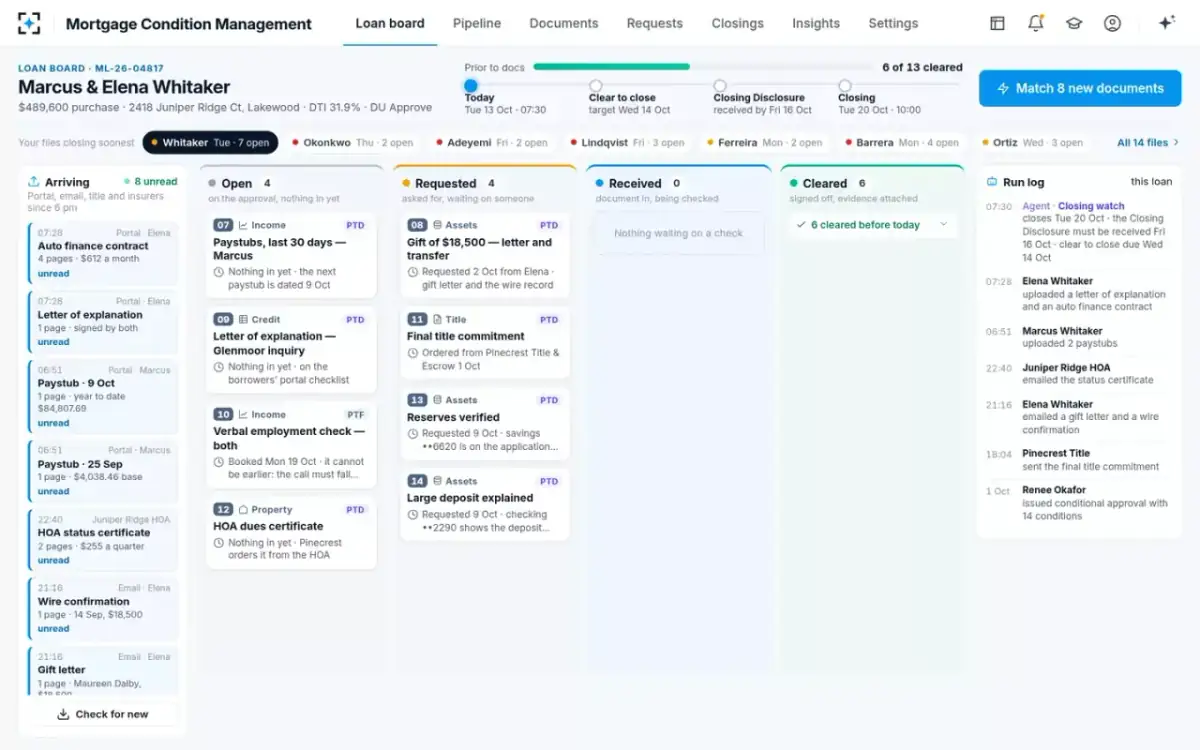
Examples come from the solution's fictional sample lender and its sample file for Marcus and Elena Whitaker, a $489,600 purchase approved with 14 conditions. The rules come from the agency guides and federal regulations, linked where they are used.
One approval, fourteen conditions, two deadlines
14
conditions on one sample conditional approval
13 prior to docs, 1 prior to funding
4months
the oldest a Fannie Mae credit document may be on the note date
50%
of monthly qualifying income: the line above which one deposit must be sourced
10days
business days before the note: the latest window for a verbal VOE
What are common mortgage underwriting conditions? Four families
Common mortgage underwriting conditions fall into four families: income and employment, assets, credit, and the property and closing paperwork. The first three prove the borrower is who the application says; the fourth proves the collateral and the transaction are what the approval assumed. The family matters more than the wording, because it decides who may clear the condition and what happens if the document changes a number.
Income conditions ask for a current paystub, W-2s, tax returns or transcripts, and a verbal verification of employment close to closing. Asset conditions ask for bank statements, the source of a large deposit, a gift letter and the gift's transfer, or proof of reserves. Credit conditions ask the borrower to explain an inquiry, a late payment or a new account, and to document a debt that appeared after the credit report was pulled. Property and closing conditions ask for the appraisal or its update, the title commitment, the homeowners insurance binder, condominium or HOA certificates, and a payoff statement on a refinance.
In the sample file, 13 of the 14 conditions are due before closing documents are drawn and one, the verbal VOE, before funding. That split, "prior to docs" and "prior to funding", is a lender's own scheduling label, not a regulator's term, and what PTD and PTF conditions mean is worked through separately.
The list: each condition, the document that clears it, and the rule
A condition is cleared when the document in the file meets the rule the condition points to, read on the right date. The table gives the common conditions on a conventional purchase sold to Fannie Mae, with the FHA difference where it matters most.
Common mortgage underwriting conditions, mapped to the document and the rule that clear them
| Condition | Document that clears it | The bar it must meet | Rule |
|---|---|---|---|
| Current paystub | Most recent paystub with year-to-date earnings | Dated no earlier than 30 days before the initial application date; still within the document-age limit on the note date | Fannie B3-3.2-01; B1-1-03 |
| Prior years' earnings | W-2s, or a year-end paystub, or a W-2 transcript | Cover the most recent one- or two-year period for the income type | Fannie B3-3.2-01 |
| Verbal verification of employment | Lender's call, written or vendor verification | No more than 10 business days on or before the note date for employment income | Fannie B3-3.1-04 |
| Bank statements | Most recent statements, typically two months | Most recent statement no more than four months old on the note date | Fannie B1-1-03 |
| Large deposit explained | Statement showing the source, or a written explanation and evidence | Source any single deposit over 50% of monthly qualifying income that is needed to close; otherwise reduce verified funds | Fannie B3-4.2-02 |
| Gift | Gift letter signed by the donor, plus evidence of transfer or donor funds | Amount, no-repayment statement, donor's name, address, telephone and relationship | Fannie B3-4.3-04 |
| Credit inquiry or new debt | Borrower's letter of explanation; statement or contract for any new account | Any new debt added to the ratios and the loan resubmitted to automated underwriting when the data change | Lender condition; Fannie B3-2-10 on DU data accuracy |
| Appraisal | Appraisal report, or an update | Within 12 months of the note date; an update if more than four months old | Fannie B4-1.2-04 |
| Homeowners insurance | Binder or declarations page | Lender's name, "its successors and/or assigns" and mailing address as mortgagee | Fannie B7-3-08 |
| Title | Final title commitment | Clear title on the terms the closing assumes | Lender and investor title requirements |
| FHA: any credit document | The same documents, dated | No more than 120 days old at the disbursement date | HUD Handbook 4000.1 II.A.1 |
Two things in the table explain most of the back-and-forth. First, half the bars are about dates, not content: a perfect bank statement can fail because it is five months old on the note date, and a perfect verbal VOE can fail because closing slipped by a week. Document expiration for Fannie Mae and FHA has its own calendar. Second, several conditions change a number. A gift that arrives for a different amount, or a car loan disclosed in a letter of explanation, means re-running the ratios and, when the data change, resubmitting to Desktop Underwriter.
Customary closing conditions or credit conditions: the split that decides who clears
Federal regulation already sorts conditions into two kinds: customary commitment or closing conditions, and underwriting or creditworthiness conditions. The split comes from the official interpretation of Regulation C, which tells lenders how to classify a conditional approval that does not close, and it is a useful rule for who should be allowed to clear what.
Two kinds of condition, as Regulation C's commentary lists them
Customary commitment or closing conditions: "A clear-title requirement, an acceptable property survey, acceptable title insurance binder, clear termite inspection, a subordination agreement from another lienholder"
Underwriting or creditworthiness conditions: "satisfactory debt-to-income or loan-to-value ratios, a determination of need for private mortgage insurance, or a satisfactory appraisal requirement"
Customary commitment or closing conditions: A settlement statement showing adequate proceeds where the borrower sells one home to buy another.
Underwriting or creditworthiness conditions: "verification or confirmation … that the applicant meets underwriting conditions concerning applicant creditworthiness, including documentation or verification of income or assets"
Customary commitment or closing conditions: The approval stands; the loan is reported as approved but not accepted.
Underwriting or creditworthiness conditions: The application is reported as denied, or closed for incompleteness after a written notice.
Customary commitment or closing conditions: A processor, where the lender allows it: the test is whether the document says what it should.
Underwriting or creditworthiness conditions: The underwriter: the test may move the credit decision.
The line runs through the middle of the asset family. A bank statement that verifies reserves is a creditworthiness condition; the HOA dues certificate is a closing condition. In the solution the split is a setting: income, asset and credit conditions are underwriter only, while title, insurance, property and compliance can be cleared by the processor or the underwriter, as the lender chooses. Only the underwriter issues clear to close.
What documents clear a gift condition?
A gift condition is cleared by two things: a gift letter signed by the donor, and evidence that the money exists or has moved. Fannie Mae requires the letter to "specify the actual or the maximum dollar amount of the gift; include the donor's statement that no repayment is expected; and indicate the donor's name, address, telephone number, and relationship to the borrower" (Selling Guide B3-4.3-04).
The transfer side is satisfied by the donor's check and the borrower's deposit slip, the donor's withdrawal slip and the deposit slip, evidence of an electronic transfer to the borrower or to the closing agent, or a check to the closing agent. If the gift actually received differs from the amount used in Desktop Underwriter, the section warns, the lender "may need to resubmit the loan casefile".
The sample file shows how a gift condition usually fails: not on substance but on one missing line. The $18,500 gift letter matched the September wire, but it had no telephone number for the donor. The agents sent the condition back to Requested with a request already drafted for the borrowers in plain words; the corrected letter came back the same morning.
What is a large deposit for a mortgage, and when does it need a letter of explanation?
For Fannie Mae, "a large deposit is defined as a single deposit that exceeds 50% of the total monthly qualifying income for the loan" (B3-4.2-02). On a purchase, if those funds are needed for the down payment, closing costs or reserves, the lender must document an acceptable source; otherwise verified funds are reduced by the unsourced amount. On a refinance, no explanation is required, though borrowed funds must still be counted.
A letter of explanation is one acceptable source, alongside proof of an asset sold or, in the Guide's own example, a wedding invitation supporting gift funds. No letter is needed when the source is printed on the statement: payroll, Social Security, a tax refund, or a transfer between verified accounts. When part of a deposit is sourced, only the unsourced part counts toward the 50% test.
In the sample file the borrowers earn $14,150 a month, so the line is $7,075. A $9,200 deposit on 21 September crossed it. The savings statement that arrived to verify reserves also showed the $9,200 leaving the borrowers' own savings the same day, so one document satisfied two conditions, each checked against its own rule.
Fourteen conditions in four lanes, with what has just arrived on the left
What is a VOD, and when is a bank statement not enough?
A VOD is a verification of deposit, Fannie Mae Form 1006: the bank itself confirms the account's balance, instead of the borrower supplying statements. It is quicker for some borrowers and slower for others, and it carries a condition of its own. When a VOD is used without the account's activity, "the lender must verify the source of funds for accounts opened within the last 90 days of the application date, and account balances that are considerably greater than the average balance reflected on the VOD" (B3-4.2-02).
That rule is why a VOD condition often turns into a statement condition. A new account, or a balance far above its average, is the same question as a large deposit asked a different way: where did the money come from, and is any of it borrowed?
What do underwriters look for when a condition comes back?
Underwriters look for three things in a returned condition: the document is the one asked for, it meets every element of the rule, and it does not raise a new question. The third is the one that sends files back. A letter of explanation for an inquiry that reveals a new car loan clears the inquiry and opens a debt, which changes the debt-to-income ratio.
In the sample file the letter disclosed a car bought on 3 October at $612 a month for 60 months, not on the application. Added to the debts, the ratio moved from 31.9% to 36.2%; the automated underwriting re-run returned Approve/Eligible under the 50% maximum. The agents prepared that arithmetic; accepting the debt was the underwriter's decision.
Which conditions come back most often?
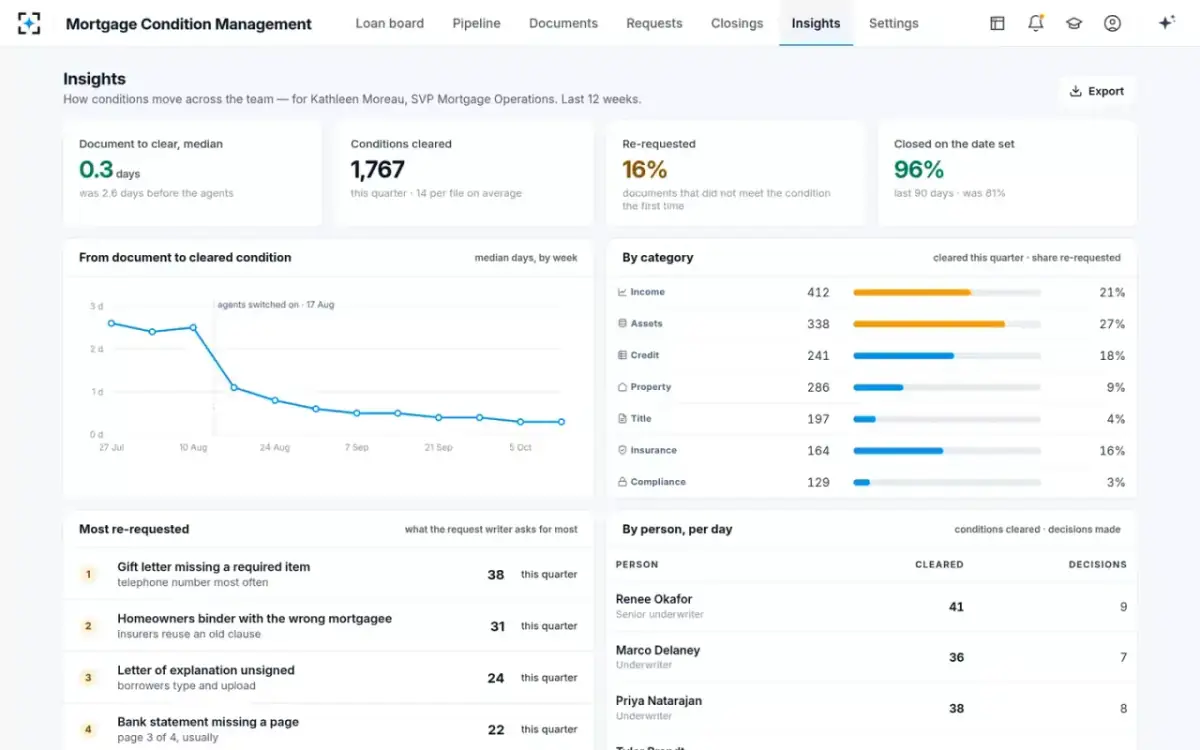
Asset and income conditions are re-requested most, because they have the most elements to get wrong. On the sample lender's quarter, more than a quarter of asset conditions needed a second request, against 4% of title conditions.
Share of conditions that needed a second request, by family
The single items behind those bars are mundane. The four most re-requested on the sample lender were a gift letter missing a required item (the donor's telephone number most often), a homeowners binder naming the wrong mortgagee, an unsigned letter of explanation, and a bank statement missing a page. Each is a rule with a checkable element, which is why it can be caught the minute the document arrives instead of when the underwriter next opens the file.
What is re-requested most, and how long a condition takes from document to clear
What conditions come after the appraisal?
The appraisal creates conditions of its own. Regulation C's commentary counts "a satisfactory appraisal requirement" as a creditworthiness condition, so an appraisal that comes in low or flags a repair can change the loan-to-value ratio, the mortgage insurance and, through them, the approval.
The common ones are a value that supports the price (or a renegotiated price or larger down payment), a repair or completion certificate, and the appraisal's own age. Fannie Mae requires the property to be appraised "within the 12 months prior to the date of the note and mortgage", with an update when the effective date is more than four months before the note (B4-1.2-04). Insurance and title conditions often follow too, because the insured value and legal description must agree with what the appraiser found.
What a cleared condition should carry
A condition is only as cleared as its evidence. An investor's quality-control reviewer, months later, needs to see what the condition asked, which document met it, where in that document, under which rule, and who decided. A checklist for any lender, whatever software it runs:
Six things every cleared condition should carry
- The condition as the approval wrote it
Not a paraphrase. The wording decides what "met" means.
- The document, with the page
A bank statement has several pages; a gift letter has one line that matters.
- The rule and its section
Selling Guide, HUD Handbook or overlay, as in force on the date the condition was cleared.
- The date test
Age on the note date (Fannie) or the disbursement date (FHA), recorded when cleared.
- Any number it moved
Income, debts, ratios and reserves before and after, with the automated underwriting result.
- Who cleared it, and when
A name and a time. A credit condition cleared by a person without credit authority is a finding waiting to happen.
That is the record Mortgage Condition Management keeps by design: every check names the requirement, the guide section and where the document meets it, every clearance is signed with a name and a time, and a document that matches nothing goes to a processor. See it on Mortgage Condition Management.
Questions people ask
What does "approved with conditions" mean on a mortgage?
The underwriter has approved the loan subject to specific items being provided or confirmed before closing or funding. If credit conditions are not met the application can still be denied; if only closing conditions remain open, Regulation C treats the loan as approved. A typical approval in the solution's sample data carries about 14.
How many underwriting conditions are normal?
No public source counts conditions per loan. The fictional sample lender in the solution clears 14 per file on average, but the number depends on the borrower's income type, the loan program and how complete the file was at submission. A self-employed borrower with a gift and a recent move will carry more.
Can a condition be waived?
A lender can remove a condition it imposed itself, such as an overlay, through its own exception process. A condition that enforces an investor or agency rule, such as the gift letter elements, cannot be waived by the lender without making the loan ineligible for sale on those terms.
Does a letter of explanation clear a large deposit on its own?
Sometimes. Fannie Mae lists the borrower's written explanation among acceptable documentation, but the lender must use reasonable judgment and place its rationale in the file. If the deposit is unsourced, the verified funds are reduced by that amount, which may still leave enough to close.
Are FHA conditions different from conventional ones?
The families are the same, but the rules differ. FHA counts document age as 120 days to the disbursement date, with day one being the day after the document's date, while Fannie Mae counts four months to the note date. Gift, asset and employment rules also differ in detail between HUD Handbook 4000.1 and the Selling Guide.