AI mortgage underwriting software now means two different things. One is the automated underwriting system, such as Fannie Mae's Desktop Underwriter, which has recommended approve or refer on loan data for decades. The other is newer: AI agents that read the documents behind a loan, test them against the guide, recalculate the numbers and prepare the underwriter's decisions on conditions. Underwriters will use the second kind only if it leaves them the decisions, shows its evidence on every proposal, and gives the lender what Fannie Mae's April 2026 Lender Letter on AI now asks sellers to have. Botminds' Mortgage Condition Management is the second kind, built for the stretch from conditional approval to clear to close, and this page sets out the conditions for trusting it, or anything like it.
Examples come from the solution's fictional sample lender. The rules are quoted from Fannie Mae's Lender Letter LL-2026-04 and the Selling Guide.
The lines a trustworthy rollout draws
0
conditions cleared without a person pressing Clear
100%
of clearances carrying the document, the page and the guide section
design target
5pts
move in debt-to-income that sends an underwriter's decision to a second look
sample lender's setting
1year
longest gap Fannie Mae allows between reviews of a seller's AI policies
What is AI mortgage underwriting software?
AI mortgage underwriting software is software that uses machine learning or language models to do part of an underwriter's work: reading income and asset documents, checking them against the investor's guide, recalculating ratios, and drafting findings for the underwriter to accept or reject. It sits beside the automated underwriting system, not in place of it. Desktop Underwriter still evaluates the loan data; the AI layer makes sure the data and documents behind it are right, and prepares the re-run when a document changes a number.
The distinction matters for trust. An automated underwriting recommendation is a known quantity with its own rules for when a loan must be resubmitted. AI that reads documents is new to most underwriters, and the question they ask is not whether it is clever but whether it will ever put its judgment where theirs belongs.
Can AI approve a mortgage?
No lender should let it, and nothing in the rules hands it that role. The lender makes the credit decision and answers for it to the investor, and when the answer is no, Regulation B still requires the lender to state specific reasons (12 CFR 1002.9). Software can test, calculate and recommend; a person with authority decides.
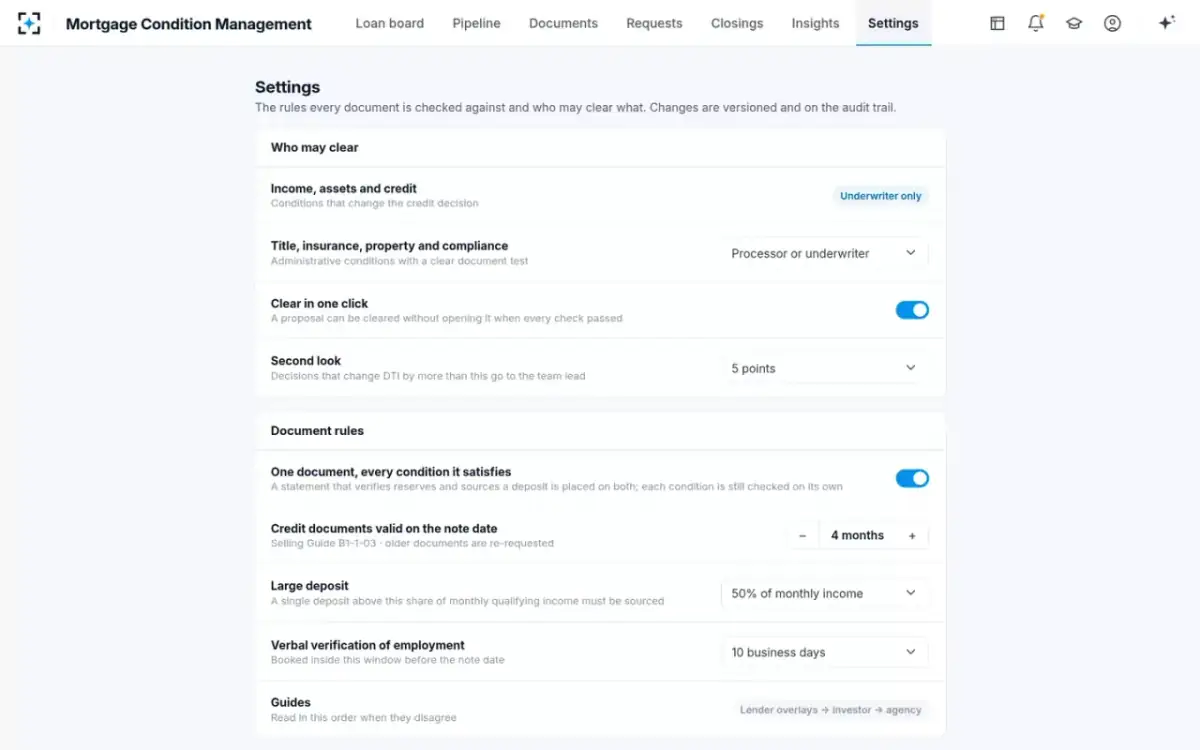
In the solution the line is drawn below the approval as well: no condition is cleared until a person presses Clear, income, asset and credit conditions are underwriter only, a decision that moves the debt-to-income ratio by more than five points goes to a team lead, and only the underwriter issues clear to close. Those are settings, so a lender can draw them tighter, but the software has no setting that lets it clear on its own.
Will underwriters trust AI? Only if they can see why
Underwriters trust a proposal they can check in less time than it would take to do the work themselves. That needs three things on the screen: what the condition asks for, the document with the passage that meets or fails it, and the guide section the test was made against. A bare "pass" saves nothing, because a careful underwriter opens the document anyway.
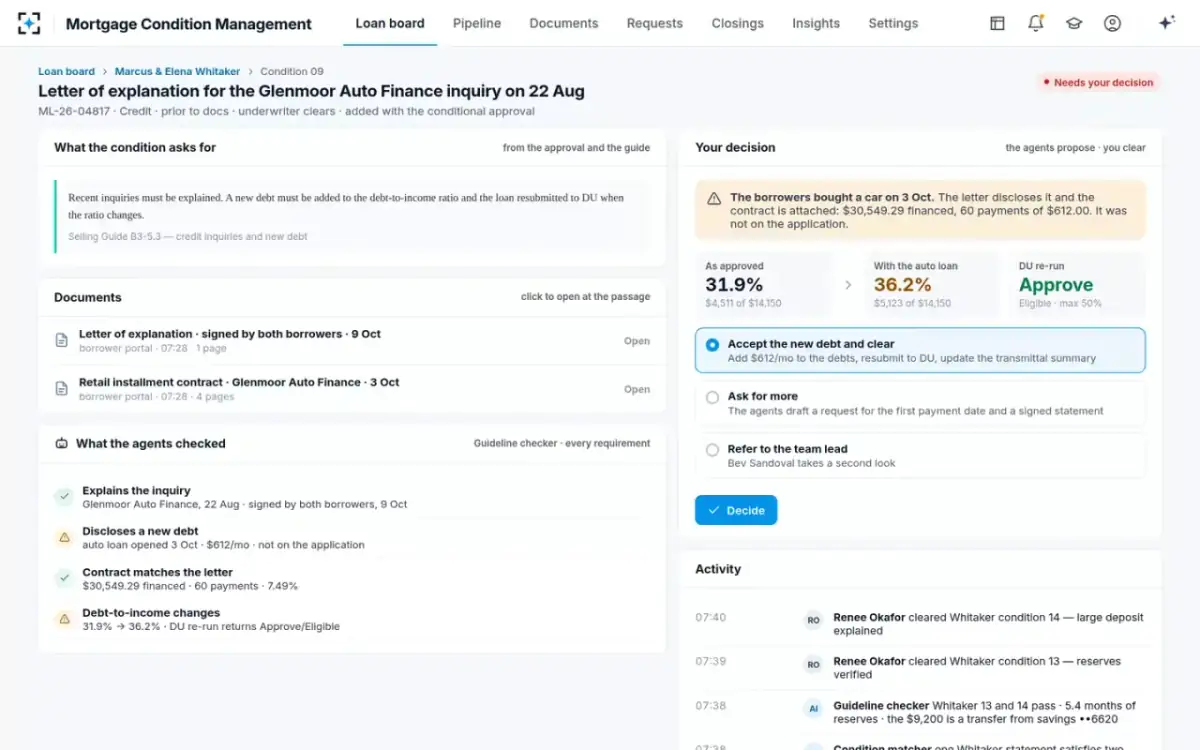
The second source of trust is how the software behaves when it is unsure. A document it cannot place should go to a person, not be forced onto the nearest condition. A condition it cannot pass should say why in a sentence. In the sample file, the letter of explanation did not clear and the card said so plainly: "Not cleared — your call," with the reason, a new $612-a-month car loan not on the application, underneath.
The underwriter's decision, with the numbers and the evidence in front of her
What are Fannie Mae's AI requirements for lenders?
Fannie Mae's requirements are in Lender Letter LL-2026-04, published April 8, 2026 and effective 120 days later, and they apply "To the extent a seller/servicer uses AI/ML in connection with the origination of loans sold to or guaranteed by Fannie Mae" (LL-2026-04). The letter asks for policies and procedures covering the development, use and maintenance of any AI system and the management of its risks, compliance with Fannie Mae's information security supplement, and governance of vendors.
Two lines in it decide how a rollout must be organised. The policies must "have an owner(s) that implements, maintains and reviews the policies and procedures at least annually", and the seller must "Manage risks and appropriate governance of subcontractor and vendor use of AI/ML that is no less protective of these requirements." AI underwriting software bought from a vendor is squarely inside the second.
What LL-2026-04 asks of a lender, and what to look for in the software
The Lender Letter: Policies and procedures for developing, implementing, using and maintaining AI/ML, and measuring and managing its risks.
What the software should let you show: Settings that encode the policy (who may clear what, second looks, document rules), versioned, with each change on the audit trail.
The Lender Letter: Policies must be "transparent and communicated to appropriate personnel" who work where AI/ML is used.
What the software should let you show: Every proposal states its reason and its rule in words an underwriter and an auditor can read.
The Lender Letter: A named owner who reviews the policies at least annually.
What the software should let you show: A log of what the agents proposed and what people decided, to review against the policy.
The Lender Letter: Governance of vendor use of AI/ML "no less protective" than the lender's own.
What the software should let you show: A vendor that will run a replay on your files and state in writing which decisions its software never makes.
The Lender Letter: Promptly disclose the types of AI/ML used, its purpose, manner of use and safeguards.
What the software should let you show: A written description of each agent, its job and its limits, kept current.
Who signs off on AI underwriting?
The underwriter signs off, and the lender's policy says on what. The useful way to write it is per decision, not per system: for each thing that can happen to a condition, who may do it. The table is the version in the solution's sample lender's settings.
Each decision on a condition, and who makes it
| Decision | Agents | Person |
|---|---|---|
| Which condition a document belongs to | Propose, including two conditions for one document | Can move it; sees every match |
| Whether a document meets the rule | Test each element and cite the page and section | Reviews the test before clearing |
| Clear a credit, income or asset condition | Propose only | Underwriter |
| Clear a title, insurance, property or compliance condition | Propose only | Processor or underwriter, by setting |
| Accept a document that changes the ratios | Recalculate and prepare the DU re-run | Underwriter; over 5 points of DTI, a team lead too |
| Send a request to a borrower | Draft in plain words | Processor or underwriter presses Send |
| Issue clear to close | Watch the clock, list what is open | Underwriter |
The second look is worth copying even without software. A decision that moves debt-to-income by several points is the one most likely to be questioned later; a second person's initials, kept with the numbers before and after, answer the question before it is asked.
How do you roll out AI to underwriters?
Roll it out the way a lender adds an underwriter: test on old files, shadow on live ones, then give authority in steps. The checklist is the sequence we recommend; each step has a measure that must be met before the next.
Rolling out AI underwriting support, step by step
- Write the authority line first
Who may clear each family of condition, what needs a second look, who owns the AI policy and when it is reviewed (LL-2026-04 asks for at least annually).
- Load your overlays and set the order
Lender overlays, then investor, then agency, so a stricter rule always wins.
- Replay a month of cleared files
Score placement, false passes and reasons against what your underwriters did. Zero false passes on credit conditions before going further.
- Have underwriters score the disagreements
They see where the software is stricter than they are, and why; that is where trust is earned or lost.
- Shadow on live files
The agents propose; underwriters work as before and compare.
- Turn on proposals, not clearances
Underwriters clear from the agents' proposals, reading each one. One-click clearing only for families where the replay showed no false passes.
- Review overrides monthly
Every proposal an underwriter rejected, and every clearance later questioned by QC, goes back to the policy owner.
- Keep the disclosure file current
Agents, jobs, limits, settings, replay results: what Fannie Mae can ask for on request.
How to replay last month's cleared files gives the scores in full. The single most useful habit is the monthly override review: every rejected proposal is either a software error to fix or a rule the policy should state more clearly.
What to measure in the first ninety days
Measure what tells underwriters whether their trust is deserved, not only what tells managers whether the files are faster. Speed follows from trust; if underwriters re-check every proposal by hand, the software adds a step instead of removing three.
Five measures for the first ninety days
| Measure | Why it matters | Sample lender |
|---|---|---|
| Proposals rejected by underwriters | Each rejection is a disagreement to explain; a falling rate means the rules are encoded well | Reviewed monthly |
| Clearances later questioned by QC | The false pass that got through; the measure that ends trust if it rises | Target zero |
| Documents sent to a person unplaced | Should be few, and each a genuine stray, not a missed match | 3 of 42 one night |
| Document to cleared condition | The time the queue used to eat | 0.3 days median, was 2.6 |
| Conditions needing a second request | Plain-language requests should bring back the right document first time | 16% in the quarter |
Where AI support helps an underwriter most: documents that change a number
The highest-value help is on documents that move a number, because those are the ones that send a file back to automated underwriting and the ones quality control reviews first. Three come up on almost every busy desk. A gift that arrives for a different amount than the one underwritten changes cash to close and may require the casefile to be resubmitted. A letter of explanation that discloses a new debt changes the debt-to-income ratio. And an unsourced large deposit shrinks the assets: Fannie Mae says that "When the lender uses a reduced asset amount, net of the unsourced amount of a large deposit, that reduced amount must be used for underwriting purposes (whether the loan is underwritten manually or through DU)" (B3-4.2-02).
In each case the arithmetic is mechanical and the decision is not. The agents can recompute income, debts, ratios and reserves the moment the document lands and lay the before and after side by side, as they did when the sample file's ratio moved from 31.9% to 36.2%. The underwriter decides whether the new figure is acceptable, whether to ask for more, and whether to resubmit. A lender's data-integrity duty runs through this step: the Selling Guide requires that "All data entered into DU must be verifiable", so a re-run prepared from a document the underwriter has seen, with the page shown, is the safer kind.
The time saved here is not the underwriter's arithmetic, which is quick. It is the gap between the document arriving and anyone noticing that it changes a number, which by hand can be days.
What AI underwriting support should not do
It should not send anything to a borrower on its own, resubmit a changed loan to automated underwriting without the underwriter, waive a requirement, or clear a condition. It should not hide uncertainty behind a confidence score: a condition either meets every element of its rule, with the page shown, or it says which element is missing.
It should also not be the only reader of the guide. Rules change monthly, as the October 2026 Selling Guide update to verbal verification of employment showed, and the underwriter who spots a change before the software is updated must be able to overrule it on the spot. In the solution, every check cites the section it applied, so a stale rule is visible on the screen that uses it.
The authority line, as the lender writes it
Research on lenders that automated more found them about 20% faster with no rise in defaults (NBER w24500). The gain comes from taking waits out of the file, which is what AI mortgage processing, task by task describes for the processor's desk. To see the underwriter's side on a file, start from Mortgage Condition Management.
Questions people ask
Will AI replace mortgage underwriters?
The decisions stay with underwriters: lenders answer to investors for each loan, and Fannie Mae's Lender Letter LL-2026-04 makes the lender responsible for any AI it uses. What moves to software is reading, matching and checking, which frees underwriters for the judgment calls.
Is AI underwriting legal under fair lending rules?
Using software does not change the lender's obligations. Equal credit rules still apply, and an applicant who is denied must still receive specific reasons under Regulation B. Software that only prepares conditions for an underwriter's decision leaves the credit decision, and its reasons, with a person.
Does Freddie Mac have AI requirements too?
We have not been able to read Freddie Mac's Seller/Servicer Guide text on AI, so we do not summarise it here. Lenders selling to both agencies should take any AI requirements from each Guide directly and hold one policy that meets both.
What happens when the software and the underwriter disagree?
The underwriter's decision stands, and the disagreement is logged. Reviewed monthly, disagreements show either a rule the software applies wrongly or a policy the lender should write down more clearly.
Can underwriters clear conditions in one click?
Where the lender allows it, a proposal whose every check passed can be cleared without opening it. We recommend turning that on only for condition families where a replay on the lender's own files showed no false passes.