A sponsor's monitoring visit report review is the step between a monitor finishing a draft and the sponsor owning what it says: a clinical trial manager, usually, reading the report line by line, asking for what is missing, deciding anything that has to escalate, and signing. It is also where the time goes. The report itself takes an evening; the review queue takes the fortnight. Monitoring Visit Report Automation is Botminds' software for the whole stretch — it drafts the report from the visit notes, the checklist, the previous report and the site data, runs the sponsor's own checks over the draft before anyone reads it, and leaves the manager with the three decisions that are actually theirs.
The names on this page are sample study data inside the solution and are fictional: Northwind Bio, studies VLT-302 and CRV-210, the clinical trial manager Lena Ortiz, the monitors Sam Patel and Omar Haddad, the clinical lead Dr. Maya Chen. The rules quoted come from ICH E6(R3), FDA guidance and US regulation, and are linked where they appear.
One manager's Monday morning, in the sample study
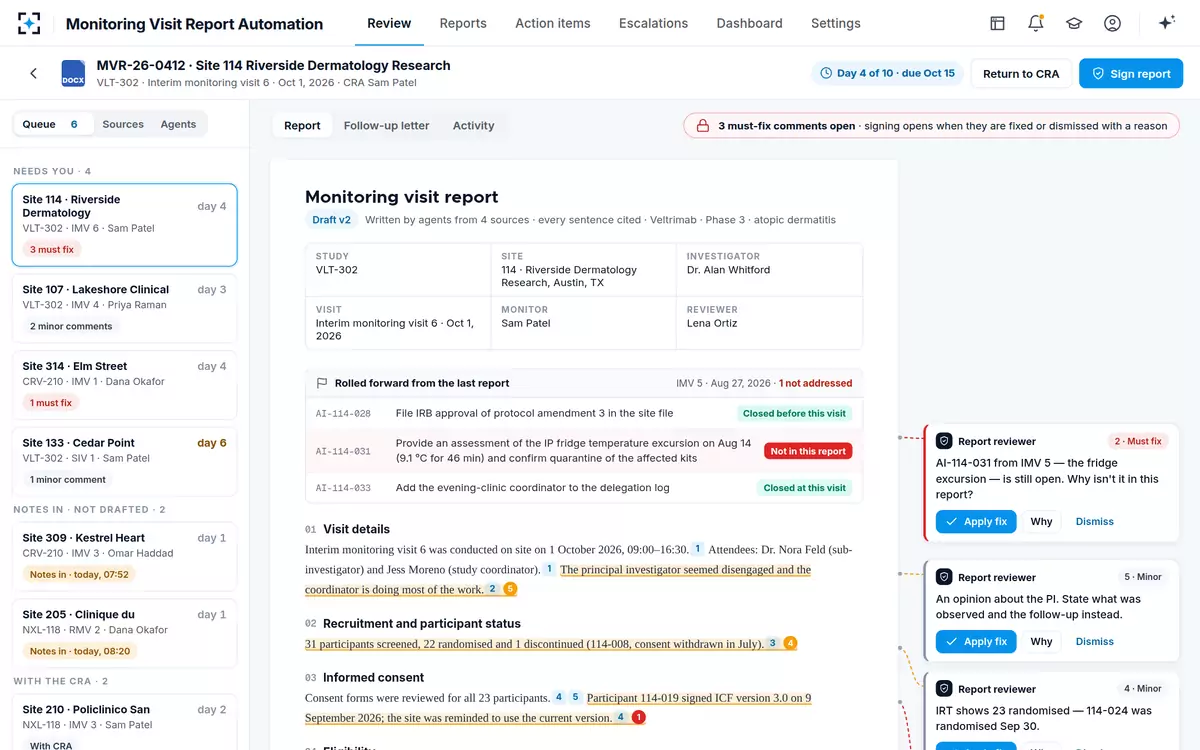
4reports
waiting on the manager; two more are drafted and still with the monitor
5comments
in the margin of the Site 114 report, three of them must-fix
Day 4of 10
when that report was signed, against a sponsor clock of 5 working days to submit and 5 to sign
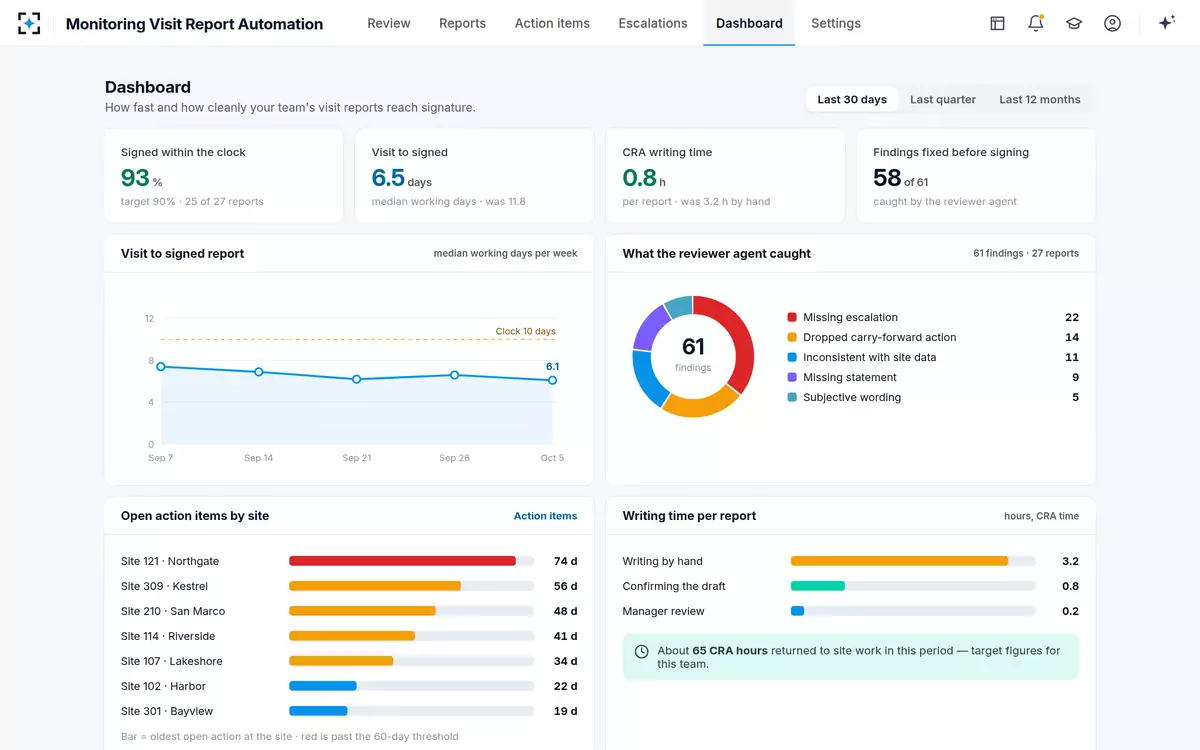
93%
of reports signed inside the clock — the design target for the live solution
Who reviews a monitoring visit report, and in what order?
In a typical sponsor organisation the order is: the monitor who did the visit writes and confirms the draft; a clinical trial manager or lead monitor reviews it and signs; a clinical lead or medical monitor sees anything that escalates; quality sees anything that might be a serious breach; and the site receives a follow-up letter, not the report. The names differ — lead CRA, clinical operations manager, study manager — but the shape tends to hold because the work splits the same way.
What the rules say about that order is narrow and worth knowing precisely. ICH E6(R3) does not name a reviewer. It says reports "should be provided to the appropriate sponsor staff as described in the sponsor's procedures in a timely manner for review and follow-up". Two obligations hide in that sentence: the report has to reach someone who can act on it, and who that someone is has to be written down in advance. A sponsor that cannot produce the procedure naming the reviewer has not met the second half.
FDA's wording is close to it, and adds the direction of travel: reports "should be provided to appropriate management (including sponsor staff responsible for the conduct and oversight of the clinical investigation) in a timely manner for review and follow-up". The phrase to notice is "responsible for the conduct and oversight". Review is not an editorial pass for house style; it is the sponsor exercising the oversight that 21 CFR 312.56(a) puts on it in one line — "The sponsor shall monitor the progress of all clinical investigations being conducted under its IND."
The same report, seen from four desks
Today
Dictates on the drive home, then writes for two to four hours across the following evenings, chasing site data and last visit’s actions as they go.
With agents
Dictates once; reads a cited draft in the sponsor template with last visit’s actions already carried into it, and confirms it.
Still theirs: Everything observed at the visit. No agent sees the site.
Today
Reads every report line by line looking for what is missing, and sends about one in six back.
With agents
Opens a report with the findings already in the margin, each with its evidence, and spends the time on the three that need a decision.
Still theirs: The signature, and the meaning attached to it.
Today
Hears about an important deviation when the report reaches them, which may be after the clock they care about has run.
With agents
Sees each escalation as it is raised, with the rule it broke and the report it came from, and records the decision.
Still theirs: The decision on every escalation.
Today
Waits for a letter that is written after the report is reviewed, and sometimes long after.
With agents
Receives a letter built from the signed report, with owners and dates, within the sponsor’s own letter clock.
Still theirs: Doing the actions. The letter asks; it does not do.
The five desks a report passes, and what each one is waiting for
Lateness in a review queue is rarely one person being slow. It is five hand-offs, each of which can stall, and each of which looks like somebody else's problem from where you are standing. The table below is the same journey written as waits rather than as steps.
Who waits on whom, between the visit and the signature
| Who is waiting | For what | Where the wait actually comes from | What shortens it |
|---|---|---|---|
| The monitor | Their own notes, written up | The visit ends at half past four and the write-up happens in the evenings that follow, between the next two visits. | Dictating once, on the day, and drafting from the dictation rather than from memory a week later. |
| The monitor | Enrolment, medication, deviations and queries | Queries raised at the visit take days to appear; randomisation posts to IRT on its own schedule. | Pulling CTMS, EDC and IRT at draft time and surfacing what disagrees instead of waiting for agreement. |
| The monitor | The previous report’s open actions | They sit in the trial master file or an inbox; ageing each one is manual arithmetic nobody budgets for. | Carrying every unresolved action into the new draft automatically, with its age and the number of visits it has crossed. |
| The manager | A draft that is complete | A report missing an escalation or an action goes back to the monitor, and the clock keeps running while it travels. | Running the sponsor’s own checks over the draft before a person opens it. |
| The clinical lead | An escalation they can decide | An important deviation written into the report as a reminder to the site never reaches them at all. | Applying the monitoring plan’s escalation rules to every draft, not to the reports someone remembers to flag. |
| The site | The follow-up letter | It cannot honestly be written before the report is signed, so every day of review is a day the site is not working the actions. | Writing the letter from the signed report the moment the signature lands. |
Read down the "where the wait comes from" column and a pattern appears: four of the six waits are for information that already exists somewhere. Only two — the monitor writing up what they saw, and the manager deciding — are work that has to be done by a person at that moment.
Why do monitoring reports get sent back?
Because something is missing rather than because something is wrong. A report that is sent back has usually passed its own template: every section has text in it. What it has failed is the comparison with everything the sponsor already knows — the previous report, the monitoring plan, the site's own data.
In the sample study's thirty-day window the report reviewer raised 61 findings across 27 reports, and the shape of them is the useful part.
What came back, and why: 61 findings across 27 sample reports
The first two together are three in five. Both are failures of memory across time rather than of care on the day: an escalation missed because the monitoring plan's rule was not in front of the writer, an action dropped because the previous report was not open. The third, inconsistency with site data, is a failure of sources — the report was written from one and the sponsor holds four. Only the last two are about writing.
The same visit, written twice
The report that comes back: Two of the three are accounted for. The third is in neither the notes nor the draft, and nothing says so.
The report signed first time: All three sit above section 01, each marked closed before the visit, closed at the visit, or carried forward with its age in days.
The report that comes back: Consent taken on a superseded version is written into the consent section as a reminder to the site.
The report signed first time: The same fact is written down and raised under the plan’s own rule, with an owner for the decision and a date.
The report that comes back: "22 randomised", taken from the site’s tally on the day.
The report signed first time: The draft shows 22 against 23 in IRT, both sources named, before the manager opens it.
The report that comes back: "No rescue medication" — which the notes and the EDC both contradict.
The report signed first time: The contradiction is marked must-fix, and signing stays locked until it is resolved or dismissed with a reason.
The report that comes back: "The principal investigator seemed disengaged."
The report signed first time: What was observed, and the follow-up planned. No opinion about anyone’s attitude.
The report that comes back: Back to the monitor on day 6, returned on day 9, signed on day 12 against a clock of 10.
The report signed first time: Signed on day 4 of 10, with the letter to the site out two working days later.
The data the report cannot be written without, and when it arrives
A monitoring visit report makes claims about numbers the monitor did not personally count. Enrolment is in CTMS, concomitant medications and queries are in the EDC, randomisation and product are in IRT, and all three move after the visit ends. A report written on the evening of the visit and a report written four days later disagree, and neither is wrong.
The practical answer is not to wait for the systems to settle, which is how a ten-day clock becomes a fortnight. It is to write the draft against all of them at once and let the disagreements show. A sentence that reads "31 screened, 22 randomised and 1 discontinued" is a claim; the same sentence with a note that IRT shows 23, because one participant was randomised on the evening of 30 September, is evidence of monitoring. Inspectors are not troubled by a discrepancy that the sponsor noticed. They are troubled by one it did not.
The same discipline applies to the open actions from the previous visit, which are the fourth source and the easiest to skip; what an interim report owes the visit before it sets out what each of the four possible outcomes needs as evidence.
What the rule actually requires of the sponsor's review
Less than most SOPs assume, and more than most queues deliver. There is no regulatory deadline for reviewing a monitoring report — not in ICH E6(R3), not in 21 CFR part 312, not in FDA's guidance. What exists is an obligation that the report reach the right people in a timely manner for review and follow-up, and an expectation that the sponsor will be measured against the timeline it set for itself.
That second half is where inspections bite. FDA's compliance programme for sponsor inspections tells its investigators to check whether the monitoring plans and procedures were followed for the study in hand, and gives three examples: monitoring visits performed, monitoring reports completed, and letters or other communications given to sites, each by the required timeline (FDA Compliance Program 7348.810). Three timelines, all of them the sponsor's own. A sponsor that writes ten working days into its procedures and signs at fourteen has a finding; a sponsor that writes twenty and signs at eighteen does not.
Lateness also has a second-order consequence that is easy to miss. The same programme directs inspectors to review the sponsor's criteria for selecting monitors "particularly when insufficient monitoring has been observed at certain clinical investigator sites (e.g., late monitoring visits and/or reports, unreported protocol deviations)". Late reports are treated as a signal about the people doing the monitoring, not only about the paperwork.
And review has teeth at the other end. Under 21 CFR 312.56(b), a sponsor that discovers an investigator is not complying with the signed agreement, the general investigational plan or the regulations has two options, and must take one promptly: secure compliance, or stop shipping the drug and end that investigator's part in the study (21 CFR 312.56(b)). The report is where that discovery is usually written down for the first time. A review queue is, in the regulatory sense, the mechanism by which a sponsor finds out.
The reviewer who is not a person: the checks that run before anyone reads it
Most of what a manager looks for is mechanical. Is every open action from the last report accounted for? Does every Partial or No on the checklist have a statement somewhere? Does any sentence contradict CTMS, EDC or IRT? Does anything in the draft meet one of the monitoring plan's escalation rules without being escalated? Does any sentence state an opinion about a person? Those five questions are the manager's first twenty minutes, every time, and none of them needs judgement.
Notes to signature in Monitoring Visit Report Automation: eight steps, two of them a person's
Agent
Notes readerTurns the dictation or typed notes into facts, each tied to the paragraph it came from, participant identifiers only.
Never: infers a fact that is not in the notes
Agent
Checklist matcherMatches every checklist answer to a statement the report owes; Partial and No answers become statements it must make.
Agent
Carry-forward trackerBrings every unresolved action from the previous report into this one with its age and the visits it has crossed.
Never: closes an action without evidence
Agent
Site data checkCompares enrolment, concomitant medications, deviations and queries with CTMS, EDC and IRT.
Agent
Report writerWrites each section in the sponsor template for the visit type, citing its source on every sentence.
Never: writes a sentence without a source
A person decides
The monitor confirms the draftReads what was written from their own notes, corrects what the day actually held, and submits it.
Agent
Report reviewerChecks the draft against the monitoring plan and the site data, and leaves each finding in the margin with its evidence and a suggested text.
Never: signs, or applies its own fix
A person decides
The manager signsFixes or dismisses each comment with a reason, decides each escalation, and signs under a stated meaning.
The manager's queue, and the comments waiting in one report
What the manager's signature means, and what it does not
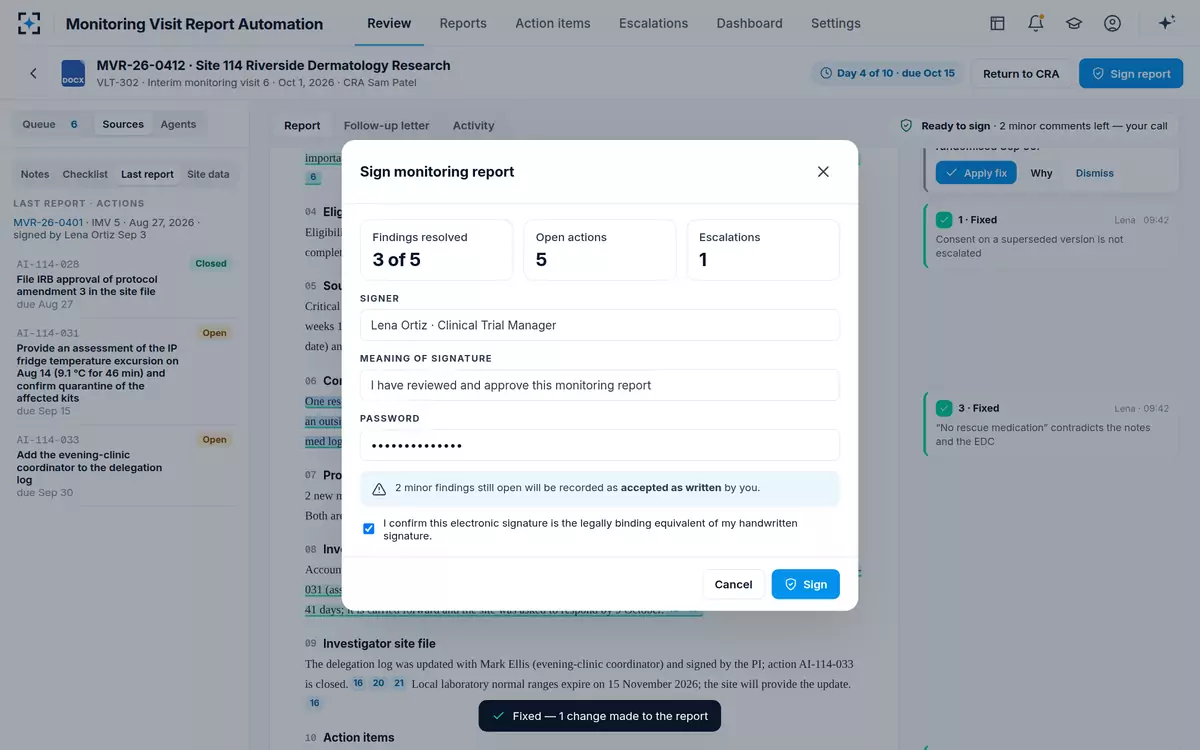
A signature on a monitoring visit report is not an assertion that the visit went well, and it is not a second opinion on what the monitor saw — the manager was not there. It is the sponsor saying: this is our record of that visit, these are the findings we accept as significant, these are the actions we require, and these escalations have been decided. That is why the meaning attached to the signature matters more than the signature itself, and why it should be stated rather than implied.
Two practices keep that meaning honest. First, a minor comment the manager chooses not to pursue should be recorded as accepted as written by them, not silently deleted — the difference between a judgement and an erasure is the whole of the audit value. Second, a must-fix finding should hold the signature closed until it is resolved or dismissed with a reason. A sponsor whose own checks say a statement contradicts the EDC, and who signs anyway with nothing written down, has created the worst of both worlds: the problem was known and the record does not say why it was accepted.
Signing with the meaning stated, and the open findings counted
Where the queue silts up, and the two hand-offs worth removing
Measure a review queue and the median is rarely the story. The median report moves briskly; a minority sit for a fortnight and drag the whole study's figures. In the sample study's own queue the oldest report is at day 11 and has been returned to the monitor, which is the characteristic shape: a report that comes back does not resume where it stopped, it rejoins the back of two queues.
So the hand-offs worth removing are not the ones that look slowest. They are the ones that cause a return. The first is the previous report's open actions, which produce 14 of the 61 findings in the sample window; carrying them into the draft before writing starts removes the category rather than speeding it up. The second is the escalation rule that lives in a monitoring plan document nobody opens while writing — 22 of 61. Apply the rules to every draft and the escalation is raised at the moment the fact is written down, which is also the moment that matters for the clock the clinical lead is on.
What is left after that is the work worth a manager's attention: whether a finding is significant, whether an action is proportionate, whether a site's pattern over three visits now means something. That is the review the rules are actually asking for.
The queue measured: visit to signature, and what the checks caught
What an inspector asks about your review, not your report
Inspections of sponsors go at the system before they go at the document. The questions that follow from the FDA programme quoted above, and from ICH E6(R3)'s requirement that the sponsor's procedures describe the arrangement, are these, and a team can rehearse all of them in an afternoon.
Five questions about the review, and what answers them
| What is asked | What answers it | What does not |
|---|---|---|
| Who is required to review a monitoring report, and where is that written? | A procedure naming the role, with the escalation route for anything the reviewer cannot decide. | Custom, or "the study manager usually does it". |
| What timeline did you set, and did you meet it? | The clock in your own procedure, and the proportion of reports signed inside it, study by study. | A median that hides the reports at day 20. |
| How do you know findings were followed up? | Every action with an owner, a date and an outcome, carried visit to visit until closed with evidence. | An action table that starts empty at each visit. |
| What happened to the findings that escalated? | The decision, who made it, when, and what it changed in the report. | An email thread. |
| How do you know the reviewer read it? | Comments, fixes and dismissals with reasons, and a signature with a stated meaning, on an unalterable trail. | A name in a box. |
Two further things are worth saying plainly. The monitor who did the visit should not be the person who signs it off; a writer cannot be their own reviewer, and the practice of checking the monitor exists for the same reason. And the site's own staff are part of this chain, not spectators: the US Department of Labor's occupational description for clinical research coordinators lists among their tasks to "Monitor study activities to ensure compliance with protocols and with all relevant local, federal, and state regulatory and institutional polices" and to prepare study documentation including progress reports. When the letter from the sponsor arrives late, it lands on a desk that is already doing a version of the same job.
The review is the sponsor's oversight made visible. It deserves the manager's judgement and almost none of the manager's search time. To see the queue, the margin comments and the signature together, start from Monitoring Visit Report Automation, or read what every monitoring visit report must contain first.
Questions people ask
Who signs off a monitoring visit report?
A sponsor role senior to the monitor — usually a clinical trial manager, study manager or lead monitor — signs, and the sponsor's procedures have to name who. ICH E6(R3) requires only that reports go to the appropriate sponsor staff in a timely manner for review and follow-up, as described in those procedures. The signature should carry a stated meaning, so that what the signer is asserting is on the record and not inferred.
How long does a sponsor have to review a monitoring report?
No cited rule sets a deadline. The sponsor sets its own timeline and is then inspected against it: FDA's sponsor inspection programme directs investigators to check whether monitoring visits, monitoring reports and letters to sites met the required timelines in the sponsor's own plans and procedures. The sample study's ten working days from visit to signature is a sponsor setting, not a legal limit.
Can a CRA sign their own monitoring report?
The monitor confirms the draft is a true account of their visit; sign-off belongs to a different person, because review is the sponsor's oversight of the monitoring, not a second draft. The same logic runs through the rest of the system: ICH E6(R3) says monitoring should be performed by persons not involved in the clinical conduct of the trial at the site being monitored.
What happens if a monitoring report is late?
Two things. The site waits longer for the letter that tells it what to fix, so every open finding ages. And the lateness becomes evidence about the sponsor: FDA inspectors are told to look harder at how monitors are selected and managed where late monitoring visits or reports have been observed. A pattern of late reports is read as a signal about oversight, not as an administrative slip.
Does the medical monitor read monitoring visit reports?
Not usually all of them. The clinical or medical lead sees what escalates — important deviations, safety-relevant findings, anything the monitoring plan routes to them — and decides it. That is why an important deviation written into a report as a reminder to the site, rather than raised as an escalation, is the failure mode that matters: the person who should decide it never learns it happened.
Why do monitoring reports get sent back?
Mostly for things the visit could not supply: an escalation the monitoring plan required and the draft did not raise, an action from the previous visit nobody carried forward, or a sentence that contradicts CTMS, EDC or IRT. In the sample study's thirty-day window those three accounted for 47 of 61 findings. Subjective wording and missing statements made up the rest.