The criteria for a serious breach in a clinical trial are short enough to quote and hard enough to apply that a sponsor can expect to argue about them during a study. In the UK they are written into regulation: a serious breach is one likely to affect, to a significant degree, the safety or physical or mental integrity of participants, or the scientific value of the trial. Everything else a monitoring visit turns up is either an important protocol deviation or an ordinary one, and the three run on three different clocks. Monitoring Visit Report Automation is Botminds' software for the moment that decision has to be made — it applies the monitoring plan's own escalation rules to every draft report, so a finding written into section 03 as a reminder to the site is raised for decision instead of filed.
The worked findings on this page are sample study data inside the solution and are fictional: Northwind Bio, studies VLT-302 and CRV-210, Riverside Dermatology Research at Site 114, Elm Street Heart Centre at Site 314, and the clinical lead Dr. Maya Chen. The regulatory text is quoted from the UK regulator and from FDA, linked where it appears. Nothing here is legal advice: the assessment is always the sponsor's.
Serious breach criteria, in plain words
The UK definition is the one most teams work from, because it is the one written as a test rather than as a list of examples.
Regulation 29A of the UK clinical trials regulations, as the MHRA's guidance of 28 April 2026 restates it, defines a serious breach as one likely to affect, to a significant degree, either the safety or physical or mental integrity of the trial's participants, or the scientific value of the trial (MHRA, notification of serious breaches). The guidance notes that this requirement is unchanged by the amended regulations that came into force that day.
"It is the responsibility of the Sponsor to assess the impact of the breach on the scientific value of the trial."
MHRA, Notification of Serious Breaches of GCP or the trial protocol, published 28 April 2026
Three words carry the test. Likely: you are judging probable effect, not waiting for harm. Significant degree: a measurable, material effect, not a theoretical one. And the two limbs are alternatives — a breach that harms nobody can still be serious if it damages what the trial is able to show. The MHRA adds that the two limbs have different geographies: the safety limb is reported when trial participants in the UK are directly affected, while the scientific-value limb applies to trials with a UK authorisation or an ongoing marketing application "regardless of whether UK participants are directly impacted by the breach".
What the definition does not contain is instructive. Nothing about embarrassment, about whether the site is usually good, about whether the sponsor caused it, or about whether it has already been fixed. A breach that was corrected the same afternoon is still a breach if it was likely to affect participants or the science to a significant degree. The question is about effect, and it is asked at the moment you become aware.
The scientific-value limb is the one that resists quick answers, and the regulator says so: the judgement "depends on a variety of factors, for example, the design of the trial, the type and extent of the data affected by the breach, the overall contribution of the data to key analysis parameters, the impact of excluding data from analysis". It also says, flatly, that assessing this is the sponsor's responsibility and that the assessment should be documented, because the appropriateness of the decision may be examined at inspection. A decision taken on a call and never written down fails that test even when the decision itself was right.
Important protocol deviation, serious breach, or neither: the three routes
Deviations are common. The regulator's own framing is that most of them are technical, should be documented, and should feed corrective action and the study report — not that they should be reported to it. What a monitor needs at the end of a visit is a way to sort one finding into one of three routes without re-opening the whole question each time.
Three routes out of one visit finding, and the clock on each
Route 1
A line in the next report
Does the deviation affect neither the data that matters nor anyone’s rights, safety or well-being?
Clock: The next report
Logged by the site, described in the report, counted when the study report is written. Not hidden — recorded in the place where deviations are counted.
Route 2
An important protocol deviation
Might it significantly affect the completeness, accuracy or reliability of the data, or a participant’s rights, safety or well-being?
Clock: The sponsor’s own escalation clock
Highlighted to the investigator, acted on proportionately, and routed to whoever the monitoring plan says decides it.
Route 3
A serious breach
Is it likely to affect to a significant degree the safety or physical or mental integrity of participants, or the scientific value of the trial?
Clock: Seven days, in the UK
Notified to the regulator in writing, by the sponsor, with investigation running alongside or after notification.
Route 2 is where most of the classification work happens, and it has a definition both FDA and ICH now share. FDA's December 2024 draft guidance on protocol deviations states that "in this guidance an important protocol deviation is a subset of protocol deviations that might significantly affect the completeness, accuracy, and/or reliability of the study data or that might significantly affect a subject's rights, safety, or well-being. While other terms such as major, critical, and significant have sometimes been used to classify such protocol deviations, FDA recommends using important to encompass all these terms." ICH E6(R3) section 3.9.3 uses almost the same words, and gives the sponsor the job of setting, for each trial, the criteria that decide which deviations count as important (ICH E6(R3), section 3.9.3).
That last sentence is the practical instruction. The criteria are trial-specific and written in advance, in the monitoring plan or the protocol. A monitor who has to invent the classification at the keyboard will classify inconsistently across sites, and the inconsistency is itself a finding.
How quickly must a serious breach be reported?
In the UK, within seven days. Regulation 29A requires that the sponsor "shall notify the licensing authority in writing of any serious breach of … within 7 days of becoming aware of that breach". The clock starts on awareness, not on confirmation, and the MHRA is explicit that where notification has been delegated — to a legal representative or a service provider — the seven days apply to that party. Where the sponsor keeps the function, agreements with other parties should require them to tell the sponsor promptly, because the clock starts when the sponsor becomes aware.
The same morning, three clocks
- Escalated1 d
- To the clinical lead for decision2 d
- To the regulator, in writing7 d
Keeping the two kinds of clock visually separate matters more than it sounds. A sponsor whose procedure folds the statutory seven days in among its own internal service levels invites two errors: treating the legal deadline as negotiable when the team is busy, and treating an internal target as a legal obligation when explaining a delay. Write them in different columns and say which is which.
One more thing about awareness. The MHRA asks sponsors to be pragmatic about when the clock starts, and warns that its inspectors review the notification process and may treat late notification as non-compliance. A sponsor that can show when it became aware — because the finding was written down, dated and routed the same day — is in a far better position than one reconstructing the sequence from an email thread.
Notify first, investigate afterwards — when that is the right order
The instinct is to establish the facts before telling the regulator. The MHRA's guidance inverts that in one specific case, and the sentence is worth quoting in full because it is often paraphrased wrongly.
"If the Sponsor obtains clear and unequivocal evidence that a serious breach has occurred (as defined in Regulations 29A), the default position should be for the Sponsor to notify the MHRA first, within 7 days, and investigate and take action simultaneously or after notification."
MHRA, Notification of Serious Breaches of GCP or the trial protocol, published 28 April 2026
The condition is "clear and unequivocal evidence". Where the evidence is that strong, you notify and investigate in parallel, and the guidance adds that the sponsor should not wait to have all the details. Where it is not — where some assessment is needed to decide whether a breach has occurred at all — the guidance accepts that investigation may come first, but expects it to be expedited to meet the seven days as closely as possible. Follow-up reports on the same form are explicitly acceptable.
For a monitoring team the operational consequence is narrow and useful. A monitor's job is not to decide whether the evidence is clear and unequivocal. It is to get the finding, dated and with its evidence attached, in front of the person whose job that is, on the day. Everything after that is a decision with a record, and the worst outcome is the one where nobody was ever asked.
Who decides, and what has to be on the record when they do?
The sponsor decides; within the sponsor, the monitoring plan should name the role. A common arrangement sends a suspected serious breach to quality or to the clinical lead within a working day, with the regulatory affairs function making the notification. What matters for an inspection is not which title appears but that the route was written in advance and followed.
The record should carry five things: what was found and on what date, which rule or criterion was applied, who decided, what they decided, and what changed in the report as a result. The fifth is the easiest to leave out. An escalation decided in a meeting and never reflected in the visit report leaves two documents that disagree about the same day.
Escalations in Monitoring Visit Report Automation, each with its rule, its report and its decision
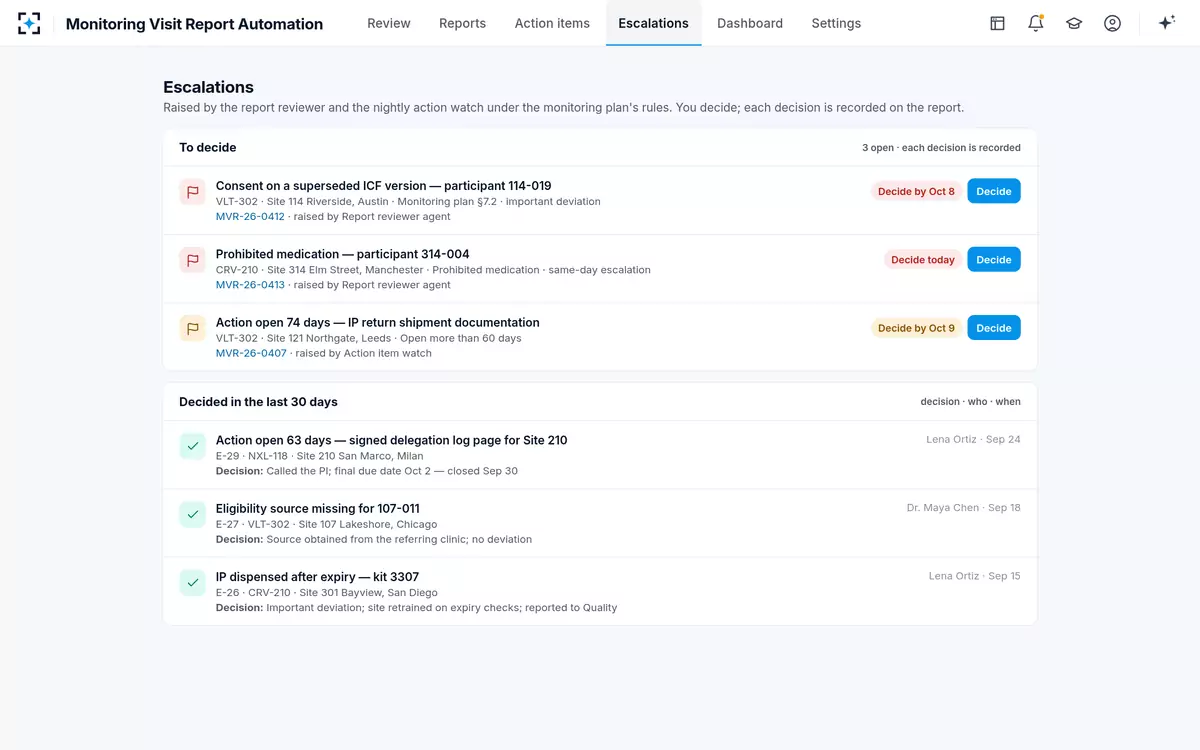
Consent on a superseded version: why this one escalates
Take the sample study's clearest case. Participant 114-019 signed consent form version 3.0 on 9 September. Version 4.0 had been in use at the site since 1 September. Nothing happened to the participant; the file looks ordinary; the monitor's draft recorded it in the consent section as a reminder to the site to use the current version.
That is the wrong route, and the reason is in FDA's own list. Among the deviations it considers important because of their impact on participant protection, the draft guidance names "Failure to obtain informed consent or meet other applicable requirements under FDA regulations for the protection of human subjects under 21 CFR part 50". Consent on a superseded version is a consent problem: the participant agreed on the basis of information the sponsor had already decided was out of date. Under the sample study's monitoring plan it is an important deviation that must reach the clinical lead within two working days, and it generates a re-consent action with a date.
Note what it is not. Nothing cited here makes it a serious breach. Whether the superseded information was material — whether version 4.0 added a safety finding or corrected a typographical error — is the sponsor's assessment, and it is exactly the kind of question the seriousness test exists for. The discipline is to route it for that decision rather than to make the decision in a sentence of the report, and the section of the report where the fact belongs is not the same thing as the route the finding takes.
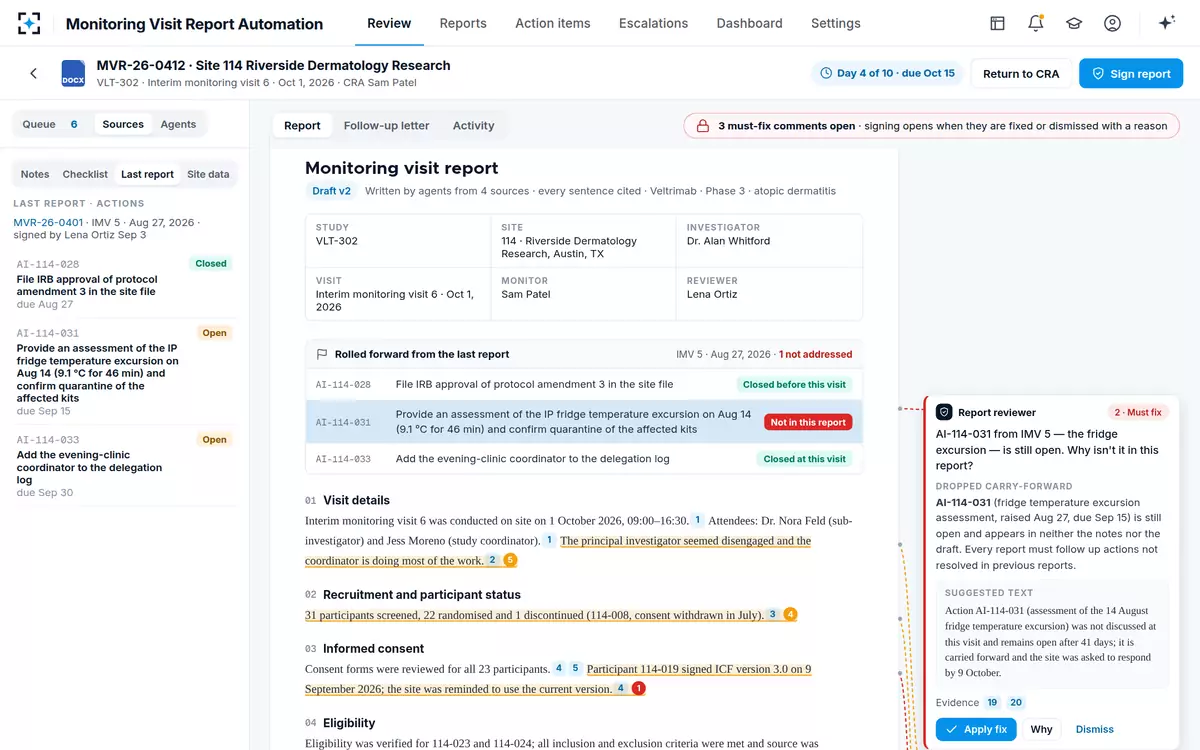
The reviewer's comment: the rule, the evidence and what the report should say
Deviations that are not important, and saying so without hiding them
Most deviations are ordinary, and a classification scheme that cannot say so is useless. FDA's draft guidance gives examples of the other category: a visit a little outside its protocol window, a signed consent form with one page missing the participant's initials, or a study procedure skipped that matters neither for safety monitoring nor for an important efficacy endpoint (FDA draft guidance on protocol deviations, December 2024).. ICH's framing is the same, and the MHRA's is blunter still: most deviations are technical, should be documented so corrective action can be taken, and should be considered when the clinical study report is produced, but not every deviation needs reporting as a serious breach.
Two classes of deviation, with the regulator's own examples
Important protocol deviations: Might significantly affect the completeness, accuracy or reliability of the data, or a participant’s rights, safety or well-being.
All other protocol deviations: Does not meet that test — what teams have variously called minor, noncritical or non-significant.
Important protocol deviations: Failure to obtain informed consent or meet other participant-protection requirements; administering the wrong treatment or dose; failing to withdraw product from participants who meet withdrawal criteria.
All other protocol deviations: A visit slightly outside its protocol window; a signed consent form with one page missing the participant’s initials.
Important protocol deviations: Enrolment in violation of key eligibility criteria; failure to collect data for important endpoints; premature unblinding for reasons the protocol does not specify.
All other protocol deviations: Failure to perform a study procedure not relevant for safety monitoring and not related to an important efficacy endpoint.
Important protocol deviations: Administration of concomitant treatment prohibited by the protocol that may increase risks to participants or affect interpretation.
All other protocol deviations: A medication the protocol permits, taken outside the window the site usually records.
Important protocol deviations: Highlighted to the investigator, routed for decision, and the focus of remediation; root-cause work where the issue is significant.
All other protocol deviations: Logged, described in the report, and counted when the study report is written.
Two findings from the sample study sit on opposite sides of that line, and they are a good pair to argue over in a team meeting. Participant 114-011 took oral prednisone for seven days from 18 September for a flare — rescue therapy under the protocol, which the protocol anticipates and defines. Participant 314-004 took ibuprofen for ten days from 12 September, prohibited under the protocol's concomitant medication section. The first is a protocol-defined event the report has to state correctly; the second is a prohibited concomitant treatment, which is on FDA's own list of important deviations when it may increase risk or affect interpretation. Under the sample monitoring plan both escalate the same day, which is a sponsor setting rather than a rule — but only one of them is likely to be classified as important.
The root-cause work that follows, and what proportionate means
Once a finding is significant, the response is no longer a sentence. ICH E6(R3) says that where noncompliance significantly affects, or has the potential to significantly affect, participants' rights, safety or well-being or the reliability of results, "the sponsor should perform a root cause analysis, implement appropriate corrective and preventive actions and confirm their adequacy unless otherwise justified". The last clause is the one teams skip: confirming adequacy means coming back to check, which is work that lands at a later visit and belongs in a later report.
Proportionality governs everything below that threshold. ICH's instruction is that actions taken in relation to deviations, errors or omissions should be proportionate to their importance — which is permission to do less as well as an obligation to do more. A sponsor that treats every deviation as a corrective-action project exhausts its sites and buries the two findings that mattered. The classification exists precisely so that effort can be allocated.
Six questions that route a finding, in the order worth asking them
- Is a participant affected, now or plausibly?
Safety and integrity come first, and they are the first limb of the serious breach test. If the answer is yes, the finding is on the fastest clock you have.
- Does it touch consent, eligibility, randomisation, dosing or an endpoint?
These are the areas FDA’s examples of important deviations cluster in. A yes here rarely ends in the ordinary category.
- Could it change what the trial is able to show?
The scientific-value limb. Consider the design, how much data is affected, and how much that data contributes to key analyses.
- What do our own written criteria say?
ICH E6(R3) expects the sponsor to set trial-specific criteria for classifying deviations as important. If they exist, apply them; if they do not, that is the finding.
- Is the evidence clear and unequivocal?
This decides sequence, not seriousness: whether you notify first and investigate alongside, or assess briefly and then notify within the same seven days.
- What has to be written down, and where?
The finding, the criterion applied, the decision, the decider, the date, and the change it makes to the visit report. The last of those is the easiest to leave out, and the one that makes two documents disagree.
Writing the escalation so the decision is traceable
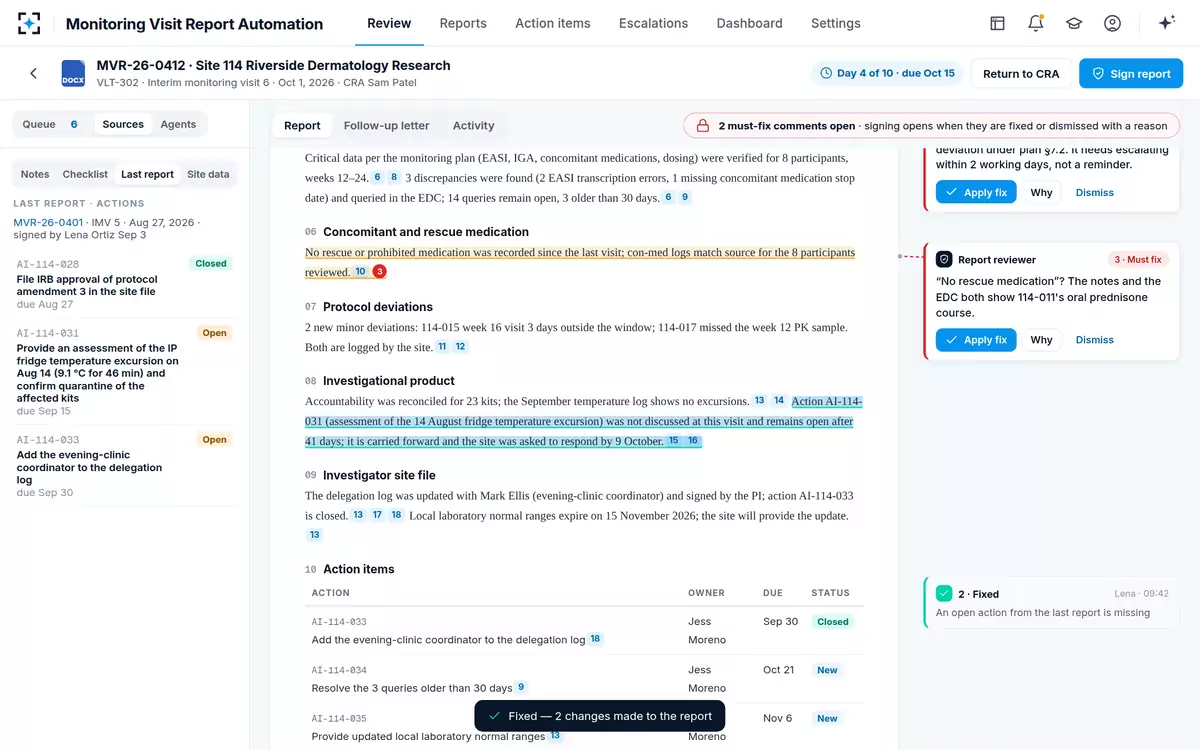
The last step is the least glamorous and the easiest to lose: making the report and the escalation agree. A finding that escalates should leave three marks — the factual sentence in the section where it belongs, the escalation with its rule and decision, and, where the site has to act, a line in the letter it receives. If any of the three is missing, somebody later will find two documents about the same visit that do not tell the same story.
Two habits make this hold up. Write the escalation from the sentence rather than beside it, so the finding and the escalation share their wording and their citation. And record the decision on the report itself, not only in the escalation list, so that a reader of the report two years later does not have to know that a separate list exists. The letter the site receives, as always, gets the action and none of the assessment — what the site may see is a line that should not move because a finding turned out to be serious.
The fix written into the report, with the medication contradiction still marked
One finding, three places it has to appear
| Where | What it says | Who reads it |
|---|---|---|
| The report section | The fact, dated, with its source cited — what was observed, for which participant identifier, on which version or date. | Sponsor staff, and inspectors later. |
| The escalation | The rule applied, the evidence, the decision, the decider and the date — and the change made to the report. | The clinical lead or quality, and the inspection that asks how the sponsor decided. |
| The letter to the site | The action only: what to do, who does it, by when. No classification, no escalation, no assessment. | The investigator and the coordinator who has to act. |
Classifying a visit finding well is mostly a matter of asking the question at the right moment — on the day, with the evidence attached, by the person whose job it is. To see the escalation rules, the decisions and the reports they attach to in one place, start from Monitoring Visit Report Automation, or read how open actions are carried between visits.
Questions people ask
Can an important protocol deviation also be a serious breach?
Yes — the two are different classifications with different consequences, and one finding can be both. An important protocol deviation is one that might significantly affect the completeness, accuracy or reliability of the data, or a participant's rights, safety or well-being — a sponsor classification, highlighted to the investigator and acted on proportionately. A serious breach is a UK statutory test: a breach likely to affect, to a significant degree, participants' safety or integrity or the scientific value of the trial, and it must be notified to the regulator within seven days. Many important deviations are not serious breaches; a serious breach that arises from a deviation will usually meet the important-deviation test as well, because both turn on a significant effect on participants or on the data.
Is consent on a superseded consent form version a serious breach?
Not automatically. FDA's draft guidance lists failure to obtain informed consent or to meet participant-protection requirements among important protocol deviations, so it is at least that. Whether it also meets the serious breach test depends on what changed between the versions and how many participants are affected — a judgement the sponsor must make and document. The safe practice is to route it for that decision on the day rather than to settle it in a sentence of the visit report.
Who decides whether a finding is a serious breach?
The sponsor. The MHRA is explicit that assessing the impact on the trial's scientific value is the sponsor's responsibility and that the assessment should be documented, because its appropriateness may be examined at inspection. Within the sponsor, the monitoring plan should name the role — commonly quality or the clinical lead — and the route should be written down before the visit, not improvised after it.
Do you report a serious breach before you have investigated it?
If the evidence is clear and unequivocal, yes: the MHRA's default position is to notify within seven days and investigate simultaneously or afterwards, without waiting for all the details. Where some assessment is needed to establish that a breach occurred at all, investigate first but expedite it to meet the seven days as closely as possible. Follow-up reports on the same notification form are expected and acceptable.
Does a monitoring visit finding have to be escalated the same day?
That depends on your own monitoring plan, not on a regulation. Sponsors commonly set same-day routing for safety-relevant findings such as prohibited medication, a working day or two for consent and eligibility problems, and a short internal clock for anything suspected of being a serious breach. Those are settings. The statutory seven-day clock for a UK serious breach runs separately, from the moment the sponsor becomes aware.
What are examples of important protocol deviations?
FDA's draft guidance gives two groups. On participant protection: failure to obtain informed consent or meet participant-protection requirements, failure to protect identifiable health information, failure to withdraw product from participants meeting withdrawal criteria, administering the wrong treatment or dose, and failing to follow the randomisation scheme. On reliability: enrolment in violation of key eligibility criteria, failure to collect data for important endpoints, and premature unblinding for reasons the protocol does not specify.