A monitoring visit follow-up letter is the document the sponsor sends the investigator after a monitoring visit: thanks, a short note of what was reviewed, the open actions with owners and due dates, what has been closed since the last visit, and when the monitor is coming back. Search for a monitoring visit follow-up letter template and you will mostly find the monitoring report with the internal columns deleted, which is the one thing it must not be. The two documents have different readers and different rules. Monitoring Visit Report Automation is Botminds' software for both halves — it writes the report, checks it, and then builds the letter from the signed report, with the site-facing actions and nothing else.
The letter on this page is sample study data inside the solution, and every name in it is fictional: Northwind Bio, study VLT-302, Dr. Alan Whitford at Riverside Dermatology Research, the coordinator Jess Moreno, the sub-investigator Dr. Nora Feld. The rules quoted come from ICH E6(R3), FDA guidance and US regulation.
What a monitoring visit follow-up letter is, and who it is for
Its reader is the principal investigator, and in practice the coordinator who does most of the work. That single fact decides everything else about it. The investigator does not need the sponsor's opinion of their site; they need an unambiguous list of what to do, who is doing it and by when, in a document they can forward to their own staff and file.
The report has the opposite reader. It goes to sponsor staff responsible for the conduct and oversight of the trial, and to inspectors years later, and it exists to record the sponsor's assessment: what was reviewed, what was found, what it means, what has been escalated. A sentence that belongs in one of these documents usually belongs nowhere in the other.
The same visit, two documents: what belongs in each
The monitoring visit report: Sponsor staff responsible for conduct and oversight; inspectors.
The follow-up letter: The principal investigator and the site staff who have to act.
The monitoring visit report: In detail: how many participants, which visit weeks, which fields, against what source.
The follow-up letter: In a line: the areas covered, so the site knows what the visit touched.
The monitoring visit report: Each one described, classified against the monitoring plan, with the sponsor’s conclusion.
The follow-up letter: Only the ones the site has to act on, written as actions rather than as judgements.
The monitoring visit report: Every action, including those owned by the sponsor and those carried from previous visits.
The follow-up letter: The site’s open actions, each with a named owner and a due date — and the ones it has closed.
The monitoring visit report: Named, with the rule, the decision, who made it and when.
The follow-up letter: Absent. The site learns what it must do, not what the sponsor has reported internally.
The monitoring visit report: Visible in the sponsor’s wider view: patterns across sites inform what is significant.
The follow-up letter: Never. No other site’s data, participants or findings appear in a letter.
The monitoring visit report: Factual and neutral; observations, never opinions about an individual.
The follow-up letter: Factual and neutral, and addressed to the person who can fix it.
The report and the letter, line by line: what belongs in each
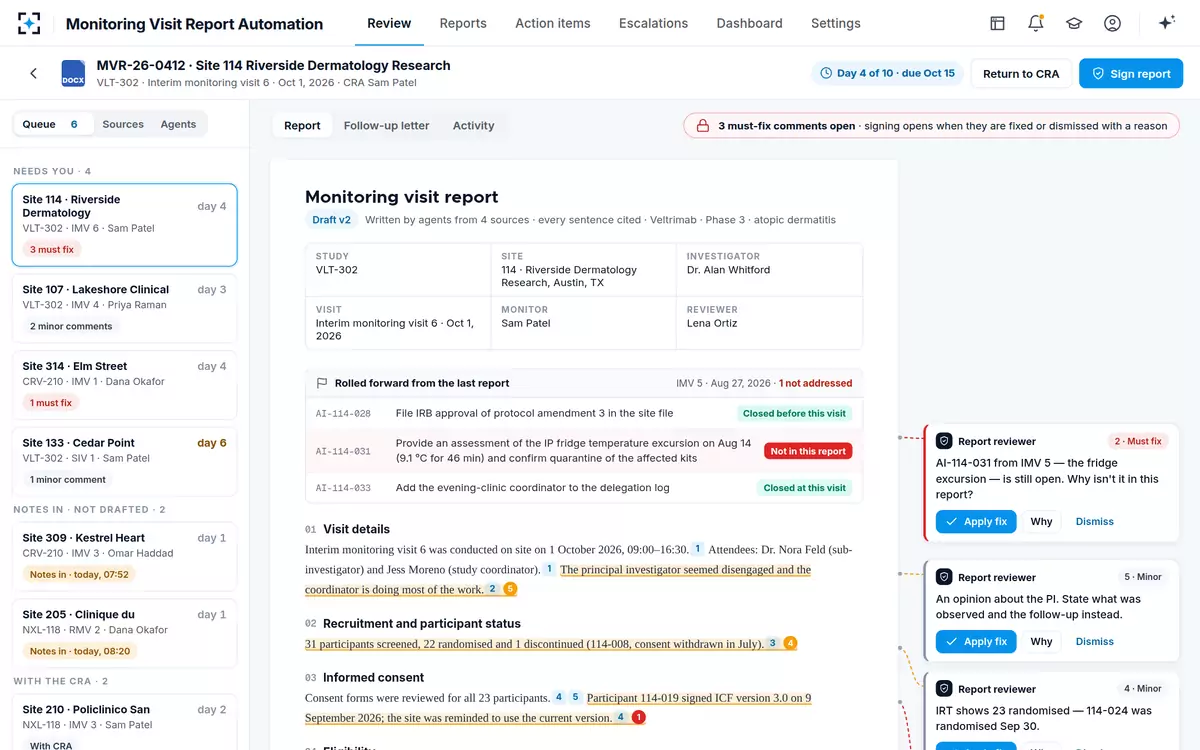
A worked example makes the line concrete. At the sample visit the monitor found that a participant had signed version 3.0 of the consent form on 9 September, when version 4.0 had been in use at the site since 1 September. Three sentences come out of that one fact, and they go to three different places.
The report records the observation and the sponsor's assessment: the participant consented on a superseded version, this is an important deviation under the monitoring plan, and it has been escalated for decision. The escalation itself carries the rule, the decision, the decider and the date. The letter says something much shorter: re-consent the participant on the current version and file a note to file holding both versions, owner the principal investigator, due 14 October. The site does not need to be told how the sponsor has classified the event internally in order to do the re-consent, and telling them creates a document that says, in writing, what the sponsor concluded before it had finished deciding.
Where the letter's material starts: the report, with its citations and its margin
The four blocks of a follow-up letter, and what each is for
The thanks
Who was met, and what was reviewed
Named hosts, and a one-line list of the areas covered: consent, eligibility, source data, concomitant medications, product and the site file. It tells the site what the visit touched, which is also what it did not.
The asks
Every open action, with an owner and a date
One line per action, identified, owned by a named person, with the date it is due. Nothing here should be new to the site; everything should have been said in the room.
The credit
What has been closed since the last visit
The actions the site completed. Omitting them makes every letter read like a complaint and quietly removes the evidence that the site responds.
The next step
The date of the next visit
A planned date turns the action list into a schedule. It also sets the deadline the site is really working to.
What should never go in a letter to the site?
Five things, and each of them leaks for an understandable reason. They are worth writing into the procedure as an explicit list, because the person drafting the letter under time pressure is usually working from the report with the delete key.
Five things that must not cross from the report into the letter
- The sponsor’s internal classification of a finding
Whether something is an important deviation, or a suspected serious breach, is an assessment the sponsor owes its own procedures and its regulator. Writing it to the site turns an open question into a stated conclusion in a document you do not control.
- Escalations, and who is deciding them
The site is told what to do. Who inside the sponsor is weighing it, under which rule, and by when, is the sponsor’s internal process.
- Anything about another site
Comparative remarks — "most of our sites manage this" — carry other sites’ performance into a document a third party keeps. The same goes for any participant who is not theirs.
- Opinions about named individuals
"The investigator seemed disengaged" is unverifiable, unactionable and durable. What was observed can be written; what was inferred about a person cannot.
- Findings the site has not been told about
A letter is a confirmation of a conversation, not its opening. A finding that appears for the first time in writing has skipped the step where the site could have explained it.
There is a sixth, quieter failure: sending a letter that contains only complaints. A letter that never names what the site has completed since the last visit reads as adversarial, and it also loses the evidence — in a document the site keeps — that findings do get resolved. The sample letter names the action closed since the last visit for exactly that reason.
What the rules say the sponsor must tell the investigator
Less than people expect about the letter's form, and more than people expect about the obligation behind it. FDA's 2023 guidance states the duty directly.
"In addition, sponsors should inform the clinical investigator of monitoring findings from monitoring activities that are relevant to the clinical investigator's activities."
FDA, A Risk-Based Approach to Monitoring of Clinical Investigations: Questions and Answers, April 2023, Q8
Two qualifiers are doing work. Inform, not "send the report" — the duty is about the findings reaching the investigator, not about which document carries them. And relevant to the clinical investigator's activities, which is the test that keeps the sponsor's internal material out: a finding about the sponsor's own vendor, or a pattern across four sites, is not relevant to this investigator's activities and has no business in their letter.
ICH E6(R3) puts the same duty in terms of deviations, and adds an emphasis rule. Monitoring activities include "Informing the investigator or other parties and individuals involved in the trial conduct of relevant deviations from the protocol, GCP and the applicable regulatory requirements and, if necessary, taking appropriate action designed to prevent recurrence of the detected deviations. Important deviations should be highlighted and should be the focus of remediation efforts as appropriate." Highlighted is a drafting instruction. A letter in which the one important deviation sits fourth in a list of five identically formatted lines has not highlighted anything.
FDA's guidance also makes clear that communicating a significant issue is not a single act aimed at one audience. Significant issues and the actions to be taken "should be documented and communicated to the appropriate parties, which may include, but are not limited to (1) sponsor management; (2) sponsor teams; (3) clinical sites; (4) institutional review boards; (5) other relevant parties … and (6) applicable regulatory agencies, including FDA, when appropriate." The letter is the clinical-site branch of that list, and it is not a substitute for any of the others.
Finally, the letter is also the first step of an escalation ladder that ends somewhere serious. Under 21 CFR 312.56(b), a sponsor that discovers an investigator is not complying with the signed agreement, the general investigational plan or the regulations must act promptly: either bring the investigator back into compliance, or stop shipping the investigational drug and end the investigator's participation. Securing compliance usually begins as a line in a follow-up letter, which is a good reason to make that line precise.
The action list the site can actually work from: owner, date, evidence
The useful part of the letter is a table a coordinator can work through on a Monday morning. Three properties make it workable: every action has a person's name on it rather than a role or an institution; every action has a date; and every action implies a piece of evidence that will close it. The sample letter's five actions are below as the letter itself presents them.
The five open actions in the sample follow-up letter
| Action | What it asks for | Owner | Due |
|---|---|---|---|
| AI-114-036 | Hold the principal investigator oversight call and file the note in the site file. | Dr. Alan Whitford | 8 October |
| AI-114-031 | Provide an assessment of the 14 August fridge temperature excursion (9.1 °C, 46 minutes) and confirm quarantine of the affected kits. | Jess Moreno | 9 October |
| AI-114-037 | Re-consent participant 114-019 on consent form version 4.0 and file a note to file holding both versions. | Dr. Alan Whitford | 14 October |
| AI-114-034 | Resolve the three data queries older than 30 days. | Jess Moreno | 21 October |
| AI-114-035 | Provide updated local laboratory normal ranges. | Jess Moreno | 6 November |
Notice what the dates are doing. They are not a single deadline applied to everything; they run from one day to thirty, because the work differs. An oversight call can happen tomorrow. Updated laboratory ranges depend on a hospital laboratory that answers at its own speed. A letter that gives every action the same fortnight teaches the site that the dates are decorative.
What the letter asks for, and how long the site has
The letter Monitoring Visit Report Automation builds from the signed report
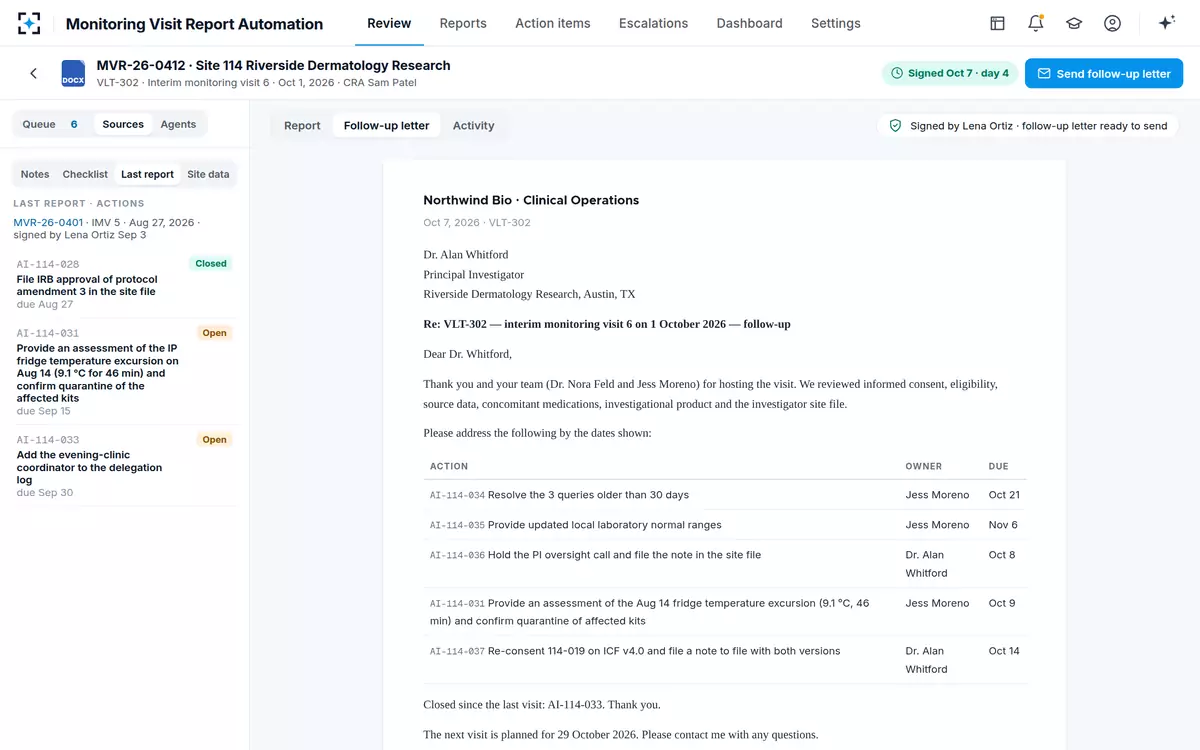
Why the letter is written after the report is signed, not before
Because until the report is signed, the sponsor has not decided what it thinks. A letter drafted alongside the report can ask the site for the wrong thing: to re-consent a participant whose finding is about to be reclassified, to fix a discrepancy that turns out to be an error in the sponsor's own data, or to act on a finding the manager will remove. Every one of those creates work at the site and an awkward second letter.
Writing the letter from the signed report has a second benefit that matters more in an inspection. Every action in the letter is traceable to a sentence in a document the sponsor has formally accepted. Asked where an instruction to a site came from, the answer is a numbered finding in a signed report, not a monitor's recollection. That is also why the letter should never introduce an action that is not in the report: the two have to agree, and the report is the one with the evidence behind it.
The sequence has one cost worth naming: the site waits. Every day of review is a day the actions are not being worked. That is an argument for a short, reliable review clock, not for writing the letter early — and it is why the review queue is worth measuring at all; where the review queue silts up follows the same clock from the other end.
Signature first: the letter unlocks when the report is approved
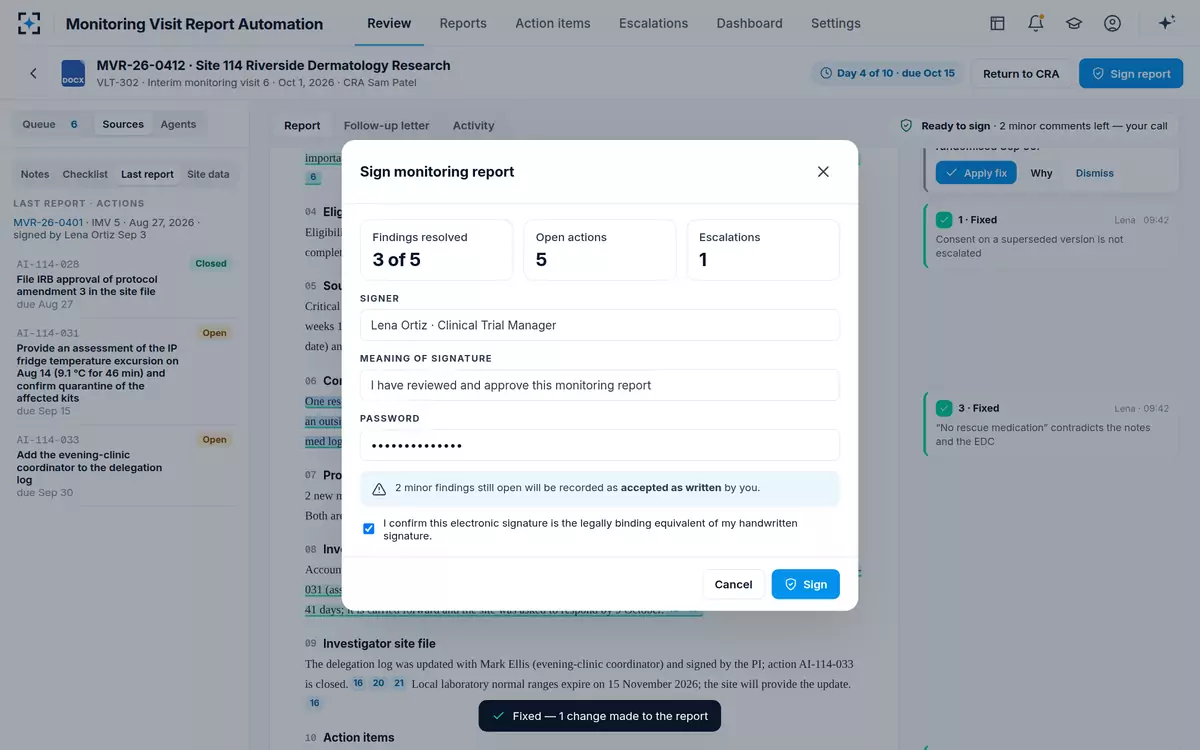
How soon after the visit? The clock, and who sets it
No rule cited on this page sets a deadline for a follow-up letter. Sponsors set their own, and the figure usually sits somewhere between a few days and a few weeks after the visit, or a short interval after signature. In the sample study it is two working days after signature, which is a setting that can be stepped up or down; with a five-day drafting clock and a five-day review clock in front of it, a site visited on the first of the month hears formally in the middle of it.
Two design choices make that interval defensible. Anchor the letter clock to the signature rather than to the visit, so that the letter cannot be the thing that forces a premature report. And keep the urgent material off the letter clock entirely: an important deviation that the monitoring plan says must reach the clinical lead within two working days, or a prohibited medication that escalates the same day, travels by escalation, not by letter. The letter is for the site's work list, and it should never be the first time anybody learns of something urgent — the three routes a visit finding can take, and the clock on each sets out which is which.
Confirmation letter, follow-up letter, and the site's own file
Two other letters surround a monitoring visit and are often confused with this one. A confirmation letter goes out before the visit: the date, the agenda, who the monitor needs to meet, which participants' records will be reviewed, what the site should have ready. Its purpose is to make the visit efficient, and a site that receives one can prepare rather than improvise.
The follow-up letter goes out after, and is the one with obligations attached. Both belong in the investigator site file, because both are correspondence about the conduct of the trial at that site; the sponsor keeps its own copies alongside the report. The report itself is filed by the sponsor in the trial master file — in the sample study, to the site management area, with participant identifiers only — and the site does not normally receive a copy.
Three letters around one visit, and where each one is filed
| Document | When | Who writes it | Where it is filed |
|---|---|---|---|
| Confirmation letter | Before the visit | The monitor | Investigator site file, and the sponsor’s own file |
| Follow-up letter | After the report is signed | The monitor or the sponsor’s system, from the signed report | Investigator site file, and the sponsor’s own file |
| Monitoring visit report | After the visit, signed by the sponsor | The monitor, reviewed and signed by a sponsor manager | Trial master file only — an internal sponsor record |
What an inspector checks about your letters
Mostly timing and consistency, and both are checkable without reading a word of content. FDA's sponsor inspection programme tells investigators to determine whether the monitoring plans and procedures were followed, including whether "monitoring letters/communications given to the sites by the required timeline" — the letter sits in the same sentence as the visits and the reports, and against the same standard: your own timeline.
The consistency check is simpler still. Take a signed report and its letter and read them side by side. Does every action in the letter appear in the report? Does every site-facing action in the report appear in the letter? Does anything in the letter state a conclusion the report does not support? A pair that fails any of those three is the kind of finding that is hard to explain, because both documents were produced by the same team about the same day.
The last thing worth checking is the one nobody schedules: whether anybody looked at what the site did next. A letter is a request, and a request without follow-up is how an action reaches sixty days unnoticed. The letter's actions and the report's action table should be the same list, aged together, so that the next interim report opens with what this letter asked for. To see the report, the signature and the letter in one sequence, start from Monitoring Visit Report Automation.
Questions people ask
Is the follow-up letter the same as the monitoring report?
No. The report is an internal sponsor record of what was reviewed, what was found and what the sponsor concluded, written for sponsor staff and inspectors. The letter is a short document for the investigator listing what the site has to do, with owners and dates. The letter is written from the signed report, but it is not the report with columns removed: internal assessments, escalations and anything about other sites stay out of it.
Does the site get a copy of the monitoring visit report?
Normally not. The report is the sponsor's record and is filed in the trial master file. What the site receives is the follow-up letter, which it files in the investigator site file. A sponsor that does share reports usually shares a site-facing version, and then has to maintain two documents that must never disagree — the problem a separate letter avoids.
How soon after a monitoring visit must the follow-up letter be sent?
No rule cited here sets a deadline. The sponsor sets the interval in its own procedures and is inspected against it — FDA's sponsor inspection programme checks whether letters reached sites by the required timeline, meaning the sponsor's own. Anchoring the clock to the report's signature rather than to the visit keeps the letter from forcing a premature report.
Who signs the follow-up letter to the investigator?
Usually the monitor who did the visit, because the letter is the written form of the conversation they had at the site. What matters more than the signature is that the letter is produced from a report that a sponsor manager has already reviewed and signed, so that the actions it asks for are ones the sponsor has formally accepted.
What is a monitoring visit confirmation letter?
The letter sent before a visit: the date and times, the agenda, who the monitor needs to meet, which records will be reviewed and what the site should have ready. It is a different document from the follow-up letter, and it carries no obligations — but it is the reason a visit can cover what it planned to cover, and it belongs in the investigator site file alongside the follow-up letter.
Does the follow-up letter go in the site file and the trial master file?
Yes to both, in the ordinary arrangement: the site keeps it in the investigator site file as correspondence about the conduct of the trial, and the sponsor keeps its copy alongside the signed report. The report, by contrast, is a sponsor record only. Keeping participant identifiers rather than names in both documents is the usual rule, and it matters most in the one that leaves the sponsor's hands.