AI in clinical trial monitoring is not prohibited and not approved: neither FDA nor EMA has published a rule permitting or forbidding software that drafts a monitoring visit report, and both FDA and EMA frame the question the same way — the sponsor remains responsible for anything it uses, and the level of scrutiny follows how much the model's output influences a decision and how bad a wrong decision would be. Writing the report is where this bites first, because a monitoring visit report is an internal working document that can nonetheless carry a safety escalation. Botminds' Monitoring Visit Report Automation is built to sit at the low-influence end of that question deliberately: six agents draft and check, every sentence cites the source it came from, and no decision — an escalation, a dismissal, a signature — is ever made by software.
Two of the three documents quoted here are not binding. FDA's is a draft guidance carrying the agency's standard nonbinding-recommendations notice; EMA's is a reflection paper, not a guideline. ICH E6(R3) is the adopted one, and it is the one that already applies. Screens are the solution's own sample study data, on fictional studies and people.
Does the FDA allow AI in clinical trial monitoring?
There is no FDA rule that says yes or no. What exists is a draft guidance of January 2025, Considerations for the Use of Artificial Intelligence to Support Regulatory Decision-Making for Drug and Biological Products, and the first thing to read in it is its scope. It covers AI models whose specific use is to produce information or data that supports a regulatory decision about a drug's safety, effectiveness or quality. It then sets two uses aside: AI in drug discovery, and AI used for operational efficiencies — the guidance's examples are internal workflows, resource allocation and drafting or writing a regulatory submission — provided they do not affect patient safety, drug quality or the reliability of a nonclinical or clinical study's results (FDA draft guidance, January 2025, section II). That proviso is the sentence that decides whether a drafting tool is inside or outside.
Read it carefully and it is a conditional, not an exemption. Drafting is named as an operational efficiency — but only where it does not impact patient safety or the reliability of a clinical study's results. A monitoring visit report is an internal document, which argues for outside; monitoring is one of the principal quality control activities protecting participants and data, and a report that fails to carry an escalation can delay a safety action, which argues for inside. FDA's own answer to that ambiguity is procedural: it encourages sponsors to engage with the agency early if they are uncertain whether their use is in scope.
The practical conclusion is not "the guidance does not apply, so nothing applies". It is that a sponsor should be able to say which side of that sentence its use falls on, and why — in writing, before the first report is drafted. The frameworks below are what the reasoning is made of.
What does the EMA say about AI in clinical trial monitoring?
EMA's reflection paper, adopted on 9 September 2024, reaches the same place from the other direction. For clinical trials it says the use of AI and machine learning should meet the applicable requirements of ICH E6 — that is, nothing new is being created, the existing GCP obligations apply — and then attaches a condition that is easy to quote badly:
Its condition, paraphrased closely: where a use in a clinical trial could carry high regulatory impact or high patient risk, and EMA has not already qualified the method for that specific context of use, the full model architecture, the logs from model development, validation and testing, the training data and a description of the data processing pipeline would likely be treated as part of the clinical trial data or the protocol dossier — and could therefore be requested when a marketing authorisation or clinical trial application is assessed, or at a GCP inspection (EMA reflection paper, section 2.3.3.1).
The condition is the whole sentence. A sponsor whose use is of high regulatory impact or high patient risk should expect to produce the model's architecture, its development and validation logs, its training data and its pipeline. A sponsor whose use is neither should still expect the ordinary computerised-system obligations, and should be able to show why it placed itself in that category. The paper is explicit that the degree of risk depends not only on the technology and the data but also on the context of use and the degree of influence the system exerts — the same two dimensions FDA names.
Model influence and decision consequence, applied to a visit report
FDA's framework turns on one definition. Model risk, in step 3 of the draft guidance, combines two factors: model influence, meaning how much of the evidence on the question of interest comes from the AI model rather than from other sources, and decision consequence, meaning how significant an adverse outcome would be if the decision on that question were wrong (FDA draft guidance, January 2025, step 3).
"Given that the decision consequence is deemed high and the model influence is deemed low with the stated mitigations, the model risk for this COU is medium."
FDA draft guidance, January 2025, step 3: the fill-volume example
That is the guidance's own worked example. For a vision system checking vial fill volumes, the decision consequence is high because volume is a critical quality attribute — but because the manufacturer also measures fill volume on a representative sample at release, the model's influence is low, and the resulting model risk is medium rather than high. Influence is reduced by other evidence that remains in play.
That is precisely the lever a well-built drafting tool pulls. Apply the framework's first three steps to a monitoring visit report and the placement is legible.
A drafted monitoring visit report, placed on the FDA framework's first three steps
| The framework’s step | For a drafted monitoring visit report | What makes it so |
|---|---|---|
| Question of interest | What happened at this site at this visit, and what has to be done about it. | The question a monitoring visit report answers for the sponsor, and the one an inspector later tests. |
| Context of use: the model’s role | Read the visit notes, the checklist, the previous report and the study data; assemble a draft in the sponsor’s template with a citation on every sentence; compare the draft against the monitoring plan and the study systems and raise findings. | Reading, drafting and comparing. Not deciding. |
| Context of use: the model’s scope | The draft and the findings go to a named CRA, who confirms them, and a clinical trial manager, who fixes, dismisses, decides escalations and signs. | The output is an input to a person, never the end of the chain. |
| Model influence | Low, provided the citations are checkable and the underlying sources stay the evidence. | The notes, the checklist, the previous report and the study systems are unchanged by the tool and remain available to the reader, as the release testing did in FDA’s own example. |
| Decision consequence | Can be high. A missed escalation delays a safety action; a wrong closure hides an unresolved issue. | Judged on the question of interest, independently of how the modelling is done. |
| Resulting model risk | Medium at most, by the guidance’s own worked logic — and only while the person actually reads. | High consequence with low influence is the guidance’s medium case. Influence rises the moment a reader stops checking citations. |
ICH E6(R3) asks for a third dimension that this framing leaves implicit. When evaluating a risk, the sponsor is told to consider the likelihood of a harm occurring, the extent to which it would be detectable, and its impact on participant protection and the reliability of results. Detectability is the one a drafting tool can genuinely change: a sentence that carries the paragraph of the notes or the row of study data it came from is a sentence whose error a reader can find, and a sentence without one is not.
Where the responsibility sits, and why that sentence matters most
Everything above is reasoning a sponsor does for itself, because the responsibility cannot be moved. EMA calls it a key principle: the clinical trial sponsor — like a marketing authorisation applicant or holder, or a manufacturer — is the one who must make sure that every algorithm, model, dataset and data processing pipeline it uses is fit for purpose and meets the legal, ethical, technical, scientific and regulatory standards of EU law, GxP and EMA guidance (EMA reflection paper, EMA/CHMP/CVMP/83833/2023). That sentence belongs in every evaluation file.
There is no vendor defence in that sentence, and no "the tool was validated" defence either. ICH E6(R3) says the same thing about outsourcing in general: the selection and oversight of service providers is a fundamental feature of the sponsor's oversight. Whatever a supplier says about its system, the sponsor is the one who has to be satisfied it is fit for the purpose it is being put to, and the one an inspector will ask.
EMA adds a practical note that cuts against a common assumption: in some respects these requirements may go beyond what data scientists treat as ordinary good practice. A model evaluation that would satisfy an engineering team is not automatically the evaluation a GxP environment expects.
What ICH E6(R3) already requires of any system you use
The obligations that apply today do not mention AI, and they do not need to. A drafting tool is a computerised system used in a clinical trial, and E6(R3) tells the sponsor to keep a record of the important computerised systems used in a trial, describing each one's use, functionality, interfaces and validation status and naming who is responsible for managing it (ICH E6(R3), section 3.16.1(x)(i)), adding that the record should also describe the access controls and the security measures in place.
The clauses around it fill in the rest: requirements for validation, audit trails, user management, backup, disaster recovery and IT security, proportionate to the importance of the system and the data it processes; a record of the individual users authorised to access it, with their roles and permissions; and a process for service providers to tell the sponsor about defects they find. The guideline's data governance section then covers procedures, training, security, validation, release, failure and technical support for computerised systems generally.
Read as a checklist, that is most of what a sponsor needs to produce about any drafting tool. The AI-specific documents add a risk judgement on top of it; they do not replace it.
What must a human do before an AI-drafted report is signed?
Four things, and none of them can be delegated to the system that produced the draft.
Confirm the facts are the visit's facts. The CRA who was in the room is the only person who knows whether a drafted sentence describes what happened. In the solution the CRA confirms the draft before it reaches the manager, and the notes reader is built never to infer a fact that is not in the notes, keeping the CRA's own numbers exactly.
Resolve every finding, or dismiss it with a reason. A reviewer's comment is a proposal. The manager applies it, rewrites it or rejects it, and a dismissal is recorded with its reason. Comments marked must-fix hold the signature until they are resolved; minor comments left open are recorded as accepted as written by the person who signed.
Decide each escalation. Whether a deviation is important in this trial, with this population and this protocol, is a judgement the sponsor's own criteria govern. ICH E6(R3) is explicit that the sponsor decides the appropriate action and that the decision and the resolution are recorded.
Sign, meaning something. A signature is a person stating that they have reviewed and approve the report. It is not a workflow step, and no model output can produce one.
The decisions the solution hands to a person, each one recorded with its reason
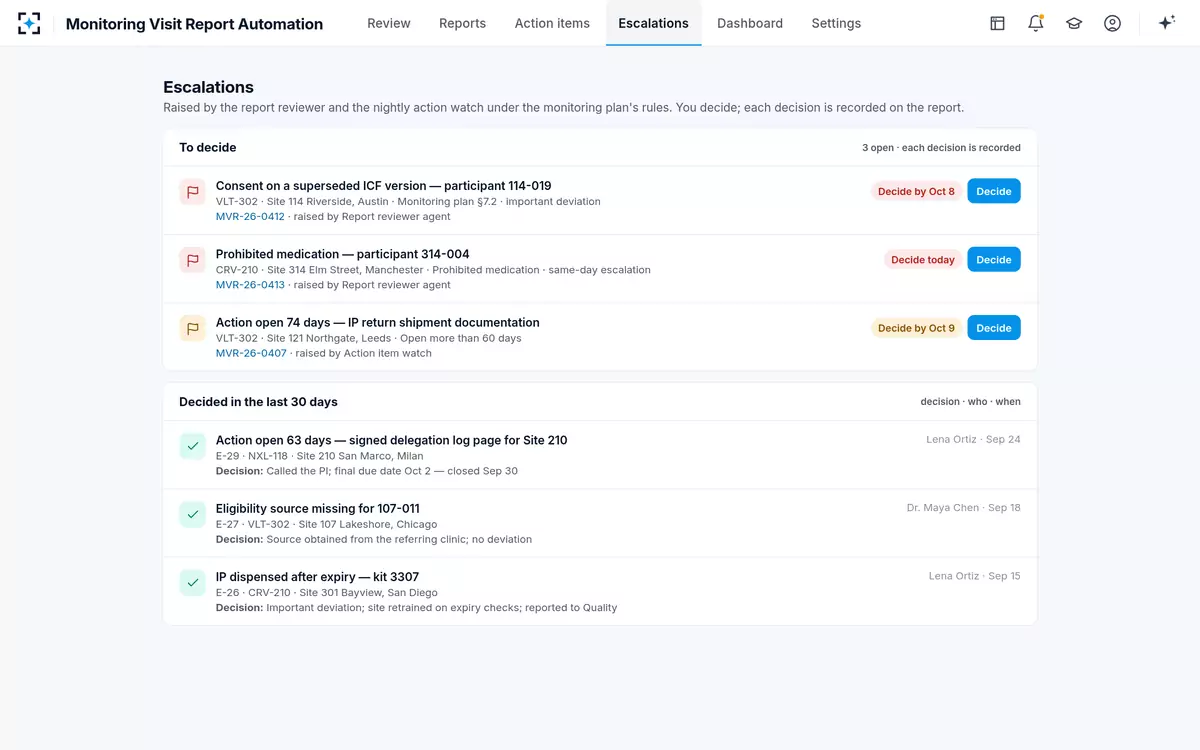
What software may draft, and what a named person must decide
The agents may: Turn dictation or typed notes into facts with their paragraph references, keeping the CRA’s numbers exactly.
A named person must: Confirm that the facts are what the visit found.
The agents may: Find every open action from the last report and every checklist answer that needs a statement.
A named person must: Decide what an unresolved action now requires, and from whom.
The agents may: Compare the draft with the trial management, data capture and randomisation systems and raise each disagreement.
A named person must: Decide which side of a disagreement is right, and say so in the report.
The agents may: Flag that a monitoring plan rule appears to be engaged, with the rule and the evidence.
A named person must: Decide whether it is engaged, and act inside the clock the plan sets.
The agents may: Flag a sentence that states an opinion about a person and propose a factual replacement.
A named person must: Choose the wording that goes into a document a regulator may read.
The agents may: Nothing. Signing is not in any agent’s scope.
A named person must: Sign with a password under a stated meaning, with the open minor comments recorded as accepted.
What you have to be able to produce at a GCP inspection
Inspection readiness for a drafting tool is mostly paperwork that already has a home. The list below maps each item to the clause that asks for it.
The records a sponsor needs about the system that drafted its reports
- The system in your record of important computerised systems
Its use, functionality, interfaces and validation status, and who is responsible for managing it — ICH E6(R3) section 3.16.1(x)(i), which also asks for the access controls and security measures.
- Validation proportionate to what it touches
E6(R3) asks that requirements for validation, audit trails, user management, backup, disaster recovery and IT security be addressed proportionately to the importance of the system and the data it processes.
- Who may use it, and as what
A record of the authorised users, their roles and their permissions, with site staff permissions in line with the investigator’s delegations.
- Your own procedure on what it may and may not do
The sponsor decides the role; write it down before you start. ICH E6(R3) requires the content and frequency of monitoring reports to be described in the sponsor’s procedures, which is where the drafting step belongs.
- The trail for each report
Who confirmed, which findings were raised, which were applied, which were dismissed and on what reason, who signed and under what meaning, with dates.
- A defect route
A process for the service provider to inform you of system defects, and your handling of the ones that touch reports already signed.
- Where the use could be high impact or high patient risk, the model file
EMA’s reflection paper says the architecture, development, validation and testing logs, training data and pipeline description would likely form part of the trial data and may be requested at a GCP inspection — a conditional, and one worth deciding in advance rather than during an inspection.
Human-in-the-loop, and the plan you need when there is not one
EMA's reflection paper asks for something most teams do not think of until an auditor asks: for every model, and above all for one with no human in the loop, a system risk management plan that sets out the likely ways the algorithm can fail (EMA reflection paper, section 2.5.6).. It goes on to ask that such a plan cover the consequences of incorrect predictions, the monitoring and correction approaches, and how a model would be suspended or decommissioned.
For a report-drafting tool the failure modes are concrete and worth naming in advance: a sentence whose citation does not support it; an open action marked closed without evidence; a check that silently stops running after a change; a template that has moved on while the drafting still follows the old one; and a reader who has learned to trust the draft and stopped opening citations, which is the failure mode that raises model influence without changing a line of code.
Each has a control. In the solution the carry-forward tracker cannot close an action without evidence; must-fix findings hold the signature; the reviewer's checks are settings a sponsor owns and can see; and every step is on an activity trail that cannot be altered. The control for the last failure mode is not in the software at all: it is a periodic sample of signed reports read back against their citations, by someone who did not write or sign them.
The design limits that keep a drafted report at low influence
6
agents that read, draft and compare — none of which signs
4
sources every sentence is written from: notes, checklist, last report, study data
1
citation on every sentence, openable beside the report
0
signatures, escalation decisions or dismissals made by software
What to write in your own procedures before you start
Because neither agency prescribes a form, the sponsor's own procedure is the document an inspector will read first and hold you to. Six sentences do most of the work, and they are easier to write before a pilot than after one.
Name the system and its role: what it reads, what it drafts, what it compares. State what it may never do — close an action, decide an escalation, apply a fix by itself, sign, or send anything to a site. Name who confirms and who signs, and the meaning each signature carries. Say what happens when a check is switched off, and who may switch it. Say how long the comments, dismissals and reasons are kept, and where. And record your scope judgement: whether you consider this use to touch patient safety or the reliability of results, with the reasoning, so that the answer exists before anyone asks for it.
A signature with a stated meaning, and the minor comments it carries
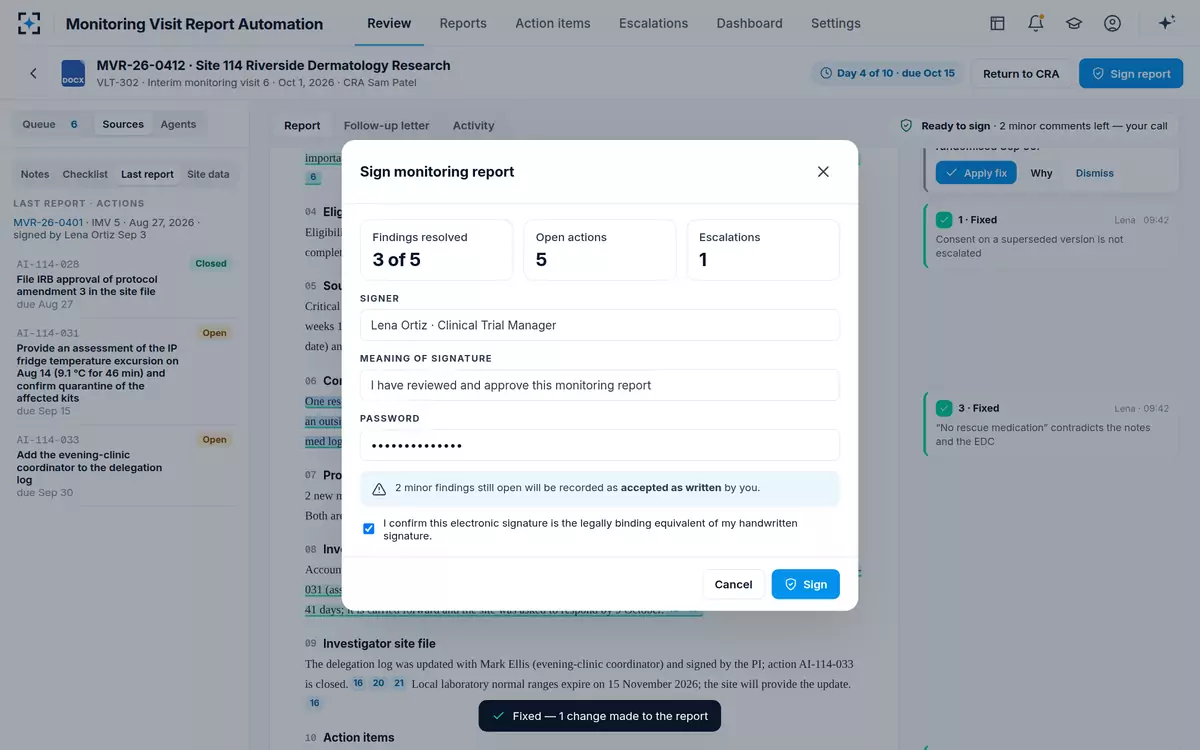
A drafting tool evaluated this way is an ordinary computerised system with an unusually good audit trail, and that is the point: the question a sponsor has to answer is not whether AI is allowed in clinical trial monitoring, but whether this use, in this trial, leaves a person deciding and a record behind. The same reasoning applies to the tooling choice itself — twelve questions to ask about monitoring software for visit reports turns it into something you can put to a supplier, and who reviews a monitoring visit report shows where the person sits in the chain today.
Questions people ask
Can AI write a monitoring visit report?
Nothing in FDA's or EMA's published material prohibits it, and nothing approves it. Both frameworks ask the same two questions — how much the output influences the decision, and how bad a wrong decision would be — and both leave the responsibility with the sponsor. A draft that a named person checks against cited sources, corrects and signs is the low-influence case; a draft that is signed unread is not, whatever the software does.
Does the FDA allow AI in clinical trial monitoring?
FDA has no rule on it. Its January 2025 draft guidance covers AI used to produce information or data supporting regulatory decision-making, and expressly does not address AI used for operational efficiencies such as internal workflows and drafting that do not impact patient safety, drug quality, or the reliability of results from a study. Whether report drafting clears that condition is a judgement the sponsor should make and document; FDA encourages early engagement where a sponsor is uncertain.
Who is responsible when AI drafts a trial document?
The sponsor. EMA treats it as a key principle that the sponsor — or the applicant, holder or manufacturer — must make sure every algorithm, model, dataset and data pipeline it relies on is fit for purpose and meets the legal, ethical, technical, scientific and regulatory standards that apply. ICH E6(R3) says the same about the oversight of service providers generally.
What is model risk in the FDA AI guidance?
The combination of model influence — how much of the evidence for the question comes from the model rather than from elsewhere — and decision consequence, the significance of an adverse outcome from a wrong decision. The guidance's own example shows a high-consequence use coming out as medium risk because independent testing kept the model's influence low.
Does ICH E6(R3) cover AI drafting tools?
Not by name, and it does not need to. A drafting tool is a computerised system used in a clinical trial, so it belongs in the sponsor's record of important computerised systems with its use, functionality, interfaces, validation status and owner, with proportionate validation, audit trails and user management, and a route for the provider to report defects.
What records do you need to keep about an AI tool used in a trial?
The system record and its validation status, the authorised users and their permissions, your own procedure stating what the tool may and may not do, and a per-report trail of who confirmed, what was raised, what was applied, what was dismissed with what reason and who signed. Where the use could be of high regulatory impact or high patient risk, EMA's reflection paper indicates the model architecture, development and validation logs, training data and pipeline description may also be requested.