A co-monitoring visit report is the write-up of a visit where a monitor's supervisor, or another evaluator the sponsor or CRO has designated, goes to the site with the monitor and records what they saw of the monitoring itself. It exists because the person who writes a monitoring visit report cannot reliably check it: the errors that get found at inspection are omissions and contradictions, and both are invisible from inside the document that contains them. Botminds' Monitoring Visit Report Automation takes the same principle into the part of the work a co-monitoring visit rarely reaches — the report written days later, off site — by running a reviewer over every draft, with a named person fixing, dismissing and signing.
The rules quoted here are FDA's inspection programme for sponsors, CROs and monitors, in force since September 2021, and ICH E6(R3), adopted in January 2025. The screens are the solution's own sample study data, on fictional studies, sites and people.
"Determine whether the sponsor implemented on-site co-monitoring visits (i.e., a function whereby a monitor's supervisor or another evaluator designated by the sponsor or CRO oversees monitoring activities)."
FDA Compliance Program 7348.810, section H.1.e
What a co-monitoring visit is, and what its report is for
The quotation above is the whole of the definition an inspector works from, and two things about it are worth noticing. It is phrased as a question the inspector asks, not as a requirement the sponsor must meet: FDA tells its investigators to find out whether co-monitoring happened, not to cite a sponsor that does none. And it describes a function — somebody overseeing monitoring activities — rather than a form.
That makes the report's subject the monitor, not the site. A site visit report says what was found at the site; a co-monitoring report says whether the monitoring was done to the plan: whether the right records were opened, the right sample verified, the site's answers pressed, last visit's items chased, and the whole handled in a way that keeps the site working with you. The two documents share a day and almost nothing else, and sponsors file them differently — the site's report into the trial file, the co-monitoring write-up into the oversight of the monitor. What every monitoring visit report must contain covers the first of those two documents.
Why can't a monitor check their own report?
Because the two failures that matter are both invisible from the inside. The first is omission: nobody notices the sentence they did not write, and an action from the last visit that was never discussed leaves no trace in the draft to notice. The second is contradiction with a system the writer did not open — a participant count that disagrees with the randomisation system, a medication statement that disagrees with the study database. Re-reading your own report finds neither, however carefully you do it, because re-reading tests the document against your memory of the visit, and your memory is where the error came from.
There is also a structural reason, and it is already in GCP. ICH E6(R3) describes what monitoring is for and where it sits: "The aim of monitoring is to ensure the participants' rights, safety and well-being and the reliability of trial results as the trial progresses. Monitoring is one of the principal quality control activities". A control activity that is signed off by the person who performed it is not a control; it is a claim. The whole design of monitoring assumes somebody independent looks at the work, which is why the guideline immediately says who may do the looking.
What the rules already say about who may monitor, and who may check
Independence is not an extra that co-monitoring adds. It is in the definition of a monitor: "However, monitoring should be performed by persons not involved in the clinical conduct of the trial at the site being monitored". The sponsor is also told to use appropriately qualified individuals for the activities they are assigned, naming monitors and auditors among them. FDA's inspection programme states the regulatory baseline the same way — sponsors are required to ensure proper monitoring and to select monitors qualified by training and experience — and then asks its investigators to look at how the work was split: whether the responsibilities of the monitors were determined and how the sponsor assigns them, particularly when different monitoring functions go to different monitors, such as remote, on-site, blinded and unblinded.
Above the monitor, ICH E6(R3) puts the obligation on the sponsor in general terms rather than prescribing a mechanism: the selection and oversight of investigators and service providers are described as fundamental features of the oversight process, and the sponsor is told to ensure appropriate and timely escalation and follow-up of issues. Nothing in any of it names a co-monitoring frequency, a sampling percentage or a form. Those are a sponsor's own choices, written into its procedures, and an inspector will read the procedures you wrote and then look for the evidence that you did what they say.
The arithmetic of co-monitoring: one visit in how many?
Because no rule sets the rate, the rate is set by what a second person's time costs. A co-monitoring visit consumes a day of the monitor's supervisor, usually plus travel, to observe one visit by one monitor at one site. Work the coverage out on a monitor making six visits a month, and the numbers are uncomfortable whichever row you choose.
What co-monitoring costs, and what share of the work it actually sees
| Co-monitoring rate | Visits watched a year, per monitor | Days of a second person, per monitor | Share of that monitor’s reports checked |
|---|---|---|---|
| One visit in five | 14 of 72 | About 29 | The same 20%, and only if the checker also reads the report |
| One visit in ten | 7 of 72 | About 14 | 10% |
| One visit in twenty | 4 of 72 | About 7 | 5% |
| One a quarter | 4 of 72 | About 8 | 6% |
The second column is the honest one. Even a generous programme watches one visit in five and leaves four in five unobserved, and the expense scales with the number of monitors, not with the number of problems. That puts the rate under steady pressure from the study budget, and the consequences of trimming it stay invisible until an inspection.
The deeper limit is not coverage but subject. A co-monitoring visit observes the visit. The report is written afterwards, off site, often days later, from notes and systems the supervisor never saw, and it is the report an inspector will read two years from now. Watching the visit and reading the report are two different checks, and only one of them is being bought.
A co-monitoring visit and a check on every report answer different questions
A co-monitoring visit: The visit itself: what was opened, what was sampled, how the site was handled, what the monitor pressed on.
A check that runs on every draft: The document: what the report says, against the notes, the checklist, the last report and the study data.
A co-monitoring visit: A sample of visits, set by what a second person’s days cost — in the table above, between one in five and one in twenty.
A check that runs on every draft: Every report, including the ones written in a rush at the end of a clock.
A co-monitoring visit: A monitor who says they verified records they did not open, and a site relationship going wrong.
A check that runs on every draft: An action silently dropped from the last report, a statement that contradicts the study data, a missing escalation.
A co-monitoring visit: See the report, which does not exist yet on the day of the visit.
A check that runs on every draft: Know whether the source documents were really reviewed; judge what this trial should escalate.
A co-monitoring visit: One write-up per observed visit, in the monitor’s oversight file.
A check that runs on every draft: A dated trail per report: each finding, who fixed it, who dismissed it and the reason given.
What a checker looks for that the writer cannot see
A second reader is not looking for prose. They are looking for four specific disagreements, each of which has a definable test, and one thing that has none.
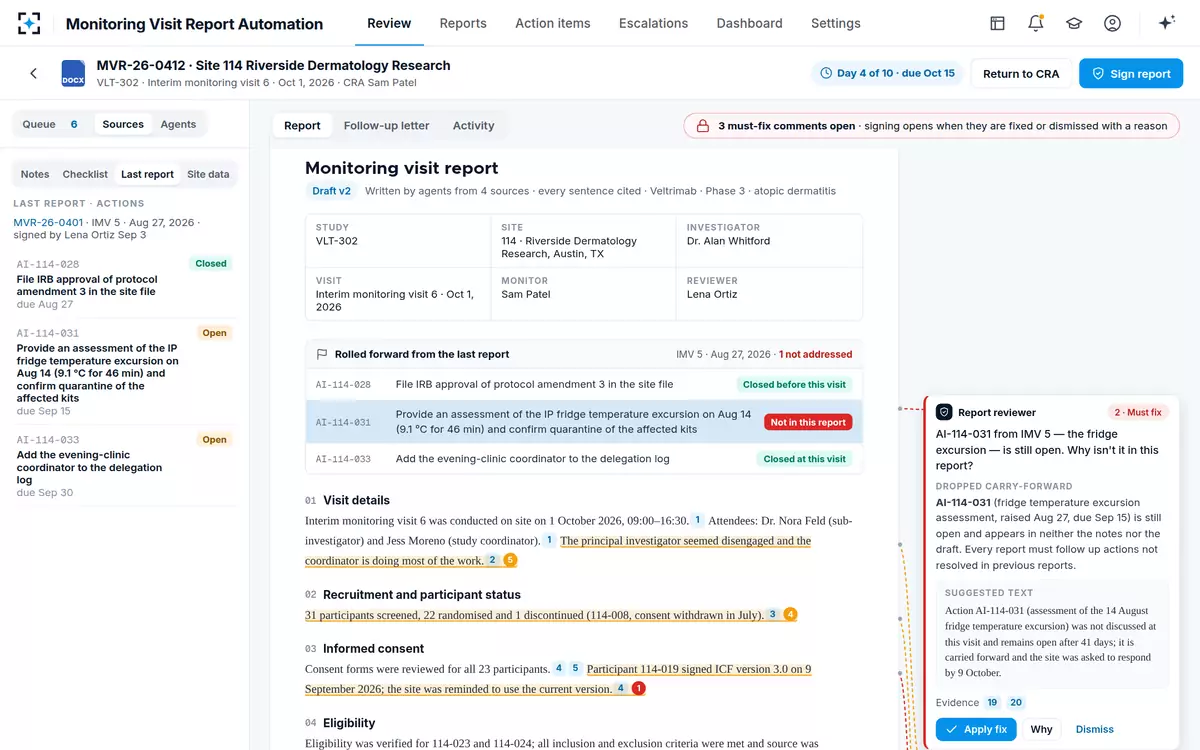
The first is a carry-forward that has gone quiet. Every action raised at the last visit has exactly four honest fates at this one — closed before the visit, closed at the visit, carried forward with its age, or not addressed — and the only unacceptable answer is silence. The second is an escalation the monitoring plan requires and the draft did not make: consent on a superseded version, a prohibited or rescue medication, a suspected serious breach. The third is a statement that disagrees with the study databases. The fourth is wording that states an opinion about a person rather than an observation, which reads badly in a file that may be read by a regulator or in litigation.
The thing no reader of the document can test is whether the monitor actually looked at what the report says they looked at. That is exactly what a co-monitoring visit is for, and it is the reason the two checks do not replace one another.
A checker's comment, with the rule it rests on and the evidence behind it
Four checks that can run on every report, and three that cannot
The distinction worth holding is not between people and software. It is between comparison, which is mechanical and can therefore run every time, and judgement, which is not and must not.
What a check on every draft can settle, and what it must hand to a person
- Can run every time: does every open action from the last report have a fate here?
A list comparison against the previous report and the action register. Silence is the finding; the action’s age and the number of visits it has been carried are facts, not opinions.
- Can run every time: does every checklist item have a statement in the report?
Each item answered Partial or No at the visit has to become a sentence somewhere. An item with no statement is a hole with a known shape.
- Can run every time: does the report agree with the study data?
Enrolment, concomitant medications, deviations and queries against the trial management, data capture and randomisation systems. A count that disagrees is arithmetic; the explanation is not.
- Can run every time: does any sentence state an opinion about a person?
Subjective wording about an investigator or coordinator is a pattern a reader can be shown. Whether to soften it is still the signer’s call.
- Cannot: was the source record actually opened?
Nothing in the document proves what the monitor looked at. This is what a co-monitoring visit, and only a co-monitoring visit, observes.
- Cannot: is this finding important in this trial?
Importance depends on the protocol, the population and the sponsor’s own criteria. ICH E6(R3) leaves the action to the sponsor, and so should any tool.
- Cannot: should this report be signed?
A signature is a person stating a meaning. No comparison can produce one, and no sponsor should accept one that did.
Proposing a fix, and never applying it: where the line sits
The line is drawn by what ICH E6(R3) asks of the report's findings: "When needed, the report should describe findings requiring escalation for action and resolution. The sponsor should decide on the appropriate action to be taken, and these decisions and the resolution of the actions involved, where needed, should be recorded". The deciding and the recording are the sponsor's, and a checker that silently edited a draft would take the first and erase the second.
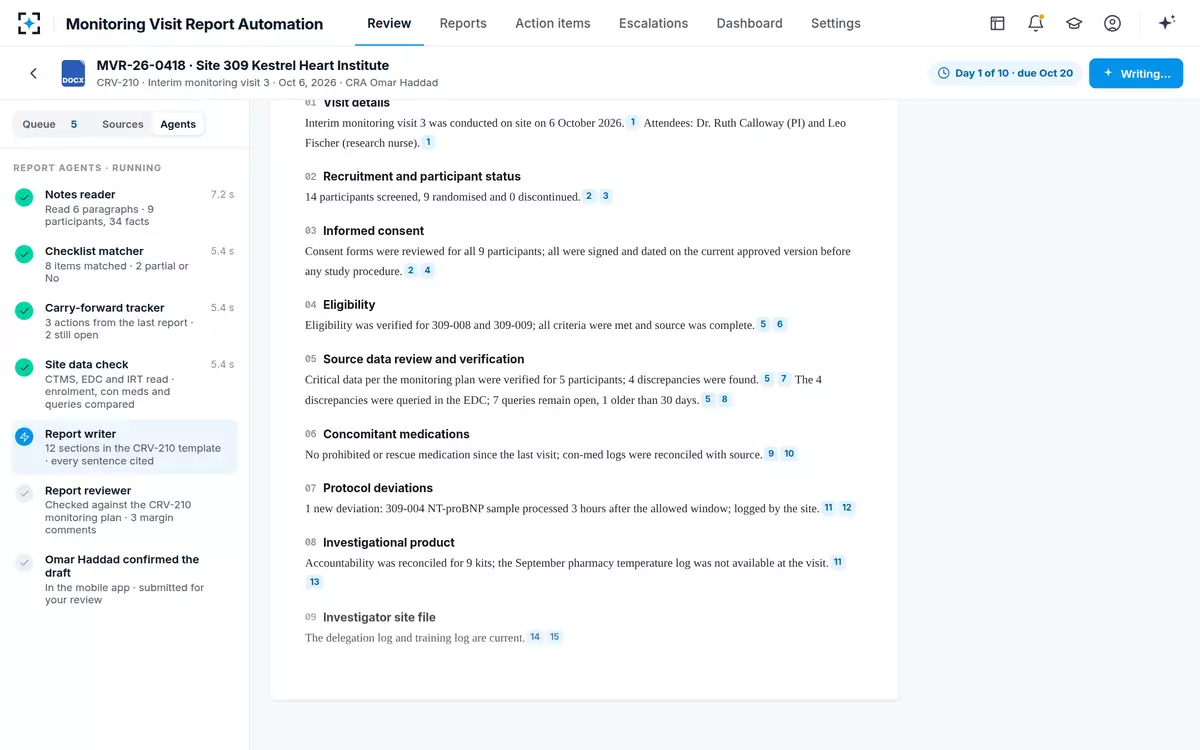
In the solution that line is a hard one. The report reviewer leaves each finding in the margin with its rule, its evidence and a suggested sentence; findings it marks must-fix lock signing until they are resolved; a comment the clinical trial manager disagrees with is dismissed with a reason that stays on the report; minor comments left open are recorded as accepted as written by the person who signed. The signature itself is a password under a stated meaning, and every step is on an activity trail that cannot be altered.
One report from dictation to signed letter, and who owns each step
A person decides
CRAVisits the site and dictates or types the notes, with the visit checklist answered.
Agent
Notes reader and checklist matcherTurns the notes into facts with their paragraph references and maps every checklist answer to a section.
Never: Never infers a fact that is not in the notes.
Agent
Carry-forward tracker and site data checkFinds the open actions from the last report and compares enrolment, medications, deviations and queries with the study systems.
Never: Never closes an action without evidence.
Agent
Report writerWrites the report in the sponsor’s template for the visit type, citing a source on every sentence.
Never: Never writes a sentence without a source.
Agent
Report reviewerChecks the draft against the monitoring plan and the site data and leaves each finding in the margin with its evidence and a suggested text.
Never: Proposes fixes — never signs, and never applies one by itself.
A person decides
CRAConfirms the draft is what the visit found.
A person decides
Clinical trial managerFixes or dismisses each comment with a reason, decides each escalation, and signs with a password under a stated meaning.
Agent
Letter writerDrafts the follow-up letter to the investigator from the signed report: open actions with owner and due date, actions closed since the last visit, the next visit.
Never: Only runs after signature; never includes internal assessments or escalations.
The follow-up letter sits on the far side of that signature for the same reason the fixes sit on the far side of a person: what the site may and may not see is a decision, not a formatting step.
What the oversight record has to show
An inspector's question about oversight is not "do you have a policy". It is what the oversight produced, and whether what it produced matches the procedure you wrote. A co-monitoring programme that files a completed form for each observed visit shows attendance. A check that runs on every draft produces something different in kind: a dated account, report by report, of what was raised, what was fixed, what was dismissed and on what reason.
In the sample study data that account reads as counts a clinical operations lead can act on: 61 findings raised across 27 reports, of which 22 were missing escalations, 14 were dropped carry-forward actions, 11 were statements inconsistent with the site data, 9 were missing statements and 5 were subjective wording, with 58 fixed before signature. A pattern in those categories is a training need for one monitor or a gap in one study's plan — which is the thing co-monitoring is supposed to surface and, at one visit in twenty, usually cannot.
One honest limitation belongs here. The reviewer in this solution is software, not a second monitor. It does not watch a visit, it cannot tell you whether a source record was opened, and a sponsor should not present it to an inspector as satisfying an expectation of co-monitoring. It checks the document; the co-monitoring visit checks the person; the sponsor's procedures should say plainly which of the two it is relying on for what.
Every report reaches the same reviewer, not every twentieth visit
The difference between co-monitoring and an audit, and when a checker should become one
Co-monitoring is quality control: it is inside the monitoring line, done by the people who run monitoring, as part of the work. An audit is quality assurance: ICH E6(R3) sets a sponsor's audit apart from routine monitoring and quality control altogether — a separate function, independent of both — with the sponsor appointing auditors who are independent of the processes being audited (ICH E6(R3), section 3.11.2). FDA's inspection programme uses almost the same words about quality assurance personnel. A supervisor watching their own monitor is, by that definition, never an audit, however thorough they are.
The distinction has a consequence sponsors sometimes discover late. Audit reports carry a protection: FDA tells its investigators in general to confirm audit certificates rather than request or copy the reports, reserving access for cases where serious non-compliance is suspected or legal proceedings are under way. Monitoring reports and co-monitoring records carry no such protection — they are collected as ordinary evidence. What you write in a co-monitoring report about a monitor is a document an inspector may read; what an auditor writes usually is not.
Three signals say a checker's findings have outgrown quality control and belong to quality assurance. The same category of must-fix finding recurring across one monitor's reports is one; an issue that appears at several sites in one study, which suggests the plan rather than the person, is the second; and an action carried over three visits with no closure is the third. FDA's own enforcement file shows where the first signal can end: in an August 2023 warning letter to a clinical investigator, the agency recorded the investigator's account that protocol deviations had not been raised during the CRO's regular monitoring visits, and that one observation the sponsor's monitoring team reviewed produced no query report. The agency did not accept it as a defence for the site, and the same paragraph is a public statement about how long a monitoring process ran without noticing. What inspectors write up about monitoring sets out how findings of that kind are counted and graded.
Questions people ask
What is a co-monitoring visit?
A visit where a monitor's supervisor, or another evaluator the sponsor or CRO designates, accompanies the monitor to the site and oversees the monitoring activities — FDA's inspection programme defines it in those words and asks its investigators whether a sponsor has implemented such visits. Its subject is the monitor's work, not the site's conduct.
How often should a CRA be co-monitored?
No regulation sets a rate. FDA asks whether co-monitoring was implemented, not how frequently, and ICH E6(R3) requires sponsor oversight without prescribing a mechanism. In practice the rate is set by what a second person's days cost — at one visit in five, about 29 days of a second person a year for each monitor making 72 visits, on our arithmetic — and whatever you choose, your own procedure is the standard you will be held to.
Can a checker be an automated check?
For comparisons, yes: whether every open action has a fate, whether every checklist item became a statement, whether the report agrees with the study data, whether a sentence states an opinion about a person. For judgement, no. Whether a finding matters in this trial, and whether the report may be signed, are the sponsor's decisions, and software that made them would be removing the record ICH E6(R3) asks for.
Who is allowed to monitor a site?
Appropriately qualified people who are not involved in the clinical conduct of the trial at the site being monitored — the independence requirement is in ICH E6(R3) itself. FDA's programme adds the regulatory baseline that sponsors must select monitors qualified by training and experience, and asks inspectors how the sponsor assigned responsibilities when different functions go to different monitors.
What is the difference between co-monitoring and an audit?
Co-monitoring is quality control carried out inside the monitoring function; an audit is quality assurance, carried out by people independent of and separate from routine monitoring, to evaluate whether the processes are appropriate. The practical difference is independence and access: an auditor is independent of the process audited, and audit reports are not routinely requested at inspection, while monitoring and co-monitoring records are collected as ordinary evidence.
What does the sponsor's oversight of monitoring look like?
Evidence rather than intention: who the monitors are and how responsibilities were assigned, what the monitoring plan requires, whether reports and letters met their timelines, what was escalated and what happened to it. ICH E6(R3) calls the selection and oversight of investigators and service providers a fundamental feature of oversight, and asks the sponsor to ensure appropriate and timely escalation and follow-up of issues.