An interim monitoring visit report is the write-up of a routine monitoring visit to a site that is already running — the third, the sixth, the thirtieth — as distinct from the initiation report at the start and the close-out report at the end. It has one structural feature the others do not: when the monitor sits down to write it, findings from the last visit are still open, and the rule that governs the report says those have to be followed up here. Monitoring Visit Report Automation is Botminds' software for that work; its carry-forward tracker lifts every unresolved action out of the previous report, ages it, and puts it at the top of the new draft before the first sentence of the visit narrative is written.
The worked example is sample study data in the solution and is fictional throughout: Northwind Bio, study VLT-302, Riverside Dermatology Research at Site 114, Kestrel Heart Institute at Site 309, and the people named. The rules and the inspection findings are real and linked where they appear.
One action, followed across two visits in the sample study
3actions
carried into the visit from interim monitoring visit 5 on 27 August
1
of the three was in neither the monitor’s notes nor the draft report
41days
it had been open when the report was signed on 7 October
9 Oct
the new due date it was given when it was carried forward
What an interim monitoring visit report is, and how it differs from the others
ICH E6(R3) names the visit types in its essential records table — site selection, initiation, routine and close-out — and a routine, or interim, visit is the one that repeats. Its frequency is not fixed by any rule. The guideline says monitoring frequency "should also be determined based on identified risks" and that monitoring activities and their frequency "should be modified as appropriate using knowledge gained". A site enrolling quickly, or one that produced findings last time, earns more visits than a site with two participants and a clean file.
That has a consequence for the report. Because the interval between interim visits is variable, so is the age of everything left over from the last one. An action raised at a visit four weeks ago and an action raised at a visit fourteen weeks ago look identical in an action table; only the date tells you that the second one has been ignored. An interim report has to show age, not only existence.
Four visit reports, and what each one owes the visit before it
| Report | What it is mainly about | What it carries forward | The question it has to answer |
|---|---|---|---|
| Site initiation | Readiness: training delivered, file assembled, product received, delegation log signed. | Nothing. It is the first. | Is this site ready to enrol? |
| Interim (routine) | What happened since the last visit, and what was verified at this one. | Every action from the previous report that is not closed with evidence. | Has anything we already found been fixed? |
| Close-out | Completion: product reconciled, queries closed, records archived and the arrangements named. | Everything still open, because there is no next visit to carry it to. | Is anything left that the site can still put right? |
| Remote or centralised | What could be reviewed without being on site, and how access was given. | The same open actions, plus whatever the on-site visit could not reach. | What did we not see, and when will we? |
The rule in one sentence: follow up on what the last report did not resolve
Everything in this guide descends from one clause. The requirement for monitoring reports ends with a phrase that is easy to read past and hard to satisfy.
Section 3.11.4.6(a) of ICH E6(R3) lists what a monitoring report has to contain, and its last item is follow-up on the resolution of significant findings — reaching back, explicitly, to findings that previous reports left unresolved (ICH E6(R3), section 3.11.4.6(a)).
The reach-back is the part that does the work: follow-up extends to findings not resolved in previous reports. Follow-up is not a courtesy sentence at the end of the report; it is the report's obligation to the past. If an action raised in August is still open in October, the October report has to say so. If it was closed, the October report has to say how it is known to be closed. Silence is a failure of the requirement even when every other section is perfect — and silence is exactly what a blank template produces, because the form arrives knowing nothing about the last visit.
Do you have to repeat last visit's action items? Yes, and here is what that means
Yes — but "repeat" is the wrong verb, and it is why reports often do this badly. Copying the previous action table into the new report is not follow-up; it is duplication, and it produces a document in which the same five lines appear at every visit for nine months with no visible change. What the rule asks for is a statement of resolution: for each action, what has happened to it, as at this visit, with the evidence.
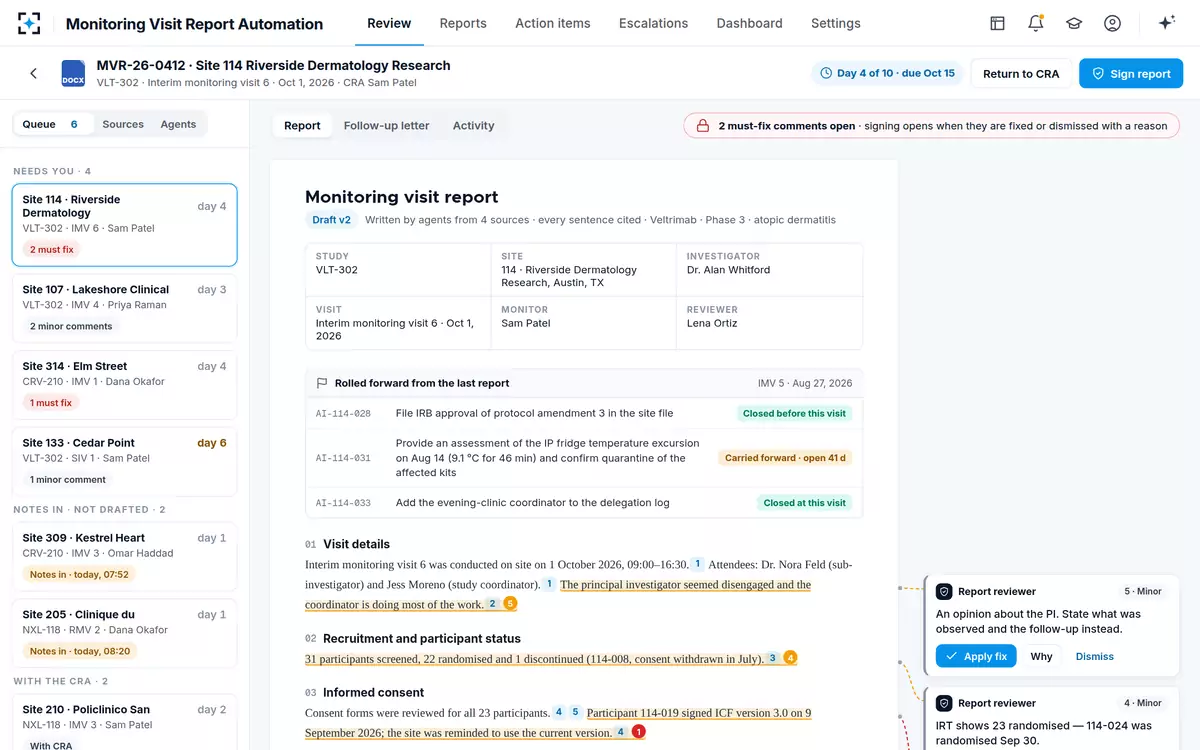
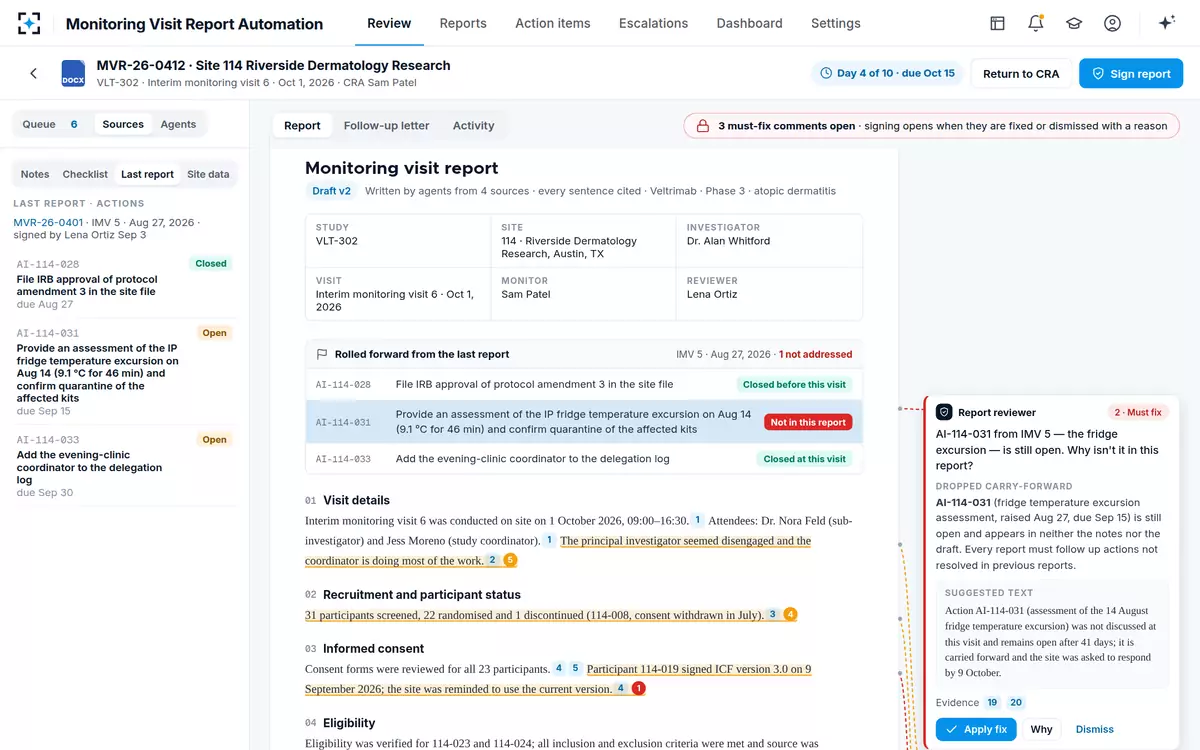
The difference shows in the sentence. "Action AI-114-031 remains open" repeats. "Action AI-114-031, the assessment of the 14 August fridge excursion, was not discussed at this visit and remains open after 41 days; it is carried forward and the site was asked to respond by 9 October" follows up — it carries the age, the fact that the visit did not reach it, the carry-forward and the new date. A reader two years later can reconstruct what the sponsor knew and when.
Fifty-four days of one action, and the 41 the report had to declare
- Excursion found, not yet raised13 d
- Raised at IMV 5 · inside its due date19 d
- Overdue before the next visit16 d
- Not discussed at IMV 6 · to signature6 d
The carry-forward block above section 01, with one action in red
Four fates for an open action, and the evidence each one needs
An action carried into an interim visit can end in one of four states, and each needs different evidence. Writing the four down is the single most useful thing a team can do to its own template, because it converts "did we mention it?" into a question with a right answer.
The four fates of a carried action, and what each one has to show
| Fate | What it means | The evidence it needs | What goes in the report |
|---|---|---|---|
| Closed before this visit | The site did it between visits and sent proof. | The artefact itself, dated: the filed approval, the signed log page, the certificate. | The closure, its date and what closed it — not just the word Closed. |
| Closed at this visit | The monitor saw the evidence on site today. | What was reviewed, where, and on what date, in the relevant section. | The closure and the section in which the underlying finding was verified. |
| Carried forward | Still open. The site has not done it, or the evidence is not yet available. | Its age in days, the visits it has crossed, and a new due date somebody agreed to. | A sentence in the section it belongs to, plus a line in the action table with the new date. |
| Not addressed in this report | The visit did not reach it at all. | Nothing — and that is the point. This fate is a defect, not an outcome. | It should never be published. It exists so the gap is visible before signature. |
The fourth row is the one worth arguing about internally. A draft in which an action silently disappears is indistinguishable from a draft in which it was closed, which is why the state deserves a name and a colour of its own. In the sample report it is marked in red at the top of the draft, and it holds the signature closed until somebody decides what actually happened.
How long can an action stay open before it has to be escalated?
No rule gives a number, and any guide that tells you ninety days is quoting somebody's SOP, not a regulator. What the rules supply is a principle: ICH E6(R3) says actions taken in relation to deviations, errors or omissions "should be proportionate to their importance". Proportionality cuts both ways — a trivial administrative action does not need a weekly chase, and a safety-relevant one should not be allowed to age at all.
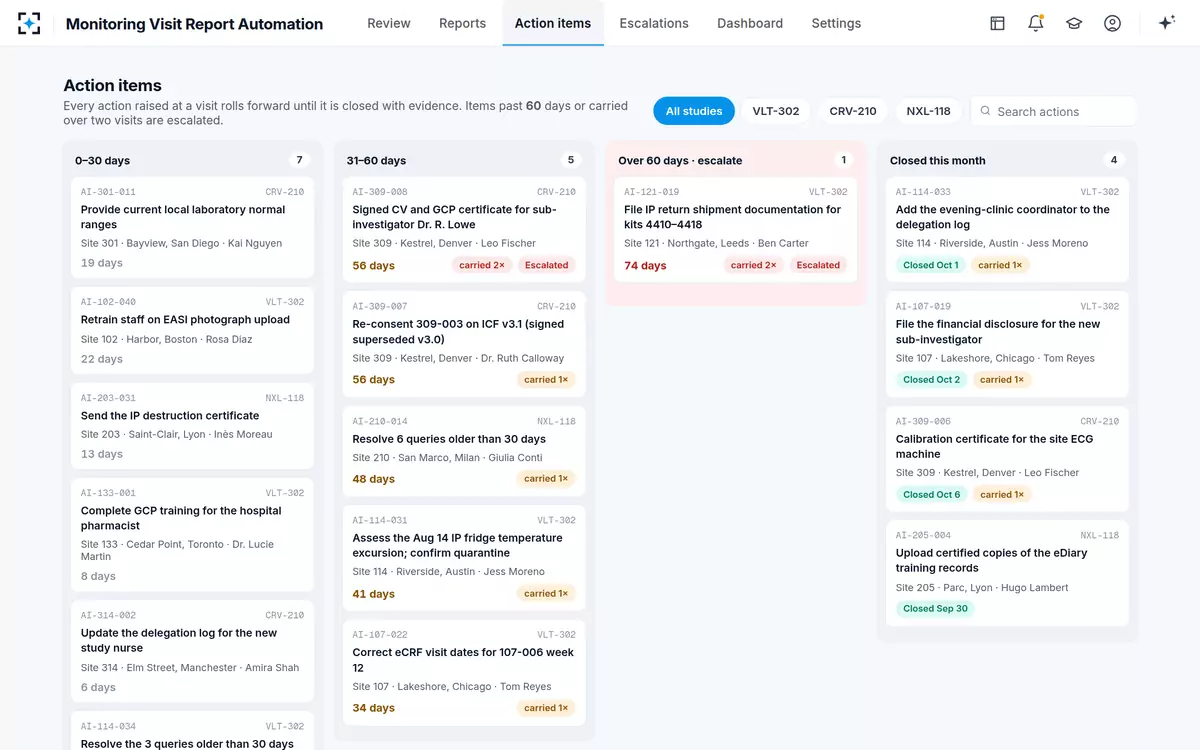
So a threshold is a sponsor decision, and the honest way to set one is to make it two-dimensional: an age, and a number of visits. Age alone misses the action that is only three weeks old but has already survived two visits at a site that is monitored weekly. Visits alone miss the action at a quarterly-visited site that has been open for five months without crossing a second visit.
Open actions by age in the sample study, across all sites
The sample study's threshold is sixty days or two visits, whichever comes first, and a nightly check ages every open action against it. The useful property is not the number. It is that the threshold fires without anyone remembering to look — an action does not need a person to notice it is old.
The silent failure: an action that is in neither the notes nor the draft
Here is how the failure actually happens, which is less dramatic than it sounds. The monitor arrives at Site 114 for interim visit 6 with a full day: consent review for twenty-three participants, source data verification on critical fields for eight, a pharmacy walk-through, a delegation log that has changed. The fridge excursion from six weeks ago is not on the day's agenda, because the agenda is built from the protocol and the checklist, not from the last report's action table. The monitor dictates the day's findings on the way home. The action is not in the dictation, because it did not happen.
Nothing was concealed and nobody was careless. The action simply had no route into the document. That is a structural problem, and it has a structural fix: the previous report's open actions have to be an input to the draft, alongside the notes, the checklist and the site data, rather than something the writer is expected to remember.
Monitoring Visit Report Automation asks why an open action is missing, and shows the evidence
What proportionate action looks like when an action is overdue
An overdue action is information about the site, not only about the action. Proportionality means letting the response grow with what the pattern suggests, and writing down which step you took. A reasonable ladder, offered as a starting point rather than a standard, runs: a reminder in the follow-up letter; a call to the coordinator with a named new date; the action raised with the principal investigator at the next visit and recorded in the report; escalation to the clinical lead with the age and visit count attached; and, where the underlying issue is significant, the root-cause work the guidance expects.
That last step is expected once the finding is significant. FDA's 2023 guidance says that "A root cause analysis followed by appropriate corrective and preventive actions should be undertaken promptly to reduce the impact of the identified issue on the rights, safety, and welfare of participants in the clinical investigation and/or the integrity of the data." An action that has been open for sixty days is itself evidence that the first corrective step did not work, which is usually the moment to ask what the cause really was rather than to re-send the request.
Five habits that stop an action ageing quietly
- Give every action an owner who is a person, not a site
Actions addressed to "the site" are the ones that age. A named coordinator or investigator can be asked; an institution cannot.
- Put the age in the sentence, not only in the table
The number of days carries most of the signal. A reader skimming the narrative should meet it there.
- Close only against evidence you can name
A verbal assurance closes nothing. The filed approval, the signed page, the dated certificate — name it in the closing sentence.
- Count visits as well as days
An action that has survived two visits has survived the mechanism meant to catch it. That is worth escalating regardless of age.
- Make the threshold fire by itself
A rule that depends on somebody remembering to run a report is not a rule. Age every open action on a schedule and route what crosses the line.
How a dropped action becomes an inspection finding
Inspectors do not usually find a dropped action by reading one report. They find it by reading two, which is why the carry-forward block is the part of an interim report most exposed to inspection. The 2023 annual report of the European Medicines Agency's GCP Inspectors Working Group counts forty monitoring findings from the inspections it covers — four of them critical and twenty-one major — and the examples it published include a trial monitor who failed to notice that adverse event, eligibility and physical examination assessments had not been done by the physician (EMA GCP Inspectors Working Group, annual report 2023). The pattern in the published examples is consistently about what monitoring failed to notice, not about what it noticed and wrote down badly.
The sharper version appears in enforcement. In a 2023 warning letter to an investigator, FDA recorded the site's own account of the sponsor's oversight: "… you stated that the sponsor's monitor visited your site 'for 18 months' and that the monitor did not bring this observation to your attention during the clinical trial or in any of the monitoring reports." That last clause is the one to sit with. The monitoring reports were the evidence of what the sponsor had and had not told the site, and their silence was the finding.
The defensive position is not a better narrative. It is a report whose carry-forward block shows every action, its age, its fate and its evidence, visit after visit, so that the question "what happened to the finding you raised in August?" has an answer in the October document rather than in somebody's memory. Several of those findings will also need a route out of the report entirely — when a visit finding has to escalate, and on what clock covers the three routes and their deadlines.
Every open action across sites, aged, with what has been carried twice
Setting your own thresholds without inventing a rule
Three cautions, for anyone about to write this into a procedure. First, say in the document that the threshold is yours. An SOP that implies a sixty-day limit comes from ICH or FDA creates a problem the first time an inspector asks where it comes from. The rule gives you proportionality and the requirement to follow up; the number is your judgement about your trial.
Second, differentiate by what the action is about. A missing training certificate and an unresolved temperature excursion on investigational product should not share a clock, because proportionate means proportionate to importance. The simplest workable scheme is two or three classes with their own ages, tied to the same classification the monitoring plan already uses for deviations.
Third, measure the thing you are trying to prevent. The useful figure is not how many actions are open; it is the age of the oldest open action at each site, and how many actions have crossed more than one visit. Those two numbers tell a clinical operations lead where a site is quietly not responding, which is the condition that precedes most of the findings in this guide.
An interim report done well is a short document with a long memory. To see the carry-forward block, the ages and the escalation thresholds working together, start from Monitoring Visit Report Automation, or read what every monitoring visit report must contain.
Questions people ask
What is the difference between an interim and a close-out monitoring report?
An interim report covers a routine visit to a site that is still running, and carries unresolved actions forward to the next visit. A close-out report covers the final visit: product reconciled and returned or destroyed, queries closed, records archived, and the archiving arrangements named. The difference that matters is that a close-out report has nowhere to carry an open action to, so anything still outstanding has to be resolved or formally escalated rather than deferred.
How long can a monitoring action item stay open?
No regulation sets a limit. ICH E6(R3) requires that actions be proportionate to the importance of what they address, which makes the threshold the sponsor's decision. A workable scheme pairs an age with a visit count — for example sixty days or two visits, whichever comes first — and differentiates by how significant the underlying finding is, so that a safety-relevant action does not share a clock with a filing task.
What evidence closes a monitoring action item?
Something dated that a later reader can see: the filed approval, the signed delegation log page, the certificate, the corrected entry in the data system. A verbal assurance from the site, or an email saying it will be done, closes nothing. If the monitor verified the evidence at the visit, the report should say in which section the verification is described.
Who owns an action item from a monitoring visit?
A named person, almost always at the site — the coordinator, the pharmacist, the principal investigator — with a due date they have agreed. Some actions belong to the sponsor instead, such as issuing a corrected lab range or a protocol clarification. Actions addressed to an institution rather than a person are the ones that age, because nobody receives the reminder.
What happens if an action item is never closed?
It compounds. The immediate risk is that the underlying issue persists; the secondary risk is that the sponsor's own records show it knew and did not act, which is the pattern behind published findings such as the warning letter quoted above. Inspectors read consecutive reports precisely to see whether findings are resolved, and an action that recurs unchanged across several reports invites the question of what the sponsor did between them.
How many monitoring visits does a site get?
As many as the risk justifies. ICH E6(R3) ties the frequency of monitoring to identified risks and expects it to be modified using knowledge gained, so a site that enrols quickly, has had findings, or runs a complex procedure sees a monitor more often than a quiet site. That variability is why an interim report has to show the age of each carried action rather than merely listing it.