A monitoring visit report template is the sponsor's own form for writing up a site visit — a numbered run of sections covering visit details, recruitment, consent, eligibility, source data, medication, deviations, investigational product, the site file and the actions raised. No regulator publishes one, and no two sponsors use the same. What the regulators publish instead is a short, hard list of what the report has to contain, and one item on that list cannot be written from the visit you have just done. Monitoring Visit Report Automation is Botminds' software for exactly this work: it writes the report in the sponsor's own template from the visit notes, the visit checklist, the previous report and the site's data in CTMS, EDC and IRT, puts a numbered citation on every sentence, and checks the draft against the monitoring plan before the clinical trial manager signs it.
The examples on this page come from the sample study data inside the solution. Northwind Bio, study VLT-302, Riverside Dermatology Research at Site 114, the clinical research associate Sam Patel and the clinical trial manager Lena Ortiz are all fictional. The rules quoted are not: they come from ICH E6(R3) and from FDA guidance, linked where they appear.
What a monitoring visit report is, and what it is for
ICH E6(R3) defines a monitoring report in one line, in its glossary: "A documented report following site and/or centralised monitoring activities." That is deliberately wide. It covers the write-up of a site initiation visit, of a routine interim visit, of a close-out, of a remote visit and of a centralised review done from a desk — any monitoring activity that happened and has to leave a trace.
The report has two readers and they want different things. The sponsor's own staff read it to find out what is going wrong at the site and what has to be done about it; that is why the guideline requires reports to be provided to appropriate sponsor staff "in a timely manner for review and follow-up". An inspector reads it years later to find out whether the sponsor was actually overseeing the trial. The second reader is the one most reports are written badly for, because the monitor writing at 10pm knows what they meant.
It is also an essential record in its own right. ICH E6(R3)'s essential records table lists monitoring reports for every kind of site visit — selection, initiation, routine and close-out — and, as a separate line, centralised monitoring reports, among the records that are to be kept if they are produced (ICH E6(R3), Appendix C). A report is not a working note that can be tidied away; once written, it is part of the trial's permanent file.
What goes in a monitoring visit report? The four required elements
Four things, under ICH E6(R3) section 3.11.4.6(a). The sentence is worth reading slowly, because the last clause is the one that templates have never handled.
"Reports of monitoring activities should include a summary of what was reviewed, a description of significant findings, conclusions and actions required to resolve them and follow-up on their resolution including those not resolved in previous reports. The requirements of monitoring reports (including their content and frequency) should be described in the sponsor's procedures."
ICH E6(R3), Guideline for Good Clinical Practice, section 3.11.4.6(a), adopted 6 January 2025
The four elements the rule requires, and why a template misses the fourth
- A summary of what was reviewed
Not a list of headings. How many participants, which visit weeks, which data points, against which source. A reviewer who cannot tell what was reviewed cannot tell what was left out — and "left out" is where risk lives.
- A description of significant findings
Significance is a classification the sponsor made before the visit, in the monitoring plan, not a judgement formed while typing. The report says what was observed; the plan says what that counts as.
- Conclusions, and the actions required to resolve them
Two separate things. The conclusion is what the finding means for this site; the action is who does what, by when. Many templates give you an action table and no room at all for a conclusion.
- Follow-up on their resolution, including those not resolved in previous reports
The one element that is not about this visit. It has to be fetched from the last report, and from any report before that whose actions are still open, before the first sentence of this one is written.
FDA's list, written for the same work, is longer in its detail and shorter on judgement. Its 2023 questions-and-answers guidance restates what documentation of monitoring activities should generally include: "(1) the date of the activity; (2) the individuals conducting and participating in the activity; (3) a summary of the data or activities reviewed; (4) a description of any noncompliance, potential noncompliance, data irregularities, and/or other deficiencies identified; and (5) a description of any actions taken, to be taken, or recommended". The 2013 guidance it points back to adds, to that fifth item, "including the person responsible for completing actions and the anticipated date of completion".
Put the two side by side and the shape of a sufficient report appears: dated, attributed, specific about what was reviewed, honest about what was wrong, and closed with named owners and dates. What neither regulator supplies is the form.
What the template gives you, and what the rule asks for
The template: Headings: visit details, recruitment, consent, eligibility, source data, medication, deviations, product, site file.
The requirement: A heading with nothing under it is not a summary. A section the monitor did not reach at this visit has to say so, in words, or the silence reads as a pass.
The template: A free-text box, often called Observations or Issues.
The requirement: A description of significant findings, classified against criteria the sponsor set in advance — not against how awkward the finding is to write down.
The template: An action table: action, owner, due date.
The requirement: Conclusions and the actions required to resolve them. The conclusion — what this means for the site — is the part many templates leave to the reader to infer.
The template: Nothing. The form arrives empty and knows nothing about the last visit.
The requirement: Follow-up on resolution "including those not resolved in previous reports". This has to come out of the previous report before writing starts.
The template: In most teams the template has quietly become the procedure.
The requirement: Content and frequency "should be described in the sponsor’s procedures". The template is an output of the procedure, not a replacement for it.
The sections of a sponsor template, and what each must say
Templates differ, but they converge, because the protocol decides what a monitor has to look at. The sample sponsor template in the solution runs to twelve numbered sections; the ten below are the ones the report shows on screen, in order, with what each has to say and which of the four sources it is written from.
Ten numbered sections of one sponsor's interim visit template, and what each is written from
01 Visit details
What it has to sayDate, hours on site, visit type and number, and who was met, by name and role.
Written fromNotes
02 Recruitment and participant status
What it has to sayScreened, randomised, discontinued, with the reason for each discontinuation.
Written fromNotes · site data
03 Informed consent
What it has to sayHow many consent forms were reviewed, on which version, signed and dated before any study procedure.
Written fromNotes · checklist
04 Eligibility
What it has to sayWhich participants were checked against inclusion and exclusion criteria, and whether source supported each one.
Written fromNotes · site data
05 Source data review and verification
What it has to sayWhat critical data were verified, for how many participants and which visit weeks, and the discrepancies found and queried.
Written fromNotes · site data
06 Concomitant and rescue medication
What it has to sayWhether prohibited or rescue medication was taken, and whether the logs reconcile with source.
Written fromNotes · site data
07 Protocol deviations
What it has to sayNew deviations found at this visit, each classified, and whether the site has logged them.
Written fromNotes · site data
08 Investigational product
What it has to sayAccountability, storage and temperature, returns and destruction, and any excursion still unresolved.
Written fromNotes · last report
09 Investigator site file
What it has to sayDelegation log, training, CVs, laboratory certificates and ranges, and what is missing or expiring.
Written fromNotes · checklist
10 Action items
What it has to sayEvery action raised or carried, with its owner, its due date and its status.
Written fromLast report · notes
Two sections repay more care than they usually get. Section 05, source data review and verification, is the one an inspector will test hardest, because it is where the monitor claims to have compared the site's records with the data the sponsor holds; a sentence saying critical data "were verified" without saying for how many participants, which visit weeks and which fields is not a summary of what was reviewed. And section 03, informed consent, carries the finding most likely to escalate: a participant consented on a superseded version is classed as an important deviation under many monitoring plans, and the test that separates an important deviation from a serious breach is worth knowing before you write the sentence, not after.
The element no template can hold: last visit's unresolved actions
Three of the four required elements describe the visit. The fourth describes the gap between two visits, and that is why it is the one that goes missing. The monitor has their notes, their checklist and a blank form; the previous report is in the trial master file, or in an inbox, or in a system they have to log in to separately, and the action it raised is six weeks old.
In the sample report for Site 114, three actions were carried into the visit from interim monitoring visit 5 on 27 August. One, filing the IRB approval of protocol amendment 3, was closed before the visit. One, adding the evening-clinic coordinator to the delegation log, was closed at the visit. The third — an assessment of an investigational product fridge excursion on 14 August, 9.1 °C for 46 minutes, with quarantine of the affected kits — was in neither the monitor's notes nor the draft. On paper the report was complete. Against section 3.11.4.6(a) it was not, because the element about resolution was silently empty.
Monitoring Visit Report Automation: the last report's actions, each with its fate at this visit
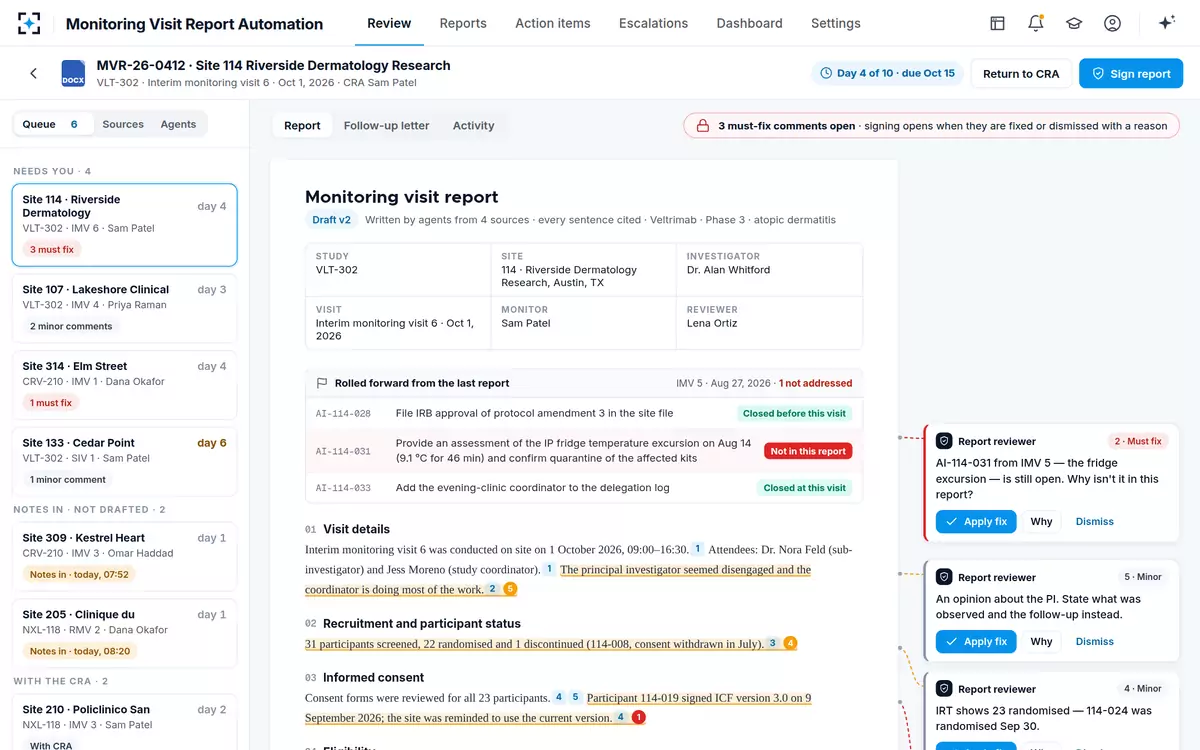
The carry-forward block is the structural answer: the previous report's open actions are written into the new report before anyone writes a word, each marked closed before the visit, closed at the visit, carried forward with its age, or — in red — not addressed in this report. Nothing has to be remembered. How an interim report carries its open actions follows that block through a full visit.
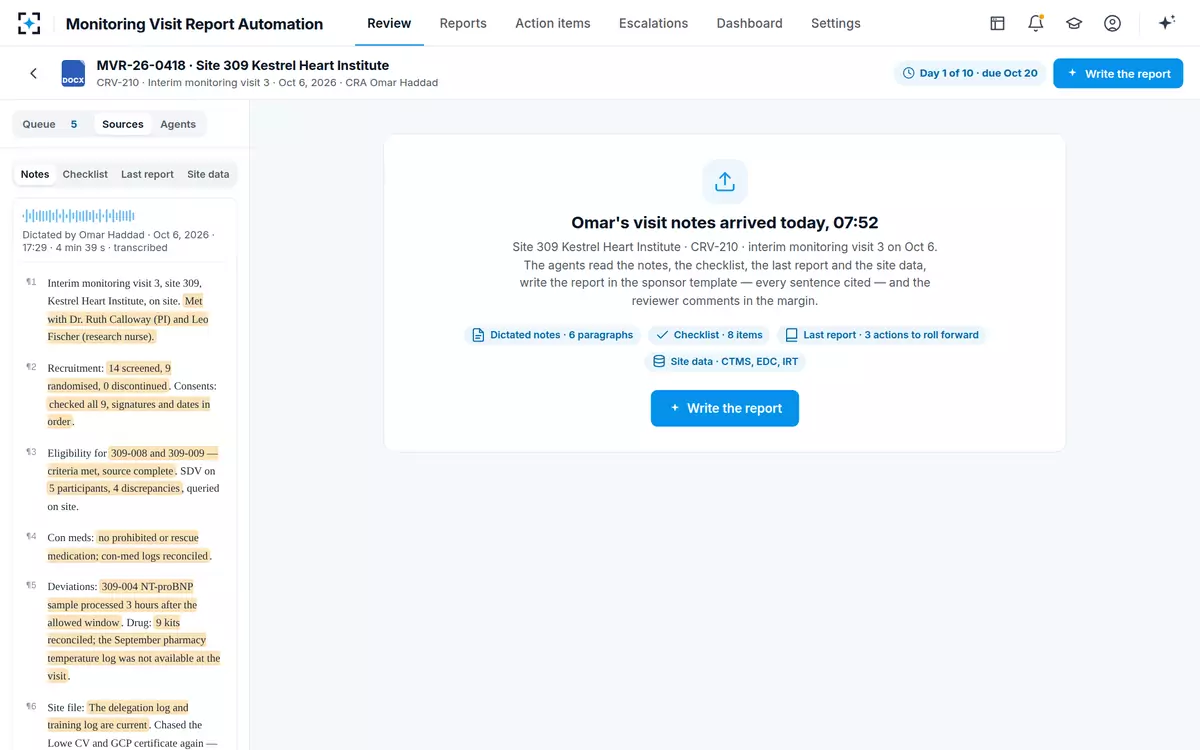
One visit, four source documents: notes, checklist, previous report, site data
A report that satisfies the rule is not written from one source. It is written from four, and knowing which is which decides what a sentence may claim.
The four sources behind a monitoring visit report, and what each may be used to say
| Source | What it is | What it can support | What it cannot |
|---|---|---|---|
| Visit notes | The monitor’s dictation or typed notes, made on site or on the way home. | Everything observed: who was met, what was seen, what the site promised. | Anything the monitor did not see. A number recalled from memory is not source. |
| Visit checklist | Every item answered Yes, Partial or No against the monitoring plan. | That a required check was carried out — and, on a Partial or No, that the report owes a statement. | Why the answer was Partial. The reason has to come from the notes. |
| The previous report | Its open actions, their owners, their due dates and their age. | The follow-up element: what was resolved, what was not, and how long it has been open. | That an action is closed. Closure needs evidence, not an assumption. |
| CTMS, EDC and IRT | Enrolment, concomitant medications, deviations, queries, product and visits per site. | The numbers in the report, and a cross-check on what the site said on the day. | What happened in the room. Systems record outcomes, not conduct. |
This is also where the common contradictions live. The monitor writes "22 randomised" from the site's own tally; IRT says 23 because a participant was randomised late on the last evening. The monitor writes "no rescue medication"; the EDC shows a participant on a seven-day course of oral prednisone for a flare. Neither is dishonesty. Both are a report written from one source when four were available, and both are the kind of thing a sponsor's review of the report is there to catch.
Four sources in, before a sentence is written
Site initiation, interim, close-out and remote visits need different reports
One template cannot serve four visit types, and the essential records table names them separately for a reason — site selection, initiation, routine and close-out are different activities with different evidence. A site initiation report is about readiness: training delivered, the site file assembled, the product received, the delegation log signed. A close-out report is about completion: product reconciled and returned or destroyed, queries closed, records archived and the archiving arrangements named. An interim report is the only one with a past, which is why its carry-forward block is the part that gets tested.
Remote visits deserve their own form rather than an on-site form with a note at the top. FDA's inspection programme for sponsors tells investigators, where remote monitoring was conducted, to determine how monitors accessed clinical site records and ensured the security and confidentiality of the records was maintained (FDA Compliance Program 7348.810, 2021). A remote report that does not say how access was given has left out the one thing the inspector came to ask about.
How long should a monitoring visit report be?
There is no page count anywhere in the rules, and anyone who offers you one is selling a house style. The test in the text is sufficiency: FDA's 2023 guidance asks that documentation include the results of monitoring activities "in sufficient detail to allow verification of adherence to the monitoring plan describing those activities". So the length is set by the plan. A plan that requires critical data verification on 100% of primary endpoint fields for every participant produces a longer section 05 than a plan that samples.
In practice the useful questions are these. Could a reader reconstruct what you reviewed, in what quantity, against what source? Does every Partial or No on the checklist have a sentence somewhere in the report? Is every finding followed by a conclusion and an action with an owner and a date? Is every open action from the last report accounted for? A report that answers those four is long enough, whether it runs to three pages or eleven. A report that fails one of them is too short at any length.
The opposite failure is padding: pages of boilerplate restating the protocol, which an inspector reads as an attempt to bury the two paragraphs that matter. Length that does not carry a fact is a cost to the next reader, and the next reader may be reading under time pressure with a finding in front of them.
What the sponsor's own procedures have to specify
The second sentence of 3.11.4.6(a) does more work than it looks. "The requirements of monitoring reports (including their content and frequency) should be described in the sponsor's procedures" means the template is downstream of a written decision, and an inspector can ask to see the decision. In practice a sponsor's procedures need to settle at least these points, and a team that has never written them down is improvising each of them per study.
What a sponsor's procedures have to settle before a template is any use
| Decision | Why the template cannot make it | A worked example from the sample study |
|---|---|---|
| Who writes, who reviews, who signs | A form has no owners. Review and follow-up are required of the sponsor, not of the form. | The monitor confirms the draft; the clinical trial manager reviews, decides escalations and signs. |
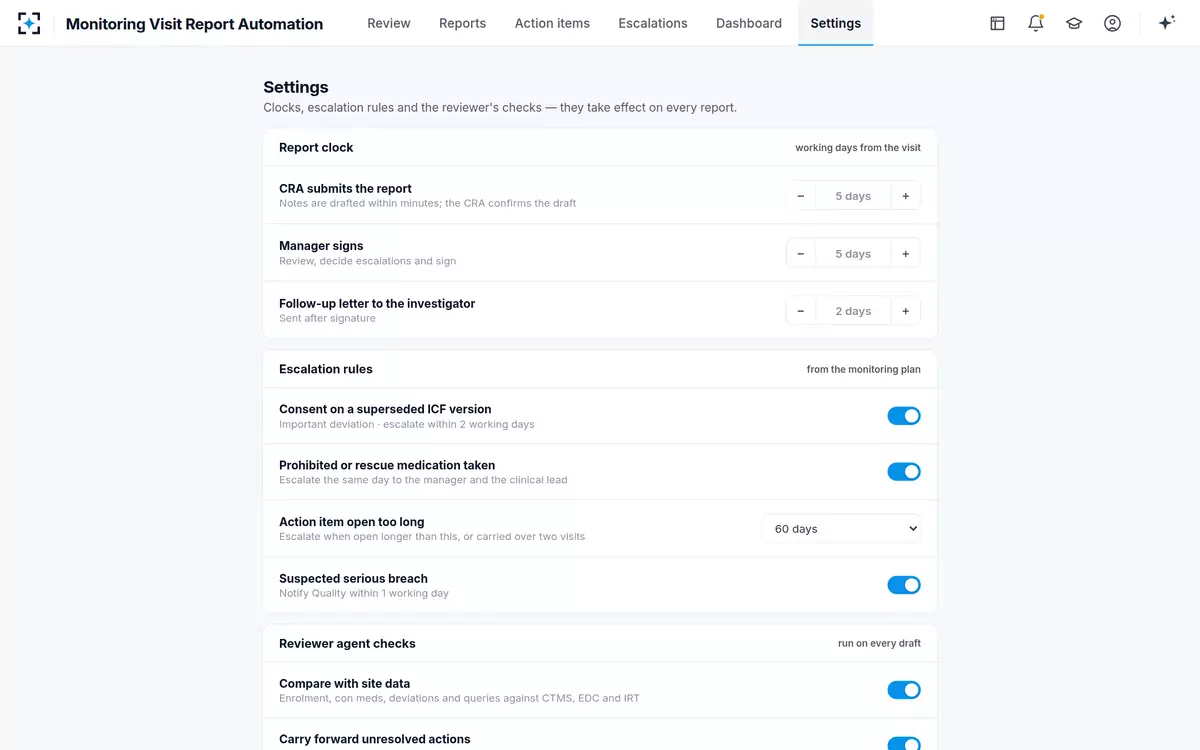
| The clock from visit to signature | No rule sets one; the sponsor does, and is then inspected against its own. | 5 working days to submit and 5 to sign, 10 in total, as a setting that can be stepped up or down. |
| What counts as significant | The word is in the rule; the criteria are the sponsor’s, set before the visit. | The monitoring plan’s escalation rules, each one switchable, applied to every draft. |
| When a finding escalates, and to whom | A template has no route out of itself. | Consent on a superseded version within 2 working days; prohibited or rescue medication the same day. |
| How long an action may stay open | An age is a policy, not a field. | 60 days, or carried over two visits, after which the action is escalated. |
| What goes to the site, and when | The letter to the investigator is a second document with a different audience. | 2 working days after signature, written from the signed report. |
The procedures as settings: clocks, escalation rules and the checks run on every draft
Where the report is filed, and who may read it
The report is an internal sponsor document. It records the sponsor's own assessment of a site, which is why it is written in neutral, factual language and why opinions about named people do not belong in it — a sentence such as "the principal investigator seemed disengaged" is unverifiable, unhelpful to the site and awkward to explain in an inspection three years later. What was observed can be written down; what was inferred about a person's attitude cannot.
The site does not normally receive the report. It receives a follow-up letter, written after the report is signed, carrying the actions it has to work on and nothing else; what the site may and may not see is a rule in its own right. The report itself is filed in the trial master file — in the sample study, to the site management zone, with participant identifiers only and no names.
One sample interim report in Monitoring Visit Report Automation
12sections
in the sample sponsor template, each written from a named source
4sources
notes, the visit checklist, the previous report and the site data in CTMS, EDC and IRT
1citation
on every sentence, opening the paragraph, checklist item, action or data row behind it
0.8h
of monitor writing per report, from notes to a confirmed draft
Writing it so an inspector can follow it two years later
Everything above converges on one habit: a sentence in a monitoring visit report should be traceable to the thing that produced it. That is the difference between a report that survives inspection and one that becomes a day of archaeology. An inspector reading section 05 will ask where the figure came from; a monitor who has left the company cannot answer, and the file has to.
Three practices do most of the work, and none of them needs software. Write the number with its source in the same sentence, so "4 of 23 queries remain open, 3 of them older than 30 days (EDC, 1 October)" replaces "most queries are closed". Say what you did not reach, by name, rather than leaving a section blank. And close every finding with the conclusion as well as the action, because an action without a conclusion tells the next reader what to do but not why, and the why is what they will need when the action is still open at the next visit.
What software adds is that the trace survives the author. In the solution each sentence carries a numbered citation into the paragraph of the notes, the checklist item, the action in the previous report or the row of site data behind it, and the report reviewer checks the draft against the monitoring plan and the site data before anyone signs. The template, finally, is only a template: the shape of the answer. The four elements, the four sources and the sponsor's own written procedures are what make the answer true. See how they fit together on Monitoring Visit Report Automation.
Questions people ask
Is there a standard monitoring visit report template?
No. Neither ICH nor FDA publishes one, and ICH E6(R3) explicitly leaves the content and frequency of monitoring reports to the sponsor's own procedures. What is standardised is the requirement: a summary of what was reviewed, a description of significant findings, conclusions and actions, and follow-up on resolution including actions not resolved in previous reports. A template that carries those four, and the sections your protocol demands, gives the report the shape the guideline asks for.
Is a monitoring visit report an essential document?
Yes, if it exists. ICH E6(R3)'s essential records table lists site monitoring reports — covering site selection, initiation, routine and close-out — and centralised monitoring reports among the records that should be retained. They are sponsor records, normally filed in the sponsor's trial master file rather than in the investigator site file.
Does a monitoring visit report go in the TMF?
The signed report is filed to the sponsor's trial master file, normally in the site management area. The site's copy of the follow-up letter goes to the investigator site file. The two documents are different: the report records the sponsor's internal assessment, the letter tells the site what to do. In the sample study both are filed automatically once the letter is sent, with participant identifiers only.
How long should a monitoring visit report be?
Long enough that a reader can verify adherence to the monitoring plan — FDA's phrase is "in sufficient detail to allow verification of adherence to the monitoring plan describing those activities". That makes the plan, not a page count, the measure. A report whose section on source data verification does not say how many participants and which fields were checked is too short however many pages it runs to.
Who keeps monitoring visit reports, and who can read them?
The sponsor keeps them. They are internal: the sponsor's staff responsible for the conduct and oversight of the trial read them, and inspectors ask for them. Sites normally see only the follow-up letter. That is why internal assessments, escalations and anything about another site must stay out of anything sent to an investigator.
What does ICH E6(R3) require in a monitoring report?
Section 3.11.4.6(a) requires four things: a summary of what was reviewed, a description of significant findings, conclusions and the actions required to resolve them, and follow-up on their resolution including those not resolved in previous reports. Section 3.11.4.6(b) adds that reports go to the appropriate sponsor staff in a timely manner for review and follow-up, as described in the sponsor's procedures.