Clinical trial inspection findings about monitoring are rarer than clinical operations teams fear and heavier than they expect. In the European Medicines Agency's own count for 2023, inspectors recorded 720 deficiencies across 67 inspections, and 40 of them sat in the monitoring sub-category — 5.6% of the total, but four of those forty were graded critical, twice the critical rate of findings overall. Writing a monitoring visit report is hard because it has to agree with four other things an inspector can also read: the visit notes, the previous report's open actions, the site's own file and the study databases. Botminds' Monitoring Visit Report Automation drafts that report from those four sources with a citation on every sentence, and runs the comparison a reviewer would run before the clinical trial manager signs, not after an inspector asks.
The counts on this page come from the published reports of two inspectorates and one FDA inspection programme; the screens come from the solution's own sample study data, on fictional sponsors, sites and people. No figure here describes a Botminds customer, and none of the inspection statistics belongs to the solution: they are other organisations' inspections.
What one year of EMA-coordinated GCP inspections recorded
720
deficiencies recorded in 2023, across every category
67
inspections requested by the CHMP and conducted that year
11
findings per site inspected, on average
40
of the 720 were in the monitoring sub-category
What do inspectors look for in monitoring visit reports?
Three things, in this order: that the reports exist, that they were written and sent inside the sponsor's own timelines, and that what they say agrees with everything else in the file. FDA's compliance programme for sponsors, CROs and monitors tells its investigators to "Review the sponsor's monitoring reports and other records related to monitoring that may be located in the, trial master file (TMF), and/or clinical trial management system (CTMS) to evaluate monitoring activities" — the typographical slip is the programme's own. An instruction just before it in the same section asks whether the monitoring plan was followed, naming visits performed by the required timeline, reports completed by the required timeline and letters to sites sent by the required timeline.
The order matters because the first two tests are mechanical and the third is not. A sponsor can answer "where is it" and "was it on time" from a system. Whether a sentence in a report is true is a comparison with four other sources, and it is the test that produces findings. That is also the test a sponsor can run on itself: nothing in the rules stops a sponsor from making the comparison on every draft, and who reviews a monitoring visit report, and what they are looking for, sets out how that review is usually staffed.
How many findings does a GCP inspection produce?
About eleven, if the EMA's 2023 numbers are the guide. Across the 67 CHMP-requested inspections the working group recorded "A total of 720 deficiencies, comprising 36 critical (5.0%), 336 major (46.7%) and 348 minor (48.3%) findings … This represents an average of 11 findings per site inspected". The UK's inspectorate publishes a different cut of the same kind of work: in its 2019–2020 metrics period the MHRA carried out 36 GCP inspections, and its seven commercial-sponsor inspections averaged 0.6 critical, 2.4 major and 4.9 other findings each — close to eight per inspection, on a narrower definition of what is counted.
Neither number is a forecast for any one inspection. What both say is that findings are normal and criticals are not: in the EMA's count, one finding in twenty was critical.
Monitoring findings are graded harder than findings as a whole
All 720 deficiencies, 2023
- Minor · 348 · 48.3%
- Major · 336 · 46.7%
- Critical · 36 · 5%
The 40 monitoring findings
- Minor · 15 · 37.5%
- Major · 21 · 52.5%
- Critical · 4 · 10%
Critical, major and minor: what the gradings mean for a report
A grading describes impact, not craft. It asks what the deficiency could do to a participant's rights, safety or well-being, or to the reliability of the trial's results. Nothing in it rewards a well-turned sentence, and nothing punishes a clumsy one. That is why a report written in plain, dull prose can still carry a critical finding, and why a polished report that quietly omits an unresolved action is the more dangerous document.
The second thing a grading carries is an address. The EMA's working group also publishes which party each finding was attributed to: of the 36 critical findings in 2023, 23 were the sponsor's responsibility and three the investigator's, with the rest shared. Investigator sites generated most of the findings by volume — 448 of 720, against 233 at sponsor sites — but the severe ones land on the sponsor, and monitoring is one of the routes by which a site's problem becomes a sponsor's finding.
Monitoring is 40 of the 138 trial-management findings EMA recorded in 2023
The shape of a monitoring finding: not written badly, but not carrying what it should
Read the EMA's own description of what its inspectors found under monitoring in 2023 and the pattern is detection, not drafting: "Assessment of AEs, eligibility, and physical examination not done by the physician was not detected by the trial monitor". The companion bullet is about procedures that failed to detect protocol deviations and to reconcile investigational product accountability. In both, the report is the place the failure became visible, not the thing that failed.
Three shapes recur across the published findings, and they need different fixes.
Three shapes a monitoring finding takes, and what each one asks of the report
| The shape | What the inspector sees | What would have prevented it |
|---|---|---|
| The monitor did not detect it | Something detectable at the visit — an eligibility assessment signed by the wrong person, product accountability that does not reconcile — appears nowhere in any report. | A checklist whose every item has to become a statement, so an unanswered item cannot pass silently into a signed report. |
| The monitor detected it; the report does not carry it | The investigator or the site raised a concern, and the monitoring reports do not reflect it. | A draft built from the visit notes with a citation on each sentence, so a fact in the notes that reached no section is visible as a gap. |
| The report says something the file contradicts | A count, a medication statement or a closure claim in the report disagrees with the study databases or with the previous report. | A comparison with the study databases and with last visit’s open actions, run on the draft, before anybody signs it. |
The third shape is the one most under a sponsor's control, because both sides of the contradiction are already in its own systems on the day the report is drafted. What every monitoring visit report must contain works through the sections where these statements live.
One inspection's critical finding, in the inspectorate's own words
The MHRA's 2019–2020 metrics report describes four critical findings raised at a single contract research organisation. The second concerned investigational product management. A principal investigator had told inspectors that they had raised concerns about blister wallets that did not state when each dose should be taken or the strength of each tablet. The site acted: it educated the parents and carers of its participants and halted recruitment. The sponsor and CRO did not submit an urgent safety measure or a potential serious breach. And then this sentence, which is the reason the finding belongs on this page:
"Furthermore, the PI concerns were not reflected in the monitoring visit reports."
MHRA GCP Inspectorate, inspection metrics 2019–2020
Two details are worth taking away. The first is that the finding was graded under investigational product management, not under monitoring: a count of findings filed against "monitoring" understates how often a monitoring visit report is part of the evidence for something else. The second is that the inspectors learned of the concern from the investigator at the site, and then went to the reports to see whether the sponsor had learned of it too. The report was read as a test of whether information travelled.
A concern of that kind usually has a reporting clock attached to it as well; what counts as a serious breach, and when the clock starts, sets out the test and the deadline.
What an inspector collects when monitoring is in question
FDA's compliance programme is unusually specific about what its investigators take away when they suspect monitoring failed. Its worked example is a sponsor that did not identify a site's late serious adverse event reporting; in that case "the ORA investigator should collect copies of study-specific site monitoring plan(s) and relevant standard operating procedures (SOPs), monitoring visit reports, monitoring logs, SAE reports sent to the sponsor by clinical investigators, other documentation to support and describe the SAEs, and any other supporting evidence, and document the observation in the EIR".
That list is a readiness exercise in itself. Every item is something the sponsor already holds, and the finding is written from the disagreements between them.
The documents FDA names when monitoring is in question, and what each is read against
| What is collected | Where it is usually held | What it is read against |
|---|---|---|
| Study-specific site monitoring plans | The trial master file, with its versions and effective dates | What the reports actually did: visit types, frequency, what was verified, what triggers escalation |
| Relevant standard operating procedures | The quality system | The plan, and the timelines the reports were held to |
| Monitoring visit reports | The trial master file and the trial management system | The notes, the site file, the study databases and the previous report’s open actions |
| Monitoring logs | The trial management system | Visit dates and report dates against the clocks the procedures set |
| Serious adverse event reports sent by investigators | Safety systems and the site file | The dates and content of the reports that should have noticed a late one |
| Supporting evidence for the events themselves | Source records at the site | Everything above |
There is an asymmetry in that programme worth knowing. Audit reports are protected: investigators are told in general to confirm audit certificates rather than request the reports themselves, and the agency reserves access for cases where serious non-compliance is suspected. Monitoring reports have no such shelter. They are collected as ordinary evidence, which makes them among the internal documents an inspector is most likely to read.
What happens when a monitoring report contradicts the site's records?
The inspector has both documents and no reason to prefer yours. A contradiction turns one question — what happened at this site — into three: which version is right, how the wrong one was signed, and what else the same process may have got wrong. The third question is the expensive one, because it invites a wider sample.
Contradictions come in three sizes, and in the solution's sample study data each has a different consequence. A count that disagrees — the Site 114 draft says 22 randomised where the randomisation system shows 23 — is a minor comment; it is still a sentence a signer has to decide about. A statement that disagrees is not minor: "No rescue medication" in a draft, against notes and the study database showing a participant on oral prednisone for seven days, is a must-fix, and signing stays locked until it is resolved. A closure that disagrees is the worst of the three: the Site 309 draft says consent forms were reviewed for all nine participants and all were signed on the current approved version, while the re-consent action from the previous visit has been open for 56 days.
A draft whose consent sentence disagrees with an action still open after 56 days
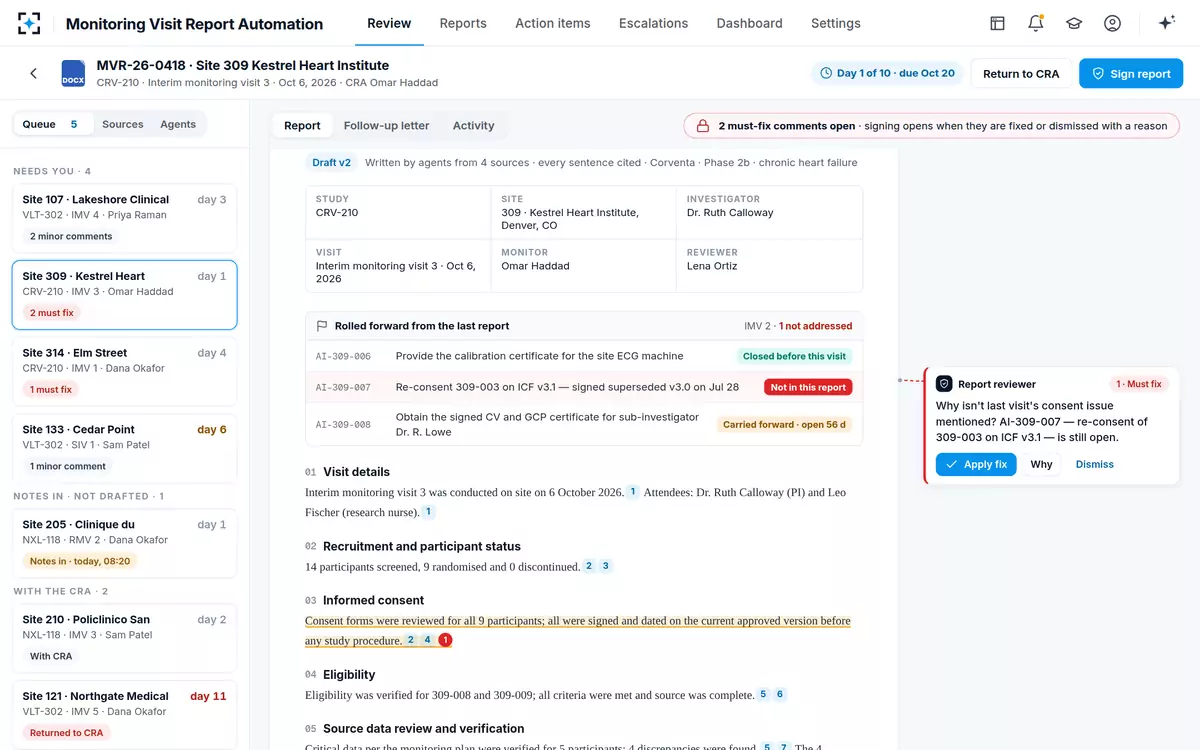
Every unresolved action from the last report sits above section 01 with its fate at this visit — closed before, closed here, carried forward with its age, or not addressed — which is why a sentence claiming the matter is settled is caught by the document itself. Carrying last visit's open actions into this report follows that mechanism through a full visit.
What an enforcement letter shows about a monitor who said nothing
In August 2023 FDA wrote to a clinical investigator about three failures to follow the investigational plan, including study drug administered outside the protocol's specified body sites. The investigator's written response explained that the deviations had not been raised during the sponsor's regular monitoring visits, and that the sponsor's monitoring team had reviewed one observation without generating a query report. FDA did not accept the explanation as a defence:
"Although the monitor did not bring this observation to your attention during the conduct of the clinical trial, as the clinical investigator, you are ultimately responsible for ensuring compliance with the investigational plan."
FDA warning letter to a clinical investigator, 8 August 2023
Read from the site's chair, that is a warning that the monitor's silence protects nobody. Read from the sponsor's chair it is worse, because the same paragraph is now a public statement that months of visits to this site produced reports in which the deviation does not appear. The sponsor's own documents became the evidence for how long the problem ran.
ICH E6(R3) asks a monitoring report to summarise what was reviewed, describe significant findings, state the actions required and follow up on their resolution, including those not resolved in previous reports. An omission is therefore not a gap in a narrative. It is a requirement the report did not meet.
How do you prepare monitoring reports for an inspection?
Not by rereading them. By the time an inspection is announced the reports are signed, filed and, in most procedures, amendable only by a documented correction that is itself visible. Preparation that changes anything has to happen earlier, at the draft, and it is the same work the inspector will do: compare the report with the notes, the checklist, the study databases and the previous report's open actions.
Four habits do most of the work, and none of them needs software to state.
What two inspectorates count, and what each one implies for a sponsor's own checks
What the published numbers say: EMA, 2023: 720 deficiencies across 67 inspections, an average of 11 per site inspected.
What it implies before signature: Findings are normal. The aim is not zero; it is that nothing found was visible in your own file first.
What the published numbers say: EMA, 2023: 36 critical findings, 5.0% of the total — but 4 of the 40 monitoring findings, or 10%.
What it implies before signature: In that year’s count a monitoring finding was twice as likely to be critical as a finding in general. Treat the ones your own review raises accordingly.
What the published numbers say: EMA, 2023: 23 of the 36 critical findings were attributed to the sponsor, 3 to the investigator.
What it implies before signature: Severity migrates upward. A site problem that the reports did not carry becomes the sponsor’s finding.
What the published numbers say: MHRA, 2019–20: of seven commercial-sponsor inspections, four had at least one critical finding and all seven had at least one major or critical finding.
What it implies before signature: Plan on being found something. The question is whether the file shows you had already found it.
What this changes about how a report is drafted and checked
Every finding shape above is a comparison that could have been made earlier by somebody with access to the same four sources. The constraint has never been the rule; it is that a clinical trial manager reading a queue of reports cannot reliably hold a previous report, a checklist, an enrolment table and a medication log in mind at once, for every report, inside a ten-working-day clock.
In Monitoring Visit Report Automation, the agents draft the report in the sponsor's template from the notes, the checklist, the last report and the study data, citing a source on every sentence; a reviewer then checks the draft against the monitoring plan and the site data, and leaves each finding in the margin with its evidence and a suggested replacement sentence. Findings it marks must-fix lock signing. A comment the signer disagrees with is dismissed with a reason that stays on the report, and minor comments left open are recorded as accepted as written by the person who signed. The reviewer proposes; it never signs.
What Monitoring Visit Report Automation shows a signer before the signature
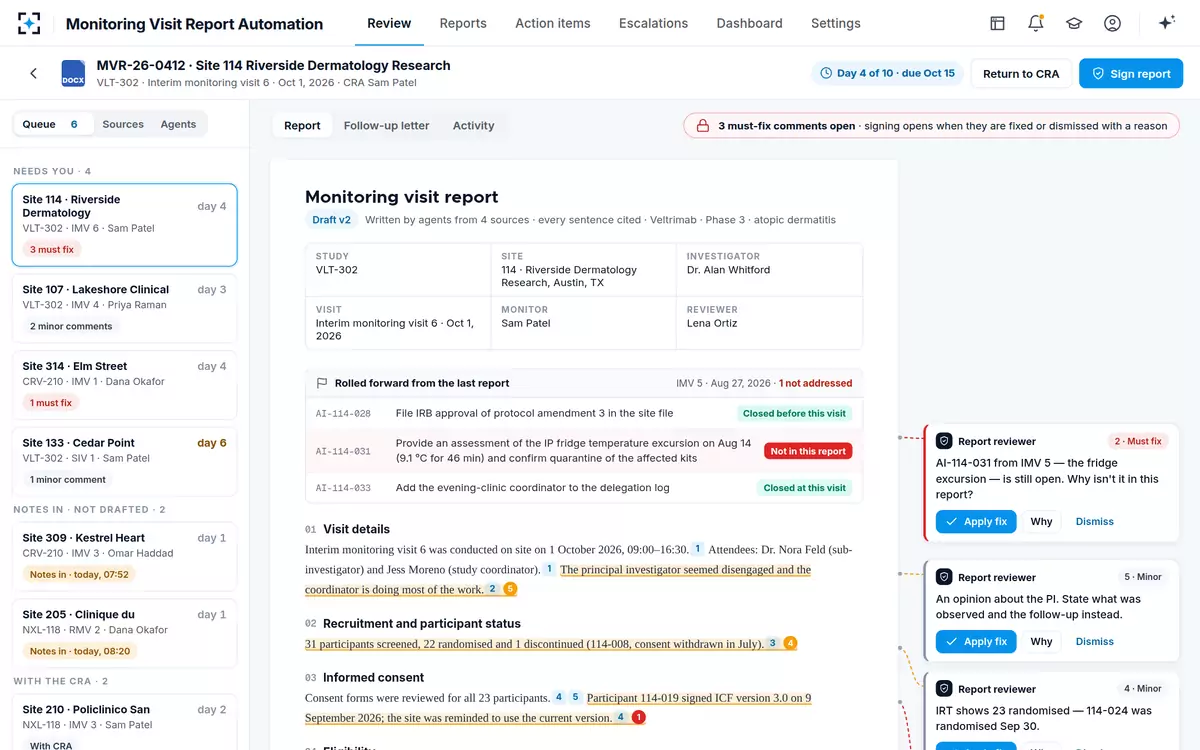
What a team can measure from that is its own position, not an inspection outcome. In the sample data the reviewer raised 61 findings across 27 reports — 22 missing escalations, 14 dropped carry-forward actions, 11 statements inconsistent with the site data, 9 missing statements and 5 pieces of subjective wording — and 58 were fixed before signature. Those are the categories the published findings describe, counted on drafts while they can still be changed.
The same categories, counted on drafts rather than at an inspection
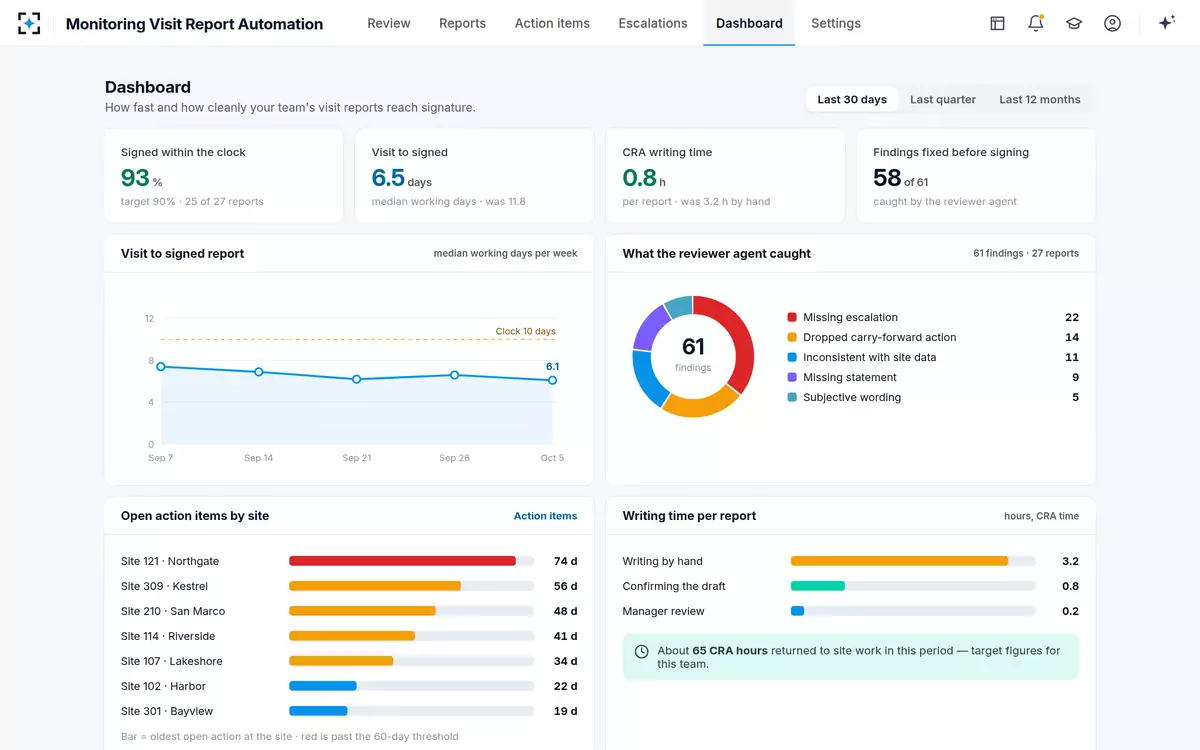
No tool lowers a finding rate on its own, and no honest one claims to. What a check on every draft changes is which document holds the contradiction: the file that goes to the inspector, or a comment the signer resolved on day four. To see the comparison run on a report of your own, start from Monitoring Visit Report Automation.
Questions people ask
Do inspectors read every monitoring report?
No. They sample. FDA's compliance programme directs its investigators to review the sponsor's monitoring reports and related records in the trial master file or the trial management system to evaluate monitoring activities, and the full collection — plans, SOPs, reports, logs, safety reports — is specified for the case where a monitoring failure is suspected. In practice, a suspicion raised at a site or in an interview decides which reports get read closely.
What is a critical finding in a GCP inspection?
A deficiency serious enough to have affected, or to be capable of affecting, participants' rights, safety or well-being, or the reliability of the trial's results. They are uncommon: the EMA's inspectors graded 36 of 720 deficiencies critical in 2023, 5.0% of the total. The grading is about consequence, not about how the document reads.
What share of GCP findings are about monitoring?
In the EMA's 2023 count, 40 of 720 deficiencies, or 5.6%, sat in the monitoring sub-category, of which four were critical. That understates the role of monitoring reports, because a report can be part of the evidence for a finding filed elsewhere: the MHRA's critical finding about poorly labelled investigational product, which also noted that the investigator's concerns were not reflected in the monitoring visit reports, was graded under investigational product management.
How often do sponsors get a critical finding?
Often enough to plan for. In the MHRA's 2019–2020 metrics, four of seven commercial-sponsor inspections had at least one critical finding and all seven had at least one major or critical finding. In the EMA's 2023 count, the sponsor was the responsible party for 23 of the 36 critical findings recorded, against three for the investigator.
What documents does an inspector ask the sponsor for?
When monitoring is in question, FDA names study-specific site monitoring plans and relevant SOPs, monitoring visit reports, monitoring logs, the serious adverse event reports investigators sent to the sponsor, the documentation describing those events, and any other supporting evidence. Every item is one the sponsor already holds; the finding is written from the disagreements between them.
What happens if a monitoring report contradicts the site's records?
The inspector has both, and the contradiction widens the question from what happened at this site to how the wrong version was signed and what else the process missed — which usually means a larger sample. This is the shape of finding a sponsor is best placed to prevent, because both sides of the contradiction are in its own systems on the day the report is drafted.