Loss run processing is everything a commercial underwriting desk does to turn prior carriers' claims histories into a loss picture an underwriter can price on: listing the runs a submission lacks, requesting them through the broker, chasing them against the state clocks, keying each carrier's layout into one summary, and checking what moved since the last evaluation. On a five-carrier, three-line account Botminds estimates about 75 minutes of keying and checking by hand, and the waiting around it can run to weeks. It is hard because every prior carrier sends its own layout, valued on its own date, with expense in or out of incurred, so nothing adds up until someone has made it comparable. Botminds' Loss Run Analysis Automation exists for that step: six agents read every run in any layout into one loss summary with each number traced to its row, so the desk's time goes to the gaps and the judgement.
This guide is written for the people who run commercial underwriting desks: heads of underwriting operations, desk leads and the underwriting managers who sign above an underwriter's authority. The examples follow a fictional sample, Marrowstone Casualty's transportation desk working one new-business submission, Calloway Cold Freight. Every person, company, carrier and claim in it is invented; the legal clocks come from the state statutes, linked where they appear.
One sample account's loss runs, as they reached the desk
5
runs from five prior carriers, in five different layouts
69
claims over a five-year look-back, 10 of them open
3 yr 7 mo
age of the oldest run on file, against a 90-day valuation window
3
gaps before the account could be quoted, including a missing policy year
How much loss run processing does one commercial account create?
The workload per account is prior carriers, times lines, times policy years in the look-back, and each of those is a document to request, receive, read and reconcile. An account that changed auto carriers twice in five years has three auto runs before general liability or workers' compensation is counted; a fleet account that bought each line from a different carrier can easily send five or more.
Each run brings its own format. On the sample account the desk received a spreadsheet export with paid and outstanding expense in separate columns, a landscape PDF grouped by policy period, a two-page scan stamped "loss only", a workers' compensation claim-detail report that splits every claim into indemnity, medical and expense, and a one-page PDF valued three years and seven months earlier. Five layouts for one trucking account is ordinary for a buyer that has placed lines separately.
Nor does the law give the desk a common format. Florida's statute gives the plainest legal definition of a run, a report "that contains the policy number, the period of coverage, the number of claims, the paid losses on all claims, and the date of each loss," and adds that "an insurer is not required to provide loss reserve information" (Fla. Stat. § 627.444). Reserves, expense, status and claim descriptions are whatever each carrier chose to print, which is why the desk spends its time making five documents say the same thing.
Who requests loss runs, and how long the clocks run
The insured owns the right to its loss history, and in practice its broker or agent requests the runs; the prospective carrier's desk asks the broker. State statutes are written that way. Kentucky makes an insurer provide a run "within twenty (20) calendar days of receipt of a written request submitted by the insured or the insurer's agent" (KRS 304.20-100), and Maine requires an agent who receives the request to send it on to the insurer "within 4 working days" (24-A M.R.S. § 2910).
How a loss run reaches the underwriting desk, and the clock at each hop
A person decides
Prospective carrier’s deskLists the runs the submission lacks: each prior carrier, each line, each policy year in the look-back.
A person decides
Broker or agentAsks each prior carrier in writing for the insured. Maine: request passed on within 4 working days.
A person decides
Prior carrierSends the run. Florida 15 calendar days; Kentucky 20; Illinois and Maine 30; Louisiana 10 business days.
Never: sending the run to the next insurer under these statutes; it goes to the insured or its producer
A person decides
Broker or agentForwards the run. Kentucky: a copy to the insured within 5 calendar days.
Agent
Loss run reader and five more agentsRead the run as it arrives, add it to the loss picture and update the gaps list.
Never: sending anything to the broker; a person sends
Two details change how a desk writes its request. Illinois lets the insured direct that "the company shall send the loss information directly to the insured's producer" (215 ILCS 5/143.10a), which saves a hop if the request says so. And Kentucky puts a price on delay: a fine of $100 to $250 a day on an insurer or agent that fails to provide a requested statement (KRS 304.99-082). A request that names the statute and the date it was received is a stronger request, and a desk that logs the date can show a broker which carrier is late. The full set of clocks, state by state, is in loss run requirements by state.
Where the days go: waiting between seats, not keying
On most accounts the elapsed time is dominated by waiting, not by work. A run passes four seats before a quote goes out, the broker who obtains it, the desk that reads and checks it, the underwriter who prices on it and the manager who signs above the underwriter's authority, and each handoff waits for the one before. The underwriter cannot start until the summary exists, the summary cannot be finished until the runs are complete, and the runs are complete only when the broker has them.
One account's loss runs: elapsed days, and where the work actually sits
- Runs arrive over the statutory windowarriving · 15 d
- Keying, then a missing year foundkey
- Second broker request and waitchase · 3 d
- Runs arrive; each read in minutes, gaps listed at oncearriving, read as they land · 15 d
The costliest pattern is the gap discovered late. A desk that keys for an hour and then finds a missing year has spent the hour on a file that still cannot be quoted, and the second broker request restarts a clock. On the sample account, the missing auto run for 2021–22 was flagged by the agents that read the runs before anyone had keyed a row, and it went into the first request rather than a second one.
How long does loss run processing take per account?
On a five-carrier, three-line account, Botminds estimates about 75 minutes of keying and checking by hand before the underwriter reads anything, and almost half of it is re-typing claim rows. The rest is the work that makes the typed rows comparable: mapping column names and status words, tying each claim to a policy year, lining up last year's evaluation and writing the summary.
Loss Run Analysis Automation's target: 75 minutes of keying become about 4
By hand, five carriers and three lines: about 75 minutes (estimated)
- Re-keying claim rows · 47%
- Mapping columns and status words · 13%
- Tying claims to policy years · 13%
- Lining up last year’s evaluation · 13%
- Writing the summary · 14%
With the solution: about 4 minutes (design target)
- Reading the runs · 38%
- Mapping · 12%
- Policy years · 12%
- Last evaluation · 13%
- Drafting the narrative · 25%
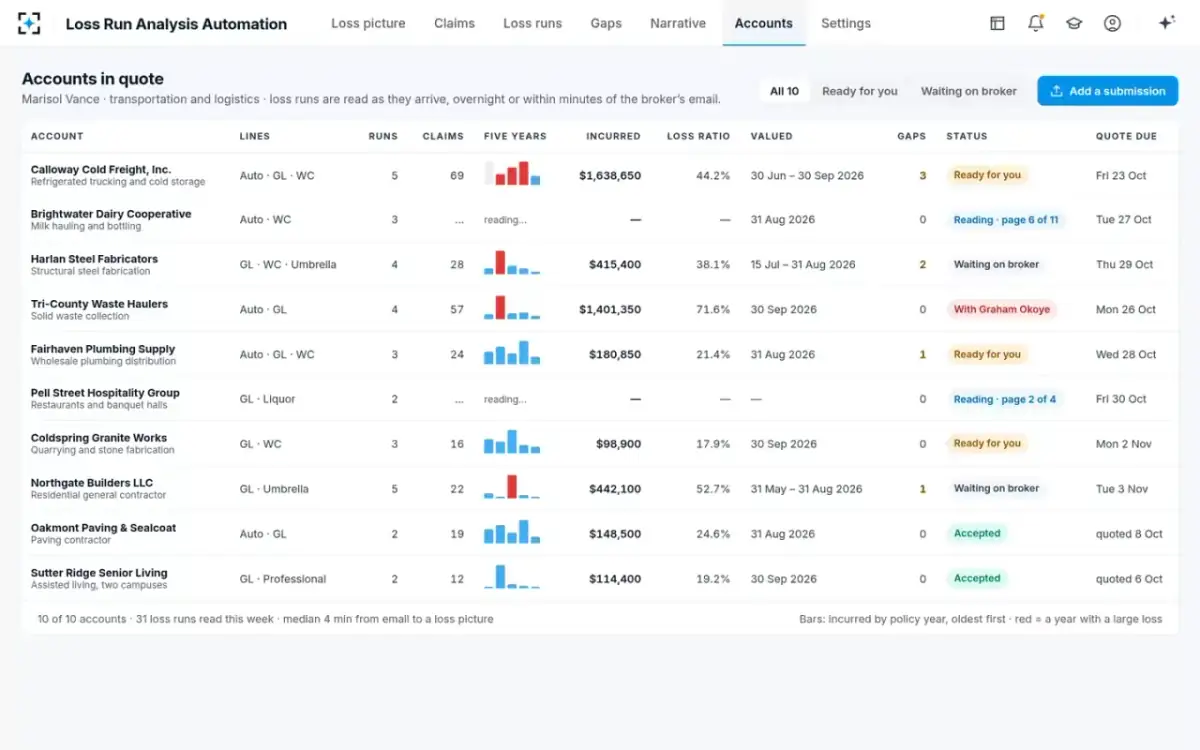
Multiply by volume and the staffing question becomes concrete. A desk's loss run minutes are accounts in quote times runs per account times minutes per run, and the re-keying share scales with claim rows, not with judgement. The sample underwriter's desk read 31 runs in one week across ten accounts in quote, a median of 4 minutes from email to a loss picture; by hand, at the estimate above of about 15 minutes a run, the same week would have held nearly eight hours of keying and checking before any underwriter read a number.
Who does what on the loss run desk, and who signs
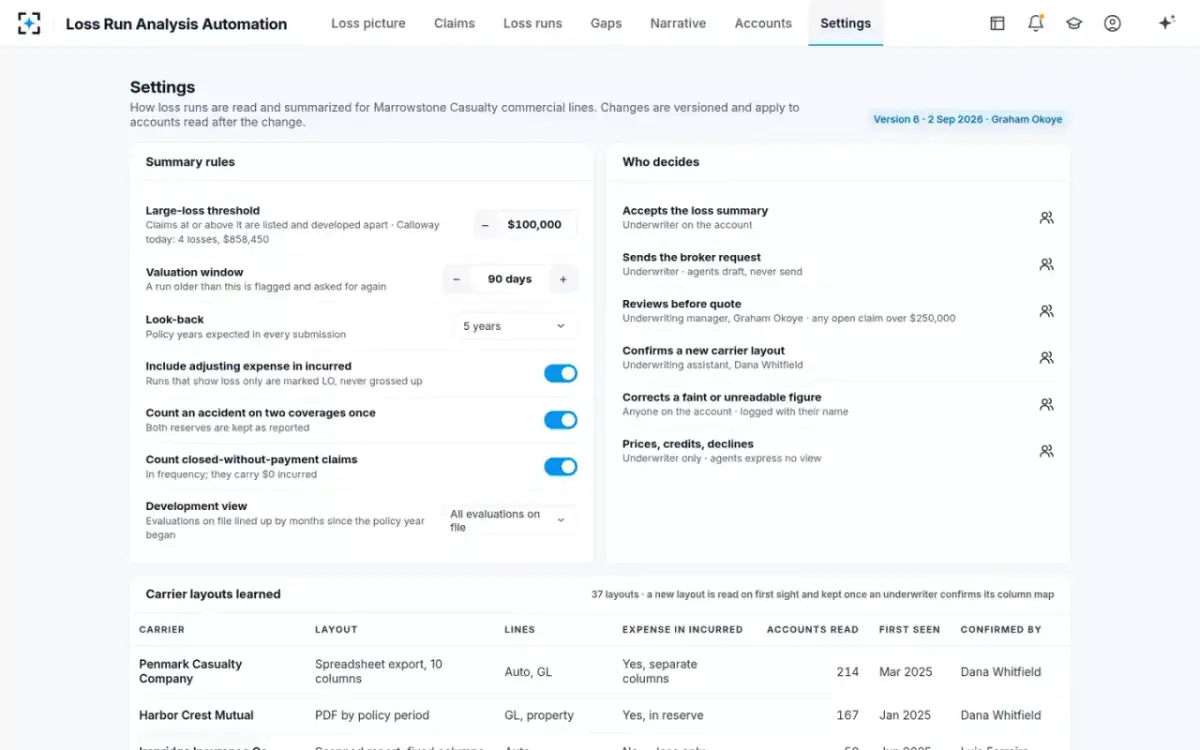
A well-run desk writes down who may do what with a loss run, because the steps carry different risks. Keying is clerical; confirming how a carrier's columns map is a judgement that every later account from that carrier will rely on; accepting the summary is an underwriting decision; and an open claim above a threshold is a referral. The table below is the split as the fictional sample desk has set it.
Loss run tasks on the sample desk, and who owns each
| Task | Owner | Control |
|---|---|---|
| Listing missing or stale runs and drafting the broker request | Underwriting assistant, with the agents’ gaps list | The underwriter sends it; one request per account, every item with its reason |
| Confirming a new carrier layout’s column map | Underwriting assistant | Kept only once a named person confirms it; reused for every later account |
| Correcting a faint or unreadable figure | Anyone on the account | Logged with the person’s name, checked against the page total |
| Accepting the loss summary for the file | Underwriter | Within the letter of authority |
| Any open claim over $250,000 | Underwriting manager | Reviewed before quote |
| Large-loss threshold, valuation window, look-back | Underwriting manager | Desk settings, versioned: $100,000, 90 days and 5 years in the sample |
| Price, credits, declination | Underwriter only | The agents suggest none of them |
Who decides what on the loss run desk, written down as settings
The checks that make a loss summary defensible
A loss summary is only as good as the checks behind it, and four catch most of the errors in a typed one. Does each run tie to its own total? Is adjusting expense in or out of incurred on each run, and are loss-only runs marked rather than added to the others? Is each run inside the desk's valuation window? And what did each open claim's reserve do since the last evaluation on file?
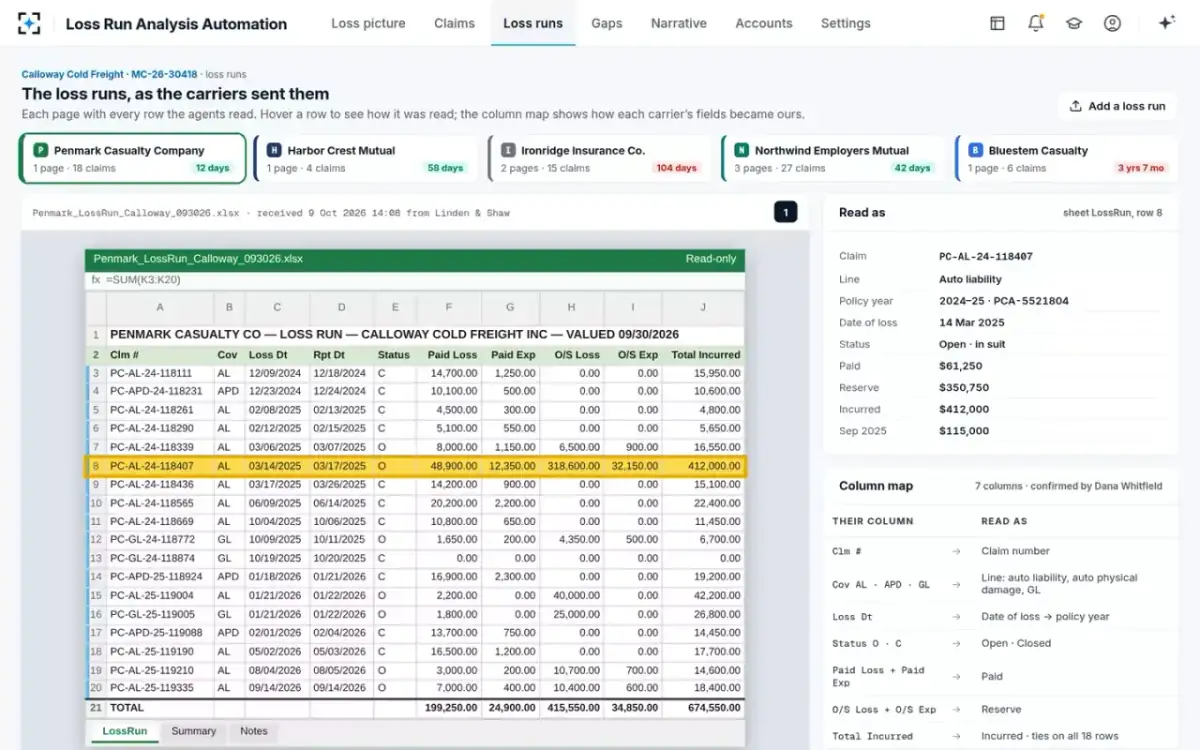
The last check is the one most often missed, because it needs two evaluations side by side. On the sample account, one open auto claim, a work-zone rear-end in suit, stood at $115,000 at the September 2025 evaluation and $412,000 a year later; its policy year moved from $252,850 to $601,150, ×2.38. A summary that showed only the current total would have priced that year without seeing the movement. How to read a loss run report works through the columns, and incurred vs paid losses traces one claim through the expense problem.
A carrier's run as it arrived, every row read, and the column map confirmed
Examiners look at the same thing from the other side. One of the NAIC's examination standards for property and casualty insurers asks whether underwriting and rating rest on adequate information gathered at or near the policy's inception (NAIC Market Regulation Handbook, ch. 21, Standard 8). A loss summary someone typed, with no way to see where each number came from, is weaker evidence of adequate information than one whose figures open the carrier's own page.
What should a desk measure about its loss run processing?
Five measures tell a desk lead whether loss run processing is helping or holding up the quote, and each can be taken from the files a desk already has. Days from submission to a complete set of runs, split into the time waiting on brokers and carriers and the time the desk held them. Requests per account: one is the target, and a second request means a gap was found late. Minutes of desk time per run. Share of accounts quoted on a run outside the valuation window, which is a pricing risk the underwriter should have seen. And share of open claims with a reserve movement noted in the file.
An underwriter's ten accounts in quote, with the runs already read
The measures also show where to staff. A desk whose days are spent waiting on carriers needs better requests and a log of statutory dates, not more keying capacity. A desk whose minutes go to re-keying needs the reading done for it. And a desk whose summaries keep missing reserve movement needs the development view, whoever builds it.
Where Loss Run Analysis Automation fits on the desk
Six agents do the reading: the loss run reader takes each run in any layout and ties it to its own totals, the field mapper turns each carrier's columns and status words into one set of fields and marks loss-only runs, the policy matcher ties claims to policy years, the valuation checker lists gaps against the application and the valuation window and drafts one broker request, the development view lines up evaluations on file, and the narrative writer drafts a loss summary with each figure cited to its row. A new layout is read on first sight and kept once someone confirms its column map.
The desk keeps what it was hired for. A person confirms each new layout, corrects any faint figure under their own name, sends the broker request and accepts the summary; the underwriting manager reviews any open claim over the threshold before quote; and the agents suggest no price, credit or declination. On the sample account the draft request listed four items, a missing year, two stale runs and a status note on the claim in suit, and the underwriter sent it the same morning. A six-week plan for bringing a desk onto the solution is in loss run automation, and the whole series starts from Loss Run Analysis Automation.
Questions people ask
What is loss run processing in insurance?
It is the work of obtaining prior carriers' claims history reports for a submission and turning them into one loss summary an underwriter can price on: requesting and chasing the runs, reading each carrier's layout, reconciling expense and valuation dates, and checking reserve movement. On a commercial account with several prior carriers, it is usually the longest step before a quote.
How many loss runs does a commercial submission need?
One per prior carrier, per line, covering the look-back the desk requires, commonly three to five years. The sample desk uses five years; its trucking account needed five runs from five carriers and was still missing one policy year of auto.
How long does a carrier have to send a loss run?
It depends on the state, and the clock runs from a written request by the insured or its agent. Florida allows 15 calendar days, Kentucky 20, Illinois and Maine 30, and Louisiana 10 business days; Kentucky fines an insurer or agent $100 to $250 a day for failing to provide a requested statement.
Do loss runs have to show reserves?
Not in every state. Florida's statute defines the run as policy number, period, number of claims, paid losses and dates of loss, and says an insurer is not required to provide loss reserve information. Desks should note which runs omit reserves rather than read a blank as zero.
Should the underwriter or an assistant process loss runs?
Most commercial desks split it: an assistant or technician reads, maps and checks the runs and drafts the broker request, and the underwriter accepts the summary and prices. What matters more than the split is that each step has a named owner, especially confirming how a new carrier's columns map.
Can loss run processing be automated without losing control?
Yes, if each automated number can be traced to its source row and the judgement steps stay with people. In the sample desk, agents read and summarise every run, but a person confirms each new layout, corrects flagged figures under their name and accepts the summary, and an open claim over $250,000 goes to the underwriting manager before quote.