The RESPA loss mitigation timeline is the set of deadlines that Regulation X, the CFPB's rule under the Real Estate Settlement Procedures Act, imposes between a borrower's first missed payment and a foreclosure sale. Live contact by the 36th day of delinquency; a written notice and a named contact by the 45th; no first foreclosure filing until the loan is more than 120 days delinquent; a written acknowledgment within five business days of an application received 45 or more days before a sale; a decision within 30 days of a complete application received more than 37 days before a sale; then 7 or 14 days for the borrower to answer, 14 days to appeal and 30 days to decide the appeal. The timeline is hard to keep because its clocks start from three different places: the delinquency, the application and the sale date, which itself can move. Botminds' Loss Mitigation Application Processing has an agent, the clock keeper, that sets every one of those dates on each file from the day the first page arrives.
This guide draws the whole timeline, explains each line and what moves it, and works one sample application against every clock. The sample comes from a fictional servicer, Cinderbrook Mortgage Servicing; its borrowers and loan are sample data.
Three sets of clocks run at once on every delinquent loan
What is the RESPA loss mitigation timeline?
It is the sequence of borrower protections in 12 CFR 1024.39 to 1024.41, adopted by the CFPB in 2013 and in force since 10 January 2014, that governs how a mortgage servicer must handle a delinquent borrower before and during foreclosure. Section 1024.39 sets early contact, 1024.40 continuity of contact, and 1024.41 the loss mitigation procedures themselves. Investors add their own clocks on top: FHA's are the most prescriptive, and they are covered below.
The clocks exist because of what happened when servicers ran loss mitigation and foreclosure side by side. The CFPB still describes the harm in its own words:
Dual tracking can cause substantial consumer harm to borrowers and investors alike. For example, dual tracking can result in inconsistent and confusing communications, servicing errors, and additional costs to borrowers.
CFPB, Streamlining Mortgage Servicing proposal, 89 FR 60204 (2024)
When must the early intervention letter be sent?
The written early intervention notice is due by the 45th day of delinquency, and live contact, or good faith efforts at it, is due by the 36th. The rule for the first is that "a servicer shall establish or make good faith efforts to establish live contact with a delinquent borrower no later than the 36th day of a borrower's delinquency and again no later than 36 days after each payment due date so long as the borrower remains delinquent" (12 CFR 1024.39(a)). After live contact the servicer must tell the borrower about loss mitigation options where appropriate.
The written notice repeats too, but less often: by day 45 and again 45 days after each missed due date, though not more than once in any 180-day period. It must encourage the borrower to call, give the number for the assigned personnel, describe example options where applicable, explain how to apply, and point to the CFPB or HUD list of housing counselors. Section 1024.40 then requires those personnel to be assigned by the time of that notice, and in any event by day 45, and to stay available until the borrower makes two consecutive on-time payments under a permanent workout.
How many days to acknowledge a loss mitigation application?
Five days, not counting Saturdays, Sundays or legal public holidays, after the servicer receives the application, if it arrives 45 or more days before a foreclosure sale. If no sale is scheduled, the commentary says the application is treated as received 45 or more days before any sale, so the notice is due. The notice must say whether the application is complete or incomplete and, if incomplete, what is missing and by when; the sibling guide on the loss mitigation acknowledgement letter takes it element by element.
A second five-day notice follows when the application becomes complete. Under 1024.41(c)(3), within five business days of receiving a complete application the servicer must say it is complete, the date it was received, that it expects to decide within 30 days, which foreclosure protections now apply, that more information may be needed later, and that other protections may exist under state or federal law. That notice is not needed if the first notice already said complete, or if the application was not complete more than 37 days before a sale.
What is the 120 day foreclosure rule?
A servicer may not make the first notice or filing for a judicial or non-judicial foreclosure until the loan is more than 120 days delinquent, under 1024.41(f)(1). The only exceptions are a foreclosure based on a due-on-sale clause and joining another lienholder's foreclosure. If the borrower submits a complete application before that first filing, 1024.41(f)(2) bars the filing until the borrower has been found ineligible and any appeal is over, has rejected every option, or has failed to perform under an agreement.
The rule worked as intended. The CFPB's 2019 assessment found that after 2014 servicers started foreclosure within the first 120 days far less often, that the drop was not made up by more starts in the following months, and that the rule therefore "prevented rather than delayed" those foreclosures (CFPB, 2019).
What is the 37 day rule, and the 45 and 90?
The 37-day rule is the sale bar: if a complete application is received more than 37 days before a foreclosure sale, the servicer must evaluate it within 30 days and may not move for judgment or order of sale, or conduct the sale, until the process ends. The 45 and 90-day lines decide which other protections apply. All three are counted from the sale date and fixed on the day the complete application is received.
The sale-date lines and what each one gives the borrower
| Complete application received | What the borrower gets | Rule |
|---|---|---|
| 90 days or more before the sale | Everything below, plus the right to appeal a loan modification denial, and at least 14 days to accept or reject an offer. | 1024.41(e)(1), (h) |
| 45 days or more before the sale (any application) | The five-business-day acknowledgment notice, saying complete or incomplete and what is missing. | 1024.41(b)(2) |
| More than 37 days before the sale | Evaluation for all options within 30 days, with a written decision; no motion for judgment or order of sale, and no sale, while it runs; at least 7 days to accept an offer. | 1024.41(c)(1), (e)(1), (g) |
| 37 days or fewer before the sale | No Regulation X evaluation duty or sale bar; the servicer must still evaluate under its policies and the investor’s rules. | 1024.38(b)(2)(v); comment 41(g)-4 |
| No sale scheduled when complete | Treated as more than 90 days before any sale. | comment 41(b)(3)-1 |
The return-by date in the acknowledgment notice is tied to these lines. The commentary caps it at the earliest of the date a submitted document goes stale, the 120th day of delinquency, 90 days before a sale and 38 days before a sale, and sets a floor of seven days. A servicer that gives the default 30 days without checking the calendar can set a date that falls after the borrower's last chance to stop the sale. The CFPB found no sign that borrowers time applications to land just outside 37 days: its 2019 assessment saw "no evidence of borrowers 'bunching'" there.
After a complete application: 30 days, then the borrower’s clocks
Once complete, the servicer has 30 days to evaluate the borrower for every option the loan's owner offers and to send a written decision, which must give the specific reasons for any loan modification denial. If documents from a third party are missing, the servicer must chase them with reasonable diligence and may not deny the application solely for their absence; it must tell the borrower what it is waiting for. Examiners have found servicers that promised a decision in 30 days and moved toward foreclosure without making one, and called the promise deceptive (CFPB Supervisory Highlights, Issue 30).
Then the borrower's clocks start. The servicer may require an answer to an offer no sooner than 14 days after it, if the application was complete 90 or more days before a sale, or 7 days if between 90 and 37. Where an appeal right exists, the borrower has 14 days to appeal; different personnel must decide it; the decision is due within 30 days and is final; and the deadline to accept any offer moves to 14 days after the appeal decision.
What is FHA's 90 day review?
FHA's 90-day review is HUD's requirement to evaluate a defaulted FHA loan for loss mitigation before four monthly payments are missed. In the handbook's words, "A Mortgagee is required to complete an evaluation of a Defaulted Mortgage for appropriate Loss Mitigation Options before four monthly installments are due and unpaid and send a written Notice to Borrower with the determination of eligibility" (HUD ML 2025-12, Handbook 4000.1 III.A.2). The servicer must also document its efforts to reach the borrower before that deadline.
Two further FHA clocks sit alongside. The servicer must take loss mitigation action or start foreclosure within six months of default, with automatic 90-day extensions when an option was approved in time. And during foreclosure FHA mirrors Regulation X: for a request received 45 or more days before a scheduled sale, written notice within five business days and no sale during the review; between 45 and 37 days, review within 30 days and no sale during it; 37 or fewer, best efforts. The economics of those six months are in how long loss mitigation takes to process.
What moves the clocks, and what does not
Most clocks do not move once they start, and the ones that do move follow specific rules. The table sets out the common events.
Events that seem to reset the timeline, and what the rule actually says
| Event | Effect on the clocks | Rule |
|---|---|---|
| The sale is postponed or rescheduled | None on protections already determined; they stay as fixed when the complete application was received. | 1024.41(b)(3); comment 41(b)(3)-2 |
| Servicing transfers mid-application | The new servicer must meet the old servicer’s timeframes; an unsent acknowledgment is due within 10 business days of transfer; a pending complete application must be decided within 30 days of transfer. | 1024.41(k) |
| A second application after a complete one | No new 1024.41 process if the servicer already complied for a complete application and the borrower has been delinquent at all times since. | 1024.41(i) |
| The borrower cures, then falls behind again | A new application gets the full process, because the borrower was not delinquent at all times since. | 1024.41(i) |
| A legal public holiday in the five days | The holiday does not count; the notice is due one business day later. | 1024.41(b)(2)(i)(B) |
| The borrower files for bankruptcy | Live contact is suspended and the written notice may be too, depending on the case; 1024.41 still applies. | 1024.39(c) |
The commentary is explicit on the first row: "The protections under § 1024.41 that have been determined to apply to a borrower pursuant to § 1024.41(b)(3) remain in effect thereafter, even if a foreclosure sale is later scheduled or rescheduled" (comment 41(b)(3)-2). A sale moved to a later date does not give an incomplete applicant more protection, and a sale moved earlier does not take protection away from a complete one.
One application against every clock
On a single file the clocks collapse into a handful of dates that the intake desk must know by heart. Take one sample application at the fictional servicer as it runs through Loss Mitigation Application Processing. The loan was 134 days delinquent, so the 120-day line had passed and a sale was set for Tuesday 1 December. The first pages arrived by fax on Thursday 8 October, 54 days before the sale, so the five-day notice applied. Monday 12 October was Columbus Day, a legal public holiday, so the notice was due on Friday 16 October; it went on Tuesday 13 October, day 2 of 5.
The 90-day line had passed on Wednesday 2 September, so this family would have no appeal right; the first decision had to be right. The 38-day line fell on Saturday 24 October, so the return-by date was set for Friday 23 October. The file completed on Thursday 15 October, 47 days before the sale: the sale bar applied, the decision was due by Saturday 14 November, and the borrowers would have at least 7 days to answer an offer.
The clocks on one application, drawn as a single strip
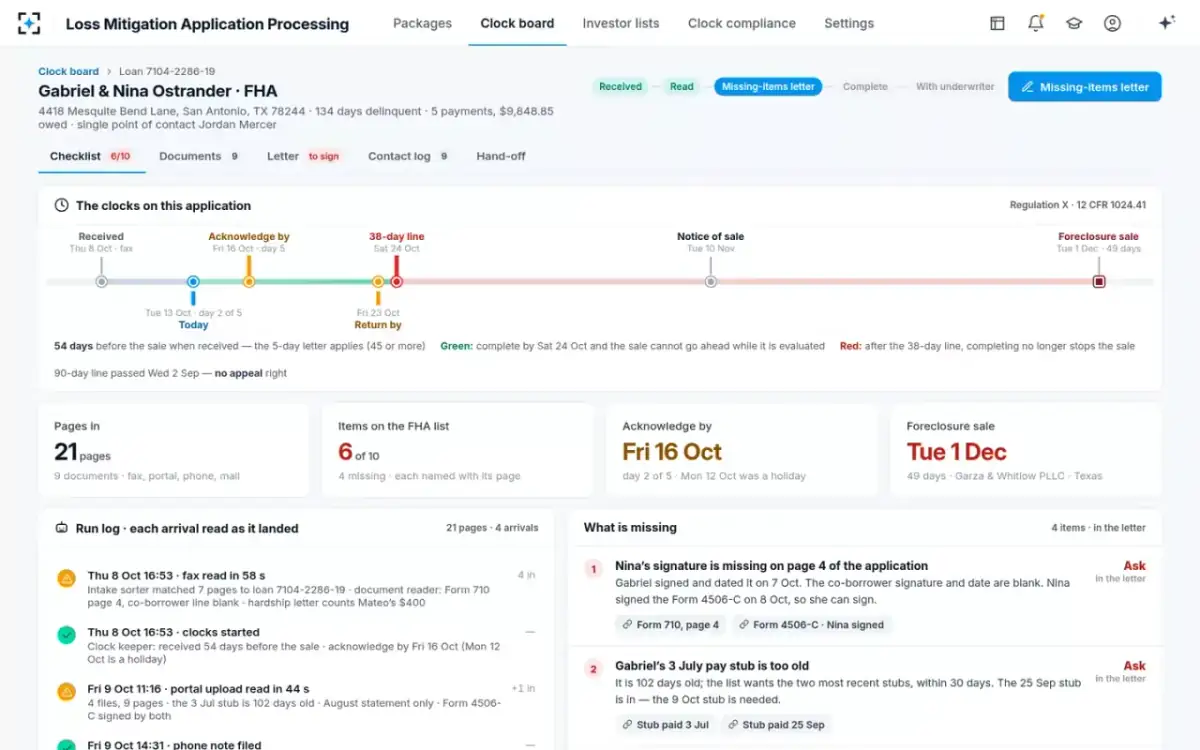
The sample application’s clocks, in days
54days
before the sale when the first page arrived
2of 5
business days used to send the acknowledgment
47days
before the sale when the file completed
9days
to spare before the 38-day line
The calendar and the return-by rule, as settings
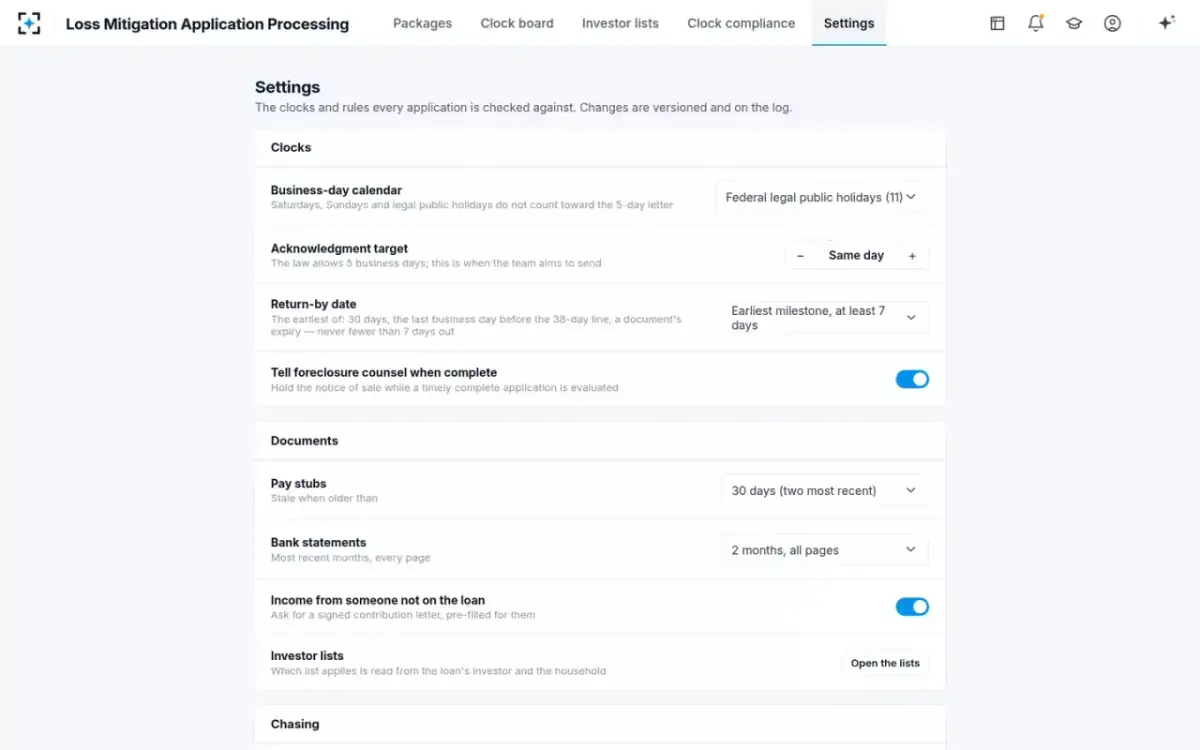
Every one of those dates came from three inputs: the date the first page arrived, the sale date and the holiday calendar. That is why the clock keeper in the solution needs nothing else to set them, and why a hand-built spreadsheet that misses one holiday or one rescheduled sale gets several dates wrong at once. The whole intake flow is on the Loss Mitigation Application Processing page.
Questions people ask
What is the continuity of contact requirement?
Under 12 CFR 1024.40 a servicer must assign personnel to a delinquent borrower by the time of the day-45 notice, reachable by phone, able to explain options, documents needed, application status and deadlines, and able to retrieve everything the borrower has sent. The assignment lasts until two consecutive on-time payments under a permanent workout.
Does the RESPA loss mitigation timeline apply to small servicers?
Mostly not. A small servicer, with 5,000 or fewer loans that it or an affiliate owns or originated, is exempt from 1024.39 to 1024.41 except the 120-day bar on starting foreclosure and the bar on foreclosing while a borrower performs under a workout agreement.
Do the COVID-19 loss mitigation exceptions still apply?
The temporary protections the CFPB added to Regulation X in 2021 were rescinded by an interim final rule effective 15 July 2025. Servicers should check any template, script or system rule that still refers to them.
Is the CFPB changing the loss mitigation timeline?
It proposed in July 2024 to replace the complete-application framework with a review cycle that would protect borrowers from foreclosure from their first request. The federal Unified Agenda, in its 2026 Regulatory Plan edition, lists the final rule for August 2026 (RIN 3170-AB04); none had been published by late October 2026, so the current timeline stands.
When does the 30-day evaluation clock start if the servicer later asks for more?
From the date the application is actually complete. If a facially complete application needs more and the borrower supplies it, the foreclosure protections date from facial completeness, but the 30-day clock and the notice of complete application use the later date.