Loss mitigation software for mortgage servicers takes in borrowers' hardship applications, checks them against what each investor requires, keeps the Regulation X and investor clocks, drafts the notices and hands a complete file to the people who decide. Whichever product you choose, most of the work of going live is not technical. It is writing down, for FHA, VA, USDA, Fannie Mae, Freddie Mac and your portfolio loans, what a complete application means, which documents go stale and when, which letters you send and who signs them, and which days count as business days. The software enforces those rules on every file, so a wrong rule becomes a wrong letter at scale. Botminds' Loss Mitigation Application Processing is built on that principle: the investor lists, calendar and letter rules are the servicer's own, versioned and reviewed by compliance, and the agents apply them.
This guide is for the buyer and the project lead. It lists what to bring, explains why FHA's list now looks so different from a GSE package, sets out the questions that separate one product from another, and says plainly where this solution fits and where it does not. Product examples come from a fictional sample servicer, Cinderbrook Mortgage Servicing, on sample data.
Why the rules, not the screens, decide a loss mitigation software project
5
investor rulebooks in a mixed book: FHA, VA, USDA, the GSEs and portfolio loans
25
archived versions of FHA’s servicing handbook between 2014 and August 2025
11
FHA Mortgagee Letters in 2026 by October, including Updates to Loss Mitigation Requirements
1
loss mitigation letter replaced before it took effect: ML 2025-06, by ML 2025-12
What is loss mitigation software for?
Loss mitigation software covers three distinct jobs, and buyers save months by deciding which one they are buying. The first is intake: receiving the borrower's pages from every channel, checking completeness against the investor's list, sending the five-day notice and chasing the gaps. The second is decisioning: running the investor's waterfall on a complete file to find the option the borrower qualifies for. The third is default management: the foreclosure and bankruptcy timelines that run alongside.
Loss Mitigation Application Processing is the first job only. Its six agents sort and read pages, apply the servicer's investor list for the loan, keep the clocks, draft the letters and build the package for the underwriter; it deliberately never chooses a workout option, moves a sale date or sends a letter without a person's signature. Botminds offers Loss Mitigation Waterfall Decisioning for the second job as a separate solution. Buying intake and decisioning as one product is common; testing them separately is still wise, because they fail in different ways.
What do I need to implement loss mitigation software?
You need ten things, and most of them are documents your compliance and default teams already own in some form. The table lists each, who usually owns it, and why the software cannot run without it.
What to bring to a loss mitigation software implementation
| Input | Usual owner | Why the software needs it |
|---|---|---|
| Investor lists: what a complete application is for each investor | Servicing compliance | The completeness test and the missing-items list are generated from them. Regulation X lets the servicer set its own requirements, so the lists are yours, not the vendor’s. |
| Household rules | Compliance, with default operations | How the list expands: every borrower signs, every earner shows income, anyone outside the loan whose money is counted signs a letter. |
| Staleness rules for each document | Compliance | When a pay stub or statement stops counting. They also cap the return-by date, because a date cannot fall after a submitted document goes stale. |
| Business-day calendar | Operations | Saturdays, Sundays and the 11 federal legal public holidays do not count toward the five days; add state or company closures if your policy does. |
| Return-by rule | Compliance | Thirty days by default, capped by the four milestones in the commentary, never under seven days. Write down which business day you choose before a milestone. |
| Letter templates and approved wording, in every language you send | Compliance and legal | Every required statement, in every language: examiners have cited Spanish notices missing a sentence the English ones carried. |
| Signing rules | Default operations | Who signs which letters, and who must be told when a sale is within 45 days. |
| Sale dates and counsel contacts | Foreclosure team | The 37, 45 and 90-day lines are counted from the sale date; the hold goes to the named counsel when a file completes. |
| Channel feeds: fax, portal, scanned mail, email, phone notes | IT and the call centre | Every page must be dated on arrival; a phone call can begin an application. |
| A sample of past applications, with their outcomes | Default operations | To replay before go-live: compare the software’s letters, dates and completion calls with what actually happened. |
Two items on the list take longest. The investor lists, because most servicers hold them as procedures and checklists rather than as one table per investor that a reviewer can sign; and the past applications, because someone has to pull the files and their real dates. Starting both before the vendor arrives is the cheapest acceleration available.
What documents does FHA require for loss mitigation in 2026?
Under HUD Mortgagee Letter 2025-12, in force since 1 October 2025, FHA requires a borrower's reason for financial hardship, their occupancy status, and hardship documentation only for certain hardships, and it does not require financial documents to evaluate a borrower for an option. HUD also bars a servicer from using financial documents to disqualify a borrower, other than the required hardship documentation (HUD ML 2025-12, Handbook 4000.1 III.A.2). The hardship reason may be taken by phone or electronically as well as in writing.
This is the single largest reason to treat investor lists as data rather than as a template. A servicer whose pre-2025 checklist asked every FHA borrower for pay stubs, bank statements and tax returns is now asking for documents the investor does not require, which delays the file, frustrates the borrower and can undermine the claim that the request was necessary. The sibling guide on the borrower response package sets out what a complete package holds under Fannie Mae's rules, and why each list must carry its investor and date.
How is a GSE borrower response package different?
A Fannie Mae or Freddie Mac borrower response package is built around the GSEs' Mortgage Assistance Application, Form 710, which the CFPB has described as the loss mitigation application most servicers use (CFPB Supervisory Highlights, Issue 22). What must accompany it, and which documents count for how long, is set by each GSE's servicing guide; we do not reproduce those guides here, and a buyer should take the current text from them directly.
An FHA request and a GSE package are different lists, maintained separately
FHA, since 1 October 2025: A request with the hardship reason, which may be given by phone, electronically or in writing.
Fannie Mae and Freddie Mac: Built around Form 710, the Mortgage Assistance Application.
FHA, since 1 October 2025: Not required to be evaluated; may not be used to disqualify, beyond hardship proof.
Fannie Mae and Freddie Mac: Set by each GSE’s servicing guide; read the current text there.
FHA, since 1 October 2025: Only for some hardships: a divorce decree or recorded quitclaim deed; a death certificate or obituary; PCS orders for a servicemember.
Fannie Mae and Freddie Mac: Set by each GSE’s servicing guide.
FHA, since 1 October 2025: HUD, through Mortgagee Letters and Handbook 4000.1.
Fannie Mae and Freddie Mac: Each GSE, through its own servicing guide and bulletins.
FHA, since 1 October 2025: The list, its version and the ML it follows.
Fannie Mae and Freddie Mac: The list, its version and the guide update it follows.
What does Reg X 1024.38 require for investor guidelines?
Regulation X requires a servicer's policies to be reasonably designed so that it can identify "with specificity all loss mitigation options for which borrowers may be eligible pursuant to any requirements established by an owner or assignee" (12 CFR 1024.38(b)(2)(ii)), and to keep each investor's criteria where staff can use them. The CFPB's commentary is explicit: "A servicer's policies and procedures must also be reasonably designed to ensure that such information is readily accessible to the servicer personnel involved with loss mitigation, including personnel made available to the borrower as described in § 1024.40" (comment 38(b)(2)(ii)-1).
Software that holds the investor lists as versioned data meets that test better than a shared drive of PDFs, but only if the lists are right and the people who talk to borrowers can see them. The commentary adds that investor requirements bind the servicer's evaluation even where 1024.41 itself does not apply, for example within 37 days of a sale. A list that the completeness checker uses and the named contact cannot read is half a solution.
Rulebooks that change faster than procedures
Investor rules change several times a year, and the software has to change with them on a date. FHA issued Mortgagee Letter 2025-06 in January 2025, effective February 2026, then replaced it in April 2025 with ML 2025-12, which moved the effective date forward to 1 October 2025 and limited borrowers to one permanent option every 24 months instead of 18. HUD's index lists eleven Mortgagee Letters in 2026 by October, including ML 2026-08, Updates to Loss Mitigation Requirements. VA opened its new Partial Claim Program on 15 June 2026, though servicers are not required to offer it until late November (NCLC, June 2026).
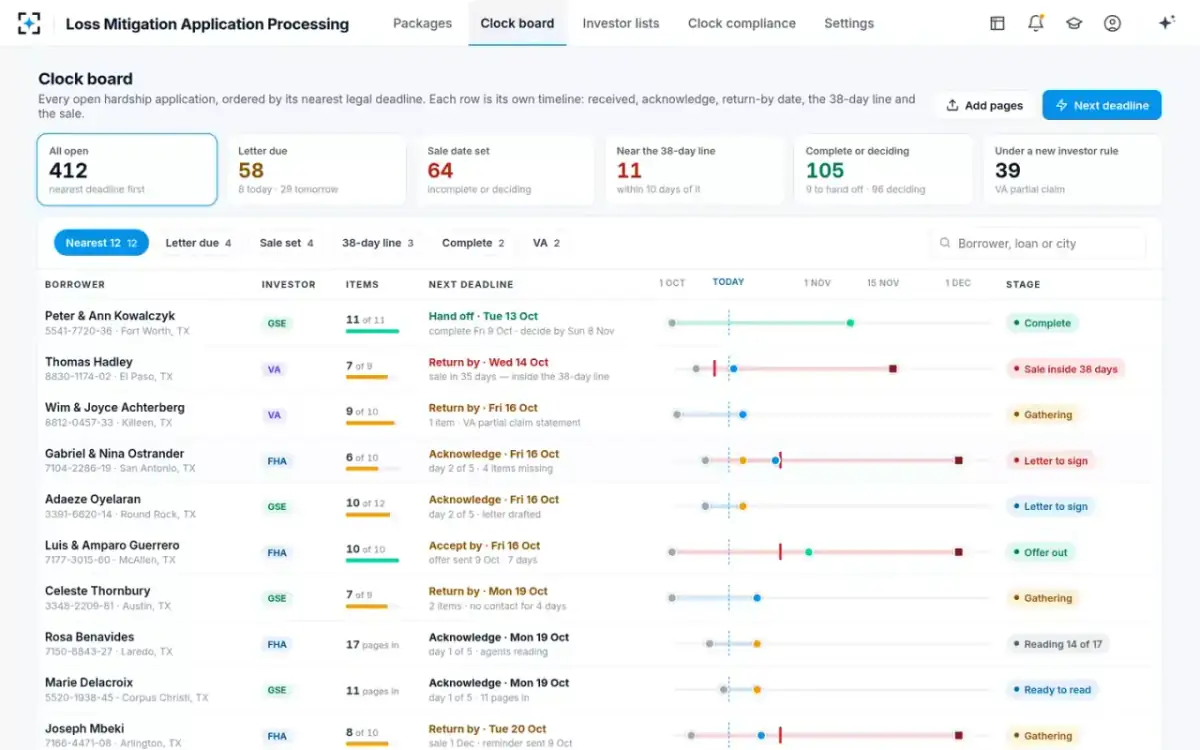
Two design requirements follow. Each investor list needs a version, an effective date and a reviewer, so that a file can be checked against the rule in force on the day it was received. And a rule change has to find the open files it affects. At the sample servicer the clock board flags 39 open applications under a new investor rule, the VA partial claim, so each one is re-checked rather than left on the old list.
Open applications under a new investor rule, counted on the board
The CFPB's own reform is the other moving part. Its July 2024 proposal would replace the complete-application framework with a "loss mitigation review cycle" and remove the complete-or-incomplete notice; the Fall 2025 Unified Agenda listed a final rule for August 2026, and none had been published by late October 2026 (reginfo.gov, RIN 3170-AB04). Software bought now should run today's rule and be able to switch, without a rebuild, if the proposal is finalised.
How long does it take to implement loss mitigation software?
The elapsed time is set mostly by how quickly you can produce and sign off the inputs above, not by installation. The sequence below is the one we would follow with any vendor; the longest steps are the investor lists and the replay of past files.
A go-live sequence that starts from your own rules
| Step | What happens | Done when |
|---|---|---|
| 1. Inventory | List every investor and loan type in the book, and every letter the intake desk sends. | Each investor has an owner for its list. |
| 2. Lists signed | Compliance writes one list per investor, with household rules and staleness, and signs a version. | A reviewer can read each list without the procedures manual. |
| 3. Letters approved | Templates and wording, in each language, checked against 1024.41(b)(2) and (c)(3). | Every required statement is present in every language. |
| 4. Calendar and dates | Business-day calendar, return-by rule, signing rules for sales within 45 days. | Dates match a hand calculation on twenty test files. |
| 5. Connect | Channel feeds dated on arrival; sale dates in; holds out to counsel. | A test page from each channel lands on the right loan with its time. |
| 6. Replay | Run 50 to 100 past applications through and compare letters, dates and completion calls with what happened. | Every disagreement explained, and the rule or the past file corrected. |
| 7. Run alongside | New applications go through both, the old process deciding. | The team trusts the drafts enough to sign them. |
Questions to put to any loss mitigation software vendor
The questions below are the ones that expose how a product behaves on the hard files. Ask for each answer to be shown on your own past applications, not on a demonstration file.
Questions that separate loss mitigation software products
- Does it date every page on arrival, by channel?
Including scanned mail and a phone call that becomes an application. The five-day clock does not wait for indexing.
- Does it count business days without legal public holidays?
Show the calendar, and how a state or company closure is added.
- Does the return-by date respect all four milestones and the seven-day floor?
Stale documents, day 120, 90 and 38 days before a sale. Many tools encode only the 30-day default.
- Does it ever fill a gap?
A missing signature, date or figure must be asked for, never inferred. Ask to see the rule that forbids it.
- Can every missing item show the page it concerns?
The specialist signing the letter, and the examiner reading it later, need the evidence.
- Does it mark complete only with a page for every item?
And does the hold go to counsel when the last item arrives, or after a review queue?
- Who signs, and can that be enforced?
Nothing should leave without a named person’s signature; escalation when a sale is within 45 days.
- Are investor lists versioned, with effective dates?
And does a rule change find the open files it affects?
- What happens when it is down?
A failed platform that sends no notices is still the servicer’s violation; ask for the fallback.
- Will you replay our past files before we sign?
Fifty to a hundred, with every disagreement explained.
The downtime question is not hypothetical. In its 2016 mortgage servicing edition, the CFPB reported that "one or more servicers failed to send any loss mitigation acknowledgment notices due to a repeated loss mitigation processing platform malfunction over a significant period of time", and directed remediation for borrowers' interest, fees and other harm (CFPB, 2016).
Where Loss Mitigation Application Processing fits, and where it does not
The solution fits servicers that are subject to 1024.41, service for more than one investor, and receive applications through several channels: the shape where intake errors are most expensive. It suits operations whose problem is the days between first page and complete file, and compliance teams who want every letter and clock on one log. Small servicers exempt from most of 1024.41 will find less of it necessary.
It does not choose workout options, run the waterfall, manage the foreclosure itself, or replace the servicing system that holds the loan. It does not remove responsibility, and no vendor can. The CFPB's guidance on service providers, still in force, says that using one "does not absolve the supervised bank or nonbank of responsibility for complying with Federal consumer financial law to avoid consumer harm" (CFPB Bulletin 2016-02). That is why the servicer's people sign every letter, own every list and confirm every completion. The cost side of the decision is set out in how long loss mitigation takes to process, and the full product is on the Loss Mitigation Application Processing page.
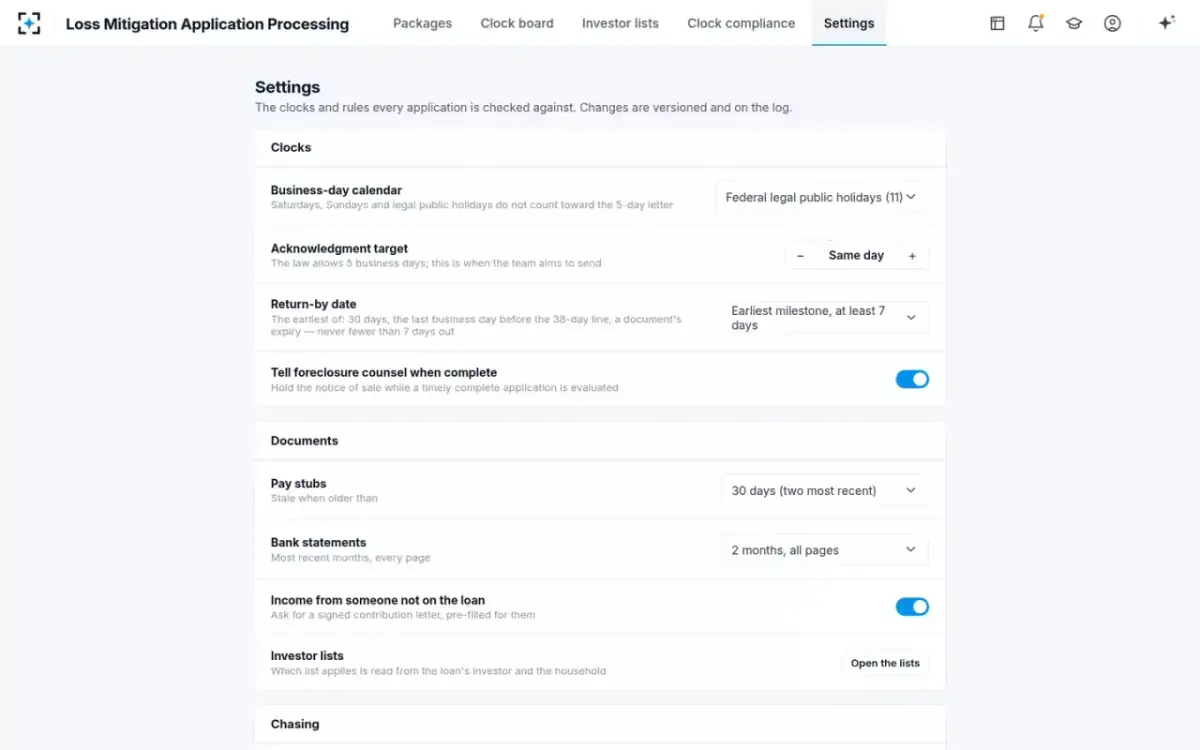
The servicer’s rules, as settings a reviewer can read
Questions people ask
What is the best loss mitigation software?
The one that applies your investor rules correctly on your own past files. Judge products by a replay of 50 to 100 closed applications: whether their letters name the right items, their dates respect the milestones, and their completion calls and holds match the real dates.
Can loss mitigation software send notices without a person?
Regulation X does not say who must send the notice, only what it must contain and when. Most servicers keep a person's signature on every letter, and the CFPB holds the servicer responsible for whatever its tools send.
Does loss mitigation software replace the servicing system?
No. The servicing system remains the system of record for the loan, payments and delinquency. Intake software reads loan and sale data from it and from the foreclosure system, and returns the letters, dates and a complete package.
Does the software need to change if the CFPB finalises its 2024 proposal?
Yes. The proposal would remove the complete-or-incomplete notice and replace the complete-application framework with a review cycle. It was still not final in late October 2026, so software should run the current rule and keep its notices and clocks configurable.
Should FHA borrowers still be asked for pay stubs?
Not to be evaluated. Since 1 October 2025, HUD has said the borrower is not required to provide financial documentation and that the servicer must not use it to disqualify them, beyond the hardship documentation HUD lists for some hardships.