A loss mitigation acknowledgement letter is the written notice a mortgage servicer must send within five days, not counting Saturdays, Sundays and legal public holidays, after receiving a borrower's loss mitigation application, when the application arrives 45 or more days before a foreclosure sale. Under 12 CFR 1024.41(b)(2)(i)(B) it must acknowledge receipt, say whether the application is complete or incomplete, list the documents and information still needed, give a reasonable date to send them, and tell the borrower to consider contacting the servicers of any other mortgages on the property. It is short, it is routine, and it has been an examination finding again and again, because each element depends on reading every page correctly before the fifth day. Botminds' Loss Mitigation Application Processing drafts the letter from the pages themselves, item by item, checks it against those elements, and sends nothing until the intake specialist signs.
This guide quotes the rule, counts the days, annotates a model letter, collects what examiners have found wrong since 2016, and explains why the letter is still required although the CFPB has proposed to remove it. Examples come from a fictional sample servicer, Cinderbrook Mortgage Servicing, on sample data.
The acknowledgement letter in four numbers
5days
business days from receiving the application: weekends and legal public holidays excluded
45days
or more before a sale, or no sale scheduled: the letter is required
5
things it must say: receipt, complete or not, what is missing, by when, other servicers
6
CFPB Supervisory Highlights editions since 2016 that we found citing these notices
What must a loss mitigation acknowledgement letter include?
The rule sets the content in two sentences and a requirement for a date. The servicer must "Notify the borrower in writing within 5 days (excluding legal public holidays, Saturdays, and Sundays) after receiving the loss mitigation application that the servicer acknowledges receipt of the loss mitigation application and that the servicer has determined that the loss mitigation application is either complete or incomplete. If a loss mitigation application is incomplete, the notice shall state the additional documents and information the borrower must submit to make the loss mitigation application complete and the applicable date pursuant to paragraph (b)(2)(ii) of this section. The notice to the borrower shall include a statement that the borrower should consider contacting servicers of any other mortgage loans secured by the same property to discuss available loss mitigation options" (12 CFR 1024.41(b)(2)(i)(B)).
Paragraph (b)(2)(ii) adds that the notice "must include a reasonable date by which the borrower should submit the documents and information necessary to make the loss mitigation application complete". The commentary turns "reasonable" into rules: generally 30 days, never later than the next milestone such as 38 days before a sale, never fewer than seven days; the guide on the incomplete loss mitigation application works the date through on a real calendar. Before any of this, the servicer must review the application "promptly upon receipt" to decide whether it is complete.
Is the 5 day letter business days?
Yes. The five days exclude Saturdays, Sundays and legal public holidays, so in practice they are five business days, and a week with a federal holiday stretches the deadline by a day. The legal public holidays are the eleven listed in federal law: New Year's Day, Martin Luther King Jr.'s Birthday, Washington's Birthday, Memorial Day, Juneteenth, Independence Day, Labor Day, Columbus Day, Veterans Day, Thanksgiving and Christmas (5 U.S.C. 6103). State holidays and company closures do not extend the federal count, although a servicer may choose a stricter internal target.
The count starts from receipt. At the sample servicer, an application faxed on Thursday 8 October counted Friday 9 October as day 1; Saturday, Sunday and Monday 12 October, Columbus Day, did not count; Tuesday 13 was day 2 and Friday 16 October was day 5. The letter went on day 2. A team that counted Columbus Day would have believed its deadline was Thursday 15, which is harmless; a team that forgot that the fax came in on Thursday afternoon, not Friday morning, would have been a day late.
The notice of a complete loss mitigation application must be sent within five days
When an application becomes complete, a second notice is due within the same five business days, under 1024.41(c)(3)(i), with six required statements: that the application is complete; the date the servicer received it; that the servicer expects to decide within 30 days of that date; which foreclosure protections now apply, worded differently depending on whether the first foreclosure notice or filing has been made; that the servicer may need more information later, and that protections could end if it is not provided; and that the borrower may have more protections under state or federal law.
It is not required if the acknowledgement letter itself already said complete and nothing more has been asked for since, if the application was not complete or facially complete more than 37 days before a sale, or if the servicer has already sent its decision. The commentary requires a fresh notice every time the application becomes complete again after a later request, with the new date. Many servicers therefore build the two letters from one template with two branches.
Sample loss mitigation acknowledgment letter, annotated
The model below is our wording, adapted from the letter the solution drafted for one sample application at the fictional servicer. Each numbered passage meets one requirement or one lesson from an exam finding; the notes say which.
A model acknowledgement letter for an incomplete application, with what each passage does
We received your request for mortgage help. A few things are still missing.
1 Thank you. We received the first part of your application on Thursday, October 8, by fax, and more on October 9 and October 13. We have read every page.
2 Your application is not yet complete. Please send the four items below by Friday, October 23, 2026.
3 1. Page 4 of your Mortgage Assistance Application, signed and dated by Nina. Gabriel has signed; Nina’s line is blank. A copy of page 4 is enclosed.
2. Gabriel’s pay stub dated October 9. We have the stub of September 25; the stub of July 3 is too old for us to use.
3. Your September statement from Arroyo Seco Credit Union, every page, even blank ones.
4. A signed letter from Mateo saying he pays $400 a month toward your home. We enclose one already filled in; he only needs to sign and date it.
4 Why this date matters: a foreclosure sale of your home is scheduled for Tuesday, December 1. If your application is complete by October 23, the sale will not go ahead while we review it, and we will give you our decision within 30 days.
5 What we already have: your hardship letter, the September 25 pay stub, Nina’s benefit letter, your August bank statement, your 2025 tax return and the signed Form 4506-C.
6 If another company services a second mortgage or home equity loan on this home, you should consider contacting them to discuss the help they may be able to offer.
7 How to send: upload in your online account, fax, or mail in the enclosed envelope. Your contact is Jordan Mercer, with a direct number and hours. We may ask for more information later if the review needs it.
- Receipt, with dates and channels. Acknowledges receipt as the rule requires; the dates let the borrower see what counted.
- Complete or incomplete, in words. The finding the CFPB reported in 2024: notices that did not say which.
- Each missing item: what, whose, why. The rule requires the documents and information needed; naming the person and the period is what makes the request answerable.
- The date, and why it matters. The reasonable date is required; the reason is ours. Never promise more protection than the rule gives.
- What is already in. Not required, but it stops duplicate sending and shows the borrower the file is being read.
- Other servicers on the property. Required. Examiners found it missing from Spanish versions of notices that carried it in English.
- How to send, and who to call. The named contact under 1024.40; the warning that more may be needed supports the facially complete rule.
Two choices in the model deserve attention. Passage 4 explains the protection in conditional words, "if your application is complete by", because the CFPB has treated a promise not to foreclose before a deadline as deceptive when the servicer then foreclosed. And passage 3 asks for the September statement "every page, even blank ones", because a statement missing its last page is the commonest reason for a second request.
What did examiners find wrong with acknowledgment letters?
Examiners have found almost every way a five-day letter can fail: not sent, sent late, not saying complete or incomplete, missing a required sentence, promising protection the servicer did not give, and leaving the borrower to work out the rest. The table collects the findings we could trace to the CFPB's own publications.
What CFPB examiners found wrong with acknowledgement notices, and the fix
| Publication | What examiners found | The fix in the letter process |
|---|---|---|
| CFPB action against Flagstar, 2014 | The bank “failed to tell borrowers when their applications were incomplete”. | A notice on every application, with its status, by day 5. |
| Supervisory Highlights, mortgage servicing edition, 2016 | No acknowledgement notices at all for a significant period because of a platform malfunction; and notices promising no foreclosure before the document deadline, followed by foreclosure. | A fallback when systems fail; protection described in conditional terms the servicer will honour. |
| Supervisory Highlights, Summer 2017 | Failures to send acknowledgement and evaluation notices with correct information, “putting the onus on borrowers to try to determine what else they had to do”. | Every missing item named; nothing left to inference. |
| Supervisory Highlights, Issue 21, 2020 | No written notice of complete or incomplete within 5 days. | Business-day calendar with legal public holidays; letters drafted on day 1. |
| Supervisory Highlights, Issue 23, 2021 | Acknowledgement letters to borrowers in forbearance missing that they would be evaluated for all options once the application was complete. | Statements that depend on circumstance generated from the file, not a fixed template. |
| Supervisory Highlights, Issue 30, 2023 | Spanish-language notices without the statement about other servicers on the property, which the English notices carried. | Every required sentence checked in every language before sending. |
| Supervisory Highlights, Issue 33, 2024 | Notices that “failed to specify whether the borrowers’ applications were complete or incomplete”. | A required status line the letter cannot be signed without. |
The 2024 finding is the plainest. In the CFPB's words, "Examiners found that servicers violated Regulation X by sending acknowledgment notices to borrowers that failed to specify whether the borrowers' applications were complete or incomplete" (CFPB Supervisory Highlights, Issue 33). A letter that says "we have received your documents and will be in touch" acknowledges receipt and does nothing else the rule requires.
Borrowers' advocates saw the same gap from the other side. In the CFPB's survey of housing counselors for its 2019 assessment, "Many reported experiences with clients who did not receive a letter within five days acknowledging the receipt of loss mitigation applications" (CFPB, 2019). The private cost can follow: RESPA lets a borrower sue for actual damages and, for a pattern or practice of noncompliance, up to $2,000 more, with class awards capped at the lesser of $1 million or 1% of the servicer's net worth (12 U.S.C. 2605(f)).
Writing the missing items so a family can act on them
The rule requires the letter to state the documents and information needed; it does not require them to be clear, but every finding above is a failure of clarity. The checklist below is the standard the solution's letter writer works to, and the one we would hold any template to.
Rules for the missing-items list in an acknowledgement letter
- One item per line, numbered
The borrower and the named contact can refer to “item 3” on the phone.
- Name the document exactly
Issuer, account ending, period or date: “your September statement from the credit union, account ending 4471”.
- Say whose it is
A co-borrower’s signature, a second earner’s stub, a relative’s contribution letter.
- Say why it is needed
Too old, a page missing, a line blank, income mentioned in the hardship letter without proof.
- Point to the page
Page 4 of the application; the last page of the statement. Enclose a copy where you can.
- Enclose what you can fill in
A contribution letter pre-filled with the name, address and amount, ready to sign.
- Never ask for what you have or can get
Not the stub already received; not the credit report the servicer orders itself.
- Never write “other documents as needed”
If it is needed, name it. If you may need more later, say so separately.
The drafted letter, checked before anyone signs
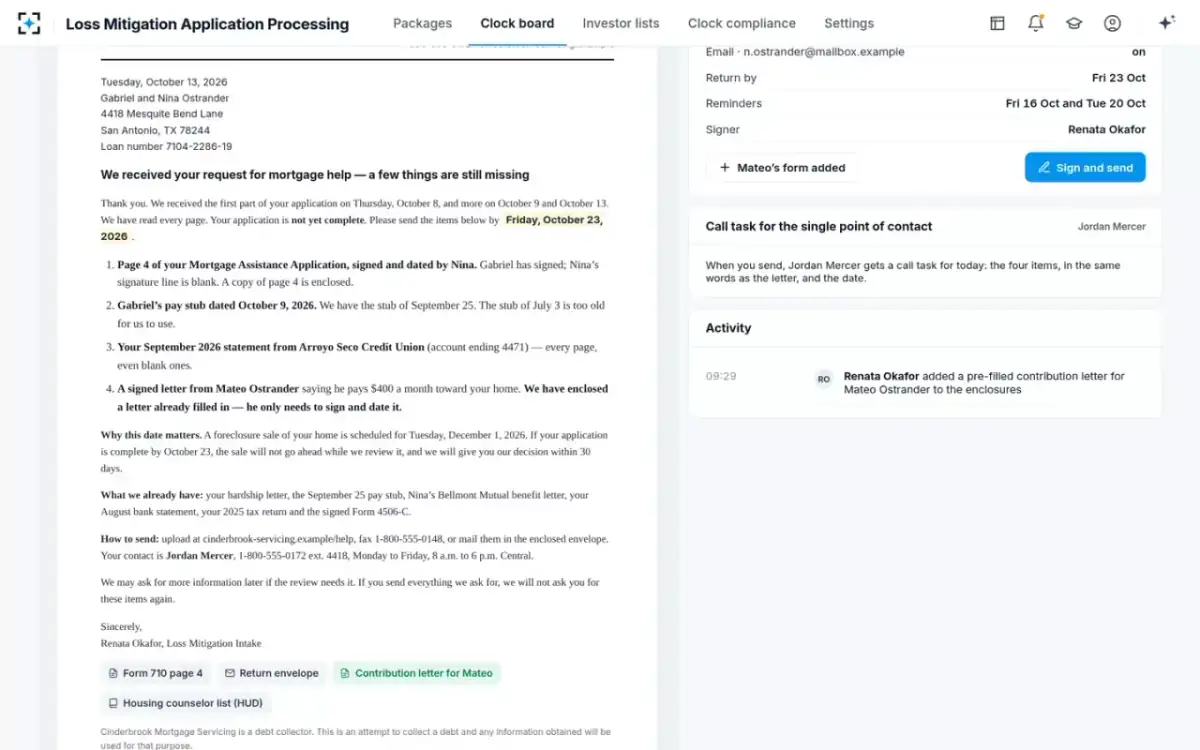
Who signs the letter, and how it goes out
Regulation X requires the notice in writing and within five business days; it does not say who signs or which channel to use. The servicer's policy should, because the signature is where the servicer accepts responsibility for every item and date. At the sample servicer the intake specialist signs each letter; when a sale is within 45 days, the intake lead signs and the director is told. Before the signature the screen confirms four things: every item names what and why, the return date beats the 38-day line, the sale date and protection are explained, and the contact and channels are set. The letter then goes by mail, portal and email, with reminders set for day 3 and day 7 and a same-day call task for the named contact.
The four checks that stand between a draft and a sent letter
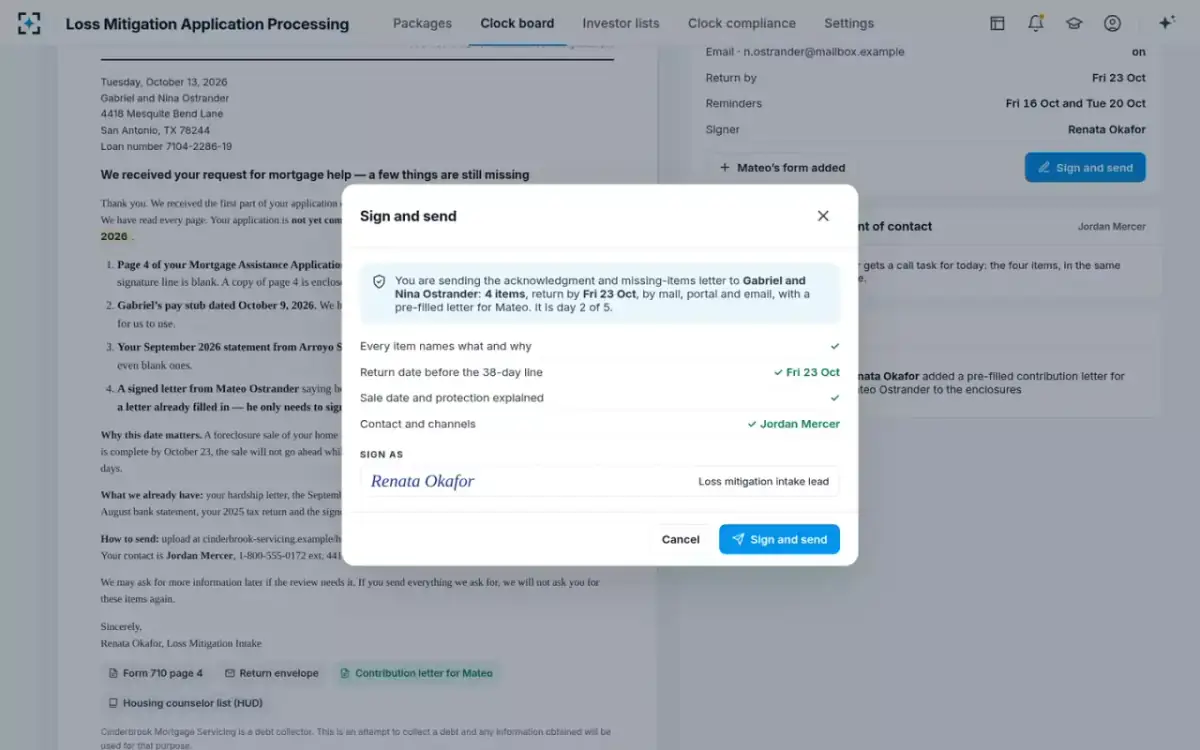
Is the CFPB removing the acknowledgment notice?
The CFPB has proposed to, but the proposal is not final, so the notice is still required. Its July 2024 proposal would replace the complete-application framework with a "loss mitigation review cycle", and said: "The CFPB is also proposing to remove currently required loss mitigation notices that would no longer be necessary under the new proposed framework, such as those notifying a borrower about whether a loss mitigation application is complete or incomplete" (89 FR 60204). The Fall 2025 Unified Agenda listed the final rule for August 2026; as of late October 2026 no final rule or withdrawal had been published (reginfo.gov, RIN 3170-AB04).
Even a final rule would not end the letter for FHA loans. HUD's handbook separately requires, for a loss mitigation request received 45 or more days before a scheduled sale, written notice within five business days that the request was received and whether it is complete or incomplete (HUD ML 2025-12). Servicers should keep the letter and keep its content configurable. The whole drafting and signing flow is on the Loss Mitigation Application Processing page, and the clocks around it are drawn in the RESPA loss mitigation timeline.
Questions people ask
Does the acknowledgement letter have to say "complete" when the application is complete?
Yes. The notice must say complete or incomplete either way. If it says complete and nothing more is requested afterwards, the separate notice of complete application under 1024.41(c)(3) is not required, though many servicers send the fuller content anyway.
Is an acknowledgement letter needed when the borrower applies by phone?
If the borrower expresses interest in an option and gives information the servicer would evaluate, the commentary treats that as an application, so the five-day clock runs from the call. A call that only asks about options, with no information given, is an inquiry, not an application.
Does Regulation X require the letter in Spanish?
Regulation X does not require translation. If a servicer sends the notice in another language, the CFPB expects every required statement in it; in 2023 it cited Spanish notices that dropped the sentence about other servicers on the property.
What happens if the servicer misses the five-day deadline?
It is a violation of 1024.41(b)(2), which borrowers can enforce under RESPA section 6(f) for actual damages and, for a pattern or practice, up to $2,000 in additional damages. Late letters also eat into the borrower's time before the next milestone.
Does a new servicer have to send its own acknowledgement letter after a transfer?
If the five-day period had not expired at the transfer date and the old servicer had not sent the notice, the new servicer must send it within 10 business days of the transfer date. It must also honour the old servicer's timeframes for the rest of the application, under 1024.41(k).