An incomplete loss mitigation application is one where the servicer has not yet received everything it requires from the borrower to evaluate them for the options the loan's owner offers. If it arrives 45 days or more before a foreclosure sale, Regulation X (12 CFR 1024.41(b)(2)) requires the servicer to tell the borrower in writing, within five business days, that the application is incomplete, which documents and information are still needed, and a reasonable date to send them. Getting that notice right is harder than it sounds: the pages arrive by fax, portal, mail and phone, each investor defines complete differently, and the return date has to be worked back from the foreclosure calendar. Botminds' Loss Mitigation Application Processing reads every page as it lands, names each gap with the page it concerns, and drafts the request for a specialist to check and sign.
This guide covers what the notice must contain, how to choose the date, what reasonable diligence requires after the letter goes out, and how to design software that asks without guessing. Worked examples come from a fictional sample servicer, Cinderbrook Mortgage Servicing; its borrowers and loans are sample data.
The four numbers behind every incomplete-application notice
5days
business days to send the notice, if the application came 45 or more days before a sale
30days
after the notice: a return date the CFPB calls generally reasonable
7days
the shortest return date the commentary allows, whatever the milestones
38days
before a sale: the latest the return date may fall, among other milestones
What is an incomplete loss mitigation application?
An application is incomplete until the servicer holds every document and piece of information it requires from the borrower, and the servicer, not the regulation, writes that list. The CFPB's commentary says a servicer "has flexibility to establish its own application requirements and to decide the type and amount of information it will require" (comment 41(b)(1)-1). In practice the list follows the investor: FHA, VA, USDA, Fannie Mae, Freddie Mac and portfolio loans each ask for different things, and FHA, since October 2025, does not require financial documents at all (HUD ML 2025-12).
Two edges of the definition trip teams up. First, an application starts earlier than many think: the commentary reads the term broadly, so a borrower who asks to be prequalified and gives information the servicer would evaluate has applied, even by phone. Second, information outside the borrower's control does not hold an application open. If the servicer needs a credit report, the application is complete once the borrower has sent everything asked of them, whether or not the report has come back (comment 41(b)(1)-5). At the sample servicer the credit report was pulled by the servicer itself and never appeared on the borrower's list.
What must the incomplete application notice say?
The notice must say five things: that the servicer received the application, that it is incomplete, the additional documents and information the borrower must send, the date to send them by, and that the borrower should consider contacting the servicers of any other mortgages on the same property (12 CFR 1024.41(b)(2)(i)(B)). It is due within five days, not counting Saturdays, Sundays and legal public holidays, and it applies when the application came 45 or more days before a scheduled sale; if no sale is scheduled, the commentary treats the application as 45 or more days out.
Content of an incomplete-application notice under 1024.41(b)(2)
- Receipt acknowledged
The servicer says it has the application. Naming the date and channel of each arrival helps the borrower see what counted.
- Complete or incomplete, stated
Examiners have cited notices that left the borrower to guess. Say "not yet complete" in words.
- Every missing document and piece of information
Specific enough to act on: which document, whose, for what period, and why it is needed.
- A reasonable date to send it
No later than the next milestone, never fewer than seven days out. See the next section.
- Other servicers on the same property
A statement that the borrower should consider contacting them about their options. Missing it is a violation in any language.
- Sent within five business days
Counted from receipt of the application, excluding Saturdays, Sundays and legal public holidays.
The wording of each item matters as much as its presence, and the sibling guide on writing the loss mitigation acknowledgement letter takes the letter apart element by element. What follows is the part of the notice that most often goes wrong: the date.
What is a reasonable date to return documents?
A reasonable return date is generally 30 days after the notice, but never later than the borrower's next milestone and never fewer than seven days out. The regulation itself says only "a reasonable date". The CFPB's commentary fills it in. Thirty days is the default: a servicer complies "by including a date that is 30 days after the date the servicer provides the written notice" (comment 41(b)(2)(ii)-1). Then the cap: "the reasonable date must be no later than the earliest of" four milestones (comment 41(b)(2)(ii)-2):
- the date any document already submitted "will be considered stale or invalid" under the rules of any option available to the borrower;
- "the 120th day of the borrower's delinquency";
- "the date that is 90 days before a foreclosure sale";
- "the date that is 38 days before a foreclosure sale".
And the floor: "A reasonable date ... must never be less than seven days from the date on which the servicer provides the written notice" (comment 41(b)(2)(ii)-3). Each milestone protects something. Before day 120 the borrower can complete the file before foreclosure can start; 90 days before a sale preserves the right to appeal a denial; 38 days before a sale is the last day on which completing the file stops the sale.
Working out the return date on one sample application
| Milestone | Date for this loan | Still ahead on the notice date? |
|---|---|---|
| 30 days after the notice (the default) | Thursday 12 November | Yes, but later than a milestone below |
| A submitted document goes stale | Depends on the servicer’s staleness rule for each document | Checked document by document |
| 120th day of delinquency | Already passed: the loan is 134 days delinquent | No |
| 90 days before the sale (Tuesday 1 December) | Wednesday 2 September | No: the appeal right has gone |
| 38 days before the sale | Saturday 24 October | Yes: the earliest remaining milestone |
| Seven-day floor from the notice | Tuesday 20 October | The date may not fall before this |
| Date chosen | Friday 23 October | Last business day before the 38-day line; 10 days for the family |
The arithmetic shows why the date cannot come from a template. A letter that gave the default 30 days would have set 12 November, nineteen days after the family lost the protection that completing the file before 24 October would have given them. And because the protections are fixed on the day the complete application is received (1024.41(b)(3)), a sale postponed later does not rescue a family that missed the line.
How long does a borrower have to send missing documents?
The borrower has until the date in the notice, which is usually 30 days and can be as short as seven when a sale is close. That date is a target, not a cliff. Nothing in the rule makes the application void on day 31; it stays incomplete, the servicer keeps its duty of reasonable diligence, and what the borrower loses is time against the milestones. The servicer may, at its discretion, evaluate an application that "remains incomplete for a significant period of time under the circumstances without further progress by a borrower" (1024.41(c)(2)(ii)), and the commentary notes that fifteen days can be a significant period when a sale is less than 50 days away.
Investor rules can be stricter or looser. FHA's handbook, for a request received more than 37 but fewer than 45 days before a scheduled sale, lets the servicer evaluate an incomplete request and offer a proprietary option if it is not completed "despite the Mortgagee's repeated requests" (HUD ML 2025-12). The practical rule for the intake desk is to treat the return date as the borrower's best chance and the milestones as the real deadline.
Can a servicer deny an incomplete loss mitigation application?
Generally, no: a servicer may not use an incomplete application to avoid the full evaluation the rule requires. Section 1024.41(c)(2)(i) bars a servicer from evading the duty to evaluate a complete application for all options by offering something based on an incomplete one. There are three exceptions in the text. A servicer may offer a short-term forbearance of up to six months or a short-term repayment plan on an incomplete application, with a written notice that says so and that the borrower can still complete it. It may evaluate an incomplete application after a significant period without progress, as above. And it may deny a complete application for lack of third-party documents only after reasonable diligence and a significant period beyond the 30 days (1024.41(c)(4)(ii)).
What a servicer may not do is let the incomplete status do the denying. Examiners reported in early 2020 that servicers failed "to notify borrowers in writing that an application was either complete or incomplete within 5 days of receiving the application" (CFPB Supervisory Highlights, Issue 21). An application that sits incomplete because nobody told the borrower what was missing is the servicer's failure, not the borrower's.
What does reasonable diligence require after the letter?
Reasonable diligence means asking promptly and following up until the file is complete or the borrower stops responding. The commentary is direct: "A servicer must request information necessary to make a loss mitigation application complete promptly after receiving the loss mitigation application" (comment 41(b)(1)-4). Its examples are ordinary: calling the borrower promptly when an address or phone number is needed to verify employment; a new servicer checking the documents it inherited before asking the borrower again.
The rule does not set a cadence, so the servicer must. At the sample servicer, the settings send reminders on day 3 and day 7 after the letter, a same-day call from the named contact with the items in the letter's own words, and a pre-filled letter for anyone outside the loan whose income the file counts. Those choices are policy, versioned and logged, which is what an examiner will ask to see when a file stalled.
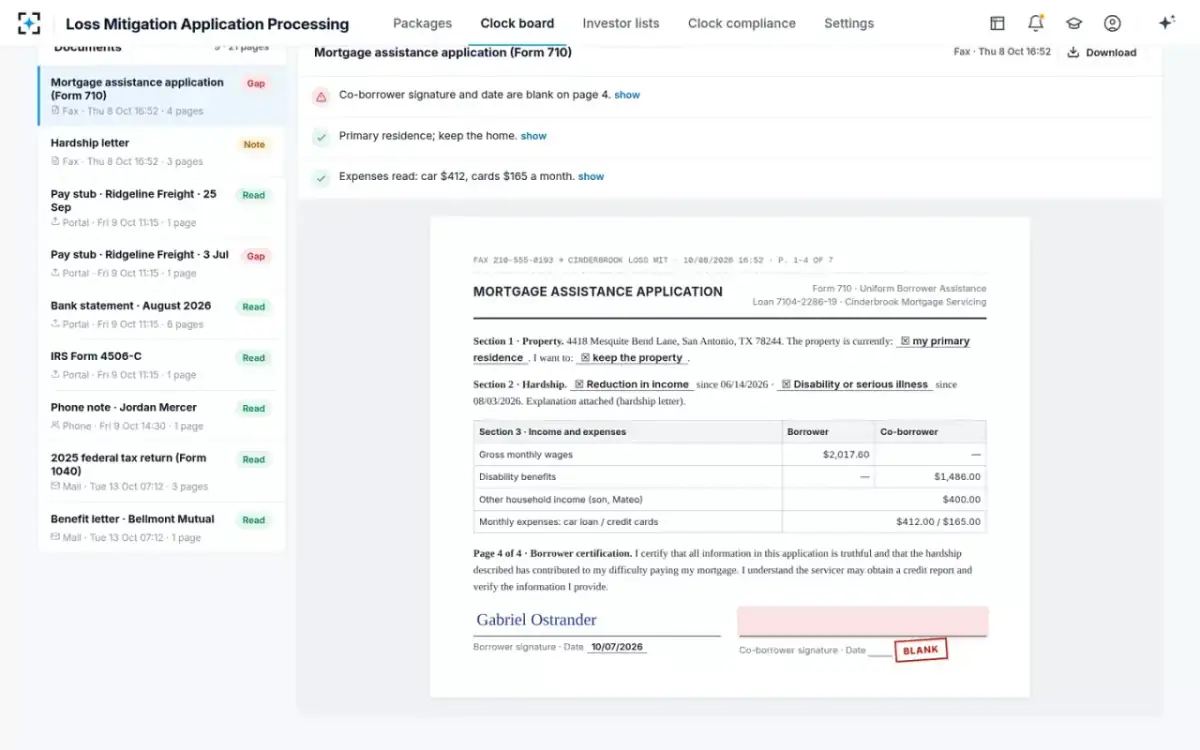
Each missing item, shown on the page it is about
Why "other documents as needed" is not a request
A request that does not name the document leaves the borrower to guess, and a guess that misses costs the borrower days the milestones do not give back. The CFPB has gone further than vague wording. In its 2016 mortgage servicing edition it reported acknowledgment notices that "represented homes would not be foreclosed on before the deadline passed for submitting missing documents. But the servicer(s) foreclosed on homes before the submission deadline", and found them deceptive "independent of whether or not the servicing rules permitted the servicer(s) to foreclose" (CFPB, 2016). The lesson for the drafter: every sentence in the notice is a representation.
The same four gaps, asked for two ways
A template request: Please sign and return the application.
A request a family can act on: Page 4 of your mortgage assistance application, signed and dated by Nina. Gabriel has signed; her line is blank. A copy of page 4 is enclosed.
A template request: Provide recent pay stubs.
A request a family can act on: Gabriel’s pay stub dated 9 October. We have the stub of 25 September; the one of 3 July is too old for us to use.
A template request: Provide two months of bank statements.
A request a family can act on: Your September statement from Arroyo Seco Credit Union, every page, even blank ones. We have August.
A template request: Other documents as needed.
A request a family can act on: A signed letter from Mateo saying he pays $400 a month toward your home. We enclose one already filled in; he only signs and dates it.
The right-hand column also shows what the notice does not ask for: the documents already received, and the credit report the servicer pulled itself. A request list that repeats what the file holds wastes the family's time and undermines trust in the rest of the letter. That discipline is one of the levers behind why some servicers complete far more applications than others.
Can AI request missing loan modification documents?
Software can draft the request, and should, as long as a person checks and signs it and the software never fills a gap itself. Nothing in Regulation X says who or what writes the notice; it says what the notice must contain and when it must go. The risk with automation is the one the CFPB described in the HAMP era, when document collection failed borrowers through "events such as the servicer losing documents the borrower sent" (CFPB, 2024): a system that loses, misfiles or misreads a page turns a complete file into an incomplete one.
How the six agents in Loss Mitigation Application Processing turn pages into a signed request
Agent
Intake sorterMatches each page from fax, portal, mail, email and phone notes to its loan and document type; records channel and time of receipt.
Never: guesses a loan; unmatched pages go to a person with suggested matches
Agent
Document readerReads signatures, dates, pay periods, balances and page counts; marks anything blank, stale or partial, with the page.
Never: fills in a missing signature, date or number
Agent
Completeness checkerApplies the servicer’s list for the loan’s investor and expands it for the household: every borrower signs, every earner shows income.
Never: asks for what the list does not require or the servicer can pull itself
Agent
Clock keeperCounts business days, sets the acknowledge-by and return-by dates against the milestones from the sale date.
Never: moves a sale date or a deadline
Agent
Letter writerDrafts the notice item by item: what, whose, why, which page; pre-fills any letter a contributor must sign.
Never: writes “other documents as needed”
A person decides
Intake specialistChecks that every item says what and why and the date beats the line, then signs and sends by mail, portal and email.
The design choice that matters most is the one in the "never" lines. An agent that reports a blank signature line and asks for it is safe; one that infers the co-borrower meant to sign is not. The same goes for the date: the agent proposes it from the milestones, and the person who signs owns it. When a sale is within 45 days, the sample servicer requires the intake lead to sign and tells the director.
The checks a person confirms before the request goes
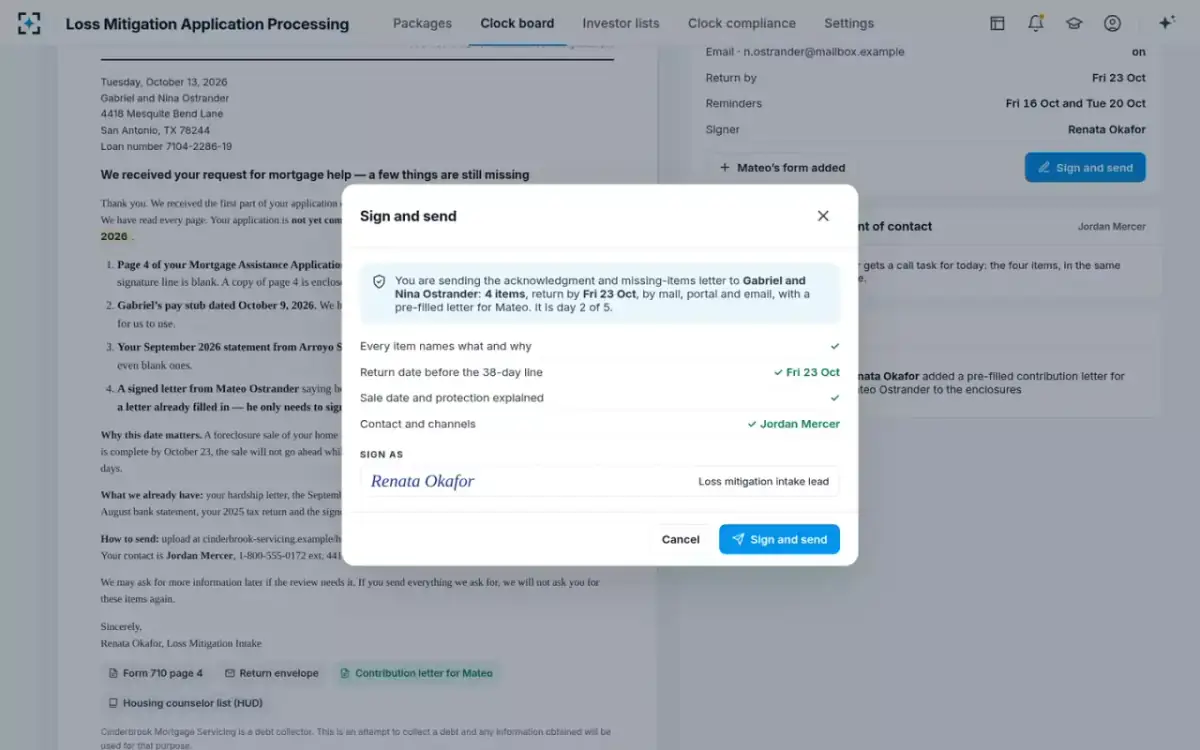
If a borrower then sends exactly what the notice listed, the application becomes facially complete and foreclosure protection attaches that day, even if the servicer later needs more. The sibling guide on facially complete applications covers what that means for the hold.
Questions people ask
Is an incomplete loss mitigation application protected from foreclosure?
Partly. The 120-day bar on starting foreclosure protects every delinquent borrower, application or not. The stronger protections, no first filing and no motion for judgment or sale, attach only when the application is complete or facially complete, more than 37 days before any sale.
Does the servicer have to send a notice if the application arrives fewer than 45 days before the sale?
Not under 1024.41(b)(2), which applies only to applications received 45 or more days before a sale. The servicer must still follow its own policies and the investor's rules, and FHA asks for best efforts to complete an evaluation even within 37 days of a sale.
Can the servicer ask for documents it did not list in the notice?
Yes, if it later finds it needs them, but it must ask promptly and treat the application as complete for foreclosure protection until the borrower has had a reasonable opportunity to send them. That is the facially complete rule in 1024.41(c)(2)(iv).
Must the notice list documents the servicer can get itself?
No. Information not in the borrower's control, such as a credit report the servicer orders, does not keep an application incomplete. The servicer must use reasonable diligence to obtain it, and may not deny a complete application solely because it is missing.
What happens when servicing transfers while an application is incomplete?
If the five-day notice was not yet sent at transfer, the new servicer must send it within 10 business days of the transfer date. The commentary also expects it to check the documents it inherited before asking the borrower for them again.