A loss mitigation system is the software and process a mortgage servicer uses to receive borrowers' applications for help, match every page to the right loan, check completeness against the investor's requirements, keep the Regulation X deadlines, send the notices and tell foreclosure counsel when to stop. Its most important job comes before any analysis: dating and matching the first page. The five-day acknowledgment clock starts when the servicer receives an application, by fax, portal, mail, email or a phone call, not when someone indexes it, and a page that sits unmatched in a queue is a page the servicer has received and cannot see. The CFPB's examination findings are full of systems that failed at exactly this point. Botminds' Loss Mitigation Application Processing is designed around the first page: an intake agent dates and matches every arrival the minute it lands, and sends anything it cannot match with confidence to a person instead of guessing.
This guide explains when the clock starts, what regulators found when systems lost or delayed pages, how matching should work, what to automate and what not to, and how to test any loss mitigation system on your own files. Timings and screens come from a fictional sample servicer, Cinderbrook Mortgage Servicing, running on sample data.
One sample package, from four channels to one loan
21pages
before the letter went out, by fax, portal, phone note and mail
58s
to read a seven-page fax and match it to the loan
4
gaps named on their pages before the letter was drafted
1min
from the last page arriving to the hold sent to counsel
What is a loss mitigation system?
It is everything between the borrower's envelope and the underwriter's desk: intake from every channel, matching to the loan, reading and checking documents, the deadline calendar, notices and letters, the hold to foreclosure counsel and a log an examiner can read. It is not the servicing system, which remains the system of record for the loan, payments and delinquency, and it is not the decision engine that runs the investor's waterfall. Buyers who blur those lines end up testing the decision logic thoroughly and the intake barely, though intake is where most of the deadlines sit.
Regulation X sets the requirements that a system must meet, even though it never names software. Section 1024.38 requires policies reasonably designed to give personnel prompt access to everything a borrower submits in connection with loss mitigation, and to keep the records that document what was done. Section 1024.40 requires the named contact to retrieve, in a timely manner, all written information the borrower has provided. Section 1024.41 starts its clocks at receipt. A system that cannot answer "what did this borrower send, and when did it arrive?" in seconds does not meet the first two and cannot keep the third.
When does the loss mitigation clock start?
The five-day clock starts when the servicer receives a loss mitigation application, and an application can begin earlier and less formally than many systems assume. The CFPB's commentary says: "If in giving information to the borrower, the borrower expresses an interest in applying for a loss mitigation option and provides information the servicer would evaluate in connection with a loss mitigation application, the borrower's inquiry or prequalification request has become a loss mitigation application" (comment 41(b)(1)-2). A call in which a borrower says she is on disability from August and her son helps with $400 a month may already be an application.
Examiners have tested this. In 2017 the CFPB reported servicers that "received oral incomplete loss mitigation applications" and offered short-term forbearance on the strength of them (CFPB Supervisory Highlights, Summer 2017). A system that only starts a file when a form arrives misses the call, the clock and the notice. In the sample, the named contact's phone note on Friday 9 October was logged as an arrival on the same timeline as the fax and the uploads.
Five channels, one clock
A typical hardship package arrives in pieces over days, by whatever route the family can manage, and every piece must land on the same loan with its own time of arrival. The chart shows the sample household's package as it arrived.
One package, five arrivals: pages by channel and the time to read them
Three details in the sample matter more than the read times. The fax mixed two documents, the application and the hardship letter, so it had to be split before either could be checked. The mail was matched by the loan number printed on a benefit letter. And the credit report never appears as an arrival at all: the servicer pulled it itself, so it was never on the borrower's list.
What happens if a servicer loses documents?
Lost or unrouted documents turn complete applications into incomplete ones, and regulators treat that as the servicer's failure. The CFPB's 2016 mortgage servicing edition described servicers that "permitted borrowers to send material through fax, but lacked policies and procedures for date-stamping, cataloging and distributing loss mitigation material to appropriate departments, which resulted in servicer personnel assigned to assist the borrower under the rules being unable to access relevant information in a timely way" (CFPB, 2016). The same edition found servicers that "failed to identify and process material submitted by borrowers to complete a loss mitigation application".
The pattern is older than the rule. The CFPB's 2024 rulemaking recalled that in the HAMP years borrowers lost permanent modifications because servicers lost documents they had sent. And the records duty is current: in its Spring 2024 edition the CFPB reported servicers that did not document actions such as live contact in their systems, against the requirement to keep records of actions on a loan until a year after it is paid off or transferred (CFPB, 2024).
Where loss mitigation systems have failed, and the test that would have caught it
| Failure in the record | What the rule requires | Test to run on any system |
|---|---|---|
| Fax material not date-stamped, catalogued or routed (2016) | Prompt access for assigned personnel to everything submitted; receipt starts the clocks. | Fax a three-document bundle at 16:55 on a Friday; check its arrival time, the split and who can see it. |
| Material submitted to complete an application not identified (2016) | Reasonable diligence; an accurate completeness decision. | Send the last missing item with no cover sheet; check that it closes the gap. |
| No acknowledgment notices for a period after a platform malfunction (2016) | A notice within five business days, regardless of system state. | Ask for the fallback and the queue report when the platform is down. |
| Oral applications treated as inquiries (2017) | An inquiry with information the servicer would evaluate is an application. | Log a phone call with income details; check that a file and a clock start. |
| Hold waited on internal analysis for more than a day (2021) | Protection from the day a facially complete application is received. | Complete a file by portal in the evening; check when counsel is told. |
| Transferred applications restarted from scratch (2020) | Reasonable diligence includes the documents the prior servicer had. | Board a loan with an open application; check what the borrower is asked for again. |
How to match faxed documents to a loan
Match on what the page itself says, in order of reliability, and send anything uncertain to a person with the likely candidates. The strongest key is a loan number printed by the servicer, on a cover sheet, a pre-printed form or the servicer's own letter returned with the documents. Next come the borrower's name with the property address, then a prior servicer's loan number for a transferred loan, then a phone or fax number already on file. A name alone is weak: two borrowers with the same name in one book is not unusual.
Faxes add two problems. A single transmission often carries several documents, so the system must split it into documents and classify each before any can be checked. And fax headers carry the sender's number and a timestamp, which are evidence of when the page arrived even if the scan was processed later. In the solution, the intake sorter splits multi-document faxes, records the channel and the time of receipt, never guesses a loan, and never files a page below 95% match confidence without a person; unmatched pages go to a specialist with suggested matches.
Each arrival, read and matched as it landed
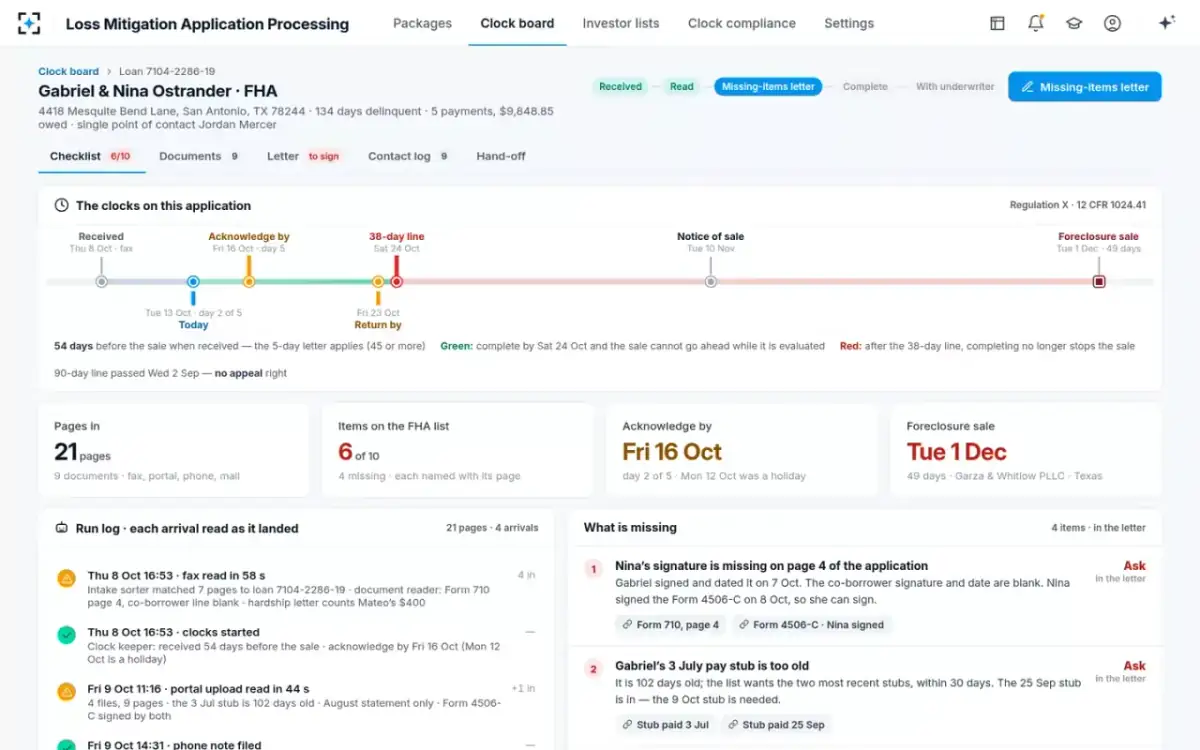
The hold that waited on a person
The most expensive delay in a loss mitigation system is not in intake at all; it is between the last page arriving and foreclosure counsel being told. In its Summer 2021 edition the CFPB described servicers that received everything their notice had asked for, yet "did not place a foreclosure hold on the account when the documents were received. Instead, the servicers waited until they had completed internal analysis that the application was facially complete, which took more than a day, during which time a foreclosure filing occurred" (CFPB Supervisory Highlights, Issue 24). The same edition found servicers that did not tell counsel a complete application had arrived until the acknowledgment notice went out.
The design answer is to make the hold an event, not a task. When the last listed item arrives, the file is facially complete for the foreclosure bars that day, whatever the review later finds; the system should send the hold then, and let the review continue under its protection. The guide on facially complete applications sets out the rule and the 2024 enforcement case built on the same gap.
What should loss mitigation software automate?
Automate everything that is mechanical and time-critical, and keep with people everything that is a judgement or a commitment. The CFPB, describing a digital version of the standard application in 2020, observed that "digitizing the loss mitigation application process has the potential to improve a process that is experiencing an increase in loss mitigation requests from consumers" (CFPB Supervisory Highlights, Issue 22), while stating that it does not endorse products. Potential is the right word: automation helps only where it does not take decisions the rule leaves to the servicer's people.
What a loss mitigation system should do itself, and what it should hand to a person
Automate: Date-stamp every page and note on arrival, by channel; split multi-document faxes.
Keep with a person: Pages that cannot be matched with confidence, with the suggested loans.
Automate: Signatures, dates, periods, amounts, page counts; blank, stale or partial pages, with the page cited.
Keep with a person: Whether a smudged mark is a signature; documents the list does not cover.
Automate: Check against the servicer’s investor list for the household.
Keep with a person: Confirm that the file is complete, with a page for every item.
Automate: Business days, return-by dates, the 37, 45 and 90-day lines; alerts when a sale is within 45 days.
Keep with a person: Any change to a sale date or deadline.
Automate: Draft the notice item by item; pre-fill forms for contributors; schedule reminders.
Keep with a person: Sign every letter; the intake lead signs near a sale.
Automate: Send the hold when a file completes more than 37 days before a sale.
Keep with a person: Exceptions, disputes with counsel and anything after the line.
Automate: Build the package and income summary, every line citing its document.
Keep with a person: Choose the workout option under the investor’s waterfall.
Testing a loss mitigation system on your own files
Test with files that are designed to break the first page, and measure the time and accuracy of matching before anything else. The checklist below is what we would run in a pilot of any system, ours included, alongside a replay of past applications.
Pilot tests for a loss mitigation system
- A page from every channel
Fax, portal, scanned mail, email and a phone note: each must land on the right loan with its arrival time.
- Late Friday and holiday arrivals
A fax at 16:55 on the Friday before Columbus Day; check the date and the five-day count.
- A mixed fax
Application, hardship letter and a stub in one transmission; check the split and classification.
- A wrong or missing loan number
Check that the page goes to a person with suggestions, and is never filed on a guess.
- The last item, by itself
One page that completes the file; check the completion time and when counsel is told.
- A duplicate
The same statement sent twice; check that the borrower is not asked for it again.
- A transferred loan
Documents held by the prior servicer; check they count before the borrower is asked.
- An outage
Switch the system off for a morning; check what happens to arrivals and to notices due.
Report three numbers from the pilot: the median and worst time from arrival to a matched, read page; the share of pages matched to the wrong loan, which should be zero; and the share sent to a person, which should be small but never zero. A system that sends nothing to people is guessing somewhere. The economics of the days saved are in how long loss mitigation takes to process.
The log a reviewer replays: pages in, letters out, clocks
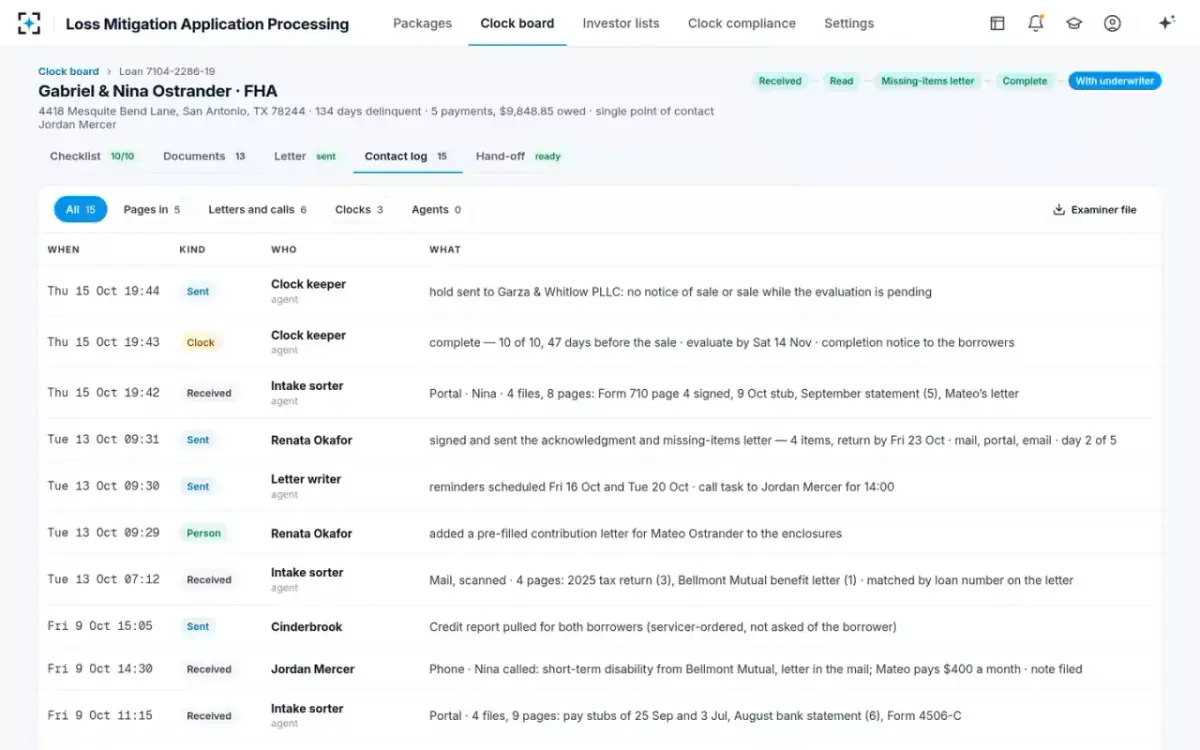
Loss Mitigation Application Processing fits servicers whose pages arrive across several channels and whose people spend their mornings finding and reading them. It does not replace the servicing system or the decision engine, and it is not a document repository for the whole servicing operation. The full intake flow is on the Loss Mitigation Application Processing page.
Questions people ask
How do servicers track loss mitigation documents?
Most log each submission against the loan with its channel and receipt date, keep a checklist per investor, and track open items until the file is complete. Regulation X requires prompt access to everything the borrower sent for the people assigned to help, and records of the actions taken.
Does a fax received after business hours count as received that day?
Regulation X counts from receipt and does not define business hours for it. The safe practice is to date each page when it arrives, as a fax header or upload timestamp shows, and count the five business days from there.
What should happen to a page that cannot be matched to a loan?
It should go to a person quickly, with the likely loans suggested, and never be filed on a guess or discarded. Until it is matched, the borrower who sent it may be waiting on a notice that cannot be accurate.
How long must loss mitigation documents be kept?
Regulation X requires servicers to keep records documenting actions on a loan until one year after the loan is discharged or servicing is transferred, under 1024.38(c). Investors may require longer.
Is a loss mitigation system the same as a servicing system?
No. The servicing system holds the loan, payments and delinquency status. A loss mitigation system reads from it, handles applications, documents, deadlines and notices, and returns the outcome; some servicing platforms include a module for this, and some servicers run it separately.