On the best public data, loss mitigation cycle time runs two to three months, from the borrower's first documents to a written decision, and most of that time is spent getting the application complete. Regulation X gives a servicer 30 days to evaluate a complete application received more than 37 days before a foreclosure sale, but it sets no limit on how long completion takes. In the CFPB's study of five large servicers, the median time from the first written documents to a complete application was 63 days in 2015. Every one of those days costs the servicer money, moves the borrower nearer a foreclosure sale and adds to the arrears a workout must absorb. Botminds' Loss Mitigation Application Processing exists to take the servicer's share of those days out of the timeline: pages read the minute they land, the missing-items letter drafted the same day, and the hold sent the moment the file completes.
This guide sets out the legal timeline, the evidence on actual timelines, the cost of a delinquent loan per day, and how to measure cycle time so that a buyer can judge any claim about it, including ours. Product figures come from a fictional sample servicer, Cinderbrook Mortgage Servicing, or are labelled as Botminds' estimates.
Loss mitigation timelines in four numbers
63days
median from first documents to a complete application, five servicers, 2015
30days
to decide once complete, if received more than 37 days before a sale
88%
of complete applications decided within 30 days in 2015, up from 64% in 2012
9×
the yearly cost of servicing a non-performing loan against a performing one, 2024
How long does loss mitigation take to process?
Measured from the first documents to a decision, loss mitigation typically takes between two and three months, and the completion stage takes longer than the decision. The best public evidence is the CFPB's 2019 assessment of its own servicing rules, which pooled application data from five servicers. "Pooling the five servicers together, the median number of days increased from 36 in 2012 to 63 in 2015" (CFPB, 2019), measured from the date the borrower first submitted written documents to the date the application was complete.
The CFPB's explanation for the increase matters to anyone designing an intake process. After the rule, servicers had to collect what was needed to evaluate the borrower for every available option at once, so their definition of complete grew; some servicers also encouraged borrowers to start applications earlier, which lengthened the measured interval without changing when files actually completed. The second half of the timeline moved the other way: the share of complete applications decided within 30 days rose from 64% to 88%.
The road to a complete application got longer after the rule
How long does it take for loss mitigation to be approved?
Once the application is complete, a decision is due within 30 days under 12 CFR 1024.41(c)(1), provided the complete application arrived more than 37 days before any sale; FHA's handbook sets the same 30 days. After the decision the borrower has time to respond: the servicer may not require an answer sooner than 14 days after the offer if the application was complete 90 or more days before a sale, or 7 days if it was complete between 90 and 37 days before. A borrower denied a loan modification, with appeal rights, has 14 days to appeal, and the appeal decision is due within 30 days. A modification usually also involves a trial payment plan before it becomes permanent.
So the answer to a borrower's "how long until I am approved" is: 30 days or less after the file is complete, plus however long completing it takes. When servicers fall behind, the delay can be extreme. Describing Flagstar Bank's loss mitigation operation in 2011, the CFPB said that "for a time, it took the staff up to nine months to review a single application" (CFPB, 2014).
Where the days go between first page and decision
Most of the calendar is the borrower's wait for documents, but much of that wait starts late, because the borrower cannot send what nobody has asked for yet. The lanes below are Botminds' estimate for a typical hardship application, by hand and with the solution. The wait does not disappear; it starts earlier and is shorter because the request is exact.
From first page to a complete file: the servicer’s days shrink, the wait starts sooner
- Sort pages to the loan1 d
- Read against the list2 d
- Letter drafted, signed, sent1.5 d
- Wait for and chase documents12 d
- Build the package1 d
- Sort
- Read
- Letter
- Wait for and chase documents7 d
- Package
The estimate is deliberately modest about the borrower's share. Software cannot make a family find a September bank statement faster. What it can do is make sure the request for that statement goes out with the first letter, on the first or second business day, and that a named contact calls the same afternoon to explain it. On the sample application at the fictional servicer, the letter went out on day 2 of 5 and the last four items arrived two days later.
What does a delinquent loan cost to service?
A non-performing loan costs roughly nine times as much to service as a performing one. The Mortgage Bankers Association's Servicing Operations Study found that "fully-loaded mortgage servicing costs of performing loans averaged $176 per loan in 2024, while the costs of non-performing loans averaged $1,573 per loan", in a sample of in-house servicers representing about 60% of the single-family market (MBA, 2025). The non-performing figure adds collections, loss mitigation, bankruptcy, foreclosure, post-sale and unreimbursed foreclosure and REO losses to the base cost.
Federal Reserve research shows the same shape and how steeply it rises at the end. In a 2018 paper, economists at the Federal Reserve Board found that the typical bank spends 10 to 12 times as much servicing a delinquent loan as a performing one, 17 times as much for a loan in foreclosure under a Fannie Mae or Freddie Mac contract, and about 50 times as much for an FHA or VA loan in foreclosure (Kim, Laufer, Pence, Stanton and Wallace, FEDS 2018-016). Every day an application sits incomplete keeps a loan in the expensive column, and every foreclosure that a complete, timely application would have prevented moves it to the most expensive one.
Volume decides how much this matters. The MBA reported FHA delinquency at 11.79% of loans in the second quarter of 2026, with the FHA seriously delinquent rate up 227 basis points in a year (MBA National Delinquency Survey, Q2 2026). The queues that fill first are the ones where foreclosure is most expensive to service.
Pricing an idle day on one loan
The direct servicing cost of one idle day is small; the value of a day lies in what it protects. Divide the MBA gap across a year and a non-performing loan costs about $3.83 a day more than a performing one. A servicer that takes ten days out of intake on 2,000 applications a year saves roughly $76,600 on that measure alone, before staff time. That is real, but it is not the main reason to move faster.
What one day taken out of intake is worth
Servicing cost avoided
($1,573 − $176) ÷ 365 ≈ $3.83 per loan-day
MBA 2024 averages spread evenly over the year. A full-year average, not a marginal cost.
Finance
Protection kept
days to spare before the 38-day line
A file that completes after the line no longer stops the sale under 1024.41(g). Near a sale, one day can decide it.
Compliance
Foreclosure avoided
≥ $30,100 per borrower (2023 dollars)
The CFPB’s lower-bound estimate of what avoiding a foreclosure is worth to the borrower and neighbours.
The borrower
Cost of the faster process
review and signing time + software
A person still checks and signs every letter. Count that time; it does not go to zero.
Operations
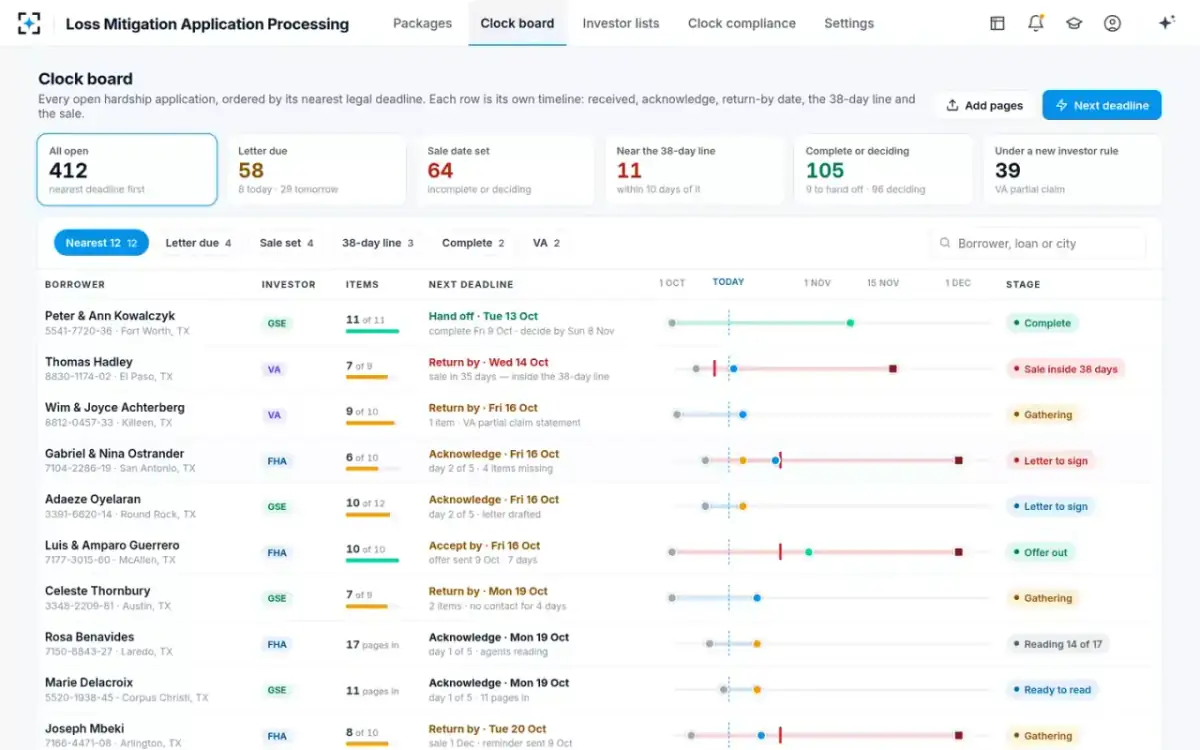
The protection term is the one with real stakes. At the sample servicer the clock board showed 11 open applications within ten days of their 38-day line. For those files a lost day is not $3.83; it may be the difference between a sale on hold and a sale held.
The files where a day matters most, sorted to the top
What is FHA's six-month first legal deadline?
FHA requires the servicer to act within six months of default, either with loss mitigation or by starting foreclosure. The handbook says the mortgagee "must determine the Borrower's ability to make monthly Mortgage Payments and take loss mitigation action or commence foreclosure, if loss mitigation is not feasible, within six months of the date of Default, or within such additional time approved by HUD" (HUD ML 2025-12, Handbook 4000.1 III.A.2). HUD grants automatic 90-day extensions where the mortgagee evaluated and approved the borrower for a loss mitigation option before the six months ran out.
That makes intake speed an investor obligation, not only a regulatory one. FHA separately requires an evaluation before four monthly installments are due and unpaid. A file that spends weeks incomplete pushes the servicer toward the point where it must either have an approved option or start foreclosure, or ask HUD for more time. The RESPA loss mitigation timeline draws these investor clocks alongside Regulation X's.
How much is avoiding a foreclosure worth?
At least $30,100 per borrower, by the CFPB's estimate. In its 2024 proposal to streamline the servicing rules, the CFPB repeated its earlier estimate of "an average per-borrower benefit of avoiding foreclosure of at least $30,100 or $35,300 in 2023 dollars" (CFPB, 2024). The figure combines a HUD estimate of the borrower's out-of-pocket cost of a completed foreclosure, $10,300 or $14,630 in 2023 dollars, with its effect on neighbouring home values, $14,531 or $20,640. The CFPB calls it a lower bound, because it leaves out lost equity, housing instability and health effects.
The same agency's 2019 assessment estimated that the servicing rules themselves meant at least 26,000 fewer foreclosures among borrowers who became delinquent in 2014. That is the scale at which process rules, acknowledgment letters and dates included, change outcomes.
How do you measure loss mitigation cycle time?
Measure each segment separately, from the borrower's first submission, and report medians with the tail. A single "average days to decision" hides where time is lost and rewards counting from a later start date. The CFPB itself cautioned in its assessment that differences between servicers partly reflected the way each one tracked applications, so a cycle-time number is only as good as its start and end definitions.
Cycle-time measures for a loss mitigation intake operation
| Measure | Start and end | Why it matters |
|---|---|---|
| Time to acknowledge | First receipt of an application to the notice sent, in business days | The five-day legal limit; examiners test it first. |
| Letter on day one | Share of acknowledgment notices sent the same or next business day | The earlier the request, the earlier the borrower’s wait starts. |
| First page to complete | First receipt to the last required item, median and 90th percentile | The longest segment; the CFPB’s 63-day median sits here. |
| Complete to hold | Completion to the hold reaching foreclosure counsel, in hours | The gap where foreclosure protections are lost. |
| Complete to decision | Completion to the written determination; share inside 30 days | The legal limit under 1024.41(c)(1). |
| Requests per file | Number of separate document requests before completion | More than one round usually means the first letter was vague. |
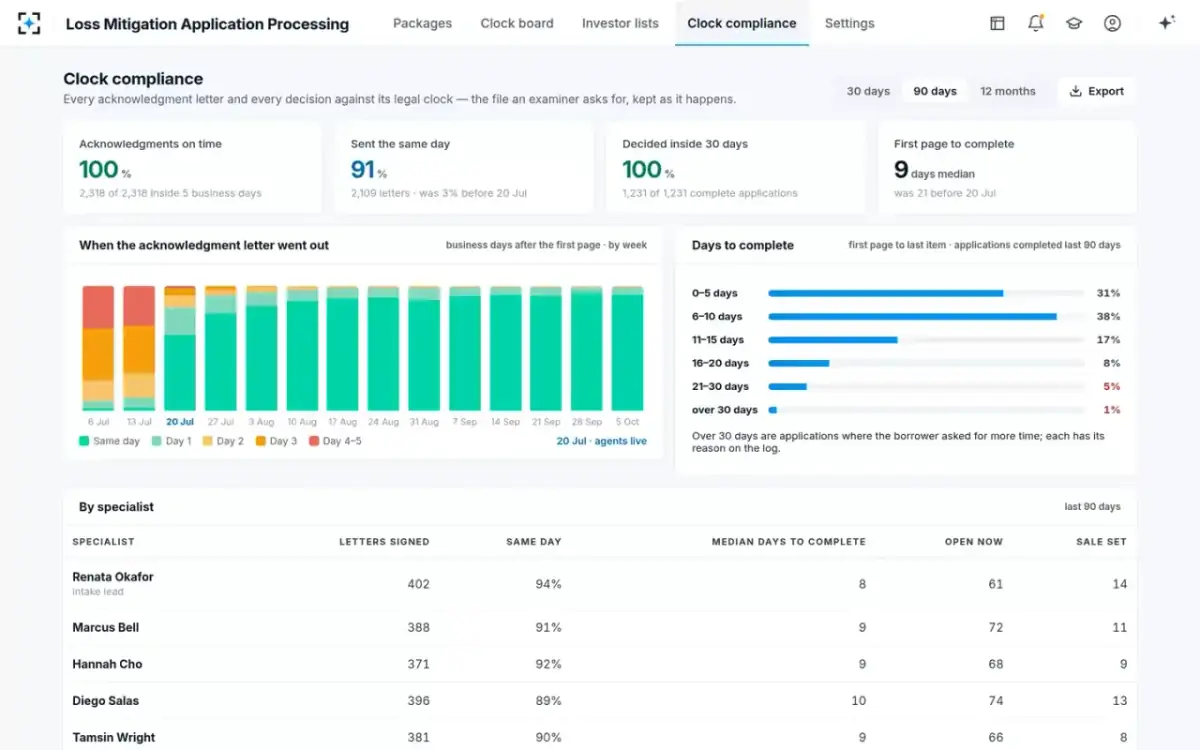
At the sample servicer, the compliance screen reports most of these on sample data: acknowledgments on time, letters sent the same day, decisions inside 30 days, and a median of 9 days from first page to complete, against 21 days before the agents went live. A buyer should ask any vendor for the same measures on a replay of their own past applications, not on a showcase file.
Every acknowledgment and decision against its legal clock
What software can shorten, and what it cannot
Software can shorten the servicer's days: sorting, reading, checking, drafting, date-counting and the hand-off. It cannot shorten the investor's own approval steps, a trial payment plan, the borrower's right to 7 or 14 days to decide, or the time a family needs to find a document. A vendor that promises to cut "time to modification" by a large fraction without saying which segment is promising to cut the borrower's wait, which is not theirs to cut.
The questions that separate real gains from claimed ones are simple. On which segment does the time fall? Measured from which start date? On whose files, and how many? Is the letter still signed by a person, and is the hold sent on arrival or after review? Botminds' answer for Loss Mitigation Application Processing is that its gains sit in the servicer's segments and in starting the borrower's wait earlier, and that we would run it on a sample of your own past applications before anyone relies on a number. The buying guide on what to bring to a loss mitigation software project covers that test.
Questions people ask
How long does a loan modification take from application to approval?
On the CFPB's figures, two to three months from first documents to a written offer, longer if the file takes many rounds to complete. The servicer must decide within 30 days of a complete application; the CFPB's data put the median time to complete an application at 63 days in 2015 for the five servicers studied.
Does the foreclosure stop while loss mitigation is processed?
Only in defined cases. A servicer cannot start foreclosure before 120 days of delinquency, nor while a complete application received before referral is pending. After referral, a complete application received more than 37 days before a sale stops a motion for judgment and the sale, but not every earlier step.
What is the fastest way for a borrower to speed up loss mitigation?
Send exactly what the servicer's notice lists, all pages of every statement, signed by every borrower, before the date in the notice. Missing pages and unsigned forms are the commonest reasons for a second round of requests, each of which adds days.
How long does a servicer have to respond to a loss mitigation application?
Five business days to acknowledge it and say whether it is complete, if it arrives 45 or more days before a sale, and 30 days to evaluate it once complete, if complete more than 37 days before a sale. Investors such as FHA add their own clocks, including an evaluation before four installments are unpaid.
Why did loss mitigation get slower after the 2013 servicing rules?
In the CFPB's view, mostly because servicers had to collect what was needed to evaluate the borrower for all options at once, so complete applications became larger. Decisions on complete applications got faster over the same period, and the rule did not change when in their delinquency borrowers completed applications.