A complete loss mitigation application is one for which the mortgage servicer has received everything it requires from the borrower to evaluate them for the options the loan's owner offers. Completion is the hinge of Regulation X: only a complete application, received more than 37 days before a foreclosure sale, must be evaluated within 30 days and stops the sale while it is. Yet the CFPB found that the share of started applications that servicers got to complete ranged from about 40% to 95%. Some of that spread is measurement, but much of it is how a servicer asks for what is missing and how hard it chases. Botminds' Loss Mitigation Application Processing works on exactly those levers: every gap named on its page in a letter drafted the same day, a pre-filled form for anyone who must sign, and reminders and a call from the named contact on a schedule the servicer sets.
This guide is for default-servicing leaders. It sets out the definition, the evidence on completion, why applications stall, what reasonable diligence requires, and how to measure completion so that the number can be trusted. Examples come from a fictional sample servicer, Cinderbrook Mortgage Servicing, on sample data.
Completion, in the CFPB’s own data
40–95%
range of application completion rates across the servicers studied
63days
median from first documents to complete, 2015, up from 36 in 2012
73%
of completed applications from newly delinquent borrowers finished before 120 days past due, 2015
43%
of borrowers starting an application within six months of 60 days delinquent, 2015
What is a complete loss mitigation application?
Regulation X defines it by reference to the servicer's own requirements: "A complete loss mitigation application means an application in connection with which a servicer has received all the information that the servicer requires from a borrower in evaluating applications for the loss mitigation options available to the borrower. A servicer shall exercise reasonable diligence in obtaining documents and information to complete a loss mitigation application" (12 CFR 1024.41(b)(1)). Two consequences follow. Completion is measured against a list the servicer writes, so a longer list means fewer and later completions. And the second sentence puts a duty on the servicer to get the file there.
FHA uses its own term. HUD's handbook defines a Complete Loss Mitigation Request as "a request for loss mitigation assistance that contains all information from the Borrower required to evaluate all Loss Mitigation Home Retention Options and Home Disposition Options", and requires only the hardship reason, occupancy status and, for some hardships, documentation (HUD ML 2025-12). Information the borrower cannot provide, such as a credit report the servicer orders, does not keep an application from being complete under Regulation X.
What percentage of loss mitigation applications are completed?
Between about 40% and 95% of started applications, depending on the servicer, in the most detailed public data. The CFPB's assessment of its servicing rules reported that "Application completion rates by servicer range from about 40 to 95 percent", and immediately cautioned: "it is likely that some of the differences in completion rates between servicers reflect differences in how servicers track applications and how they compiled the data they provided to the Bureau. Within-servicer comparisons in completion rates are likely more reliable than between-servicer comparisons" (CFPB, 2019).
That caution is the first lesson for any executive comparing completion rates. A servicer that opens a file only when a full form arrives will report a higher rate than one that opens a file at the first phone call with financial information, though the second is closer to what the rule treats as an application. The spread is still too wide to be only measurement. Even within servicers, the CFPB found completion rising at some and falling at others between 2012 and 2015.
When and whether delinquent borrowers complete an application
Why do borrowers not complete loss mitigation applications?
Some borrowers stop because they no longer need to, and the rest stall on the servicer's process. The CFPB's assessment found both. On the first side, borrowers whose finances recovered cured without completing, and many GSE borrowers received a streamlined modification that needed no complete application: at one servicer, 21% of borrowers who sent documents but never completed received one. On the second side, the definition of complete grew after the rule, so finishing took longer.
The examination record adds the servicer-side causes: notices that did not say what was missing, documents received but never routed, and files that restarted after a transfer. In 2020 the CFPB reported that after servicing transfers "certain applications were virtually complete, but some transferee servicers asked borrowers to submit new applications", which it treated as a failure of reasonable diligence caused by "errors during the onboarding process as well as inadequate policies and procedures" (CFPB Supervisory Highlights, Issue 22). Each of these lowers the completion rate without any change in the borrowers.
A stricter definition makes a longer road
The more a servicer requires, the longer completion takes and the more files never finish. The CFPB's explanation for slower completion after 2014 was direct: "This may be because the Rule required servicers to define a complete application to be a more comprehensive package than what some servicers considered a complete application pre-Rule" (CFPB, 2019). Servicers had to collect what was needed to evaluate the borrower for every option at once, so the median time from first documents to completion rose from 36 to 63 days in the five servicers it could measure.
Investors and the CFPB have both moved against that trade-off since. FHA, from 1 October 2025, stopped requiring financial documents to evaluate a borrower. The CFPB's 2024 proposal would go further and replace the complete-application framework with a review cycle that protects the borrower from the first request; it cited the cost of collecting full packages for options that need little paperwork (CFPB, 2024). Until that proposal is final, the practical lever is the list itself: ask for what each investor actually requires, and nothing it does not.
What is reasonable diligence in loss mitigation?
Reasonable diligence is the servicer's duty to obtain the documents and information that complete an application: ask promptly, follow up, and use what it already holds or can get itself. The commentary gives examples rather than a cadence, so examiners judge it by outcomes. In 2019 the CFPB reported servicers that offered short-term forbearance on collection calls to borrowers who had asked about help and given financial information, without telling them the offer rested on an incomplete application, and then "near the end of the forbearance period, the servicer(s) did not contact the borrowers as to whether they wished to complete the applications to receive a full loss mitigation evaluation" (CFPB Supervisory Highlights, Issue 18). That was a violation of 1024.41(b)(1).
The duty has an end. If a servicer has used reasonable diligence and an application stays incomplete for a significant period with no progress from the borrower, 1024.41(c)(2)(ii) lets it evaluate the incomplete application at its discretion. The guide on the incomplete loss mitigation application covers the notice and date that start the chase.
How to improve loss mitigation completion rates
Completion rises when the first request is complete and exact, when it goes out early, and when someone follows it up by name. None of these needs new regulation; all of them need the servicer to know exactly what is missing on day one.
Levers that raise completion, and why each works
- Ask once, for everything
One letter that names every missing item. Each extra round of requests adds days and loses borrowers.
- Name the document, the person and the reason
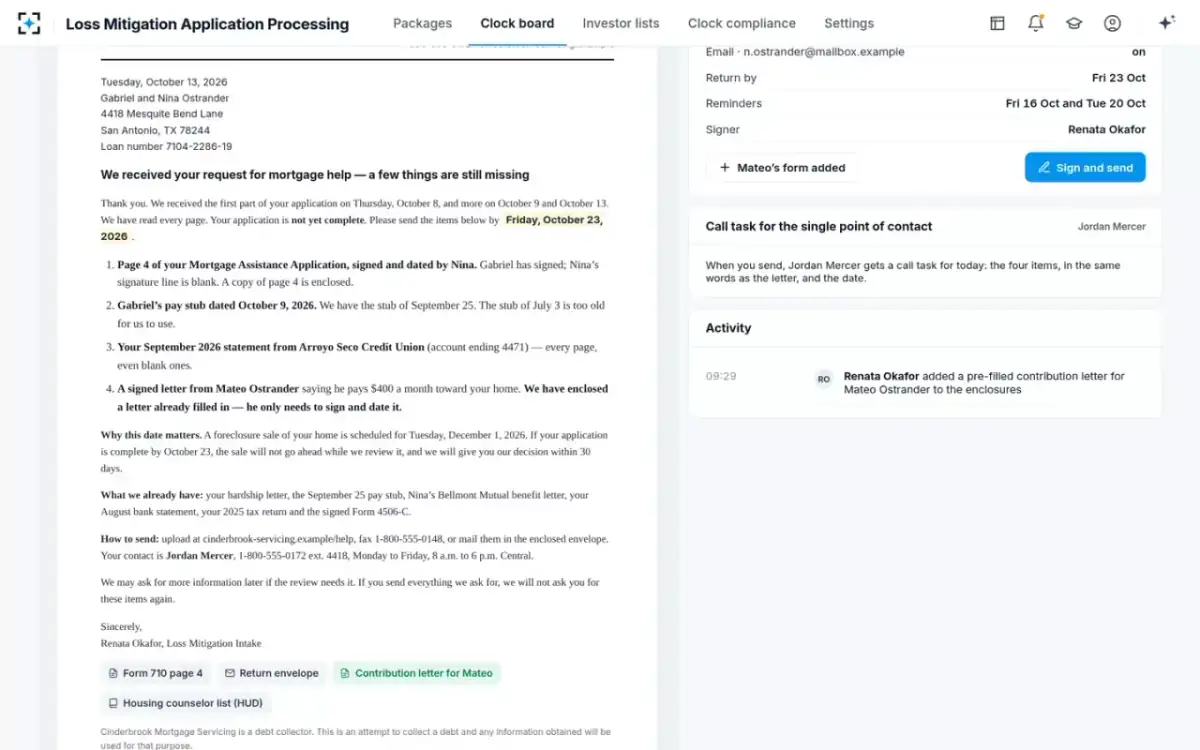
A borrower who knows it is “page 4, signed by Nina” sends page 4.
- Send the letter on day one or two
The borrower’s wait cannot start until the request arrives.
- Enclose what others must sign, filled in
A relative who only has to sign a pre-filled contribution letter usually does.
- Call the same day, in the letter’s words
The named contact under 1024.40 turns a letter into a conversation.
- Never ask for what you have or can get
Duplicate requests and requests for servicer-ordered reports damage trust and cost days.
- Accept every channel and date it on arrival
Fax, portal, mail, email and phone. A page lost in a queue is a missing item to the borrower.
- Check inherited files before asking again
After a transfer, the prior servicer’s documents count; asking anew was cited as a failure of diligence.
- Trim each investor list to what it requires
FHA no longer requires financial documents. A list that still asks for them depresses completion for no reason.
One request with every gap named, sent on day 2
Measuring completion so the number means something
Measure completion as a cohort rate with a fixed start, and report the reasons files do not complete. The CFPB's caveat about tracking applies inside a servicer as much as between servicers: if the start date moves, the rate moves with it. The definitions below make the number comparable month to month.
Completion measures for a loss mitigation operation
| Measure | Definition | What it tells you |
|---|---|---|
| Completion rate | Of applications started in a month, the share complete within 30, 60 and 90 days, counting from the first submission, including a phone call that became an application. | Whether the chase works; compare only like with like. |
| Days to complete | First submission to last required item: median and 90th percentile. | Where the long tail sits, by investor and channel. |
| Requests per file | Separate written requests before completion. | More than one usually means the first letter missed something. |
| Duplicate asks | Items requested that the file already held, or the servicer could obtain. | A process fault the borrower notices. |
| Reasons not completed | Cured, offered an option without a full application, withdrew, unresponsive after diligence, sale passed. | Separates good non-completion from bad. |
| Completed before the line | Share of files with a scheduled sale completed more than 37 days before it. | Whether completion is arriving in time to protect anyone. |
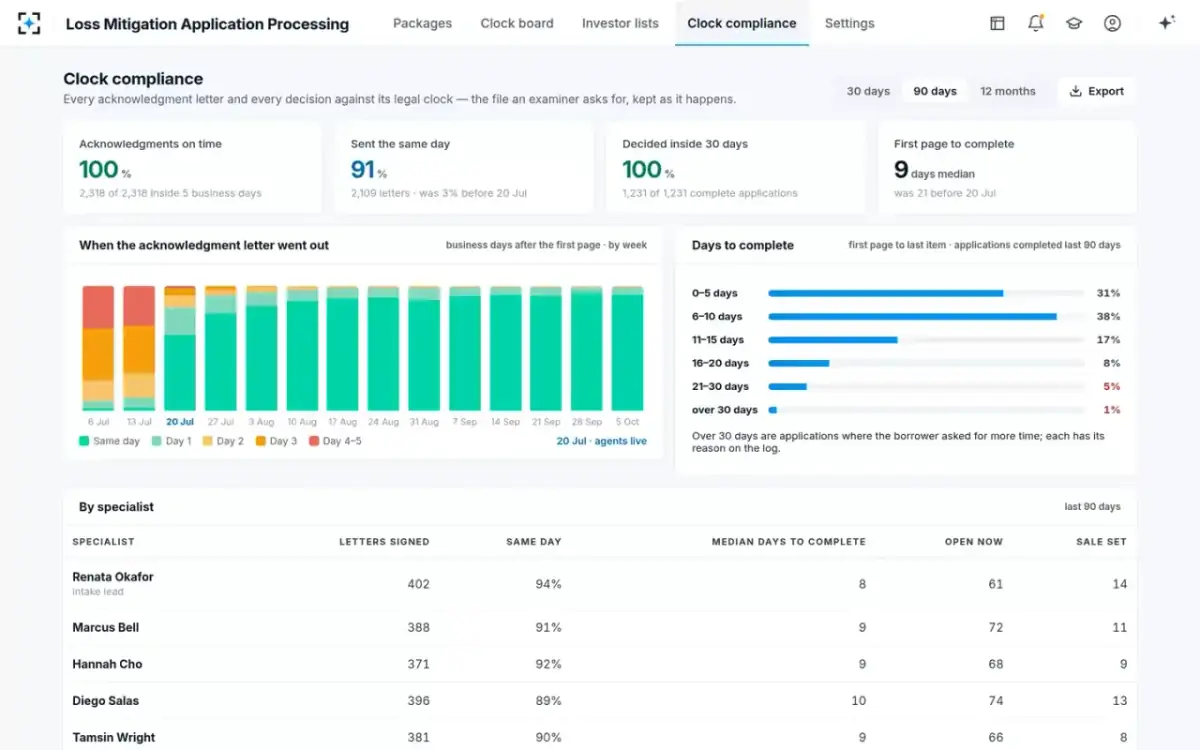
At the sample servicer, the compliance screen shows the distribution of days from first page to complete over 90 days of sample data: 31% within five days, 38% in six to ten, 17% in eleven to fifteen, 8% in sixteen to twenty, 5% in twenty-one to thirty and 1% beyond. The screen notes that files over 30 days are ones where the borrower asked for more time, each with its reason on the log.
Days from first page to a complete file, on the sample servicer’s book
Completion and the clocks, by week and by specialist
What did the CFPB's servicing rule assessment find?
The assessment, published in January 2019, is the most thorough public review of the 2013 servicing rules, and its findings on loss mitigation cut both ways. Borrowers started applying somewhat earlier in delinquency, and decisions on complete applications came faster. Completing an application took longer, because complete packages became larger. The 120-day bar on starting foreclosure prevented foreclosures rather than delaying them, by the CFPB's estimate at least 26,000 among borrowers who became delinquent in 2014.
For operations leaders, one finding stands out. Asked which loss mitigation changes cost the most, "many servicers said the most significant and costly changes they made were to comply with the Rule's requirement to provide a five-day acknowledgment notice for loss mitigation applications" (CFPB, 2019). The notice is where reading, checking and dating all have to be finished inside a week, and it is the step that decides whether a family gets a request it can complete. That is the step Loss Mitigation Application Processing is built to make routine; how long the rest of the process takes is priced in how long loss mitigation takes to process.
Questions people ask
Is a complete loss mitigation application the same as an approval?
No. Complete means the servicer has everything it requires from the borrower to evaluate them; it then has 30 days to decide which options, if any, the investor will offer. A complete application can still be denied, with specific reasons for any loan modification denial.
What if the servicer is waiting on information from someone other than the borrower?
The application is still complete once the borrower has sent everything asked of them. The servicer must chase the third party with reasonable diligence, tell the borrower what it is waiting for if it cannot decide in 30 days, and may not deny solely because the third party is late.
Can a servicer evaluate an incomplete loss mitigation application?
Only in limited cases: a short-term forbearance or repayment plan, with a notice saying it rests on an incomplete application; or at its discretion after reasonable diligence and a significant period without progress. It may not use an incomplete application to avoid evaluating a complete one.
Does a servicing transfer reset a complete application?
No. A new servicer must decide a complete application pending at transfer within 30 days of the transfer date, and the borrower keeps the protections already earned. The CFPB has cited new servicers that asked for fresh applications instead.
How do I compare completion rates across servicers or vendors?
Only with the same start definition, cohort and window. The CFPB itself warned that differences between servicers partly reflected tracking. A vendor's completion claim is meaningful only when replayed on your own past applications with your own definition.