A facially complete loss mitigation application is one where the borrower has sent every missing document and piece of information named in the servicer's five-day notice, or where that notice asked for nothing more. Under Regulation X, 12 CFR 1024.41(c)(2)(iv), the servicer must then treat it as complete for the foreclosure protections, no first filing and no motion for judgment or sale, even if it later finds it needs something else. That makes the date of facial completeness the most consequential date in the file, and the easiest to get wrong: a servicer that waits to review the documents before placing a foreclosure hold has already let the protection lapse. Botminds' Loss Mitigation Application Processing checks each arriving page against the items the notice listed, marks the file complete only with a page for every item, and sends the hold to foreclosure counsel as soon as the last one lands.
This guide explains the rule, the three dates it forces a file to keep apart, the enforcement case that defines the risk, and how to test a completeness process, human or automated, by the date it protects. The worked example comes from a fictional sample servicer, Cinderbrook Mortgage Servicing; its borrowers and loans are sample data.
Why the protection date is the one to measure
Day 0
when protection starts: the day the last listed item arrives, not the day it is reviewed
5days
the longest one servicer took to review documents before placing a hold, in the CFPB’s 2024 order
$5M
penalty and redress in that order, with a further $2 million for servicing technology
1min
from complete to hold sent to counsel on one sample application
What is a facially complete loss mitigation application?
The regulation gives three ways an application becomes facially complete. In its words, "A loss mitigation application shall be considered facially complete when a borrower submits all the missing documents and information as stated in the notice required under paragraph (b)(2)(i)(B) of this section, when no additional information is requested in such notice, or once the servicer is required to provide the borrower a written notice pursuant to paragraph (c)(3)(i) of this section" (12 CFR 1024.41(c)(2)(iv)).
The first trigger is the one that matters on the intake desk, and it turns the five-day notice into a contract. Whatever the notice listed is, by definition, the set of items that makes the application facially complete. If the notice forgot the co-borrower's signature, the application can be facially complete without it. If it listed an item the servicer did not really need, the application is not facially complete until it arrives. The quality of the incomplete-application notice therefore decides when protection begins.
Complete by checklist and facially complete are different tests
Complete by the checklist: The servicer’s full investor list for this household.
Facially complete: The items the five-day notice actually asked for.
Complete by the checklist: A review that every item is present and usable.
Facially complete: Arrival: the last listed item is received.
Complete by the checklist: When the review finishes.
Facially complete: On the day of receipt, whatever time the review ends.
Complete by the checklist: Starts the 30-day evaluation clock.
Facially complete: Foreclosure protections under 1024.41(f)(2) and (g), and the appeal and acceptance windows.
Complete by the checklist: The application is incomplete again.
Facially complete: Still treated as complete for foreclosure until the borrower has had a reasonable chance to send the rest.
When does foreclosure protection start?
Protection starts on the day the borrower's complete or facially complete application is received. Before the first foreclosure notice or filing, 1024.41(f)(2) bars the servicer from making it. After the first filing, if the application is complete more than 37 days before a sale, 1024.41(g) bars moving for judgment or order of sale and conducting the sale. Both bars last until the borrower is found ineligible and any appeal is spent, rejects every option, or fails to perform under an agreement.
The servicer cannot satisfy the bar by intending to; it must stop its lawyers. The commentary says that once it has received a complete application, "the servicer must instruct counsel promptly not to make a dispositive motion for foreclosure judgment or order of sale; where such a dispositive motion is pending, to avoid a ruling on the motion or issuance of an order of sale; and, where a sale is scheduled, to prevent conduct of a foreclosure sale". It adds: "A servicer is not relieved of its obligations because foreclosure counsel's actions or inaction caused a violation" (comment 41(g)-3).
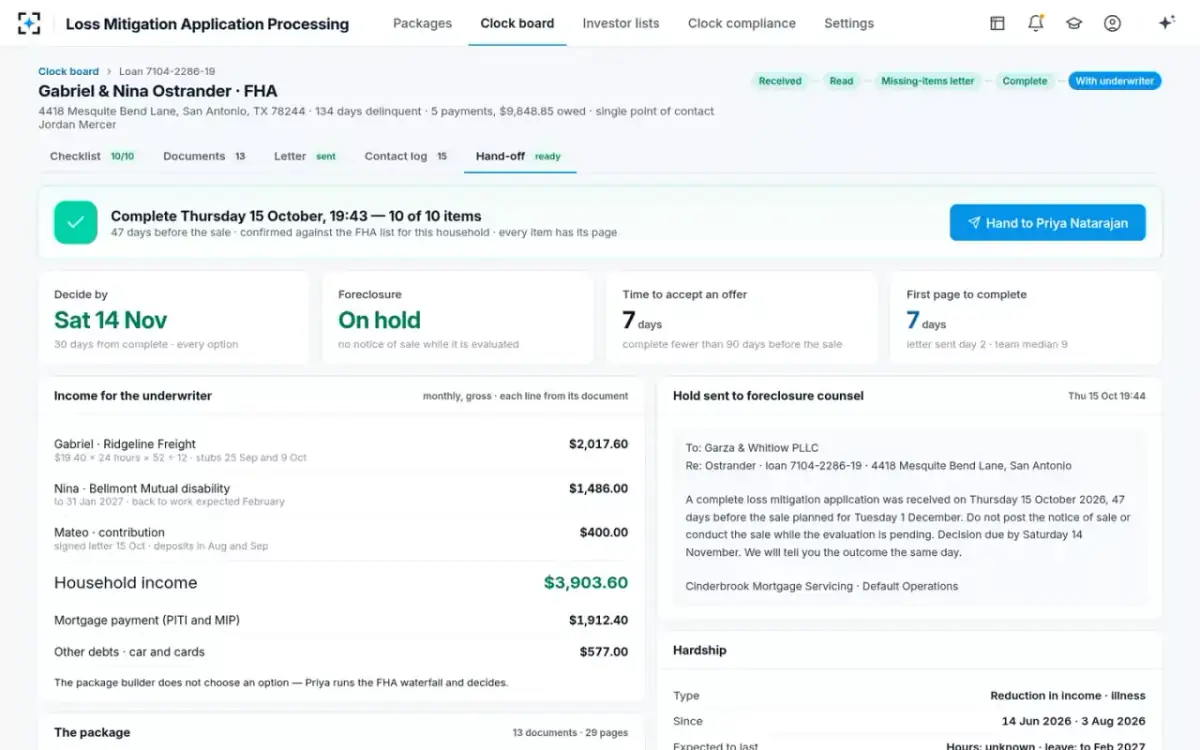
The hold to counsel, sent with the last page
Can a servicer ask for more documents after an application is facially complete?
Yes, but asking does not suspend the protection. If the servicer later finds it needs more information or a corrected document, the rule says it "must promptly request the missing information or corrected documents and treat the application as complete for the purposes of paragraphs (f)(2) and (g) of this section until the borrower is given a reasonable opportunity to complete the application". The commentary defines a reasonable opportunity as telling the borrower what is needed and allowing "sufficient time to gather the information and documentation necessary", which "will depend on the facts and circumstances" (comment 41(c)(2)(iv)-1).
The usual causes are ordinary: a pay stub that turns out to be unreadable on the second page, a bank statement whose last page was blank on the fax, an income source mentioned in the hardship letter that the first review missed. Each is a reason to ask again, quickly and specifically. None is a reason to lift the hold.
What happens if the servicer later finds the application incomplete?
If the borrower sends the extra items in the time allowed, the application is complete as of two different dates, depending on the purpose. For the foreclosure bars, the acceptance window, the appeal and the denial-reasons rule (paragraphs (d), (e), (f)(2), (g) and (h)), it is complete "as of the date it first became facially complete". For the 30-day evaluation clock in paragraph (c), it is complete as of the date it actually became complete. If the borrower does not send them, the commentary says "the application shall be considered incomplete" (comment 41(c)(2)(iv)-2), and the protections end.
The notice of complete application follows the second date. The commentary works an example: a borrower first completes the application on March 1; on March 10 the servicer finds it needs more information and asks for it; the borrower completes it on March 21. "The servicer must provide another notice in accordance with § 1024.41(c)(3)(i) and disclose March 21 as the date the servicer received the complete application" (comment 41(c)(3)(i)-1). The borrower's protections still date from March 1.
Three dates every file must keep apart
A file that stores one "complete date" will get at least one clock wrong. The rule needs three, and a fourth comes from the sale calendar.
The dates a loss mitigation file has to hold, and what each one drives
| Date | What it drives | Sample application |
|---|---|---|
| First receipt of the application | The five-day acknowledgment notice; whether the 45-day rule applies. | Thursday 8 October, by fax |
| Facially complete | Foreclosure bars under (f)(2) and (g); the 7- or 14-day acceptance window; the appeal right; and, under (b)(3), which day-count protections apply at all. | Thursday 15 October, 19:42, when the last of the four listed items arrived |
| Actually complete | The 30-day evaluation clock and the date on the notice of complete application. | Same day here: nothing further was needed |
| Scheduled sale at that date | The 37, 45 and 90-day lines, fixed as of the day the complete application is received. | Tuesday 1 December: complete 47 days before it |
The fourth row is the one teams forget. Under 1024.41(b)(3), whether a day-count protection applies is decided "as of the date a complete loss mitigation application is received". A sale later postponed does not add or remove protection, which is why the RESPA loss mitigation timeline is drawn from the sale date in force on that day.
What did the CFPB find against Fay Servicing?
The CFPB found that Fay Servicing reviewed documents before placing foreclosure holds, and so left borrowers unprotected for up to five days after their applications became complete or facially complete. The 2024 consent order states that from June 2017 until early 2020 Fay "did not ensure borrowers were protected from a First Filing, Moving for Judgment, or a foreclosure sale beginning on the day the borrower submitted the documents making their Loss Mitigation Application complete or facially complete. Instead, in some instances, it took Respondent up to five days to review the documents and decide whether the documents made the application complete, or facially complete, before placing a foreclosure hold" (CFPB consent order 2024-CFPB-0007).
Fay's policy was to back-date the hold to the day the documents arrived. The order treats that as no defence: the foreclosure activity during the review window broke 1024.41(f)(2) or (g) regardless. It was also a repeat; a 2017 order had already addressed Fay's loss mitigation practices. The 2024 order required a $2 million penalty, $3 million in redress and $2 million of spending on servicing technology and compliance management. The CFPB terminated it early, on 1 July 2025 (CFPB enforcement page), so cite it as history; the rule it enforced has not changed.
The same five days, with the hold placed after review and on arrival
- Review: did these complete it?up to 5 days
- Hold, back-datedday 5
- Hold sent
- Protected while the review runsdays 0 to 5
Fay was not alone. In its Spring 2017 Supervisory Highlights the CFPB reported servicers that did not classify applications as facially complete after receiving what their own acknowledgment notices had asked for, and made a first foreclosure notice or filing anyway (CFPB, 2017). A later edition, in 2021, found servicers waiting more than a day on internal analysis before placing the hold; the guide on what a loss mitigation system must do with the first page covers that case.
How is completeness tested in a compliance review?
A compliance review tests completeness by replaying files and comparing the time each protection should have started with the time the hold actually reached counsel. Sampling for "was the five-day letter on time" misses the failure in the Fay order entirely, because the letter can be perfect and the hold still late. The cases below are the ones we would put in any test set, whether the process is manual or automated.
Test cases for a completeness review, and what a pass looks like
| Case | Set-up | A pass |
|---|---|---|
| Last listed item arrives | The final item named in the notice arrives on a weekday afternoon. | File marked facially complete with that receipt time; hold to counsel the same day. |
| Arrives after hours | The last item comes by portal at 19:42 on a weekday, or on a Saturday. | Receipt date is the day it arrived, not the next business day the queue was worked. |
| Partial arrival | Three of four listed items arrive. | Not facially complete; reminder and call go out; no hold yet if none is otherwise due. |
| Gap found after completion | A second page of a statement proves unreadable after the hold. | Prompt request for that page; hold stays; protection dated from first facial completeness. |
| Item listed in error | The notice asked for something the servicer did not need. | The file is still not facially complete until it arrives, which is a reason to fix the notice template. |
| Sale postponed | The sale moves after completion. | The 37, 45 and 90-day protections stay as fixed on the completion date. |
| Transferred mid-file | The last item reaches the old servicer after transfer. | The new servicer honours the earlier receipt and the protections under 1024.41(k). |
Measuring a completeness engine by the date it protects
The right accuracy measure for completeness software is not whether it reads documents well in general; it is how far its completion time lands from the true one, and in which direction. A late call exposes the borrower to foreclosure steps; an early call starts a 30-day clock on a file the underwriter cannot decide. We would report four numbers on any test set: the median and worst gap between the last listed item's receipt and the hold reaching counsel; files marked complete without a page for every item; files left incomplete although every listed item was in; and files where the borrower was asked again for something already received.
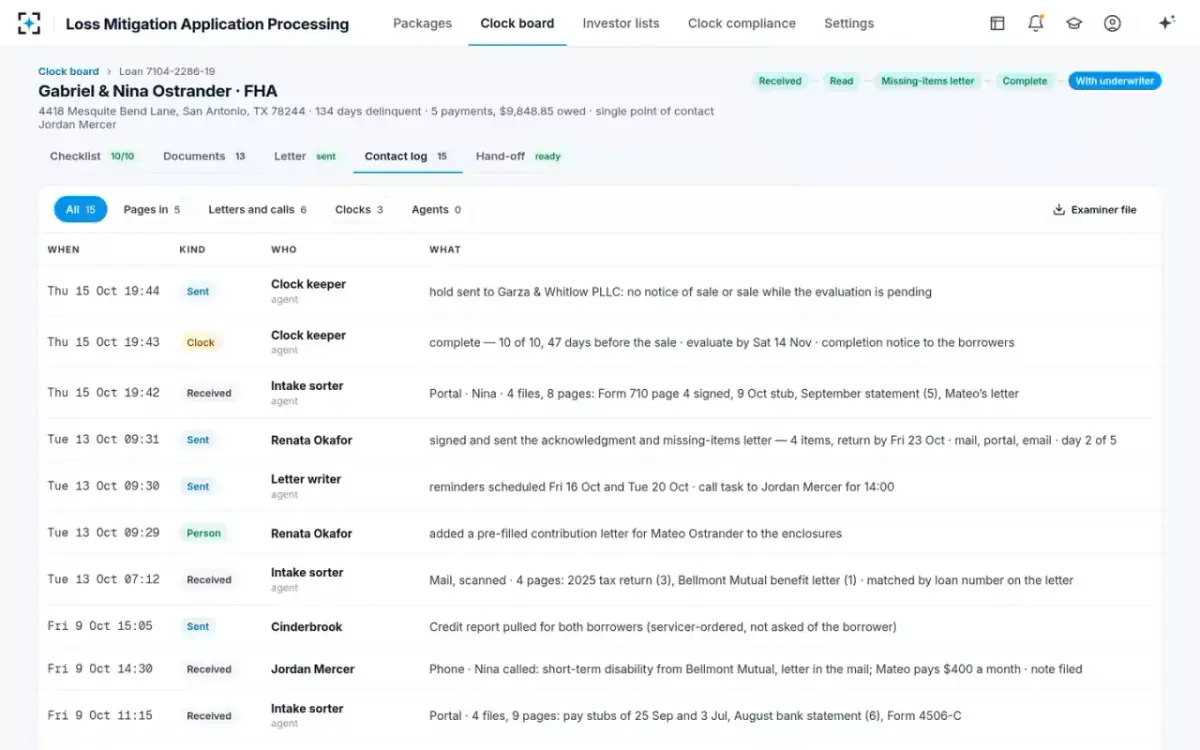
Loss Mitigation Application Processing is designed around those failure modes. The completeness checker never marks a file complete without a page for every item; the specialist confirms it; and the clock keeper sends the hold when an application completes more than 37 days before a sale. On the sample application, the last four items arrived by portal at 19:42, the file was marked complete at 19:43 and the hold went to counsel at 19:44, all on the contact log an examiner would read.
Every page in and every message out, minute by minute
The design will not remove every judgement call. A specialist still decides whether a smudged signature is a signature, and whether an unlisted item the borrower volunteered changes anything. What it removes is the review queue between arrival and hold, which is where the violations in these cases lived. The whole flow, from first page to the underwriter, is on the Loss Mitigation Application Processing page.
Questions people ask
Is "facially complete" the same as "complete" under Regulation X?
No. Complete means the servicer has everything it requires from the borrower. Facially complete means the borrower has sent everything the five-day notice asked for, and it is treated as complete for the foreclosure bars, appeal and acceptance rights while any later gap is cured.
Does a facially complete application start the 30-day evaluation clock?
Only when it is also actually complete. If the servicer later asks for more and the borrower supplies it, the 30-day clock runs from the actual completion date, while the foreclosure protections keep the earlier date.
How long must the servicer give the borrower to fix a gap found after facial completeness?
The rule says a reasonable opportunity, and the commentary says that depends on the facts and circumstances. The servicer must say exactly what is needed and allow enough time to gather it; a date measured in days, not hours, is the safe reading when a sale is scheduled.
Does facially complete apply if the application came within 37 days of the sale?
The sale bar in 1024.41(g) protects only applications complete more than 37 days before a sale, so a later one does not stop the sale under Regulation X. The servicer must still evaluate it under its policies and the investor's rules, and FHA asks for best efforts in that window.
Does the CFPB's Fay Servicing order still apply?
No. The CFPB terminated it early, on 1 July 2025, under its power to end orders before their term. The regulation it enforced, 1024.41(f)(2) and (g), is unchanged, and the order remains the clearest public account of how a review queue between arrival and hold breaks it.